Showing posts with label hope. Show all posts

Sunday, December 21, 2025

With the turn of the season, perhaps more light ahead

On this winter solstice, Jamelle Bouie, that wise commentator/historian of America, writing in the NYT [gift], thinks we might just be seeing the Trump catastrophe losing momentum. Overreach and sheer incompetence are finding some kind of limit. 

... In their pursuit of power, Trump and his allies have done a lot of damage to the United States, and the world. But as this year comes to an end, I think it’s clear that they’ve reached the limits of what they can accomplish through brute force alone. More important, Trump’s attempt to consolidate authoritarian power has inspired a large and ferocious backlash, from mass protests and organized efforts to stymie his most draconian plans to election results that show a voting public ready for change.

The 2024 presidential election wasn’t a plebiscite in favor of regime change, it was just a vote over the choice of chief magistrate. And when Americans put Trump back in office, they expected him to turn the page back to the prepandemic status quo, not make the country his personal fief. A more able president would recalibrate, take control of his administration and try to salvage what is left of his standing before he loses the trust of everyone but his most devoted followers.

Trump is not an able president.

He interrupted prime time television to yell at the American people this week because he does not know what to do besides yell. He can’t convince and he can’t persuade and so he demands, in the hope that he can browbeat the public into giving him the praise he thinks he deserves.

I think he’ll find that this isn’t going to work.

Of course a failing Trump is likely to escalate. There will likely be more violence from the regime in our future. 

If Bouie is right -- if the Trump turn of the Ameriican people is on a downslope -- we need as much commitment from those who have thwarted Trumpism to repair and to reparations as his collection of thugs and looters have made to destruction ... and then some!

Happy Solstice! 

Sunday, December 07, 2025

Advent time: what time is this?

This is the second Sunday of the four week version of the Christian season of Advent, the season of waiting in joyful hope for more light and for Light Incarnate. 

As always, I wonder how this feels if one lives in the southern hemisphere; when we worked in South Africa, our friends described this as a time to go the beach ...

For this day, in the North American bit of the world, I'll share this musing from historian, Jemar Tisby, who cannot resist preaching alongside teaching the story of this country.

How Can We Talk of Hope?
In the context of the news going from bad to worse, speaking of hope seems foolish.

Hope has become another 4-letter word—something forbidden and distasteful.

Hope seems out of style, hokey, detached from reality, blindly optimistic, historically uninformed, naive. 
But what if we have misunderstood hope? 
Hope is not a feeling. 
Hope is action. 
Hope is a choice. 
Hope is a conviction. 
As Ta-Nehisi Coates recently said,
“So I don’t think it requires you to feel that you’ll eventually lose. On the contrary, I think it requires you to feel that even if you do lose, you have this steadfastness to keep going.” 
Hope is the steadfastness to keep going. 

We don't know what is around the corner; the future has not happened yet. 

Something is coming. But what? Might our actions or inactions effect what is to come? We can't know. Hope is the steadfastness to keep going. 

Saturday, October 18, 2025

Happy NO KINGS day!

I'll be out today, and I hope you will be too. No Kings is where it is at today.

I'll pass along the some tempered optimism about our struggle from Garrett Graff --  a former editor of Politico and prolific author of journalistic histories of the events that shape our present country.

Why I Have Hope for America

... Whenever and however Donald Trump exits the stage, there just isn’t anyone who will step into the MAGA movement’s shoes — there are plenty of people who will try, from JD Vance to Marco Rubio to Ron DeSantis to Don Jr. to Ted Cruz, but the thing we’ve seen over and over across the last decade is that no one is Donald Trump. Vice President JD Vance, an incredibly awkward and unfunny Trump-lite who is widely despised by both sides, is most certainly not Donald Trump.

Trump has built in MAGA not a movement but a personality cult — a fragile coalition of anti-government extremists, white nationalists, conspiracists, disaffected people hurt by globalization, and a lot of low-information voters whose brains have been fried by right-wing media and social media algorithms.

Post-Trump, the MAGA cult will likely splinter and fracture into bitter power-hungry factions, many of which will be terrified about their own culpability to criminal, civil, or other public accountability. That fragile coalition is unlikely to survive months past Trump himself — and if and when that collapse happens, the reality of #1 (“there are more of us than of them”), powered by the history and mission of #2 (“the dream of America is a country that gets more just and more free”), will have an important opening and opportunity.

If civil society and good people, like the millions who will march this weekend at the No Kings protests, can stay strong, vocal, and active in the months and years ahead, there’s plenty of reason to believe that the United States — or at least parts of the United States — can begin to repair the damage done by Trumpism and continue to advance our national, collective 250-year-old dream of a multiracial democracy more just, more equal, and more free.

The damage that Trump has already done to our government, our institutions, and our civic national fabric will be real and lasting. We will never be the country we were before Donald Trump corruptly won the election in 2016 with Russia’s help, but someday — across years and decades, and maybe not even during my lifetime but perhaps during my childrens’ lifetime — we can strive to work together to ensure that the country we hand off to future generations is better than the one we’ve inherited. 

 We are the people we've been waiting for ...

Saturday, October 11, 2025

Thoughts from a wise elder

Howard Zinn (1922-2010), historian of American possibility, saw a lot in his long life. His wisdom remains relevant.

Sunday, December 22, 2024

For the fourth Sunday in Advent: we work in joyful hope

Bill McKibben is one of the best of us. Diana Butler Bass asked the Methodist environmental activist for his 2024 Advent reflection.

... Even in 2024, there are some things to be looking forward to. For me, the most important is the real possibility that in the next few years, we could be seeing quick end to human beings making their living by setting things on fire, coal, gas, oil, anything else.

Because all of a sudden, we've really figured out how to capture the power of the sun that the good Lord hung 93 million miles up in the sky. That star that we need to make our North Star in the climate fight.

This year, just to give you one example, so many people just went out in the country of Pakistan and installed solar panels on their roofs, on their farms, everywhere else, that the use of diesel fuel dropped 30% in a year. Those are the kind of numbers that help us deal with climate change

And they're because we're using our God-given wits to make the most of the world around us. It won't be easy. It'll require lots of activism and pushing to make it happen. We'll have lots of opportunities to do that. But there are powerful forces afoot in God's world that give us some real chance.

He's not blowing hot air. Quite separately in his own substack, McKibben has described the progress humankind is making on ending our dependence on fossil fuels which pollute the atmosphere and alter the climate. 

Here’s a contestant for the dumbest headline of all time (and no shade on the writer, because They Do Not Write The Headlines). The normally insightful team at Bloomberg produced an article about the remarkable fact that as the Chinese market breaks decisively for EVs, this is driving down demand for gasoline. Instead of heralding this as a potentially mammoth breakthrough in the climate fight, here’s how they titled it: “China’s EV Boom Threatens to Push Gasoline Demand Off a Cliff.”

The more rapid-than-expected uptake of EVs has shifted views among oil forecasters at energy majors, banks and academics in recent months. Unlike in the US and Europe - where peaks in consumption were followed by long plateaus — the drop in demand in the world’s top crude importer is expected to be more pronounced. Brokerage CITIC Futures Co. sees Chinese gasoline consumption dropping by 4% to 5% a year through 2030.

“The future is coming faster in China,” said Ciaran Healy, an oil analyst at the International Energy Agency in Paris. “What we’re seeing now is the medium-term expectations coming ahead of schedule, and that has implications for the shape of Chinese and global demand growth through the rest of the decade.”

For a global oil market, which has come to rely on China as its main growth driver for most of this century, that will erode a major pillar of consumption. The country accounts for almost a fifth of worldwide oil demand, and gasoline makes up about a quarter of that. The prospect of a sharp drop from transport is also coming on top of tepid industrial consumption due to slowing economic growth.  ...

The U.S. may not be at its best. But though we're often a shortsighted, self-centered species, we humans collectively do have an instinct leaning toward trying to leave something for future generations.

Sunday, June 09, 2024

Justice catches a break

Ya gotta have hope!
Mustn't sit around and mope ...

[From the musical "Damn Yankees"]

Author Jemar Tisby audaciously offers "the tools and knowledge necessary for you to move from follower to leader on the journey of racial justice" on his Substack Footnotes. I share his reaction to Donald Trump's conviction for 34 crimes last week.

... as people concerned about justice we need to learn to be as concerned about what is a win as what is right.

There’s a sense in which Trump’s conviction is both a win and it is right. But it’s not an unequivocal win. He can still, very likely, become president.

Yet is there any relief in the right being done (a conviction in this case)? Do we allow ourselves the space to be glad that a system works, even occasionally?

I get it. I study racism and justice all day, every day. We face a lot of setbacks, heartbreak, and resistance.

What is also true is that we occasionally catch a break. Sometimes light pierces the darkness of our political atmosphere. And we have every right to appreciate those moments.

There is no virtue in suppressing our feelings. Feelings are a compass that point to our most authentic thoughts.

Allowing yourself to feel a glimmer of joy and hope is not foolish. It is inward, the spark of the Creator, that reminds you of your humanity and that you can still imagine a better future. ...

In a long career of working for more justice and more compassion, I too have found it hard to note and savor the moments when justice momentarily prevails. But they do happen. The New York State convictions are one such. Let's be glad -- and defeat the Orange Crybaby and his MAGA hordes in November.

Monday, September 25, 2023

The Times They Are A-Changin

John Della Volpe writes "for more than two decades, I’ve been embedded in the land of young Americans. First millennials, and now Gen Z with an eye on Gen Alpha. From my perch since 2000 as polling director at Harvard Kennedy School’s Institute of Politics, at SocialSphere, and as the dad of a few Zoomers and one Zillennial — I spend most of my time talking with, surveying, and thinking about young Americans. ..."

He concludes, based on long running CBS News polling, that younger Americans are approaching the looming 2024 election and our general prospects with a lot more hope than their elders. 

#1: Younger Americans are the most optimistic Americans
    •    Younger Americans have dealt with more chaos more quickly than most Americans — indeed, before most reached adulthood;
    •    Yet, they’re not turning away from their country; they are leaning in with a generous and tenacious spirit.
Gen Zers and millennials are significantly more likely than older generations to indicate that things in the country are going “very” (13%) or “somewhat well” (31%).
And unlike their elders, they think well of Vice President Harris. Her presence along with Joe Biden increases their confidence in the ticket.

#2: VP Harris is polling solidly with younger voters who see her as an asset to President Biden and the 2024 ticket

Although the GOP presidential candidates are attempting to downplay Vice President Harris’s role in the administration and her potential impact on the 2024 Democratic ticket, this poll indicates that younger voters remain undeterred and supportive.

The Vice President’s approval ratings are trending ahead of most national figures and are particularly strong across the younger cohorts. (55%: among the 18-29 age group)

On a fraught subject, a majority think Joe Biden is getting U.S. support right for a free Ukraine.

#3: Gen Z and millennials are more in favor of U.S. engagement in Ukraine than older generations

For as many adults over 30 who believe that the Biden administration is generally handling things the right way in Ukraine, about the same number think the U.S. should be pulling back and doing less. The pattern reverses, though, with younger Americans. ...those under 30 are between seven and ten points more likely to support greater U.S. support for Ukraine.

Additionally, young adults are also more supportive than older generations of sending aid and supplies (76%), weapons (57%), and troops (48%) to Ukraine.

Though I agree about the justice of Ukraine's cause, I marvel at the reversal from past wars which younger people questioned more readily than did their elders.

• • •


Los Angeles Times writer David Lauter took up the question of who among us might spark hope in the years ahead. He found an answer in the paper's reporting: 

The optimism of President Obama’s “Yes we can” and President Reagan’s “shining city on a hill” seem like increasingly quaint relics....

... a campaign for reform is not an impossible idea. In the early 20th century, a national debate and calls for systemic change led to the direct election of senators, widespread adoption of ballot initiatives and women’s suffrage. In the 1960s, another wave of reform enfranchised Black Americans and swept away legally enforced racial segregation.
Could that happen again? The optimism about the future that our Times/KFF poll of immigrants found and the deep discontent the Pew survey documented among younger Americans point to a possible way the current era of stalemate could end.
... Both immigrants and young people vote at much lower levels than the rest of the population. Many immigrants aren’t citizens, and even those who do have citizenship often aren’t plugged into U.S. politics. Young people often aren’t habitual voters and need a cause to motivate them.
But both groups are poised to play a larger role. Millennial and Gen Z Americans are forecast to become a majority of voters by the end of this decade. And the number of immigrant voters will grow as well, as more achieve citizenship. Both groups want more than the current system offers and could push it out of its rut.

• • •

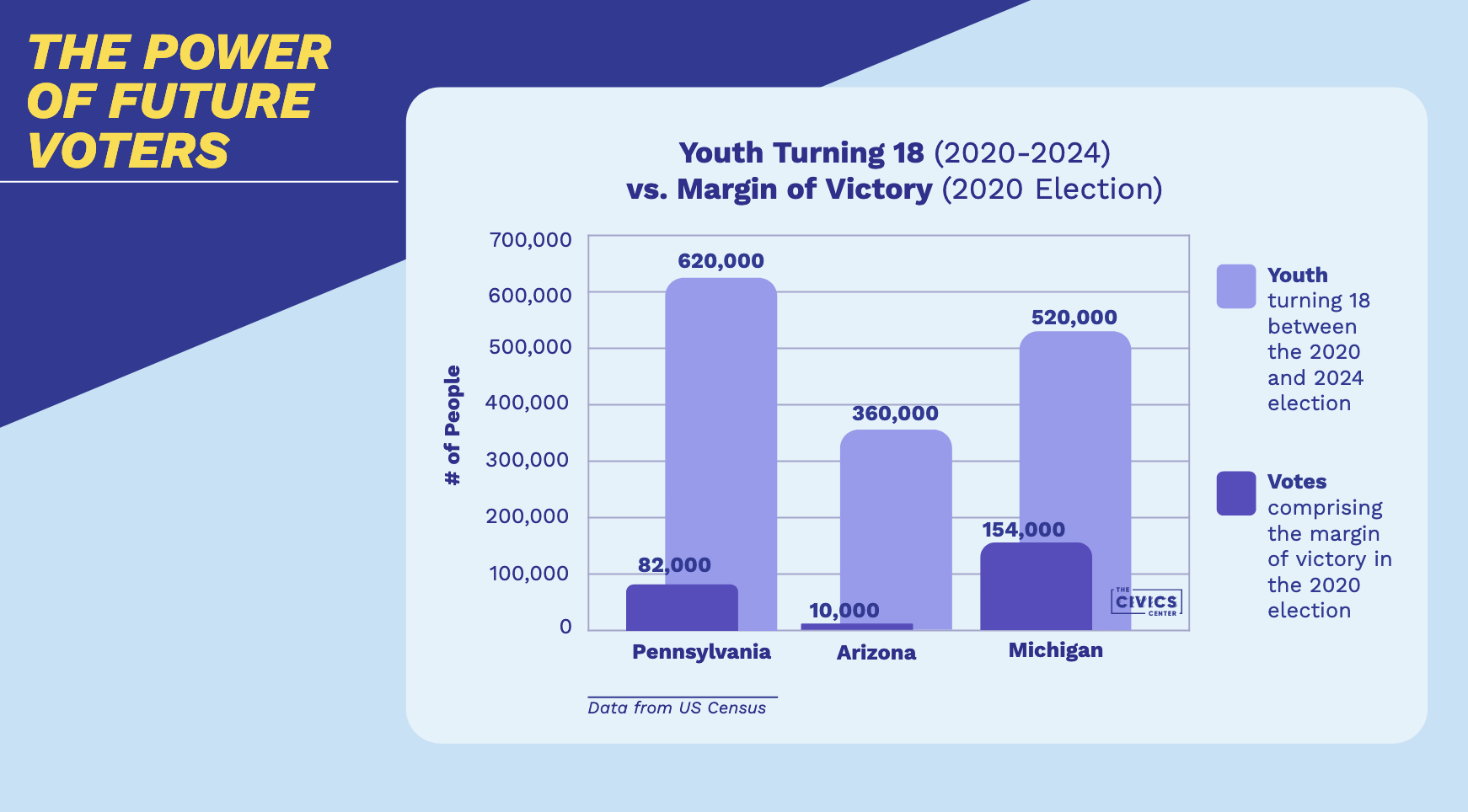
The Civics Center works to get young people registered as soon as they turn 18, mostly while still in high school. That early start on encouraging engagement with politics is important. Once they leave high school, spread out, start college or a job, often elections can seem one thing too many in a challenging time of life. It becomes hard to catch them to ensure they are registered -- but they will vote once they are already registered. 


And the number of young new registrants can make all the difference to outcomes.

If this inspires, check out The Civics Center. They've got a program to get the job done.

Wednesday, April 19, 2023

We need a "can do" frame of mind

When I first read about the United Nations Millennium Goals (MDG), I was mighty skeptical. Eradicate extreme poverty and hunger everywhere in the world by 2015? -- not likely.

But in fact, a vast international effort, about which most of us here in the rich world have been oblivious, has accomplished an enormous amount, improving the lives of people all over the planet, even in Africa.

Click to enlarge.

That's one heck of a trajectory and a lot of people are living better than their parents even imagined.

Matt Yglesias explores the paradox of rising global living standards in the context of climate change.

One thing that’s important to understand about this is that the huge drop in global extreme poverty is a leading cause of climate change.

What first started me on my current climate trajectory was talking to book publishing people about “One Billion Americans.” I got pushback from some folks who said it would be bad to have more immigration to the United States because it would raise emissions. I said it’s true emissions would go up, but emissions would be rising because living standards would be rising, and from an adaptation perspective, it’s clearly better to have more people in the U.S. (much of which is relatively cold) than fewer.

But then it turned out lots of people believe we are facing an absolute decline in global living standards such that keeping people poor as an anti-emissions strategy has net benefits. That’s just not true.

Having been overly skeptical about the MDGs, I try to appreciate that, just maybe, we can hope that hard work and human ingenuity will enable us to come to terms with the mess we've made of the planet's carbon balance. 

Erudite Partner and I are temporarily at a family residence in Massachusetts, working toward installation of a hump pump system to replace an oil burner -- that is, the house is going all electric. That seems to be a thing that relatively affluent individuals can do. The Biden administration's climate legislation provides a big rebate that makes it less costly.

On climate, every little bit helps.

Saturday, February 26, 2022

Shards from Putin's war on both Ukraine and hope

The horror of this moment has literally rendered me a little dumbstruck. As a friend remarked on Thursday, my heart is heavy. In more time, I'll share my own thoughts. Today, thoughts of others, with a little commentary in italics.

Max Seddon is the Financial Times bureau chief in Moscow. He tweeted:"It’s remarkable how [Ukrainian President] Zelensky has finally grown into the role. When the US warned if Russia’s plans to invade, he was slammed by Ukrainians for not taking it seriously. But when the war became inevitable, Zelensky started playing the president on TV again – he’s a natural."

This short BBC clip conveys Zelensky's performance of heroism in his beleaguered role. 

Russian journalist Yana Pashaeva: "The main feelings of liberal Russians are concerns for Ukrainians—many of whom are our relatives and friends—shame for Putin, and helplessness." The shame and helplessness -- this is something citizens of the United States know when we have watched and protested our country big footing small countries.

Amie Ferris-Rotman, who reported from Russia for a decade tweets "Over 170 Russian journalists, including from Kremlin-run RT and TASS, have signed an open letter calling for an end to war with Ukraine." That's risk taking, as are peace demonstrations resulting in over 1000 arrests in Moscow.

Marc Santora, reporting for the New York Times from Lviv, Ukraine: "The civilian resistance in Ukraine received instructions on Saturday night from the military on how to help stop the Russian advance. They were told to destroy a road if they saw tanks passing along it, because fuel trucks were sure to follow; to burn a forest if they spotted Russian vehicles there; and to shoot out tires on military vehicles if they had rifles and could shoot from a distance. Above all, the defense ministry advised people to keep themselves safe but make life for Russian soldiers as difficult as possible." You have to assume Russia's army can crush these Ukrainians -- and that even amidst the adrenaline rush of war and patriotic feeling, they know it.

That cosmopolitan student of democracy, Yascha Mounk, concludes: "... the world’s dictators are taking off their masks. Autocratic leaders from Myanmar to Nicaragua no longer feel constrained by the need to maintain some semblance of democratic legitimacy or appease the State Department. And those dictators, like Vladimir Putin, who also have significant military might at their disposal are now trying to remake the world order in their image." The struggle for the possibility of humane civilization is indeed on the line. Of course it always was, but we are forced to notice.

Click to enlarge.
"A solid plurality of U.S. voters say they’re willing to face higher prices at home in order to sanction Moscow for invading Ukraine — and fewer than 1 in 10 oppose any sanctions"  according to pollsters Morning Consult. Let's hope we can unite enough to persist. That is our struggle.

Climate activist Bill McKibben knows how we ought to respond to Putin's war: "If you care about freedom, shut up about high gas prices. And put a solar panel on your roof." He's right! Putin's base state is a gas station with nukes -- if we, and especially Europe can replace fossil fuels, this is over. You can't eat nukes.

For many years, Joe Cirincione worked for international nuclear disarmament through the Ploughshares Fund. He speaks our appropriate fear in this moment.

Foreign policy maven David Rothkopf has worked for the last word here: "But usually big global conflicts have grey areas in which the irresolute or weak can hide, sometimes grey areas that make knowing who if anyone to support difficult. That's not the case here. Either you are for or against Putin's evil, for or against freedom & democracy." Yes.

Friday, January 07, 2022

Old fight; new year

If the horror of it all is getting you down, there's a prescription for malaise: DO SOMETHING.

These good people gathered at the main intersection in the affluent Bay Area suburb of San Mateo yesterday.

 
They were pumped -- maybe it was President Biden's bluntly calling out the former guy, or maybe it was just that they'd worked alongside each other during long hard years of the Trump presidency and this was sort of a reunion. Our necessary masks make it harder to see who is there ...
 
We don't need no f-ing kings ...
 
We know who told us the score ...

Onward to 2022.

Some somethings are better to do than others -- but if we want a democracy, we all have to do what we can.

Sunday, October 24, 2021

On making a better face of the world

Timothy Snyder is a real deal historian. He teaches the modern history of Eastern and Central Europe at Yale and at the Institute for Human Sciences in Vienna. His Bloodlands: Europe between Hitler and Stalin is an essential text for re-including in our awareness vast parts of that continent we learned to ignore during the Cold War.

The election of Donald Trump inspired Snyder in 2017 to write On Tyranny: Twenty Lessons from the Twentieth Century, accessible reflections which might be useful in a country suddenly finding itself governed by a racist authoritarian. The book was a best seller.

In 2021, Snyder is back with a new edition, with commentary somewhat updated for a new moment of danger and hope, now illustrated by Nora Krug.  The new edition is once again a best seller on Amazon. I'm encountering it via his Substack podcast where he is reading the entries aloud. Last week Lesson 4 turned up in my email inbox.
Take responsibility for the face of the world. The symbols of today enable the reality of tomorrow. Notice the swastikas and the other signs of hate. Do not look away, and do not get used to them. Remove them yourself and set an example for others to do so.” 
Life is political, not because the world cares about how you feel, but because the world reacts to what you do. The minor choices we make are themselves a kind of vote, making it more or less likely that free and fair elections will be held in the future. In the politics of the everyday, our words and gestures, or their absence, count very much.
In conclusion, he adds that removing negative symbols -- such as monuments to Confederate generals -- is not enough.
... Taking responsibility for the face of the world also means thinking about what the world should be. ... Without the future, democracy if very hard to maintain. ... Part of taking responsibility for the face of the world is thinking about what the future should look like and taking seriously the people who labor in the direction of  generating possibilities, aesthetic possibilities and moral possibilities."

Given this conclusion, I was a bit surprised that Snyder made no recognition that people all over this country -- most frequently in blue cities and college towns, but in corners everywhere -- have been displaying alternative signage during the last five years, repudiating encroaching fascism and offering better values. For too many observers, it has become a mark of sophistication to mock "Resistance" to Trumpism as a kind of performative self-indulgence. Do the resisters really accomplish anything? Probably both yes -- and never enough. 

But might we not be wiser to applaud Resistance signage as an attempt to put out front alternative humane values? A decent democracy needs more than is proposed here; a fair economy that values workers would be one element of such a polity. So would a reduction of reliance on violence and the military. Not to mention stopping with the fossil fuels! But we need a starting place, and for many, this declaration provides one.

Over the last five years I have been walking and photographing every corner of San Francisco, from toney St. Francis Woods to the rundown avenues of the Bayview. Nowhere I have walked has been without this signage of hope.
Let's not knock this performance of "resistance" -- it's a form of "taking responsibility for the face of the world." It's not enough; but it preserves and advances something precious.

Wednesday, October 20, 2021

We need truth. We need truth tellers.

The Swedish committee which awards the Nobel Peace Prize annually chose two brave journalists as this year's winners. Maria Ressa of the Philippines and Dmitry Muratov of Russia both risk their lives in order to publish factual news which their violent rulers hate and fear.

Here's a short clip of Ressa explaining why she chooses her dangerous vocation.

If you don't have facts, you can't have truth. If you don't have truth, you can't have trust. If you don't have any of these three, democracy as we know it is dead.

Sunday, September 19, 2021

Activism's in-between

So you feel something is very, very wrong in this country and society -- the climate turning more hostile; anti-vaxxers doing their best to prolong the pandemic; Republicans trying to trash democracy ... and whatever more immediate malaise has grabbed your heart.

Working to replace the Donald with Joe Biden gave activism some direction for awhile; working for Jon Ossoff and the Reverend Warnock in Georgia, even more. And while the pandemic refuses to go away, at least Gov. Gavin prevailed.

But now what -- how to engage in a world that needs everything, but no obvious, clear cut path seems on offer for this moment. You are tired. And worried.

You are not alone.

At Daily Kos, someone who uses the handle of "truemajority" offers some thoughtful suggestions for activists and all of us that seem worth passing on in this anxious in-between moment.
A lot of concern and a lot of desire to be of help is expressed by people who are standing on the sidelines because they aren’t sure what to do, or where to direct their energy. What is the best first step? Fortunately there is an area of activism anyone can do, that is always helpful and always important. You can start doing it today.

Encouragement.
Find someone who needs a little support and encouragement, and give it to them. 
Did a name pop into your mind just now, reading that sentence? There’s always someone close at hand who fits the bill. Look around and it won’t take long to see a person plugging away behind the scenes who is not expecting any recognition, but who would receive it as gratefully as a tree in a drought welcomes a surprise summer shower. ... 
Appreciation makes invisible work visible.
Read about the great change agents of the past, some of whom worked for years or decades without seeing many results, and without anybody outside their immediate circle knowing who they were. Somehow they persevered, usually with far fewer resources than we have today, and managed to lay a solid foundation for progressive advances we currently enjoy. ... 
• It is better to do something than nothing.
While you’re waiting to launch your next big thing, or even flailing about trying to determine what your very next small step might be, consider starting a side project of intentional support to activists around you. You could even direct this powerful energy to yourself, by creating inspirational moments to start your own day. ...

 As always, we need to empower imagination and choose hope.

Monday, April 12, 2021

Just the difficult truth

This morning, Erudite Partner and I agreed: along with Brenda, we're flightless hope truthers.

Too busy to blog this morning, but most everyone I know would enjoy this:

Monday, November 09, 2020

Can an activist have druthers?

The Times queried a sample of individual voters:

... [what were] their hopes for the country — whatever the outcome of the election. What did they want for America?
This isn't the sort of thing I tend to think about. Experience and education have given me the opportunity to think more granularly about both policy directions that appear desirable to me and about the twisted trade-offs that advancing toward any of them might entail. So I write about that stuff.

But what would I hope for in a new presidency? I'll restrict myself to two:

  • One: that the necessary popular mobilization that so many of us learned we must take part in during the Trump regime/GOPer remains alive in some form -- or in many forms. My greatest disappointment with the Obama presidency was that after the first Black man won the big job, he allowed all the energy which had been Organizing for America to be drained off into busy work, such as public service projects to mark the MLK holiday. It was pretty clear even before the inauguration that his crew didn't want the awakened tiger to stay around. And our hopes crashed along with the organized energy. I don't think we're as dependent on Biden for leadership in this as we were on Obama, though the money may dry up.

  • Two: I hope to regain some feeling that this troubled land is once again in forward motion, is grappling with the inescapable requirements of our history and reality. You can't duck this stuff and live. The Trump regime felt as if a country limping toward a better, if imperfect, future had slammed into a wall. (There's that ur-Trumpian wall theme again.) The needs for forward motion are so many: for climate sustainability, for more racial justice, for a more equitable economy, for more gender equality, for more democracy, for less militarized empire. We aren't going to get to any of them (will, maybe, involuntarily, that last). But the country more or less works when we are trying. 

Thursday, April 23, 2020

Evil words, evil acts

This past weekend was the 25th anniversary of the Oklahoma City bombing, the most destructive act of domestic terrorism in our recent history. The implosion of the Federal Building by a fertilizer bomb took the lives of 168 very ordinary people -- many of them children in daycare -- and injured 680. Timothy McVeigh, a former U.S. Army soldier, was convicted of the crime and executed. He claimed this act of mass murder was in retribution for the deaths of Branch Davidian cultists in Waco, Texas.

There would have been a large public commemoration if it had not been for our present "shelter in place" condition. The site of the Alfred P. Murrah Federal Building is now a national monument, recalling this act of political violence. Oklahoma City Mayor David Holt offered these remarks about the atrocity which has lived on for many Oklahoma City residents ever since:

The Bombing was, ultimately, an act of extremist political violence made possible through dehumanization.  The journey to such an act begins with thoughts; those thoughts become words.   Like a virus, those words are heard by others and they pull out of the listener the thoughts and words that their better nature had previously rejected.  Soon, one carrier becomes many and an ecosystem is created, where ideas once considered absurd are treated with credibility. Blowing up an office building full of civilians and children requires someone to walk down that dark path.   It’s a path humanity has walked down too many times before.   It is a path of dehumanization.   And even though it ends with the most evil and horrific acts imaginable, that path is largely lined with the simplest gesture we have – words.  And if you are not hearing those echoes again in our current political discourse, I ask you to listen harder.

Evil acts like the one that occurred behind me depend on the triumph of dehumanization, the idea, first perpetuated through words, that you’re different than me.   That your motivations are not pure.   That you are my enemy, the enemy of my people, and that this struggle is so real that all tactics must be on the table.   To accept such dehumanization and to reject all the things that we share in common, the reality that we all love, we all have families, we’re all seeking virtually the same outcome, requires a remarkable amount of delusion.   But we as humans have proven ourselves time and time again capable of such delusion.   And we pay a terrible price, time and time again.

... Right now, I hear such words coming out of the mouths of some of the most prominent people in our country, and I see them echoed in daily life by those who know better.   We should know how this story ends, but let this place be a reminder.   We must have better conversations, we must reject dehumanization, we must love one another.

... To the people of Oklahoma City, I say, it is our unique obligation to carry these lessons forward.  We did not choose this obligation, it was given to us, but we must carry the load so that our people will not have died in vain.   We must speak with the authority of those who will always have a scar to which we can point, in the heart of our downtown.  We know better than most Americans what happens when empathy, love and understanding are lost.   We must be the first ones to always say, we’re all in this together.   Let’s listen to each other and let’s find common ground.

As is all too obvious, Donald Trump and his chorus of obedient GOPers play with inciting the sort of mad hatred that led to Tim McVeigh's crime. The killer virus, the crashed economy that has been sacrificed to limit the disease, the inequality that distributes the burden of the crisis so unfairly, a president desperate to pass off responsibility to someone else -- all these factors inflict pain and incite violence. Thanks to David Holt for reminding us that striking out leaves only dead children and more agony.

Wednesday, February 26, 2020

Choosing hope

The Christian faith is not sensible. After all, we claim to live in hope that death has no further dominion, that life wins -- errant nonsense in a material sense. And, once we reach a certain maturity, we all learn in our creaky bones that our individual life won't win. We see that for too many around us, life didn't win. And there was nothing "fair" about it.

On Ash Wednesday we are reminded that we come from dust and to dust we will return. (Perhaps stardust?)

Daniel Schultz, a feisty UCC minister, who has been kicking around the progressive blogosphere as long as I have, seems to be currently happily ensconced at Religion Dispatches where he makes himself the scourge of white evangelicals who wallow in terror of cultural erasure. He reminds that we've been enjoined in our old books to "fear not."

Christianity teaches ... that there are worse things than dying (chief among them the hardening of one’s heart), and that life can only be properly lived by surrendering it compassionately to others. That’s what it means for Christians to belong to Jesus. It isn’t remotely radical to say that we believe that Christ gave up his life for God and for the community of people who followed him; Christians give up their lives for Christ, and for one another. (In theory, anyway. Practice is another thing.)

As we contemplate our mortality through the ashes, let's try to at least pretend that we are not afraid and can aim our brief lives more toward hope than fear.

Tuesday, December 24, 2019

Herod's Christmas today

The 81-year-wise Brazilian liberation theologian and enduring disturber of any complacent peace, Leonardo Boff, offers this seasonal reflection.

Christmas always has its idyll. There can be no sadness when life is born, especially when the puer aeternus, the Divine Child, Jesus comes into the world. There are angels that sing, the star of Bethlehem that shines, the shepherds who watch their flock at night, but there are mainly Mary, the good Joseph and the Child lying in a manger, "because there was no room for them in the inn". And, behold, some wise men, called magicians, who opened their chests and offered gold, frankincense and myrrh, mysterious symbols appeared also from the East.

But there was also a bad king, Herod, very cruel to the point of executing his entire family. He heard that he was born in the city of David, Bethlehem, a child who would be the Savior. Fearing to lose the throne, he ordered all children under two years of age to [be] kill[ed] in Bethlehem and its surroundings.

The sacred texts retain a lament [among] the most lacerating of the entire New Testament: ”In Ramah a voice was heard, many cries and many groans. It is Rachel who cries to her children and does not want to be comforted because they no longer exist ”(Evangelist Matthew 2:18).

This year's Christmas brings to mind the current Herods who are decimating our children and youth. Between 2007-2019, 57 children and young people under 14 died in Brazil from bullets lost [random shootings;stray bullets] in police actions. In this year of 2019 alone in Rio de Janeiro, 6 children and 19 teenagers lost their lives in police actions, reports the Crossfire Platform. In the metropolitan region of Rio there have been 6,058 gunfire, with 2,301 people shot, of which 1,213 were killed and 1,088 seriously injured. The most clamorous case was that of the 8-year-old girl Agatha Felix killed by a gunshot in the back when she was inside a Kombi van going home with her mother.

Their names deserve to be mentioned. With a few more years, they had the same fate of the dead for Herod: Jenifer Gomes, 11 years old; Kauan Peixoto 12 years; Kauã Rozário 11 years; Kauê dos Santos 12 years; Agatha Felix 8 years; Ketellen Gomes 5 years.

The governor of Rio de Janeiro, with his fierce police, is being accused of crimes against humanity, as he orders to attack the communities with helicopters and drones, terrorizing the population. Mayor Marcelo Crivella confessed that in the 436 schools installed in the communities, due to police operations, the children lost 7,000 classroom hours.

Together with Agatha Felix's mother, Vanessa Francisco Sales, who was carrying her daughter's doll at the funeral, the same voices are heard as those of the Biblical Rachel: the mothers of Morro do Alemão, of Jacarezinho, of the Chatuba de Mesquita, from Vila Moretti de Bangu, from the Chapadão Complex, from Duque de Caxias, from Vila Cruzeiro in the Complexo de Penha, from Maricá. Let's listen to your regrets:

“There are many voices, many cries and many groans. Mothers mourn their beloved children, killed by lost bullets; They don't want to comfort themselves because they have lost their children forever. They ask for an answer that comes from nowhere. Between tears and many regrets they plead: stop killing our children. Stop, for the love of God. We love our children alive. We want justice".

This is the context of this Christmas of 2019, aggravated by an official policy that uses the perverse means of lies, of fake news, of much rage and visceral hatred. Jesus was born poor and lived poor all his life. And a president emerges who frequently has Jesus on his lips but not in his heart, because he spreads offenses to homoaffectives, blacks, indigenous people, quilombolas and women.

He says openly that he does not like the poor, that is, he does not like those of whom Jesus said: "Blessed are the poor" and called them "my younger brothers and sisters", and that in the twilight of life they will be our judges ( Mt 25.40). That he does not like the poor means that he does not want to govern for the majority of Brazilians who are poor and even miserable, for whom he should govern first and take care of them.

Despite all that, you have to celebrate Christmas. It is dark, but we celebrate humanity and the joviality of our God. He became a helpless child. What happiness to know that we will be judged by a child who only wants to play, receive and give love.

May Christmas grant us a little of that light that comes from the Star that filled the shepherds of the fields of Bethlehem with joy and that guided the wise-wizards towards the grotto. "His light illuminates all the people who come to this world" (Jn 1,9), you and me, everyone, not just the baptized. " Merry Christmas.

We rejoice in the birth of the divine child -- the child who "only wants to play, receive, and give love."

Boff's text in the original Portuguese at his site. Translation, slightly smoothed, from the comments here.
...

Your blogger has been completely felled by a raging head cold. I hope to be back in regular form when the fog clears.

Tuesday, August 13, 2019

Creating friction where he could

US champion fencer Race Imboden acted in response to his feeling that something ought to be done. He explains himself here.

I’m proud to be an American fencing champion. Here’s why I knelt for our anthem.
... at the podium, my palms wet from nerves, when the “Star-Spangled Banner” began to play, I took a knee — following in the footsteps of Colin Kaepernick, Megan Rapinoe, Muhammad Ali, John Carlos and Tommie Smith: black, LGBT, female and Muslim athletes who chose to take a stand. I’m not a household name like those heroes, but as an athlete representing my country and, yes, as a privileged white man, I believe it is time to speak up for American values that my country seems to be losing sight of.

I’ve been honored to represent my country in international competition, and each time I hear our national anthem played, it’s a moment of personal pride. I love my country, full stop. When I look around, though, I see racial injustice, sexism, hate-inspired violence and scapegoating of immigrants. This isn’t new, but it feels like it’s getting worse, and after the mass killings in El Paso and Dayton, Ohio, I wanted to use that moment on the podium to send a message that things have to change.

Rather than acquiesce in hate and passivity, each of us we resists where we can. Each of us can learn from others that resistance is possible.

Unexpected good news

The findings from this Gallup Poll blow my mind. Apparently Trump/GOP howling about "an invasion" and visible cruelty to migrants at our southern border have had the effect of sensitizing an increasing fraction of us to our neighbors who are seeking asylum. Even rank and file Republicans are becoming more sympathetic toward migrants.

Support for allowing Central American refugees entry is now higher than Gallup has found for most refugee cases it has polled on historically, including Syrian refugees in 2015 as well as stretching back to refugees from the German Holocaust in the 1930s and 40s.

More and more us think there's a border "crisis." Apparently more and more of us also understand that people coming our way are not marauding hordes, but desperate vulnerable humans.

It's time to isolate the hard core racists and oust craven Republican enablers.