Showing posts with label prisons. Show all posts

Wednesday, March 18, 2026

The people are saying NO to Trump's concentration camps

Yesterday's post chronicled the brutal history of concentration camps. But it made scarcely a mention of resistance to these facilities in societies where authoritarians have used them to crush designated enemies and those who resist.

We're not all the way there yet. For the time being, the broad resistance to Trump's detention camps should inspire us all. In jurisdictions across the country, people reject having these facilities as part of their landscape. As of today, the ICE warehouse purchase tracker, Project Salt Box, shows that DHS has bought 11 properties intended to become detention camps -- and seen 11 other acquisitions canceled because of citizen agitation.

In early February, NBC News via AP reported:

The fatal shootings of Renee Good and Alex Pretti during immigration enforcement actions in Minnesota have amplified an already intense spotlight on U.S. Immigration and Customs Enforcement, increasing scrutiny of its plans for new detention sites.

A proposed ICE facility just north of Richmond, Virginia, drew hundreds of people last week to a tense public hearing of the Hanover County Board of Supervisors.

"You want what's happening in Minnesota to go down in our own backyard? Build that detention center here, and that's exactly what will happen," resident Kimberly Matthews told county officials.

As a prospective ICE detention site became public, elected officials in Kansas City, Missouri, scrambled to pass an ordinance aimed at blocking it. And mayors in Oklahoma City and Salt Lake City — after raising concerns about building permits — announced last week that property owners won't be selling or leasing their facilities for immigration detention.

Meanwhile, legislatures in several Democratic-led states pressed forward with bills aimed at blocking or discouraging ICE facilities. A New Mexico measure targets local government agreements to detain immigrants for ICE. A novel California proposal seeks to nudge companies running ICE facilities out of the state by imposing a 50% tax on their proceeds.

Journalist Scott Dworkin passes along what happened in one town in rural George when ICE tried to set up a camp:

GEORGIA TOWN SLAMS THE DOOR ON ICE PRISONS

In the nearby towns of Social Circle and Oakwood, ICE prisons landed with no warning. DHS quietly bought the buildings, signed the deeds, and told local leaders only after the fact. Mayor Michael Owens saw the “calamity and unrest” that followed—and vowed Mableton wouldn’t be next.

Mayor Michael Owens
“They are stood up much faster and a lot of times without taking into account the burden that’s going to be placed on a local community,” he said.

The Mableton City Council unanimously approved a moratorium on detention centers within city limits—effective through December 31, 2028.

State Rep. Terry Alexis Cummings backed the vote. Her statement was read into the record at the council meeting: “Our community should not be a site for expanding a system that too often operates with limited transparency and accountability. Every person deserves to be treated with dignity and our community should stand on the side of justice and human rights.”

Trump's camps are largely being built in rural areas where people voted for Trump. But lots of locals don't want to be known as where ICE put its immigrant concentration camp. The objectors won't win all these skirmishes. But every eruption of resistance makes it slower and more difficult for the Trump regime's fascist project to succeed. 

Sand in the gears, folks! Detention Watch Network has a great guide to taking action against detention camps.

Sunday, October 05, 2025

Red Scare all over again. We've been here before.

By now you've probably heard the story. MAGA is seeking its revenge against modern America by attacking cities and their inhabitants. Lawyer and activist Jay Kuo recounts the attack by Donald Trump's goon squad on a Chicago apartment building this week: 

... federal authorities, including agents from ICE, the ATF (Bureau of Alcohol, Tobacco, Firearms, and Explosives), and the FBI sought to make good on Donald Trump’s recent threats against U.S. cities. 

In the dead of night, they swarmed a residential building in Chicago, even dropping in from Black Hawk helicopters like some sort of special commandos going after dangerous terrorists. They indiscriminately broke into people’s apartments and yanked them from their beds. Some residents were naked. They ransacked apartments and even zip tied small children. Some U.S. citizens were detained for hours. 

... The justification for this blatantly illegal and unconstitutional assault is a familiar one. The regime claims it was going after drug traffickers and gang members. But once again, it offered no proof. We just have to take their word for it. Authorities seized people first, without probable cause, treating merely living in the same complex as suspected undocumented migrants as a crime. 

Eboni Watson, neighbor

... “They just treated us like we were nothing,” [resident Pertissue] Fisher said.

She had come out to the hallway in her nightgown around 10 p.m. Monday, where armed ICE agents were shouting “police.”

“It was scary, because I had never had a gun in my face,” Fisher said. “They asked my name and my date of birth and asked me, did I have any warrants?”—apparently meaning outstanding warrants for her arrest. “And I told them, ‘No,’ I didn’t,” she responded.

Fisher relayed that she was handcuffed and only released some five hours later around 3 a.m. ....

It's no surprise that this sort of government terrorism, backed by panic among the ignorant, has been a recurrent feature of U.S. history. After World War I, the country was unsettled. An unpopular foreign war and oligarchic exploitation of the country's workers provoked protest from society's underclass and fright in the ruling class. Might there be Reds under the bed?  David R. Lurie describes what came next: 

Out of control federal agents invading the nation’s cities and kidnapping people en masse, a president and his cronies fomenting public anger and fear of immigrants, and dissent suddenly declared to be an illegal threat to national security.

All of that is happening now. But it also happened in 1919, at the height of what came to be called the first Red Scare, when a young J. Edgar Hoover and his new federal police force led a crackdown on dissent, focused on “radical” Americans born abroad.

Hoover and then-Attorney General A. Mitchell Palmer had plans to use another tool now favored by the Trump regime — mass deportation. But while Hoover and Palmer did succeed in silencing prominent dissenters, their deportation scheme largely came undone as the public became increasingly revulsed by the government’s performative cruelty and lawlessness.

... But as the weeks and months proceeded, something else began to happen. Members of the American public, who previously seemed to agree with the mob that jeered at [defiant anarchist Emma] Goldman, began to change their minds as evidence emerged of the brutality and lawlessness of the G-Men. And the deportation scheme ended up failing. Out of 6,396 cases Hoover brought, fewer than 600 ended in deportations.

The people can be misled to applaud injustices for a season; we can also repudiate injustices. A recent report found that attempts by MAGA TV drunk and Trump's U.S. Attorney Jeanine Pirro to charge protesters as felons in occupied Washington, DC, were collapsing at an unheard of rate. Grand juries made up of fellow Washingtonians refuse to indict.

We don't like this cruel BS. We can turn the tide. We've done that before. No Kings on October 18!

• • •

I thought it might be interesting to share how the 1919 Palmer raids played out for someone I once knew who was caught up in them.

In that year, Dorothy Day was swooped up in the general lawless repression in Chicago. Today Dorothy is remembered as a founder of the Catholic Worker Movement and potential Roman Catholic saint.  Then she was a drifting, loosely leftist, young intellectual. Being a young woman, her experience of the Palmer raids was different from that of male workers and agitators. She recounts this in From Union Square to Rome, a 1938 autobiography.

On wandering back from an aimless year in Europe after the war, she discovered: 

... The Socialists were too dull. They had too little vitality as far as I was concerned, and my allegiance for the most part was with the I. W. W.’s whose ideas in regard to solidarity and direct action appealed greatly to my youth.

 It was about this time that I had my second jail experience. ... I was associated at that time with some I. W. W.’s who had their headquarters on West Madison Street, Chicago. Across the street from their printing office was an old rooming house where a great many of them stayed, and where in true Wobbly fashion they had an everlasting pot of Mulligan on the fire. Everyone who came in was supposed to contribute to the pot whether it were a bunch of carrots, a piece of meat or a few pounds of potatoes. It was kept going from week to week, and when the funds were low the boys used to beg from grocers in the neighborhood. Those who had funds took care of their companions who had none, and there was a good spirit of comradeship. Their slogan was “An injury to one is an injury to all” and their sense of solidarity went even into housekeeping details.

... One day I opened the paper to find [a female acquaintance in these circles] had taken bichloride of mercury and was in the city hospital. They managed to save her life but when she was released from the hospital she went straight to the I. W. W. lodging house where she knew she would be taken in. I went over to see her in the evening to bring her food and planned to stay for the night with her. She was still ill and very much depressed and not altogether happy that they had dragged her back from death.

We were undressed and getting into bed when a knock came at the door and four men burst in telling us that we were under arrest for being inmates of a disorderly house. ... we were alone. It made no difference that radical headquarters all over Chicago were being raided and wholesale arrests being made. We could not feel that we were a part of a movement that was suffering persecution. Perhaps we were not sufficiently indoctrinated.

It had not occurred to us that it was unconventional or unseemly to be staying in a lodging house on West Madison Street. ... The ugly fact remained that we were two young girls arrested by four plain-clothes men who refused to leave the room while we got up and dressed for fear we would try to get away by the fire-escape. These were the days of the Palmer red raids when no one was safe. Those were times of persecution for all radicals. ...

Dorothy found her subsequent jail experience both brutal and enlightening.

... It was just a case of our knowing that these things were occurring every day and yet not realizing that they could occur to us. We were booked on the charge of being inmates of a disorderly house. We were not allowed to use the telephone to get in touch with a lawyer or our friends, although according to law we should have had this privilege. ...

... Before I had merely read about prison life and had agreed with Tolstoi that such punishment of criminals was futile when we were guilty for permitting such a system as ours to exist and that we, too, should bear the penalty for the crimes committed by those unfortunate ones. We all formed part of one body, a social body, and how could any limb of that body commit a crime alone?

We were photographed and finger-printed and finally taken to the morals court. Before we were placed in the detention pen we were examined for venereal diseases. When men are arrested during a red raid the police can express their brutality with rubber hoses and blackjacks. They can show their scorn and contempt for those who are trying to “undermine” our present system by kicking and beating them until their victims are a degraded mass of quivering flesh. 

They show more gallantry in regard to the women. They have a more subtle way of affronting their sensibilities. They can charge them with being prostitutes, make them submit to degrading physical examinations, and throw them into the company of those whom they feel should degrade them. But I felt more horror of the police and that police matron during this experience than I did of the [street walking] women. The women did not disgust me, it was their profession that disgusted me. They themselves may have been superior, as human beings go, to their captors. There was no pride or hypocrisy among them. 

The prostitutes Dorothy was jailed alongside worked for pimps who quickly bailed them out. Dorothy and her friend were locked up for several further days before a reporter friend who had discovered their incarceration managed to get them out.

Her short jail time reinforced Dorothy's conviction about whose side she was on.

Wednesday, April 17, 2024

Good riddance


It's great to learn that the Federal Bureau of Prisons has decided to close the Federal Corrections Institution at Dublin, California. This minimum security women's prison has been a sexual abuse hellhole for a couple of decades. The last few male wardens have ended up charged and convicted for assaulting and raping inmates. 

... “It is a remarkable admission,” said attorney Michael Bien, whose law firm represents inmates in a class-action lawsuit over conditions at the prison. Prison authorities are “saying they can’t operate this prison safely.” He said closure doesn’t address the underlying issue. “How does this solve the problems? The same policy and procedures are in place at other prisons. It is not the building that did anything wrong.” ... “It is an unprecedented move to opt for closure,” said Amaris Montes, director of West Coast litigation and advocacy for Right Behind Bars. “It has been a long time coming for Dublin.”  

... Maria Ledesma, a former inmate released from Dublin after two years in 2022, said she was surprised the closure took so long. “I wish it would have happened sooner,” the 52-year-old Salt Lake City woman said . During her time there, she saw frequent sexual abuse. “Girls were getting raped on the daily there,” she said.

Ledesma recalled walking back from her prison job when she heard some shuffling and spotted two people between the buildings. “There was the warden, zipping up his pants,” she said. “He looked at me, I looked at him, and I knew in that moment I needed to put my head down and keep walking.”

It may or may not be relevant that the current head of the Bureau of Prisons is a woman.

• • •

The article from the LA Times I've quoted here describes the culture of abuse at the Dublin facility as going back to the 1990s. I have reason to believe it is even older.

In 1978-9, I regularly visited a very young Native American woman who was doing a couple of years in there as part of a plea agreement. She claimed she had been waiting in a car while some guys she was with charged into a bank and apparently attempted an armed heist. Hence, there was a federal crime, as bank robbery was then usually prosecuted by the feds. She copped to a guilty plea for a short sentence just to be done with this; somehow the guys got off altogether, but she didn't much understand any of it except that she ended up locked up in a federal prison in another state. I met her through friends who had befriended her in the Seattle King County jail when she was awaiting trial; my friends were in jail for pouring blood on signature petitions for a county anti-gay rights initiative. (Those were the days.)

FCI Dublin was a dreary place. The visiting area was an open space with plastic chairs and tables that looked like a school lunchroom. Each group jostled for its own space amid the hubbub. Many visitors came with children; as I understood it, the younger kids had to be left in a prison day care pen, but older ones did join the visiting. I'm sure that, despite all the searches of inmates and scanning of their visitors, a lot of contraband came in through that room, though I never knew how it worked.

My friend did assure me that some women could get anything they wanted through "relationships" with male guards. She never clarified to me how she fit in the economy of the place and I was too ignorant to know how to ask.

The curiosity of the era was that Patty Heart, the newspaper heiress turned terrorist, was locked up there. She was always in the visiting room with a couple tables of visitors, very much a queen bee for the moment. In February 1979, President Jimmy Carter commuted her bank robbery sentence.

One evening the prison put on a dance to which the inmates were allowed to invite a guest. This was a challenge to me; not only didn't I dance, but I looked like a proper '70s lesbian, a schlub. I took as much care as I could with what I wore, wanting not to embarrass my young friend. I am sure I didn't enhance her status any. 

There was a rumor (later true for awhile) that FCI Dublin was about to be made coed. My friend belonged to a set that hated the idea: they were sure that whatever privileges were available would go to the guys. They were proved right when the experiment happened.

Eventually my friend got out and returned to the Northwest. I lost touch with her. She'd be 65-ish today. I wonder if she has made it alive ...

Saturday, June 10, 2023

Do we know what to do about people who scare and harm?

Bill Keller was the executive editor of the New York Times from July 2003 until September 2011. For those of us who thought the GW Bush administration's Iraq invasion was an immoral disaster, Keller, an establishment war hawk with the power to define the public narrative, was a major public enemy.  It didn't seem to bode well when Keller landed in 2014 at The Marshall Project:

The Marshall Project is a nonpartisan, nonprofit news organization that seeks to create and sustain a sense of national urgency about the U.S. criminal justice system. We have an impact on the system through journalism, rendering it more fair, effective, transparent and humane.
That's a bit boosterish. But Marshall Project journalism does a good job of professionally raising up what America does in the prisons to a wide public. Their output gets read, which is saying something in an arena we usually would prefer not to gaze at.

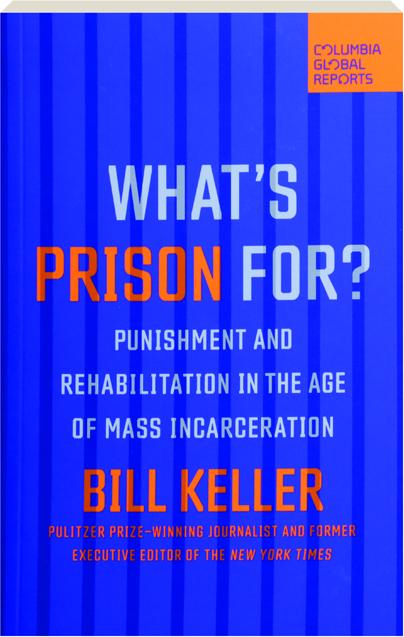
Keller has shared what he learned in five years getting that project off the ground in a slim book, What's Prison For? Punishment and Rehabilitation in the Age of Mass Incarceration.
 
He's candid about his learning curve on the job.
My crash course in criminal justice taught me that this country imprisons people more copiously than almost any other place on earth. Some countries, including China and North Korea, do not fully disclose their prison populations, so America may not actually hold the dubious distinction of first place. But there is ample justification for calling what we do in America "mass incarceration." ...
This perfectly captures the tone of this book -- measured, careful, accurate to a fault, designed to lower the temperature about a topic that arouses passions.

As if writing a longform magazine article, Keller explores through close observation and gentle on-scene interviews the fraught realities of sentencing, race, drugs in prisons, violence -- and life after release, prison education, and what incarceration does to the jailers. He makes a diligent effort to study and apply what academic study of prisons has suggested. He describes Nordic systems of corrections, which center helping offenders learn to live normal civilian lives though practice while still inside. And he raises up US experiments on the same lines. There's even a short chapter on women's experiences in the system.

Maybe what conversation about the US prison system most needs is less yelling, more deliberate humanity. This is a useful little book if that's a right prescription for readers not struggling in the immediate horror. If, for good and tangible reasons, the prison system presents as a screaming injustice that destroys people, families and communities -- as it does to too many Americans -- Keller will seem bland, too comfortable, and too complacent.

What I'm sure Keller would agree on is that ending mass incarceration is going to require all of us. Keller's take is at least smart and kind. That's not nothing. This is a useful little introductory book.

• • •

It feels apprriate that I'm writing up What's Prison For? the week that Donald J Trump received his federal felony indictments. Can the United States actually put away the old con man? The best discussion I've encountered of this came in a podcast discussion between former US Attorney Joyce Vance and former Republican operative Steve Schmidt. He asked the question that lurks for all of us: if Trump is convicted, "is he going to prison?" Vance said "no" with a clear explanation that I haven't met elsewhere. Whatever happens, by statute, Donald Trump will be accompanied by his Secret Service detail for the rest of his life -- it's just not happening that the system will lock up the whole entourage.  We'll have to see how it all plays out ...

Wednesday, December 16, 2020

Unanticipated consequences


In the wake of this United States' most momentous of our sporadic lurches toward greater justice and truer freedom, radical abolitionist Congresscritters passed the 13th Amendment to the Constitution in 1864 and thereby ended slavery. In so they thought. But the language they chose, inadvertently historian Eric Foner argues, set incarcerated persons up to be re-enslaved. An "Abolition Amendment" has been introduced in Congress this year to finish the job. Foner explains:

The Abolition Amendment would eliminate the Thirteenth Amendment’s “criminal exemption” by adding these words to the Constitution: “Neither slavery nor involuntary servitude may be imposed as a punishment for a crime.”.
.. When it came time during the Civil War to write an amendment abolishing slavery, Charles Sumner, the abolitionist Senator from Massachusetts, proposed wording based on the 1791 French Declaration of the Rights of Man and the Citizen. His colleague Jacob Howard of Michigan rejected the idea of using a French model. “Good old Anglo-Saxon language” was adequate, he declared, and Congress gravitated to the wording of Jefferson’s ordinance. 
Because of its very familiarity, the text of the Thirteenth Amendment did not undergo necessary scrutiny. The criminal exemption was almost never mentioned in congressional debates, contemporary newspapers or at antislavery conventions that endorsed the proposed amendment. 
... But with the overthrow of Reconstruction and the imposition of the comprehensive system of white supremacy known as Jim Crow, the prison population expanded rapidly. 
Southern states filled their jails with African-Americans, often former slaves convicted of minor crimes. They then rented them out as labor for the owners of railroads, plantations and factories, or required them to work on chain gangs building roads and other public projects, or inside prison walls for private businesses. 
The labor of prisoners became a significant source of revenue for Southern states. The system also took hold, but in a much smaller way, in the North. ... Conditions were barbarous and the supply of convicts seemingly endless. “One dies, get another,” became a popular refrain among those who profited from the labor of prisoners. ... With the expansion of private prisons, more and more inmates work for private contractors, sometimes in factory settings within prison walls. In recent years, many companies have used or benefited from the labor of prisoners. 
... the 13th Amendment shows that unanticipated consequences can be as significant as intended ones. The amendment, which destroyed the largest slave system the modern world has known, was deservedly an occasion for celebration. Especially given our heightened awareness of the inequities of our criminal justice system, it is high time the criminal exemption was eliminated, as the abolition amendment proposes.
This Abolition Amendment isn't going to become law anytime soon, but it's important that we understand that we need it.

•••

Another example of less-than-entirely expected consequences: the smart, annoying, contrarian pundit Matthew Yglesias has turned himself into a subscription Substack he names "Slow Boring." He's prolific and I find I learn from him.

But this email/blogging medium also provides space for self-indulgence. And this week he has been whining about social media backlash for promoting his current book on Joe Rogan's podcast. Rogan is apparently a wildly popular misogynist bro-talker who, like many of his breed, has an ant in his pants about gender bending and takes it out on transfolk.

Yglesias complains he's being subjected to "cancel culture" for going on Rogan's show. But also, his response is to lay out where he stands on trans rights as follows:

I support trans rights:
I am glad that transgender people won Civil Rights Act protections from the Supreme Court.
I’m glad Biden has committed to reversing Trump’s executive orders on trans health care.
I’m for open access to restrooms and frankly for the abolition of gender-segregating of bathrooms in general.
I’m looking forward to a new and more enlightened era on military service.
This isn't all warm and fuzzy -- it's not going mollify people who suffer directly from society's rejection of their non-standard gender identity and presentation. But getting a majority of us to this level of understanding of what right behavior looks like would create the context for a better life for millions of people. Maybe we can get to where a young friend doesn't find the job he had been promised had somehow disappeared when his prospective employer realized he'd transitioned. 

Formal tolerance and recognition is what comes first; only when we get this far can we live into deeper acceptance of the unfamiliar. 

Yglesias didn't like being called out -- but it got him on record. That's a good consequence. 

Photo from a contemporary video about Louisiana' Angola Prison.

Sunday, September 23, 2018

Beyond #resistance

If you were a college student in a liberal arts curriculum in the early part of this decade, there's a good chance that your professors attempted to introduce you to the damage and durable horrors of white supremacy in the USofA by pointing to Michelle Alexander's The New Jim Crow: Mass Incarceration in the Age of Colorblindness. Others had struggled to raise consciousness about the Prison Industrial Complex for years, but Alexander's book reached a wide audience and amplified a rising movement. She toured frequently learning from grassroots justice activists, and in 2013 gave an interview to Bill Moyers which remains a timely exposition of the injustice of a system that locks up 25 percent of the worlds' prisoners, most of them Black and brown men.

Then in 2016, Alexander decided she needed to go on, stop practicing and teaching law, and embed herself in a more visionary context at Union Theological Seminary. She explained:

... there is something much greater at stake in justice work than we often acknowledge. Solving the crises we face isn’t simply a matter of having the right facts, graphs, policy analyses, or funding. And I no longer believe we can “win” justice simply by filing lawsuits, flexing our political muscles or boosting voter turnout. Yes, we absolutely must do that work, but none of it — not even working for some form of political revolution — will ever be enough on its own. Without a moral or spiritual awakening, we will remain forever trapped in political games fueled by fear, greed and the hunger for power. American history teaches how these games predictably play out within our borders: Time and again, race gets used as the Trump Card, a reliable means of dividing, controlling and misleading the players so a few can win the game.

I've long thought Alexander was onto a truth here; we must struggle against the forces that would eradicate human decency and even inconvenient human beings -- but we must do so in the context of a communal vision of where we want to go to. Around me, I see Black Lives Matter activists struggling for such a vision; I see Native American Water Protectors embodying their version of that vision; I see the #MeToo movement birthing a vision of a whole new relationship between the sexes.

And I'm delighted to see to see that as of Friday, the New York Times has given Alexander a megaphone as an oped columnist. She admonishes us to move beyond #Resistance.

Yes, of course, we can and must resist the horrors of the current administration — thousands of lives depend on us doing what we can to mitigate the harm to our fellow humans and the planet we share. But the mind-set of “the resistance” is slippery and dangerous. There’s a reason marchers in the black freedom struggle sang “We Shall Overcome” rather than chanting “We Shall Resist.” Their goal was to overcome a racial caste system — to end it — and to create a new nation, a Beloved Community. Similarly, those who opposed slavery didn’t view themselves as resisters; they were abolitionists.

Today, many of us in the movements to end mass deportation and mass incarceration do not want to simply resist those systems. We aim to end them and reimagine the meaning of justice in America. By the same token, many of those who are battling climate change and building movements for economic justice understand that merely tinkering with our political and economic systems will not end poverty or avert climate disaster, nor will mere resistance to the status quo. As the saying goes, “What you resist persists.” Another world is possible, but we can’t achieve it through resistance alone.

Alexander is a voice we need. I'll watch for her columns.

Sunday, July 01, 2018

Reminders from a higher authority

Seen outside the West County Detention Center in Richmond, CA where several hundred migrants in ICE custody are imprisoned on any given day. Fifteen hundred or so demonstrators rallied yesterday as part of the national Families Belong Together protests.

Religious groups have been expressing their solidarity at the jail for months. "We usually get about 100 people," one regular explained. Yesterday there were a heartening number more ...

It was a hot day; the Trump/GOPer family separation atrocity made us hotter.

In the Trump era, resistance is a family affair.

In this crowd, the question is not just whether people will remember to vote, but which campaign they'll be working on. If we do it right, the people are still the higher authority.

Thursday, March 23, 2017

From inside the wire


One of the things the organization Critical Resistance does that hardly anyone does is ask prisoners what they think. Prisoners have their own, multifaceted and not necessarily uniform, takes on the goings on in the world outside.

Recently, [CR] asked imprisoned people to share their reflections on Trump's presidency and how to strengthen our resistance to what some see as rising fascism. Lacino, Robert, and Asar (quoted here), as well as others have generously offered their analysis and experience.

... The testimonies include excerpts of letters from immigrants, Black men and other men of color, people sentenced to the death penalty or life without parole (the other death penalty), gay people, and people imprisoned in California, Pennsylvania, Florida, and South Carolina. 

The entire collection of responses, including images of original letters, are posted at Prisoners Speak Out: Analysis and Perspectives.

Asar Imhotep Amen wrote from California State Prison - LA County:

"Trump's regime will greatly affect me, along with the community at large as well as all presently incarcerated people... Trump's regime serves a deliberate and specific purpose in sustaining white terror, power, and domination. In other words, the relationship between people of color, along poor white folks in America and the holders of state power in the United States is similar to that which exists between the colonized and the colonial master."

Lacino Hamilton, imprisoned at Chippewa Correctional Facility, Kincheloe, Michigan, had this to say:

Repression doesn’t come and go, it merely becomes more or less evident, as its "spectacular episodes" are spaced closer or farther apart. Donald Trump being an expression of a "spectacular episode". Repression is a permanent blanket covering the movement. Many people don't think this is so, because you don't notice the difficulty you have trying to breathe. This is because you’ve become accustomed to the reality and the weight of the blanket, long gaps between "spectacular episodes” have given many of us the impression that the blanket had been "pulled back” or “lifted". But it’s been here all the time, before Trump was elected president, and we’ve learned to move under its weight, and now consider this type of repression to be normal.

Robert Chan, imprisoned at California State Prison - LA County, added his view:

Now is the time to stand with our free-world allies as they daily protest Trump's latest ugly declarations and executive orders. In our thoughts and in our prayers, with our hearts and with our words, we stand with the oppressed and all progressives fighting for social justice. Never before have I been so surprised and inspired by the outpouring of unity that's coalescing in the sea of courageous people stepping up against tyranny.

I figure I'm called to live up to Mr. Chan's expectations -- will I?

Sunday, September 18, 2016

They wanted to be seen as human beings

Forty-five years ago this month, about 1000 mostly Black prisoners at New York's Attica state prison revolted against the terrible conditions in which they were jailed. They killed two guards in the struggle, seized 42 additional guards and other personnel as hostages, and used their momentary power over the prison to present demands to correctional authorities, to Governor Nelson Rockefeller who was gearing up to run for president, and to the world.

We are men! We are not beasts and we do not intend to be beaten or driven as such. The entire prison populace, that means each and every one of us here, have set forth to change forever the ruthless brutalization and disregard for the lives of the prisoners here and throughout the United States. What has happened here is but the sound before the fury of those who are oppressed.

Elliott James "L.D." Barkley

The prisoners requested a group of sympathetic free civilians be brought in to act as witnesses and go-betweens with the authorities; Rockefeller, hoping to tamp down the rebellion, agreed.

Clarence B. Jones, a lawyer and former advisor to Dr. King who was also the publisher of the Black newspaper, the Amsterdam News, was one of the observers. He retold (with co-author Stuart Connelly) the Attica events as he lived them in Uprising: Understanding Attica, Revolution, and the Incarceration State. How he came to be chosen by the prisoners is an appealing story. This wasn't about his connection to Dr. King.

To enable incarcerated readers to develop a special connection to my paper, I soon created a weekly feature for our op ed page entitled “From Behind Prison Walls.” I did this to provide inmates in prisons within New York a voice, the opportunity to have their letters read by the public at large. It turned out I was one of the very few—perhaps the only—editor in the country who actually published letters like this.

So when the convicts of Attica’s Cellblock “D” had their hostages and the government waiting for them to make their first move, they wanted some righteous representation. They wanted me to do their talking for them. To speak truth to power. From the rioting inmates’ perspective, it was a perfect fit. Apparently, without my realizing it, printing these letters had made my name intertwined with prison reform. ...

So Jones allowed himself to be transported to the prison and, alongside several dozen others acceptable to the prisoners, visited the insurgents. The longer prisoners controlled the yard, the longer the demand list grew.

The prisoners’ list of fifteen so-called practical demands [about immediate conditions like overcrowding and racist white officers] had more than doubled. They were now asking for 33 concessions, including a plane to fly them out of the country. Cuba was mentioned several times. Things were moving in the wrong direction. The issue of amnesty was still paramount; it was listed third after getting food and water and replacing the warden.

Jones was horrified. This wasn't going to happen after two guards had died -- and the most likely outcome would be a massacre of prisoners. He describes his introduction to the prisoners.

As each observer’s name was shouted, there was a roar from the crowd. One of the riot’s leaders, a Black Muslim, told the inmates in “D” Yard that each of us would be called up to the microphone and makeshift podium to say a few words to them.

All through the night, the inmates made speeches and so did the observers. As important as it was for us to be there for them, they in fact spent more time making proclamations to each other than they did listening to us. They were merely, in street parlance, “sellin’ wolf tickets” to one another. When the observers did have a chance to speak, there was a thematic consistency threading through almost every one of our comments. The idea behind nearly every one of the observers’ remarks was that we were individually committed to facilitate a peaceful resolution of the uprising and to try to get the prison authorities to respond to and redress the inmates’ demands.

Over two tense days, the observers tried to avert bloodshed. The authorities made some feints toward agreeing to a few demands, but the situation was at an impasse. Rockefeller feared his presidential prospects were dribbling away as the nation watched him fail to crush the rebellion. And so, four days after the revolt began, the guards and state police came in with tear gas, clubs, snipers and guns blazing. Ten hostages and 29 inmates died, all apparently killed by the invading prison authorities.

Jones describes his last visit to the yard before the massacre.

As I made my way out of the yard, the prisoners parted to make a path for me and I could feel the tension in the air shift. It was a deflated sensation, all that pent-up hostility turning in an instant to despair. On either side, I could hear the sobbing. Convicts’ emotions poured forth–a litany of swearing, praying, moaning, and crying. A jumble of lost voices sifting through to my ears, drumming into my head:

Tell my boy daddy loves him...
Oh god, save us...
It’s not our fault...
Don’t go, brother...

Because they knew, just knew, they were watching their last hope walk out that door. Black and brown hands reached out, forcing into my grip notes written on the inside of cigarette packs and torn-out edges of Bible pages.

Outside of the yard, I sifted through the dozens of hand-scrawled notes. They were all written to loved ones or family members, many with phone numbers and/or addressed for me to reached out to on behalf of their doomed. These inmates were being realist now. They never expected to survive in “D” Yard once the order was given by Rockefeller to take the prison back. And that order was coming sooner or later.

The brutal re-occupation of Attica was the inaugural scene in a decades long racist backlash against Black gains, characterized by "law and order," "tough on crime," mandatory sentencing, and mass incarceration.

The second half of Uprising deals with the subsequent investigations of the Attica revolt and the continuing struggle against mass incarceration. Jones affirms what he draws from the experience working with Dr. King:

Make no mistake, history follows its own arc unless we make a purposeful determined effort to bend it in another direction.

He's still alive and, I suspect, appreciating the contemporary struggles of the Movement for Black Lives.
***
During the Attica rebellion, I was on the hot, anxious streets of the Lower East Side of New York where many of the nine percent of Attica prisoners who were Puerto Rican originated. Fear and despair were everywhere. Attica seemed very close.

Thursday, September 01, 2016

After 15 years ...

... a majority of us think it is time that remaining prisoners at Guantanamo should either face trial or be released according to the pollster YouGov.

Our shameful off-shore prison still holds 61 men. Of these, 20 are known to have been cleared for released by U.S. government vetting processes; some were cleared as long ago as 2009. Andy Worthington reports the chronology of releases that have pared down the number of those held from 779 to the present dozens.

Worthington also points out that Bloomberg News (via Global Post) has established ...

as the U.S. draws down the prison population by transferring inmates to friendly nations, the cost of housing terrorism suspects at the detention facility in Cuba has climbed to about US$6 million per person, according to an analysis of Defense Department figures. That’s produced a politically convenient byproduct for an administration determined to close the site: sticker shock.

The per-inmate cost will only increase as Obama continues to transfer prisoners, as he did last week when 15 detainees were sent to the United Arab Emirates.

“The ballooning waste of taxpayer dollars to imprison people without charge or trial is one of the many good reasons why Guantanamo should be closed,” said Hina Shamsi, director of the National Security Project at the American Civil Liberties Union, which highlighted the prison’s cost.

When political, prudential and ethical appeals fail, it always helps to remind taxpayers of government waste.

Still, Guantanamo remains a partisan issue, one on which Republican panic outweighs widely stirring second thoughts:

Wednesday, July 01, 2015

Greece; Iran; terrorism; doors opening, maybe

Things I think that I think about the situation we're in ... some, guardedly, hopeful. While other events wrung me out over the last few days, I can't let pass three developments foreign and one domestic.

Tourist photo from Athens
1. Does it seem to anyone else that the German government and European banking elites are treating Greeks much as rural state legislators treat cities where people of color are the majorities -- as stupid, incompetent, foolish, lazy and incapable of self government? In Europe, are Greeks the blacks?

Nobel winning economist Joseph Stiglitz might concur:
We should be clear: almost none of the huge amount of money loaned to Greece has actually gone there. It has gone to pay out private-sector creditors – including German and French banks. Greece has gotten but a pittance, but it has paid a high price to preserve these countries’ banking systems. The IMF and the other “official” creditors do not need the money that is being demanded. Under a business-as-usual scenario, the money received would most likely just be lent out again to Greece.

But, again, it’s not about the money. It’s about using “deadlines” to force Greece to knuckle under, and to accept the unacceptable – not only austerity measures, but other regressive and punitive policies.
2. Sometime in the next ten days, the U.S. and its partners in nuclear negotiations with Iran will or will not come up with a deal to prevent further bomb making for some period of time. If there is a deal, there'll be war in the U.S. Congress between the administration and the fully bought and paid for representatives of the Israel Lobby in both U.S. parties. Oil industry friends of the Saudis will be doing their best to scuttle the deal as well. It's going to be one of those times when people who care about peace will have to push for spine transplants for our legislators.

It is worthwhile remembering a little of the backstory of U.S./Iran relations. In addition to using the C.I.A. to impose the Shah's dictatorship over Iranians in the 1950s, the U.S. supported chemical war by Iraq against the revolutionary Iranian people during the 1980s. Robin Wright in the New Yorker explains:
Officially, the United States was neutral. But Washington did not want Iran to win, so U.S. intelligence provided satellite imagery of Iranian positions to Iraq, along with military options. With American and other foreign guidance, the Iraqis constructed a replica of Faw for practice runs.

Iraq also used U.S. intelligence to unleash chemical weapons against the Iranians in Faw. U.N. weapons inspectors documented Iraq’s repeated use of both mustard gas and nerve agents between 1983 and 1988. Washington opted to ignore it. At Faw, thousands of Iranians died. Syringes were littered next to bodies, a U.S. intelligence source told me; Iranian forces had tried to inject themselves with antidotes. The battle lasted only thirty-six hours; it was Iraq’s biggest gain in more than seven years. The war ended four months later, when Iran agreed to a cease-fire.

... U.S. intelligence estimated, at the time, that Iran suffered more than fifty thousand casualties—deaths and injuries–from Iraq’s use of nerve agents and toxic gases. A senior Reagan Administration official told me that he was ashamed of the covert U.S. role at Faw and during the final period of the war.
No wonder we're not buddies with Iran.

3. Last Friday, militants linked plausibly with ISIS killed scores of people in Tunisia, Kuwait, and France. Probably fortunately, most U.S. media where too preoccupied to notice. U.S. media have lately pointed out that, since 9/11, nearly twice as many people in this country have been killed by right-wing (racist) extremists as by Islam-tinged nutcases.

And 4, here at home: Some recognition that our legal system of mass incarceration and brutal punishment is off the rails seems to be infiltrating the rarefied precincts of the Supremes. And it is the "centrists" who are talking. First, out of the blue, Justice Kennedy questioned the constitutionality of unbounded solitary confinement in prisons. Then Justice Breyer raised the likelihood that application of the death penalty, in the words of former Justice Potter Stewart, is as random as being struck by lightening.
The problem, Breyer suggests, may be irresolvable. We can have executions without long delays, or we can have the procedural review necessary to avoid unfair executions, but we can’t have both. If the Constitution requires both, the death penalty may well be unconstitutional.
It's a start.

Thursday, April 16, 2015

Something happening here ...

It's not entirely clear what it is or may become, but it does seem a meaningful sign of the moment that ESPN, the TV sports near-monopoly, thinks it needs a subsidiary site devoted to race issues. The Undefeated will launch this summer.


The mission statement is ambitious.

Through the lens of sports, The Undefeated will be the premier platform for intelligent analysis and celebration of black culture and the African-American struggle for equality. The Undefeated will challenge, engage and advocate for people of color in a manner consistent with the black-press pioneers, such as Sam Lacy, who led the charge for Jackie Robinson's civil rights-sparking baseball career.

The site will be anchored by veteran sports journalist Jason Whitlock, who has made a career of bold and opinionated writing about racially tinged subjects.

Here's Whitlock:

Segregation by incarceration (SBI) has pitted the African-American community vs. the police. Segregation has never been a shadowy, impossible-to-pin-down conspiracy. It's been an American way of life. The people who opposed the civil rights movement and the end of segregation did not hold a news conference, concede defeat and pledge support for racial equality. They hatched a new strategy.

Segregation by incarceration removes the offensive, in-your-face, whites-only signs and replaces them with strategic enforcement of criminal laws that: (1) segregate poor people behind bars; (2) segregate ex-cons and their loved ones outside the traditional pathways to the American dream, aka, upward mobility.

SBI is much worse and more corrosive than Jim Crow.

Jim Crow had unintended benefits. It forced blacks to build and rely on their own economic, educational and social systems. SBI is a silent killer with no benefit. It extinguishes hope.

... SBI is why the African-American community is distrustful of law enforcement. SBI decimated the black family structure, leaving our communities fatherless and leaderless. SBI fertilized the cultural rot that makes us believe prison culture is African-American culture.

SBI is why black and brown folks feel they can't breathe.

Not everyone is going to love Whitlock, but it has to be a good thing that ESPN thinks it needs him ...

Thursday, March 12, 2015

Second chance citizens

This country is beginning to notice that we over did it. Scared by a real crime wave in the 80s (possibly a consequence of childhood exposure to lead) and, habitually inclined to treat black and brown males as threatening throwaway people, we locked up a larger proportion of our population than any other country in the world.

Now we're beginning to regret it. The costs of incarcerating a felon for a year run around what it costs to attend a public college. And according to the same report, prison terms are "criminogenic." Great word coinage that.

Intuitively, that makes sense: You're locking someone up, away from family and employment, in a place where their only companions are ... other criminals. It would be small wonder to find that when they emerge from an institution, their best employment opportunities lie in the fields of mayhem and mountebankery. But that intuition now has data to back it up: Juveniles who are given harsher sentences are more likely to end up back in the criminal justice system. So the cost to law-abiding citizens may not just include the cost of imprisonment, but also more crime.

We've begun to let some folks out; California voters passed Prop. 47 last fall, leading to reduction of nonviolent felonies to misdemeanors.

But what if, when these people get out, they can't get jobs because employers don't dare look beyond their criminal records?
This Brave New Films video supports a campaign to "Ban the Box" -- to prevent employers from asking prospective employees about their criminal records until they have at least interviewed them. You can sign a petition at that link which will connect you to PICO National Network.

The All of Us or None campaign works in California at removing the many obstacles to bringing people out of prison and back into the community including removing gang injunctions, clearing their records where possible, and restoring voting rights.

The National Employment Law Center publishes an excellent map that shows where victories in the campaign to "Ban the Box" have already been won. California is one of those places.

Friday, November 14, 2014

UN review puts US on the hot seat about torture treaty


Over the last two days, US State Department representatives have tried to answer questions from a United Nations expert panel in Geneva about our compliance with our obligations under the Convention against Torture and Other Cruel, Inhuman or Degrading Treatment or Punishment (often called CAT).

Their job hasn't been easy. It's hard to put lipstick on a pig.

Legal advocates who have long represented Guantanamo prisoners and other human casualaties of our global war on our fears raised the resort to torture the Prez has admitted, the use of brutal force-feeding on inmates, and indefinite captivity.

Advocates for US domestic prisoners charged that widespread use of solitary confinement violates our treaty obligations. So does police brutality.

Numerous civil society groups who know perfectly well that they are not heard within the United States -- gays subjected to "reparative therapy," transgender people, homeless citizens, Chicago youth members of We Charge Genocide (pictured) -- seized the opportunity to make their case.

Mike Brown's parents came from Ferguson to testify to the brutality of militarized law enforcement.

The best account of the two-day hearing I've seen is from Newsweek. Extensive excerpts follow:

  • Where does the U.S. think it is restricted by its CAT obligations?
    Alessio Bruni, one of the committee’s experts, asked the U.S. representatives to elaborate on whether the government believes the prohibition on torture applies to its officials “abroad without geographic limitation.” But in answering the question, the U.S. reiterated its vague position.

    Representatives responded that the CIA no longer operates secret detention facilities and clarified that the U.S. understands the CAT obligations to only apply “where the U.S. acts as a governmental authority,” by which they meant on U.S. soil, in Cuba, and on ships and aircraft.
  • What parts of CAT does the U.S. adhere to abroad?
    The experts cited instances in which the U.S. violated CAT abroad, and asked for clarification “as to whether the U.S. considers all aspects of the convention to be applicable.”

    Bruni wondered how the U.S. was able to reconcile the force-feeding of Guantanamo prisoners with the terms of the treaty, and how it could claim it was not operating secret facilities when it fails to register detainees, calling registration “a first step to prevent torture since his or her identity and location are a sort of deterrent against any form of ill treatment, which needs secrecy to be carried out with total impunity.”
  • Has anyone been prosecuted for torture?
    Since the U.S. last reported to the committee in 2006, more evidence of violations have been reported by the media or alleged by human rights groups. But the U.S. has done little to demonstrate that it is holding the top officials who gave the orders to torture accountable. Groups like the Advocates for U.S. Torture Prosecutions say that the United States is shielding those responsible, which is in direct violation of its CAT obligations.

    “It’s is at the heart of everything,” Deborah Popowski, a clinical instructor at the International Human Rights Clinic at Harvard Law School and a member of Advocates for U.S. Torture Prosecutions said in an interview with Newsweek.
  • Do U.S. domestic prison conditions align with CAT?
    The committee brought up the U.S. prison system and inquired as to how current practices can be justified in light of the country’s CAT obligations. Among the concerns were the use of solitary confinement, the treatment of minors and those with mental health disorders in particular, the lack of accountability for prison officials who have been accused of sexual abuse, and the sentencing of those who have committed nonviolent offenses to life without parole.

    U.S. representative Deputy Assistant Attorney General David Bitkower said that solitary confinement is not imposed with the intention of inflicting psychological harm on inmates. The U.S. could not provide a number of inmates in solitary confinement.

    The U.S. representatives also touched upon minors in prison, saying that 7,400 juveniles were in adult prisons in 2011 and followed with the claim that sexual assault is higher in juvenile facilities than in adult prisons. The delegation also assured the committee that if states do not adhere to federal standards regarding the sexual abuse of prisoners they lose funding.
  • What about police brutality and militarization at home?
    Jens Modvig, another expert serving on the committee, asked whether anything was being done to prevent police from using excessive force or if any steps were being taken to review the distribution of military equipment to local law enforcement, especially in light of the events that occurred over the summer in Ferguson, Missouri or the prolonged gun violence in Chicago.

    Voicing concerns about the treatment of black people in the U.S. is a rare occurrence at the U.N.

    As the U.S. delegation skirted around these questions about police misconduct, youth from Chicago staged a silent protest to commemorate those killed by law enforcement.

The United States Human Rights Network took the lead in this country on organizing community groups for this periodic review.

Monday, November 03, 2014

Getting our fears in order

The United States really did have a crime wave during the 1980s. There were more assaults, more burglaries, more stranger murders (most murders were committed by people known to the victim, even then, but you get the idea.) The crime wave peaked in 1991. The incidence of these frightening crimes has been falling ever since.

The number of violent crimes has fallen by 32% since 1990 across America as a whole; in the biggest cities, it has fallen by 64%. ... The number of people behind bars has grown substantially in many countries over the past 20 years. ...Prison takes existing criminals off the streets. But in many places, the drop in crime seems to be down to people not becoming criminals in the first place. ...

The Economist

There are lots of theories about why this happened: the linked article is partial to the idea that most businesses now use better burglar alarms; I am impressed by the thesis that a whole cohort of young people suffered low-level lead poisoning that messed with impulse control.

Some places, especially California, responded to the crime wave by locking up people convicted of minor offenses and throwing away the keys. Politicians competed to be "tough on crime." We ended up with too many dangerous, overcrowded prisons; communities where most of a generation of young men of color were rendered unemployable and unmarriageable outcasts; and unsustainable state and local expenses for incarceration.

This year's Prop. 47 aims to put the state on a different, more realistic, path. According to the New York Times:

Under Proposition 47, many low-level drug and property offenses — like shoplifting, writing bad checks or simple drug possession — would be converted from felonies to misdemeanors.

That would cut an average of about a year off the sentences of up to 10,000 inmates, potentially saving the state hundreds of millions of dollars annually. To keep people from returning to prison, or from going in the first place, the savings would be invested in anti-truancy efforts and other programs like mental health and drug-abuse treatment. Some would go to victims’ services, a perennially underfinanced part of the justice system.

Prop. 47 makes sense to me. We overreacted to a few spectacular atrocities then; we can act more sensibly now.

Concurrently, I am intrigued by this chart from Vox:
Some of these fears seem to me to make sense -- others seem wildly unrealistic. I share the fear of my credit card being hacked, not so much because of losing money (the issuers are good about refunding losses) but because of the enormous nuisance involved in resetting all the automated payments I use.

I'm not sure what people mean by fearing computer hacking: if this means that cyber-warfare could bring down our entire economic infrastructure, I'm on board with this. (And distrustful that our "security" apparatus is on the job.) If it means that someone will hack my computer, I'm not so worried: the social networks I participate in spread my "voluntarily" surrendered information far and wide every day. We seem to have chosen to live with this as a society; presumably we'll somehow find a balance.

I'll cop to being concerned about a break-in to car or house. Both have happened here.

I am not a bit worried about being a victim of terrorism. Could happen, but the likelihood is vanishingly small; that goes double for invasive tropical diseases. We need to grow up and learn to live with these as miniscule background risks.

The items in the 18 percent category -- hate crime, murder, sexual assault -- probably aren't nearly as likely as we fear, but the consequences are so devastating that it isn't crazy to be slightly concerned about them. It is no advertisement for the social conditions that we tolerate that we have to fear these at all. This is not part of the human condition!

Not on this list, but as little controllable as most items on it, I'm afraid of "natural disasters"-- some human-influenced, some not (think earthquake) -- that could completely upend the life I lead and the city in which I live it.

Where do you put your fears?

Wednesday, October 22, 2014

#EndTorture: organizing for the UN review of the USA


You might think that signing on to an international treaty -- making promises to the nations of the world -- would mean you'd attempt to abide by what you promised. These days, for the United States, some of our treaty obligations seem to be treated as so much blank paper, occasions for political spin.

The United Nations Convention against Torture and Other Cruel, Inhuman or Degrading Treatment or Punishment was passed in the General Assembly in 1984, signed by President Reagan in 1988 and ratified by the Senate in 1994. In theory, we're on board with 80 other nations.

I'd be remiss if I didn't add that I've just listened my partner the author give a couple of dozen talks around the country explaining that US accession to the treaty was qualified by some magic (limiting) asterisks legally called "reservations." Our authorities apparently wanted to be sure the CIA could go on doing "academic research" on how to replicate North Korean "brainwashing" techniques used on US prisoners in that early Cold War conflict. And they were concerned that someone would claim that treatment of persons in US prisons might be torture. So the US enabling legislation only outlaws torture outside the country. Within our boundaries, legal claims of torture are covered (if recognized at all) by other existing laws.

All this is introduction to the fact that countries which have signed the treaty against torture come up for periodic review of their compliance by a United Nations Committee Against Torture. The United States will next have its turn this November 11-13 in Geneva.

In advance of that meeting, the New York Time's relentless torture reporter Charlie Savage tells us that some lawyers in the Obama administration seek to revert to Bush-era weaseling about what treatment of prisoners amounts to torture in order to give our spooks all the freedom they want to mistreat captives without fear of punishment. The Prez may be on board with this sophistry.

Meanwhile, there is an organized US-based effort to call the United States to account for torture practices. The US Human Rights Network has collected dozens of "shadow reports" that have been submitted to the UN Committee Against Torture detailing potential and actual violations of US treaty obligations. Some examples:
  • The Harvard Law School Human Rights Program recommends that "the United States promptly and impartially prosecute senior military and civilian officials responsible for authorizing, acquiescing, or consenting in any way to acts of torture committed by their subordinates" including former President G.W. Bush and former DOJ lawyer John Yoo.
  • The National Religious Campaign against Torture (NRCAT) calls out "the continued widespread practice of holding prisoners, disproportionately people of color in prolonged solitary confinement in U.S. prisons" as does another another shadow report from the Center for Constitutional Rights (CCR), Legal Services for Prisoners with Children (LSPC), and California Prison Focus (CPF).
  • The Immigrant Defense Project (IDP) protests a "convergence of criminal and immigration law" which obscures the US obligation to entertain claims that deportation to home countries will subject individuals to violence and torture.
The full list of shadow reports is available at the link. They are absolutely worth perusing. We have far too many possible violations of the treaty and of simple human decency to answer for!