Saturday, November 19, 2005

Lurking immigration contradictions:
trap for Republicans, potential for Democrats


One of the hidden people who work in the United States; detail from a mural by Joel Bergner.

Leslie Sanchez is an up and comer. Her bio, as posted on her website, is such a fulsome example of marketing hype that one almost suspects parody. Here’s her first sentence: "America is a great country - but it still not every day that a young girl from Texas starts off by working her way through college selling encyclopedias door to door, only to rise up and become an adviser to the leaders of major corporations, members of Congress and the President of the United States." Sorting through the fluff, Sanchez' actual work seems mostly to have been being visibly "Hispanic" among Texas Republicans, at the fringes of the Bush White House, and in such media as Fox News.

This morning, Sanchez riled Republican waters with an oped in the WaPo
asserting that Republican Jerry Kilgore hurt his unsuccessful candidacy for governor of Virginia by railing against "illegal" immigration. None of what she says would be surprising from a liberal do-gooder, but such an advocate probably couldn't have pointed out what underlies attacks on "illegals" so bluntly:

Substantial numbers of immigrants (not to mention their children and grandchildren, too) hear attacks on "illegal" immigration as attacks on them -- so that a discussion of, say, day laborers can quickly turn into an anti-Hispanic free-for-all.

Hispanics know from experience that most people can't tell the difference between legal and illegal immigrants or, in many cases, between immigrants and U.S.-born, Spanish-speaking Hispanics -- so they just assume the worst absent proof to the contrary. …

Republicans embrace anti-immigrant fervor at their peril. The party is perilously close to adopting as its immigration policy the hanging of a "closed" sign on the border.

Yes indeed -- the hue and cry against the undocumented gets its energy from xenophobia and racism -- and politicians who adopt it will pay a price.

Republican critics have been quick to point out that Sanchez's evidence that Kilgore's anti-immigrant rhetoric hurt him is very thin. I agree with them on this, even though, like Sanchez, I've been interested in the probability that losing the Muslim vote hurt him. But what really gets a reaction is her rejection of the label "illegal." She has committed heresy. There are many aspects of the rule of law that right wingers will flout with delight; think how they go apoplectic over environmental regulation that restricts free exploitation of property or about laws requiring accommodation for the disabled. That kind of law they'll encourage breaking. But woe to a hungry person who crosses a border looking for a way to feed his family. He or she is labeled a non-person, "an illegal." What better excuse to vent the underlying racist bile that even so deracinated an "Hispanic" as Sanchez can feel lurking beneath surface concerns for legal hoop jumping?

As a matter of prudent politics, Sanchez' warning to the Republicans to stay away from demonizing immigrants is almost certainly correct. That has been the lesson here in California. Pete Wilson got himself re-elected governor in 1994 riding a tide of vicious anti-immigrant xenophobia and has became the icon for marginalization of Republican politicians statewide ever since. Being a Republican became electoral poison: the only major GOP statewide officeholder to win after Wilson has been an outsider, Arnold Schwarzenegger, who sold himself as non-partisan. Not only did California Latinos become naturalized and get registered in record numbers to vote against Republican xenophobia, but also the rest of Californians clearly don't want to go back to the rancor that anti-immigrant politicking lets loose.

Republicans can't really get away with making distinctions between good "legal" immigrants and bad "illegal" ones -- the latter are nearly always someone's sister or uncle, part of the family even if not recognized as such by the state. And one important set of Republicans will never get on the "close the border" bandwagon: employers of low wage labor, usually GOP stalwarts, depend on an ample supply of readily exploitable undocumented workers. Though they won't usually speak out publicly, their political contributions flow away from anti-immigrant Republicans.

Democrats have just as much of a political interest in not demonizing the undocumented as Republicans -- and not much more reliable instincts about this. There is lots of anti-foreign sentiment in their party too. But they have much to gain if they can unite behind a sensible immigration policy that
  • recognizes reality (immigrants are here and will keep on coming for jobs, so there must be some kind of legalization and a path to citizenship);
  • is humane (encourages family reunification);
  • and protects the rights of immigrants as workers. (Anything short of full labor rights will drag down the standard for everyone who works for wages; post-9/11 profiling and discrimination points up the need for civil rights protections.)
Because new immigrants sense the underlying racism of the Republicans, most will flock to Democrats if given half a chance. And down that path lies a long-term Democratic majority, despite whatever strains incorporating newcomers may bring up on the way.

Hidden war grinds on;
Congress responds with food fight


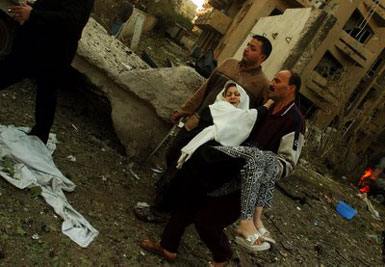
Outside Baghdad's al Hamra hotel, after Thursday's suicide bombing. Photo by Bill Putnam who lives there.

So yesterday, the Republicans in Congress treated that institution as a sandbox, suitable for a kindergarten brawl over the right of opponents to question Prez. Nincompoop's war. Democrats demonstrated, more than in a long time, enough fight to show the Reps up for the mean, whining incompetents that they are.

All very cute. But meanwhile, Iraqis and our unfortunate cannon fodder keep dying.

Riverbend speculates from Baghdad about why world media act so surprised about the recently uncovered "torture houses."

The Americans know they exist- why the sudden shock and outrage? This is hardly news for Americans in the Green Zone. The timing is quite interesting- it shouldn't matter that this raid came immediately after the whole white phosphorous story came out, but the Pentagon and American military have proven to be the ultimate masters of diversion.

Only last year in an area called Ghazaliya, one such house was discovered. It was on a smaller scale though. My cousin lives in Ghazaliya and he said that when the Americans got inside, they found several corpses and a man hanging from the ceiling on a makeshift noose. The neighbors had tried to get the Americans to check the house for months- no one bothered. They finally raided it because they got information from someone in the area that it was an insurgents hiding place.

I read once that in New York, if a woman is being raped, she should scream 'fire' instead of 'rape' because no one would come to save her if she was screaming 'rape'. That's the way it is with Iraqi torture houses- the only way they'll check it is if you tell them it's a terrorist cell.

All this is very reminiscent of the 1980s when the US conducted "secret wars" in Central America -- wars that were certainly not "secret" to the unfortunate Nicaraguan and Salvadoran peasants who found themselves on the wrong end of them -- wars hidden only from inattentive US residents.

The forces fighting the US in Iraq are doing their best to remind the US that there is a war on; last week they got the journalists' attention by attacking the al-Hamra Hotel where many live. Chris Albritton of Back to Iraq and Time magazine is on R&R in Beirut, but he links to his friends' articles about what it is like to be the target of a suicide bomber. Catherine Philip describes "the moment when a suicide bomb is suddenly aimed at you" in the Sunday London Times.

I pulled on the first clothes I could find, picked up a bag with all my personal documents in it, and ran for the door. … I ran down the remaining nine flights of stairs to the ground floor. Shattered glass and smears of blood covered the reception floor.

Dazed staff wandered around searching for one another. Outside, the courtyard was strewn with the charred gobbets of flesh, the unmistakeable sign of a suicide bombing that I had seen on Baghdad’s streets so many times before.

At the end of the road, a woman in a black abaya was screaming, searching for her missing husband. Two men rushed out of a neighbouring apartment block whose side had been ripped off. They were carrying a child still dressed in her pink pyjamas, bloodied and weeping. It was the little girl who used to wave at me from her balcony. …

It was the sheer scale of the insurgents’ ambition that saved our lives. The crater and pile of debris created by the first explosion was so huge that the second lorry could not get through. It detonated where it was, killing at least eight of those living in the surrounding flats. Miraculously, not a single journalist was killed. …

I looked at the bomber’s foot still lying on the ground. No, I thought to myself. If I believed in Hell, I’d hope that you were there now.

Well, the bombers certainly got the reporters' attention. It is hard to imagine that journalists will continue to try to report from these conditions. Who is served by a hidden war? The guys with the guns, on every side? Not really even them. Meanwhile, meaningless killing goes on for everyone else.

Congressman Murtha was right: he "concluded the presence of U.S. troops in Iraq is impeding … progress…. it's time to bring the troops home. …It's the right thing to do. … There's times you just got to -- you got to change your mind about this thing, you got to change your direction. "

Journalists have started a collection for the families of Iraqis who had the misfortune to live next to the Al Hamra, according to Albritton.

Friday, November 18, 2005

Designer donates sneakers for border run


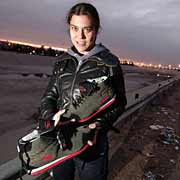
Argentine artist Judi Werthein displays a pair of Brinco shoes before handing them out to takers along the U.S.-Mexico border. Photo by Denis Poroy, AP

Too weird almost for words. According to this morning's SF Chronicle via AP the artist is trying to help:

The high-top sneakers cost $215 at a San Diego boutique, but the designer is giving them away to migrants before they cross to this side of the U.S.-Mexico border….

A compass and flashlight dangle from one shoelace. The pocket in the tongue is for money or pain relievers. A rough map of the border region is printed on a removable insole.

They are red, white and green, the colors of the Mexican flag. On the back ankle, a drawing of Mexico's patron saint of migrants.

On this side of the border, the shoes sit in art collections or the closets of well-heeled sneaker connoisseurs. On the other side, in Tijuana, it's a utilitarian affair: Immigrants to be are happy to have the sturdy, lightweight shoes for the hike — or dash — into the United States.

Sounds crazy, but Werthein did the research to make these actually useful to people coming across the border looking for work. A native Spanish-speaker, she "joined the Mexican government's Grupo Beta migrant-aid society on long border hikes" and interviewed migrants. She also found patrons who have funded the project to the tune of $40,000.

What to make of this? My immediate reaction was censorious and utilitarian. Doesn't such an art project make light of the sufferings of people driven by the need to eat who cross our fortified deserts? Couldn't the money in this project have been spent on advocating for immigration reforms that made dangerous, extra-legal border treks unnecessary? (Full disclosure: I am currently consulting with immigrant groups and reform advocates.)

But a little reflection backs me off the judgmental impulse. Just maybe this project can help loosen up some people's view of a situation on which attitudes seem frozen, polarized. Immigration policy is broken; most of the debates around it simply penalize the hungry and provide permanent employment for bureaucrats and various kinds of police. None of it focuses on the continuing human drama and cost. Maybe Judi Werthein has a clue how to do that.

Thursday, November 17, 2005

Religious boobs or "American Taliban"?
Or other choices?

Alan Wolfe's The Transformation of American Religion: How we actually live our faith perhaps might more accurately be titled "the closing of the American religious mind." Wolfe, a social scientist, wants readers to know upfront that "I do not write about religion out of religious conviction. …I am not, and never have been, a person of faith." Nonetheless he seems awfully distressed by the picture he draws of a religious landscape in which churches aim, apparently above all, to cater to the needs of self-centered individualists. "American faith has met American culture -- and American culture has won."

Wolfe is a sometimes sharp, and often sharp-tongued, observer.
  • "…all of America's religions face the same imperative: Personalize or die."
  • "…the Bible, considered as a body of ideas, is something of an afterthought, there to ratify ideas already so well formed that one need never puzzle over them."
  • "Pentecostal forms of religious expression have become popular because -- like increasing numbers of school teachers, leaders of therapeutic communities, mental-health professionals, and even occasional academics who live in secular worlds -- they seek authenticity through experience rather than ideas."
  • "In many contemporary American religious precincts, Antigone would have been asked if she wanted help in letting go her obsession with her brother."
All these rather similar plaints, none particularly novel, amply supported from the social science observations, add up to a picture of faiths more trivial than terrifying, more redolent of the New Age homilies of Deepak Chopra than the puritan rigor of a Jonathan Edwards.

The title of Wolfe's last chapter "Is Democracy Safe from Religion?" points up where all this rather disdainful description of the religious landscape leads him. Wolfe wants above all to assure readers that the religious boobs he has been depicting needn't be feared. He assures us that:

…believers who prefer a God of love to a God of truth are not going to kill for their beliefs -- or give their support to those who do. … As much as we may be tempted to denounce as flighty Americans who change their faith as often as their cars, we ought to recognize that religious switching acts as a kind of insurance against bigotry. …Sometimes the more seemingly frivolous of the ways Americans practice their faith turn out to be blessings in disguise.

As someone who, as an uppity woman and a lesbian, constantly fears being a target of the religious right, do I find Wolfe reassuring?

Not particularly. Popular commodity culture is pretty easy to ridicule; and ridicule is an easy form of dismissal. Ill-informed, incurious people who seek out faith practices that do not challenge them to experience a larger human family may not be malevolent. But they can be oblivious to active evil done out of their sight. And we live in a society increasingly segregated by wealth and education that enables many not to have any idea how others live, as recent events in flooded New Orleans showed us.

Moreover, there are "religious" leaders, currently exemplified by James Dobson of Focus on the Family, who seek to use the unexamined enthusiasms of ordinary seekers to build power for their fascist agendas. The followers may have benign intent -- however democracy will not be safe from these right wing authoritarians without continued struggle that includes the many religious people who actively oppose any intolerant agenda.

Tuesday, November 15, 2005

Animal house U.S. Army-style in Iraq


They don't look hungry right now…

This seems too unbelievable to be true, but the AP is reporting that two Iraqi businessmen say they were tortured by US soldiers by being thrown into a cage with lions. A lot of other things that once seemed unbelievable have proved true; perhaps this too is fact:

Dressed in suits, the two men talked solemnly about the hot July day in 2003 when they were arrested by American troops with guns and armored vehicles. Their voices rose, and their words tumbled out more quickly, as they described being covered with plastic hoods and repeatedly struck by soldiers using the butts of their weapons.

“I was very scared,” said Khalid. “I felt I was going to suffocate. Every time I screamed and pleaded with them, they would hit me.”

They both described standing in front of a lions’ cage, and said they could hear other prisoners screaming as the metal cage door creaked opened and slammed closed.

“They threatened that if I did not confess they would put me in the cage,” said Khalid, adding that the soldiers kept asking him where Saddam was. “I laughed; I thought they were kidding me. They asked where are the weapons of mass destruction. I was very surprised, and I thought it was weird.”

When he laughed, he said, he was beaten more. He said they pushed him into the cage three times, pulling him out as the lions moved toward him.

The pair have sued Defense Secretary Donald Rumsfeld and other military officials seeking damages for their mistreatment. They are represented by the ACLU and are currently telling their story on a U.S. tour.

I know there is an old book that tells as story about a lion's den near Babylon; what have those troops been reading?

Parsing endorsement of torture


That's what the Senate has been doing for the last few days, while deciding to whether to deny Bush-designated "enemy combatants" access to legal review of why they are being held. There was a dreadful Graham amendment to do away with habeas corpus passed by the Republican majority, some more-Republican-than-Democrat Senators from very red states, and the atrocious Joe Lieberman, then a Bingaman amendment that was better, then a compromise or three. Also some kind of statement asking the President to explain his Iraq policy.

Better people than I have attempted explicate all this: for some good commentary, see especially As the Senate elaborates legal epicycles, I'm reminded of protracted battles in Congress during the 1980s over overt US aid to the Nicaraguan anti-Sandinista terrorist movement, the contras, that Ronald Reagan's administration broke many laws to support. Those of us hoping to impose limits on this dirty war dutifully petitioned, made our calls to legislators, and tried to keep up with the ins and outs Congressional maneuvering. We won some and lost some; in a sense what came to be called "Iran-Contra," the scheme of trading arms for hostages with Iran while hitting up the Sultan of Brunei to pay for the Nicaraguan thugs was something our opposition imposed on the executive.

Then and now, what matters is that we keep our eyes on the real issues. No normal person can keep track of the legislative minutia, nor should we try to. The legal, moral and even merely prudent objectives for sane residents of the US are pretty clear: reinstate the rule of law; stop torture; don't make wars based on lies; and, at the most sophisticated level, learn to play well with others.

Monday, November 14, 2005

Potpourri


If I didn't ever hunt for new blogs to read, I'd be missing the riches the blogosphere offers. Here are some recent finds:

The Moor Next Door writes here on the difference between the experience of Arab Americans and American Muslims and that of European Arabs and Muslims. Nouri bin Ziri had a number of interesting posts on the riots in the French "suburbs," a subject on which it has been hard to find good information.

Black Looks: Musings and Rants of an African Fem covers the enormous topic of women in Africa. The current lead post deconstructs the claim that the election of Ellen Johnson-Sirleaf as President of Liberia represents something utterly new for the continent.

Operation Eden is Clayton James Cubitt's chronicle of what Hurricane Katrina did to his family, with extraordinary photos. This one is a work of art -- and outrage.

Ginger Mayerson at Hackenblog always has good commentary on our world from Los Angeles, but I particularly enjoyed this post on feminism as we live it now.

For sheer beauty (and to brush up on your high school French), take a look at Sur Le Pont Des Arts.

There's a universe of great stuff out there; we owe it ourselves to look around.

Sunday, November 13, 2005

Post-election roundup: Muslims in the electorate


Tarrant County Republicans reached out to Muslims at a festival celebrating the end of Ramadan last week. Photo: BRAD LOPER/DMN

From Texas: The Dallas Morning News reported that Republicans sought to attract Muslim voters by appealing to their conservatism on gender issues, promoting the ban on gay marriage. They met a mixed reception:

Mir Barethz of Arlington said "Gay marriage is against my religion….God made men for women and women for men."…

Nawal Suleiman, a substitute English teacher from Arlington, said that she voted for Mr. Bush in 2000 but that then he "turned 180 degrees against Muslims and Arabs."…

"If one Israeli dies, it's a tragedy," she said. "If 100 Muslims are killed, it's not a big deal."


In Virginia: The Washington Post detected that Muslims were among the voters who gave Democrat Timothy Kaine surprising margins of victory in exurban counties that previously had voted Republican.

Studies show that a larger proportion of new residents moving to the outer suburbs in the past few years are immigrants, creating a diversifying population whose voting patterns may have aided Kaine.

"There has to be a reason for this, and for me the reason is the influx of the new people, and the biggest chunk of that influx are foreign-born citizens," said Mukit Hossain, president of the Virginian Muslim Political Action Committee.

Hossain said his group, which endorsed Kaine, compiled a comprehensive database of Muslim voters in Virginia, finding that about 15,000 of 49,000 statewide live in Prince William and Loudoun. Many legal immigrants in the area were turned off by Kilgore's pledges to use state police to fight illegal immigration and his opposition to a proposed taxpayer-funded day labor site in Herndon, and voted accordingly, he said.

The group also endorsed Democratic delegate candidate David E. Poisson, who unseated Richard H. Black (R-Loudoun), one of the most conservative House members. Hossain said an analysis of survey data showed that more than 60 percent of Muslims in Poisson's district voted and that they supported the Democrat by more than 30 to 1.

"If the politicians have any sense, I'd hope they'd pay attention," said Hossain.


In New Jersey: Local election officials used a convenient, accessible mosque as a polling place and were taken aback when voters complained.

Tina Palagonia, wife of Whitehall Township Commissioner Jerry Palagonia, who was working the polls for her husband Tuesday, said about 70 of the 234 people she encountered complained about the use of the Muslim hall.

Palagonia said one woman told her she found it ''offensive to come to an Islamic Center to vote.'' Another woman told Palagonia that she has a daughter in Iraq. ''We know what's going on there; she tells us what's going on there,'' Palagonia said the woman told her. ''And we have to come here and vote?''

Jerry Palagonia, who won a second term Tuesday, responded, ''That's wrong, that's totally wrong,'' describing the mosque as pretty, very clean and nice.

He also praised the members of the mosque for their courtesies during the long Election Day. ''I don't want to hurt the feelings of the people at the church. I just don't understand it.''

Meanwhile, elsewhere in New Jersey, a Muslim candidate for office overcame a blatant racist attack.

The anonymous flier mailed to households days before a new mayor was to be chosen was direct and devastating in its claims: A Muslim council member, one of three candidates for the post, was "a betrayer living among us" with ties to the 9/11 terrorists.

The mailing said Mohamed Khairullah "should not be living in our clean town" and "will try to poison our thoughts about our great country."

But the letter failed to derail his candidacy; the Borough Council chose Khairullah in a 4-0 vote Wednesday night, making him one of only two Muslim mayors in New Jersey.


All these incidents replicate a common trajectory by which immigrant communities become part of the US multicultural mix. Latinos in California experience the same dissonance between the values they bring from their home cultures and US attitudes toward abortion, gender roles and gay marriage. If all else were equal, they might be attracted by Republican stances on these issues. But they identify Republicans with racism and xenophobia. When push comes to shove, most register as Democrats, not because the Democrats are so attractive, but because there really is no home for them in the other party.

Muslims seem to be following the same pattern, faced with Republican promotion of panicked cries of "Islamofascism" and embrace of militant rightwing Christianity. Until and unless Muslims in this country achieve economic and political security, which Republican post-9/11 posturing denies them, the majority will be Democrats. Meanwhile, at the local level, they can hope to move into the system, winning more space and respect.

Friday, November 11, 2005

Ward's Wonderful World: NOT!


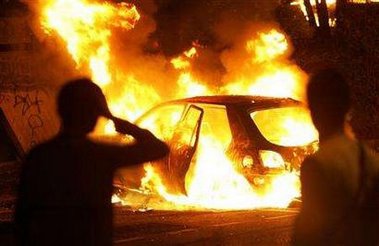
A car burns during a riot in the Paris suburb of Le Blanc-Mesnil November 3, 2005. REUTERS/Franck Prevel

Next time Ward Connerly comes calling with one of his "color blind" scams, claiming that issues of racial discrimination will go away if we stop counting what happens to people of color, somebody remind him of France. Connerly is the regent (appointed member of the governing board) of the University of California who succeeded in outlawing affirmative action by the state in 1996.

Students of color, not surprisingly, either gave up on college or went to schools where they felt more welcome, according to a US Civil Rights Commission Report. So in 2003, Connerly came back for more, seeking to prohibit the state from counting people of color. No data, no problem. Through hard work and fortuitous circumstances that initiative went down to defeat.

France has been trying Connerly's experiment, choosing to see no evil:

France's Constitution guarantees equality to all, but that has long been interpreted to mean that ethnic or religious differences are not the purview of the state. The result is that no one looks at such differences to track growing inequalities and so discrimination is easy to hide.

"People have it in their head that surveying by race or religion is bad, it's dirty, it's something reserved for Americans and that we shouldn't do it here," said Yazid Sabeg, the only prominent Frenchman of Arab descent at the head of a publicly listed French company. "But without statistics to look at, how can we measure the problem?" NY Times.

It clearly got French society in a lot of trouble.

Washington Post columnist Eugene Robinson finds a lesson:

The riots in the suburbs of Paris and other French cities ought to wipe the smirk from the lips of even multiculturalism's smuggest critics. Those who lobby against bilingual education or get upset when their children learn about Cinco de Mayo should look at France and realize that multiculturalism is a lot like democracy -- it's the worst system except for all the others….

In France, it's against the law to keep statistics based on race or ethnicity. But the fact that no one knows the precise number of Muslims living in France today doesn't mean those Muslims don't exist: There are about 5 million of them by most estimates….

Just because no one knows how many first- or second-generation Moroccans or Senegalese live on the grim periphery of the City of Light doesn't mean they aren't there. Just because you don't know precisely how many of them are unemployed doesn't mean there's no job discrimination….

People of different races, backgrounds, cultures, histories and languages can indeed live together productively and with common purpose. I know that because we do it here in the United States. It's a messy process, because it means we have to argue a lot, and many of us resent all the constant conflict and negotiation that's involved in getting along with one another….

So let's end all this "English-first" nonsense and embrace Spanish as our second language, since that's what it is. Let's learn more about those 5,000 years of Chinese history. Let's have the dates of Ramadan and Eid noted on our calendars. Let's remind ourselves of a big, important lesson that we've already learned, and that we can teach the world: Multiculturalism works.

Take that, Ward.

Veterans Day: War is not the answer

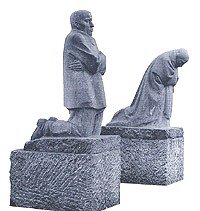
Memorial sculpture depicting Peter Kollwitz' parents praying for their son killed in WWI

One day, a new ideal will arise, and there will be an end to all wars. I die convinced of this. It will need much hard work, but it will be achieved… The important thing, until that happens, is to hold one’s banner high and to struggle… Without struggle there is no life. -- Sculptor Kathe Kollwitz (For much more, read this.)
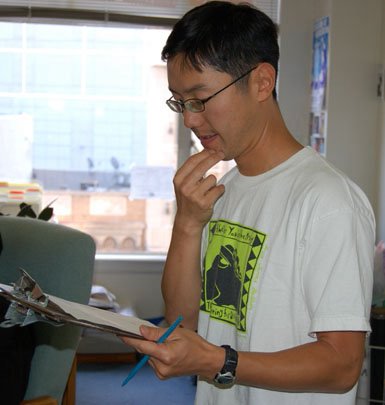
Yesterday I joined a tiny contemporary piece of the "hard work." For four years, faithful Quakers, joined by Buddhists and Episcopalians, have witnessed against war ever Thursday at noon outside the San Francisco Federal Building. Yesterday Fr. Robert Cromey broke Eucharistic bread with those who wished to participate.


Thursday, November 10, 2005

Millions of South Asian earthquake victims need our help: "let's blog the hell out of it."*


Graphic: Church World Service

Eighty thousand have already died; 3 million people are homeless. The Himalayan disaster is approaching the scale of horror reached by last year's tsunami (300,000 dead).

Oxfam warns:

The thousands of people living in remote villages are in serious danger - especially once the snows come - but the plight of those who are living in camps has not received the same attention. Unless conditions are improved in these camps, diseases like cholera could spread like wildfire. If disease does break out in the camps, the number of deaths could far exceed those in danger in their villages.

Meanwhile in the US, via Juan Cole*:

A [congressional] staffer writes:
So far, the US has only given $50 million and pledged another $150 million. USAID has only $10 million left in their budget, after that US assistance will run out of funding. Today, the President instructed five Fortune 500 CEOs to travel to Pakistan. They will be doing fact finding and help with private donations. Unfortunately, with all the hurricanes (Katrina, Rita, Wilma, etc) there is "disaster fatigue" in the US Congress.

Those of us who can need to contribute now. Two good agencies with strong ties in the region are: I've given repeatedly. Please leave a comment if you have -- tell readers what agency you chose.

On "Bowling Alone" -- hanging separately or together?

Quite simply, Robert D. Putnam's Bowling Alone: the collapse and revival of American community has had more of an impact on my thinking about this country and the social and political movements in which I work than anything I've encountered in years. Published in 2000, Putnam wrote before the dubious election of 2000, before 9/11, before the present rightwing ascendancy. The fact that nothing in my reading of events since contradicts his main thesis greatly increases its authority for me.

This is an astonishingly ambitious book. Putnam seeks to aggregate huge quantities of disparate data -- then explain -- and then understand -- the implications of a huge decline in what he names "social capital," the communal networks of trust that that underlie a well functioning society.

Since the mid 1960s, in every arena, he documents that people in the US have withdrawn massively from the institutions and social structures that create social cohesion. We not only are less likely to vote, we are less likely to belong to a church, attend a club meeting -- or perhaps even more tellingly to spend our recreational time playing cards with neighbors or visiting friends. As the pre-World War II generation passed from the scene, Boomers (born 1946-1960) participated less and less in the collective activities that build social trust. And the generational cohorts that have followed are even less participatory.

This is hard for those of us who do live very actively in community, of whom I am emphatically one, to believe. I'm a Boomer who grew up inspired by notions of "participatory democracy" and has never stopped trying to build it. And so I am tempted to suggest simple explanations for the social trends Putnam describes. Maybe he has missed (or misread) the changed nature of social capital when most women work outside the home? Maybe he assumes cohesive neighborhoods have to look like older cities, while suburbs generate new forms like megachurches and soccer leagues? Maybe the new self-assertion of gay people has generated new customs and venues that replace some of the time once spent on family dinners? Maybe informal book groups have replaced club meetings for many? Maybe we watch a lot of TV alone, but we communicate with others actively on the internet and through blogs? Putnam looks at all these apparent countervailing trends and many more, and concludes convincingly that none has slowed the erosion of our social capital.

And that erosion matters, because social capital is what makes possible trust between people who do not know each other, as well as trust in community institutions. Trustful societies work.

A society characterized by generalized reciprocity is more efficient than a distrustful society, for the same reason that money is more efficient than barter. If we don't have to balance every exchange instantly, we can get a lot more accomplished. Trustworthiness lubricates social life.

By that standard, this society is a mass aggregation of frustrating frictions.

Having laid out the problem exhaustively, what does Putnam propose we should do about it, this reflexively activist reader asks? Not surprisingly, this section is much weaker than that desribing our condition. These are huge social forces after all. He looks for lessons from the Progressive Era in US history at the end of the 19th and the beginning of the 20th centuries. He describes a conscious effort in that time and place, by many sectors, immigrants and industrialists, men and women, religious and secular folks, to launch organizations and activities that held together amidst the uncertainties of rapid technological and economic change. And though he acknowledges many limitations from a modern perspective in the efforts made in that era, he hopes for a similar attempt today.

The prescription is, unhappily, not very convincing to me. The one question Putnam doesn’t ask or answer in this exhaustively argued volume is: who benefits from our increasing atomized isolation from one another? It seems pretty clear to me that today's winners -- the rich, the elites, the greedy -- have been doing very well in a society of unorganized and increasingly paranoid folks who do not even imagine they can collectively improve their environment. So I don't see many forces with actual clout that are going to lead US society in a different direction.

Changes along the lines needed require genuine re-evaluation of how we've allowed our lives to be structured, changes only likely to happen in the wake of massive economic dislocation (peak oil?), a losing war (got one of those, but so far a distant one), or other national trauma. We are all living now in the backwash of our right wing rulers' successful effort to deflect any such evaluation after 9/11. How much more trauma will it take?

In another dark hour, W.H. Auden's poem, "September First, 1939," had it right: We must love one another or die.

Wednesday, November 09, 2005

Morning after Arnold went down


This morning California's newspapers put photos of Governor Schwarzenegger on the front pages, even in abject defeat. They should have pictured the voters, or if they could have found the image for it, the process of a freewheeling election itself.

Because Schwarzenegger took on the public employee unions, he didn't have the usual advantage that bullying pols enjoy: there was a force with money and people power to contest him. And in a fairer than usual fight, Californians said no to a rightwing celebrity's power grab, yes to education and social services, yes to unions being able to contest corporate power and even, as a bonus, yes to young women's right to choose.

The morning's headlines were indeed sweet; self-indulgently, I'll round up some tidbits here:

Voters Reject Schwarzenegger's Bid to Remake State Government -- Los Angeles Times

"Schwarzenegger put in $7.2 million of his own money. That brings his total personal spending on political endeavors to $25 million since he ran for governor in the 2003 recall race."

This governor role has proven to be an expensive hobby.

Why His 'Sequel' Failed to Captivate -- Los Angeles Times

"Gov. Arnold Schwarzenegger on Tuesday met the limits of his celebrity: Even a campaign built around his action-star persona could not persuade voters to embrace his 'year of reform' agenda."

"A Republican strategist and occasional Schwarzenegger advisor put it more bluntly Tuesday, saying privately: 'The act is getting stale.'"

Enough with the actors already. California faces real problems; let's get on with solving them.

Schwarzenegger faces 'resounding defeat'-- San Jose Mercury News

"Elizabeth Garrett, who directs the USC-Caltech Center for the Study of Law and Politics [said] 'It means that, Wednesday morning, he is an ordinary Republican governor working with a Democratic Legislature in California -- no stronger, no weaker.'''

That's pretty weak; the current districting of the legislature ensures that Democrats will remain in large majorities throughout this decade.

Analysis: A bruising blow from 'the people' -- Sacramento Bee

Gale Kaufman, who presided over the multimillion-dollar campaign that brought the governor to his knees, said his political recovery won't be that easy.

"'I think he comes out of this election ... deeply damaged, and really in a very different place," she said. "Just waking up again and saying, 'Today I'm back to the middle,' doesn't make it so. He's lost the ability to just keep changing and having people believe it."

He always did seem to be an actor with only one character.

CALIFORNIANS SAY NO TO SCHWARZENEGGER-- San Francisco Chronicle [Full caps are the Chron's.]

"This must be the worst defeat the governor has ever had,'' said Kevin Spillane, a GOP consultant. "It's not like having a movie that underperforms. … Now, we have to see how he deals with defeat.''

I'll hazard a prediction here: Arnold will pull out of the governor's race if it looks like a fight for him. I hope the unions and the Democrats in Sacramento don't let up now. Californians deserve better and yesterday they proved they know it.

Tuesday, November 08, 2005

Right wingers out for blood:
An analysis of a wingnut attack on progressive nonprofit work


Current attacks on free speech via threats to the non-profit status of dissenting institutions are not limited to harassing war opponents who deliver fiery sermons.

Writing in The Nonprofit Quarterly, Rick Cohen unpacks the complicated story of how rightwing House Republicans managed to attach language to a housing trust fund bill that will bar nonprofit housing developers from encouraging nonpartisan voter registration activities or working with other agencies that do civic engagement and advocacy -- even if the housing nonprofits use only privately raised, non-federal funds for their advocacy activities. The newly prohibited advocacy work is all completely legal nonprofit activity under the Internal Revenue code. But free market wingnuts are working to change that.

Cohen enumerates lessons that nonprofits have to take to heart if they are to survive the Republican reign of greed:
  • Right wingers will use nonprofits' need to force them to accept unacceptable restrictions. "Even conservatives who not only had no interest in [the housing] fund but actually opposed it… were willing to vote for it if it impaled nonprofit advocacy rights as part of the bargain."
  • Republicans are willing stick these poison pill requirements on any legislation, however important to real people; in this case, they've hooked it on Katrina relief. "There is virtually no federal program that is so important to the right wing (except perhaps the Administration's faith-based initiative) that they won't sacrifice and skewer it if it can score a point to advance their odd ideological agenda."
  • Nonprofits can't cede a few rights at the margin in the hope that the assault on their activities will be limited. In the housing bill "options arose for technical solutions, like exempting nonprofits that are required to engage in voter registration through state “motor voter” and other laws, or exempting groups that do voter registration among the disabled, one of the least registered population groups in the nation. All that does is peel off groups that might believe--mistakenly--that their concerns or stake have been addressed or solved….To fight these attacks, advocates have to see the issues and implications in their fullest breadth, not their narrowest possible technical grounds."
  • These attacks on nonprofits are about scaring them into pulling back from their missions, not just some technical regulations. "With the enactment of the law, nonprofits interested in building or rehabilitating affordable housing would not only look at the law and avoid the kinds of activities outlined as prohibitions against trust fund participation, they would likely go further. Given the possible latitudes of interpretation, nonprofits wary of running afoul of the program auditors would probably avoid activities and projects that might trigger problems."
  • Advocacy restrictions ultimately aim to put nonprofit housing developers out of business, leaving housing to for-profit builders. Private developers influence politicians with campaign contributions; nonprofits can only show their clout by mobilizing constituencies. "By putting advocacy and voter registration restrictions on nonprofits, it is all too clear that the Republicans have unleveled the playing field in favor of for-profit developers. None of these restrictions would have applied to for-profits and their national and regional interest groups or their Political Action Committees."
  • The right will not be placated by throwing in some bones for "faith-based" groups. That tactic just shows Democratic ignorance of how well most "fatih-based" nonprofits already work at providing services."Trust fund eligibility was not a real problem for faith-based providers….If they haven't mobilized to win their point to date on the faith-based funding formulas of the Administration, it is difficult to think that changing the eligibility standards for participating in the Fannie/Freddie affordable trust fund would stimulate the political juices of the faith-based players….And in the end, raising the specter of faith-based concerns about the RSC amendments swayed no votes among the Republicans."
  • The Democrats caved by hoping, vainly, that the bad provisions would all go away in a conference committee. That is, they capitulated to letting the Republicans pull a stealth attack on a valuable program."The arcane world of a House/Senate conference committee to work out differences between companion bills is a not much more transparent process than an amendment sneaked into the Rules Committee to avoid full floor debate. These issues have to be put out in front of the public, not simply discussed on the Web pages and listservs of the nonprofit cognoscenti."
Cohen emphasizes that these sorts of attacks on services the government aids outside the market are going to keep on coming. He advises nonprofits to get tough in standing up for their mission:

Sometimes, the nonprofit sector has to “just say no”--and say it with courage and power, even with the possible consequence of rejecting long-sought government funding programs.

I've excerpted liberally from Cohen's article but would urge anyone interested in the future of progressive work under nonprofit rules and regulations to study it thoroughly. In fact, the entire NonProfit Quarterly is worth checking out as it regularly covers these issues in a non-technical, morally serious manner.

Monday, November 07, 2005

Emphatically not a time for reasonable dialogue from All Saints Pasadena


The offending priest: Rev. George Regas arrested 4 April, 2005 supporting Los Angeles Security workers.

The LA Times reports this morning that the IRS threatened All Saints Pasadena, a prominent Episcopal parish, for a sermon in 2004 by its retired rector Rev. George Regas denouncing Bush's Iraq war.

In some ways, I'm even more upset by the tack All Saints' rector J. Edwin Bacon is reported as taking in response, than by the IRS's obviously political audit. The parish got the letter threatening to pull its tax-exempt status in June 2005. Why did they wait to publicize the attack until now? Bullies need to be exposed, not humored or placated with legalistic responses.

The letter on its face aims at political repression: the IRS wrote down that All Saints was a risk because of a "searing indictment of the Bush administration's policies in Iraq" and noted that the sermon described "tax cuts as inimical to the values of Jesus." The IRS is plainly asserting that a church can be punished for opinions stated within its community -- not claiming any action or practical intervention on behalf of a candidate in an election! That is an attempt at thought control.

Fr. Bacon opines that the IRS will eventually drop this case and he is almost certainly right. But given the parish's relative wealth and standing, a lot of others need it to take a far more aggressive, prophetic, stance. More than most who might be attacked for denouncing US imperial wars, All Saints should be able to afford to speak out.

The Episcopal Church has come a very long way from its early 20th century character as "the ruling class at prayer." But we sometimes act as if just being reasonable and practicing decorum will recover an influence we've given away, choosing instead for the poor and the marginalized with whom Jesus associated. Having taken that hard path, any influence the ECUSA may have for good in this society, for the poor and suffering, comes when we push boundaries, following the example of the Founder. And he didn't negotiate politely with the authorities.

Sunday, November 06, 2005

Where there is smoke …


This morning it comes out that the persistent Bush Administration contention that Al Qaeda was working with Saddam Hussein's Iraq was based on statements elicited by torture. The NYT provides the story of how the tale was "offered" by a captured Al Qaeda operative. The excellent "emptywheel" at The Next Hurrah connects the dots to show how very probable it is that this "evidence" for something Bush and Cheney wanted to hear was extracted by torture.

So there it is -- the city on the hill has morphed, before our eyes into its guise of evil empire spewing poisons on the earth. My optimistic ancestors weep from their graves; what do I do?

In the teachings of historic Christianity, hope is not a feeling, but a virtue, an orientation to the human experience to be cultivated as an expression of faithfulness to the knowledge of the goodness of God. Hope at this time of shame and horror is also a necessary civic virtue, an orientation faithful to the vision of a society where justice, not capricious human greed, prevails. Lots of work to do.

Friday, November 04, 2005

Short takes: money -- three possibilities


Photo: Aasil Kazi Ahmad

Endorsements for sale?

The nation's drug makers have given hundreds of thousands of dollars to political leaders and civil rights groups that have endorsed the industry's initiative on the Nov. 8 ballot.

"The measure, Proposition 78, would avert state caps on the price of prescription drugs. Those embracing it while taking the industry's money include the conservative Traditional Values Coalition, an emergency-room physician in Los Angeles, the California arm of the NAACP and the Mexican American Political Assn.


Federal budget is 'beyond redemption,' bishop says:

The Right Reverend F. Neff Powell, bishop of the Diocese of Southwestern Virginia, declared, 'The current budget reconciliation package in Congress is quite frankly beyond redemption and should be abandoned.' ….

The Senate narrowly passed its version for the budget on October 27, which includes $39 billion in cuts, including cuts to Medicaid, student aid, and farm subsidies while offering limited Hurricane Katrina relief. The House bill cuts $50 billion for programs serving the working poor, children and the elderly, including eliminating 300,000 individuals and families from nutritional assistance, 40,000 children from free or reduced-price lunch programs, and reducing care for 4,000 foster children....


People power and generosity

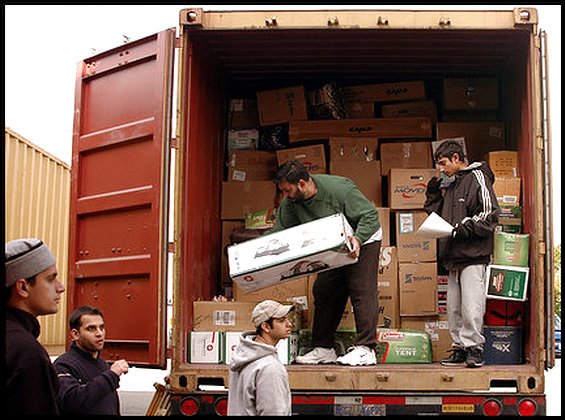
Dozens of members of the [DC] region's Pakistani community gathered at the Loudoun County warehouse … in their second attempt at sending badly needed relief to those left injured or homeless by the Oct. 8 earthquake. …

Hanif's group bought 250 tents, 100 sleeping bags and 20 boxes of medicine and other medical supplies. In fact, so many Pakistanis bought tents to donate to the relief effort that local department stores were running out, said Farah Chohan, one of the organizers of yesterday's drive. …

"If we don't do something about it, people are going to die," said Zarrar Husain, another of the event's organizers.

We can help the victims of the earthquake in South Asia via UNICEF-USA among many relief agencies.

Thursday, November 03, 2005

The Governor's Neighborhood


On opening my online LA Times this morning, I was greeted by the ad pictured above. Totally worth clicking through for a sight of the "Bush Bird" that wanders this Sesame Street parody.


Visit Schwarzenegger Street here. And, if you like, you can go on the visit the sponsor, Democratic gubernatorial aspirant Phil Angelides here. I'm as yet agnostic on whether Angelides is the right person to take on the Governator next year, but the race is very important. There is no reason except the recent inability of Democrats to govern this state that it should be led by a celebrity Republican.

On the subject of governors in national politics, Mark Schmidt has some very interesting musings at The Decembrist. Dissecting the defeat of Colorado's tax limitation measure this week, he makes the point that Republicans used to be able to claim they had a stable of governors who could claim they had made state government work -- but their anti-tax mania has ended that situation, leaving the Democrats with the better set of known leaders. He argues "governors are where presidents come from." Worth thinking about. Found the link at Discourse.net.

Wednesday, November 02, 2005

Remembering Tim Sampson

Feast of All Souls/Dia de los Muertos

"On this day, the Church remembers all of the faithful departed who died peaceable deaths, … these were ordinary people…" according to the useful Episcopal liturgical website Mission St. Clare. I like the idea of remembering with delight the people who've been important to us. Today I remember a friend and mentor who left us in 2001 at the age of 66.

Tim Sampson was certainly not ordinary, in the sense of "unremarkable;" however he would never have thought of himself as anyone special, so in that sense, this does seem to be his day. As far as his being one of the "faithful," I really don't know what that means: I think of Tim as a Jewish-Quaker-Buddhist-anarcho-commie-Santa Claus, so I am sure he fits under that word somehow. In any case, his life was the art form of a man who found ways to live out what he believed in.

Tim lived for the struggle for justice and his notion of justice was wide and deep. His concerns bridged divides that often act as barriers between people who ought to be on the same side.
  • He was an academic, teaching for 30 years in the School of Social Work at San Francisco State University. The campus remembered him as uniquely present to students, joining their marches and picket lines.
  • He was a union activist, not only as a member and officer of his own union, the California Faculty Association, but also in support of the bleeding edges of labor such as the United Farm Workers and Justice for Janitors. Not long before he died, he was pushing the AFL-CIO to organize and utilize the energies of retirees.
  • He was a community organizer in the Saul Alinsky and Fred Ross Sr. traditions who had worked with the National Welfare Rights Organization, the Legal Services Corporation, Highlander Center in Tennessee, and the National Campaign for Jobs and Income Support of the Center for Community Change.
I knew Tim best in that last role: periodically he would wander into the CFJ office with a briefcase full of flyers and petitions for various good causes. His arrival was usually literally like the arrival of Santa Claus. We never were sure how we were going to make the payroll in those days. Tim sold CFJ buttons everywhere he went. The $60 or $110 he brought us was an important addition to our pathetic stash!

Organizing to take political and economic power from the strong for the weak is hard, frustrating work that can leave its practitioners cynical and bitter. Tim never succumbed to those temptations. He was enthusiastic about each new campaign, thoughtful, hopeful and warm toward those he worked with. Forgoing the brash, macho posture many organizers of both sexes assume,Tim taught aspiring organizers that:"The flowers of organizational relations grow from personal interest, kindness, and cultivation."

For many organizers, building power for the weak is about harnessing anger and resentment against the powerful. And certainly where injustice and oppression are the rule, anger can be righteous and useful. But it can also be a corrosive addiction and Tim knew that.

When I started organizing, one of my primary motivations, which I came to cherish, was anger. But as my life went on, I learned there is a more powerful force in the struggle for social change, and that is love.

The older I get, the more I know he was right.

¡Tim Sampson, presente!

Tuesday, November 01, 2005

Absentee voting in California:
a field worker's view


Photo by Irfan Khan / LAT.

As a voter, I love casting my ballot by mail, voting "absentee." I have time to figure out all the obscure propositions and can do my civic duty from home.

As a person who works to maximize turnout for my side in elections, I hate absentee voting. When people vote all at once on Election Day, you know when you have to reach them. If they don't vote, you can figure this out by mid-afternoon and chase them down on the phone or in person. And there is something about participating along with everyone else that helps voters feel that they are performing a meaningful activity. That's good for continued political participation, I think.

Today's San Francisco Chronicle reports that:

Next Tuesday's special election could be the first in which half of all votes cast are by absentee ballot. …

"Last November, absentee voters were 37 percent of the turnout," [Acting Alameda County registrar Elaine] Ginnold said. "In this election, they could make up between 50 percent to 60 percent."

Different types of absentee voters have different voting patterns. Of the absentee ballots mailed out for this election, 613,000 are from voters requesting a ballot specifically for this election.

Those voters tend to have the highest return rate, averaging more than 90 percent. Permanent absentee voters tend to vote at levels 5 percent to 10 percent lower.

From the point of view of a person working to defeat Gov. Arnold's initiatives, this is both good and bad news.

According to today's LA Times the Schwarzenegger hopes to make up what he lacks in volume of support by working selectively to maximize turnout among his supporters: "his campaign strategy relies on relatively few people showing up next Tuesday and large segments of voters staying home."

Gov. Arnold hasn't tried to raise the profile of the election in areas where he won't do well; we are not seeing his ads in the San Francisco Bay Area. And he has hired a micro-targeting firm to reach out to voters on the basis of their consumer habits and TV-viewing preferences.

Pollsters like absentee voting; voters can't change their minds at the last minute. Today's Field poll shows "20 percent of the 1,071 likely voters surveyed Oct. 18 through Sunday already have voted by absentee ballot."

Large scale absentee voting makes campaigning more expensive. For one thing, you have to start sooner as folks may vote weeks early. Further, your TV buys become less and less effective as their target audience shrinks because more people have already voted. Gov. Arnold is running into that today as he has launched a new ad saying taxes will go up if he doesn't get his initiatives passed; too bad, many votes are already in the bag.

For a field operation, absentee voting is an expensive nightmare. County registrars furnish lists of who has voted that can be cross-checked against eligible voter lists. Campaigns compile lists of voters who have requested absentee ballots. Then the campaigns have to try to reach potential voters who are holding onto their absentee ballots and encourage them to get them in. The campaigns have to teach volunteers to explain to voters that they can take their ballots to any poll on election day. The process is a recipe for confusion for any but well-staffed, well-funded organizations. It's only merit is to reduce the number of voters you are trying to reach in 12 intense hours on election day.

And yet, mail-in ballots are clearly one wave of the future. For governments, they are cheap and popular. The state of Oregon does all its elections by mail. I don't know if this is good for democracy, but it is a fact of our lives.

Meanwhile, we still have to get out the vote against Arnold's initiatives on November 8.

Monday, October 31, 2005

Are we here yet?

"The world you live in—your nation, your people—is not the world you were born in at all. The forms are all there, all untouched, all reassuring, the houses, the shops, the jobs, the mealtimes, the visits, the concerts, the cinema, the holidays. But the spirit, which you never noticed because you made the lifelong mistake of identifying it with the forms, is changed. Now you live in a world of hate and fear, and the people who hate and fear do not even know it themselves; when everyone is transformed, no one is transformed. …"

Copyright notice: Excerpted from pages 166-73 of They Thought They Were Free: The Germans, 1933-45 by Milton Mayer, published by the University of Chicago Press. ©1955, 1966 by the University of Chicago.

Let's see, the Preznit just appointed to the Supreme Court a guy who, according to Think Progress:
  • thinks states should have the right to force women to have unwanted children;
  • would allow employers to make (their favorite) race a condition for employment;
  • would permit disability-based discrimination;
  • thinks Congress can't mandate a right for employees to take unpaid leave to care for a loved one;
  • supports strip searches of persons not named in a warrant, including a 10 year old girl;
  • has ignored settled law to rule against protections for immigrants.
Charming gentleman.

It still looks like a liberal democratic country, but is it?

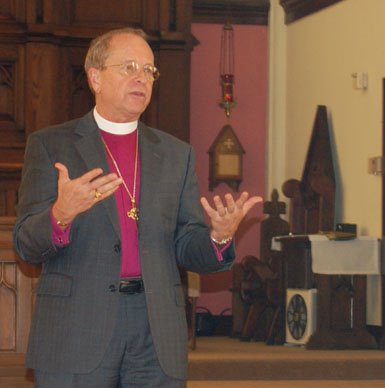
Bishop Gene Robinson speaks at St. John the Evangelist


Yesterday Bishop Eugene V. Robinson of New Hampshire presided over the Eucharist at my little no-count Episcopal parish in San Francisco's Mission District. Bishop Robinson is the "gay bishop," the person whose election and confirmation is the proclaimed casus belli that is exposing strains within the worldwide Anglican Communion. (I think there is a lot more to this conflict; the best primer on the issues I know of appears here.)

After the service, Bishop Robinson talked for nearly an hour with members and friends gathered to meet him. Some points:
  • by supporting gay inclusion, the Episcopal Church is putting its life on the line for the first time since the Civil Rights movement. [Though I know plenty of Black and Brown people who would question whether more than a tiny handful of white religious folks put lives on the line then, I believe Robinson is right that our homophobic conservatives take the decision of the ECUSA to fully include gays as a life and death issue. And what are churches for if not life and death issues?]
  • the intense homophobia of some parts of the Church is a form of misogyny, of a piece with opposition to women's priestly leadership;
  • if Episcopalians really care about being in solidarity with our brothers and sisters in the Global South, we can work to ensure that the ECUSA honors its verbal commitment to the U.N. Millenium Goals by committing at least .07 percent of all budgets to this work;
  • churches ultimately need to get out of the business of marrying people for the state -- they should stick to blessing people's relationships before God. We need new language which separates the form of relationship that legally regulates childcare responsibilities and inheritance ("marriage"?) from a relationship blessed by a religious community ("matrimony"?) The confusion of the two makes the question of "gay marriage" that much more volatile and impedes achievement of full gay civil rights.
Bishop Robinson was warm, wise, sometimes funny, and tough at the same time. If we get a new Bishop here in the Diocese of California (we're in a search and election process now) anywhere near as inspiring, we'll be very fortunate indeed.

Sunday, October 30, 2005

Precinct walk against Gov. Arnold:
a photo essay


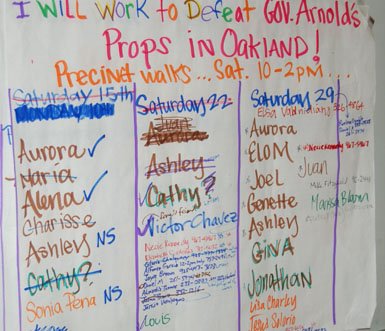
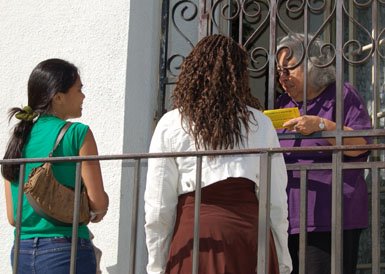
I spent yesterday afternoon going door to door in Oakland with two young women from Californians from Justice (CFJ)* urging infrequent voters to turn down Arnold's initiatives as well as Prop. 73, a measure that requires parental notification before youth exercise their abortion right.

Oakland is friendly territory -- the question here is not whether folks will oppose the Governor's power grab, but whether they will vote at all. Several people said they were not going to vote: "My vote doesn't count; they put Bush back in." My young friend begged these people to go out again: "I'm only 17 and I can't vote. Don't let Arnold take the money for the schools." At least one citizen promised she'd turn out one more time.


Precinct walks happen because people sign up.


Walkers are trained on their goals.


Walkers are trained about the propositions.


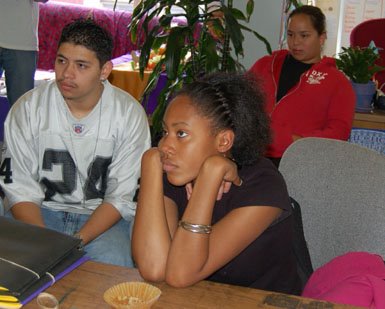
The group listened attentively.


Here's what we handed out.


This woman had an absentee ballot. After talking with the young women for awhile, she said she'd be sure to mail it in.


She voted for Arnold in the recall; but not again: "He's bad for the Mexicans!"


This voter was a teacher who wanted to talk.


When you walk a precinct, you have to keep track of your lists.


And when you bring your lists back, organizers check over the results.


After all that walking around, it is easy to feel at little glazed over.

*Full disclosure: I worked for CFJ in 1995-6 and again in 2003. The group describes itself as "a 10 year old statewide grassroots organization working to empower communities that have been pushed to the margins of the political process. We bring people of color, young people, and poor people together by leading large-scale community education efforts, training a new generation of grassroots civil rights leaders, and mobilizing public support for major public policy change in California."

Friday, October 28, 2005

We can do better: "Quake copters may be grounded"


A father and son wait to board a helicopter to Islamabad. © UNHCR/B.Baloch

As winter closes in, survivors of the October 8 Pakistan earthquake are in danger of freezing to death without help from the world.

Aid workers are scrambling to supply the millions of Pakistanis who have no food, water, shelter or medicine in the freezing temperatures of the Himalayas. Workers have resorted to rafts and pack mules to reach them, but helicopters, though costly, have proven the most useful.

"When the money runs out, the choppers stay on the ground and that's what's going to start happening in the next couple of days," said Robert Smith, financial expert at the United Nations' leading disaster-relief body, the Office for the Coordination of Humanitarian Affairs (OCHA). (Reuters AlertNet)

The earthquake is believed to have killed 55,000 people; among natural disasters in the last hundred years, that makes this event one of worst ten.

And aid is simply not getting through.

Marc Joolen, Medicins Sans Frontieres's Operations Coordinator, flew over … to get some perspective on how much relief work had been done at the southern end of the quake's death zone in Pakistani Kashmir….

"It's crap -- there are hardly any tents distributed so far," he says as the helicopter swoops over ridge after ridge dotted with sloping tin roofs atop the rubble of caved-in walls that used to be houses. "It seems the higher you go the worse it gets…"

In places people run out waving white handkerchiefs, hoping the helicopter will bring salvation. Joolen tells the pilot not to go any closer for fear of blowing away the cotton and plastic sheets the destitute villagers are using for makeshift shelter. (MSF)

And potential donor countries just are not rising to the need. Pledges have been made for long term reconstruction, but people's needs are not getting support. Jo Leadbeater, Oxfam's Head of Advocacy, insists "we needed 30 times more than they pledged."

Not surprisingly some countries are doing more than others. Oxfam has created an interesting chart showing how much governments have pledged, as a percentage what their fair share of the UN's estimate of need suggests, according to each country's wealth. (Available as a pdf here.) Several countries have promised more than their fair share: Sweden (298%); Luxembourg (211%); Netherlands (135%); Denmark (119%). Others are contributing respectably: Canada (90%); Norway (84%); United Kingdom (79%); and Australia (63%). And some very rich countries have responded pitifully: Japan (16%); Germany (14%); the United States (9%); and France (0%).

Individuals who can do their little bit have numerous good agencies to choose from. Some of my favorites: