
Saturday, March 23, 2019
Spotted in a San Francisco garden


Friday, March 22, 2019
5th Year Alex Nieto Angelversary
 | |
| Elvira and Refugio Nieto, parents of Alex Nieto who was murdered by San Francisco police officers on Bernal Heights five years ago, look on as Aztec dancers open the commemorative ceremony. |
Friday cat blogging

Thursday, March 21, 2019
Reading 2020 through a study of 2016
Racism done it; what a shock!
 Political scientists John Sides, Michael Tesler and Lynn Vavreck document overwhelmingly that the overriding factor which enabled Donald Trump's election was racial anxiety, or as I'd put it, white fragility in a society and culture feeling more and more unfamiliar to some white people by the day. They quote Hillary Clinton's summation approvingly:
If for nothing else, I'd urge interested activists (and others) to consider two points that stood out to me in this book.
Many of us had a completely inadequate understanding in 2016 that any Presidential election after an incumbent from either party has been in office for eight years is going to be something close to a toss-up. I know this was not part of my thinking. After even a successful presidency, there will be pent up grievances and pressures and room for demanding some change. These authors conclude that Obama's strong approval ratings and the good economic conditions probably predicted something like "a 72 percent chance of a Democratic [Clinton] victory -- a real, but hardly definitive, advantage." A lot of us leaped from an intuitive sense that this was the case to a misplaced confidence that Clinton would certainly prevail over the manifestly weak Trump candidacy. Pollsters interpreted their own data in the same light; Nate Silver has maintained plausibly that the polls weren't so much wrong as that too many of us failed to look at them realistically.
Sheer volume of media coverage enabled Trump to dominate the Republican primary race; he just crowded out the rest of them. Trump was such a ratings draw that the TV networks sometimes covered his rallies (circuses of hate, I'd call them) even when nothing was happening. The authors describe the general principles:...
Does that description of a primary seem familiar? It should. We're in precisely that phase with the Democratic hopefuls these days. I am reading current 2020 coverage through a lens very much informed by this insight about media influence from Identity Crisis.
For example, here's a snippet this week from Thomas Edsall:
Or this from political scientist Brendan Nyhan:
A reporter new to covering politics offers some revealing reflections from Iowa on the experience of following candidates in the early stages:

This is their major, well-documented, take away, but the conclusion was not what has made Identity Crisis The 2016 Presidential Campaign and the Battle for the Meaning of America valuable to me.... her campaign 'likely contributed to [2016's] heightened racial consciousness.' 'As a result,' she wrote, 'some white voters may have decided I wasn't on their side.'
If for nothing else, I'd urge interested activists (and others) to consider two points that stood out to me in this book.
Many of us had a completely inadequate understanding in 2016 that any Presidential election after an incumbent from either party has been in office for eight years is going to be something close to a toss-up. I know this was not part of my thinking. After even a successful presidency, there will be pent up grievances and pressures and room for demanding some change. These authors conclude that Obama's strong approval ratings and the good economic conditions probably predicted something like "a 72 percent chance of a Democratic [Clinton] victory -- a real, but hardly definitive, advantage." A lot of us leaped from an intuitive sense that this was the case to a misplaced confidence that Clinton would certainly prevail over the manifestly weak Trump candidacy. Pollsters interpreted their own data in the same light; Nate Silver has maintained plausibly that the polls weren't so much wrong as that too many of us failed to look at them realistically.
Sheer volume of media coverage enabled Trump to dominate the Republican primary race; he just crowded out the rest of them. Trump was such a ratings draw that the TV networks sometimes covered his rallies (circuses of hate, I'd call them) even when nothing was happening. The authors describe the general principles:
... nominations often present a challenging task for voters. There can be lots of candidates, some of whom are familiar only to political cognoscenti. How then is a voter to know which candidates are "good"? Which candidates have adequate experience? Which candidates have beliefs that a voter shares? Which candidates can win the general election? Voters need information to answer these questions, and the news coverage helps to supply it.
... Candidates who meet standards of "newsworthiness" garner coverage. Because news coverage of campaigns typically focuses on the horse race -- which candidates are winning and losing, their campaign strategies, and the like -- candidates will earn more coverage when they raise large sums of money or do unexpectedly well in prediction polls or early primaries and caucuses. News coverage also features events that are novel -- such as when a candidate first announces his or her candidacy -- and episodes that make for good stories, with compelling characters and conflicts. When candidates succeed by any of these metrics, even if they have been largely ignored to that point, they will be suddenly "discovered" by media outlets and, therefore, by the public. Their poll numbers will increase ...
Does that description of a primary seem familiar? It should. We're in precisely that phase with the Democratic hopefuls these days. I am reading current 2020 coverage through a lens very much informed by this insight about media influence from Identity Crisis.
For example, here's a snippet this week from Thomas Edsall:
Will this move the polls? Will a lot of media attention bring more? We'll see. FiveThirtyEight has published an informative graphic showing how much coverage each current Dem aspirant received from their kick-off.G. Elliott Morris, a political data reporter for the Economist, noted on Twitter that O’Rourke has received more cable news coverage in the five days since his announcement than any other candidate during the full post-announcement week. O’Rourke is on a path to get 180 percent of the coverage received by Bernie Sanders, the previous leader on this measure.
Or this from political scientist Brendan Nyhan:
He's on to something there. The journalists need to shape an attention-grabbing story out of whatever politicians offer; they will flock to the off-beat and the bizarre. Then more coverage leads to more coverage ...With most candidates’ speeches and rallies generating relatively few headline-worthy sound bites, reporters and commentators often instead turn their focus to theater critic–style assessments of a candidate’s strategy and campaign skills. In its most dangerous form, this form of coverage centers on manufactured narratives about a candidate’s personality. These narratives often center on whether the candidate is “authentic” — a media construction that ignores the reality that all candidate behavior is strategic.
A reporter new to covering politics offers some revealing reflections from Iowa on the experience of following candidates in the early stages:
Out of such as this are winners chosen. Not only this, but very much this. I'm sometimes skeptical of academic political science; is it really science? But I'm finding Identity Crisis very much applicable to our current moment.Voters listen to candidates differently from the way reporters do. I can see why people who cover these events regularly start to get cynical or at least start to tune out the message. After hearing it four times, even I could probably repeat Harris’s stump speech by the end of that day. But what I didn’t realize until I got here — and should have, and hope to remember — is that everyone in the crowd is hearing those speeches (and most importantly, those jokes) for the first time. I’ve probably heard Harris say Americans need to base policy on “science fact, not science fiction” about 15 times. But the elderly man in front of me in Ames still chuckled when he heard it Saturday night and elbowed his wife, who did the same.
Wednesday, March 20, 2019
In honor of the 16th anniversary of George W. Bush's Iraq war ...
EP pointed out today that we weren't even thinking about the anniversary. I pointed out that for those of us in the peace movement who knew better, the U.S. invasion of Iraq in 2003 was a long running catastrophe which we anticipated (and protested), denounced (and protested), and bemoaned (and protested) from a year before "shock and awe" until years later when the people, the media, and the historians pronounced it an immoral clusterfuck.
Our friend Roy Eidelson reminds us that Bush, and Dick Cheney, and authoritarians everywhere understood that fearful people can be made suckers for immoral acts.
Eidelson spells out the story in Stoking Fear.Voice or no voice, the people can always be brought to the bidding of the leaders. That is easy. All you have to do is tell them they are being attacked and denounce the pacifists for lack of patriotism and exposing the country to danger. It works the same way in any country. -- Nazi leader Herman Goerring
Honoring Huli

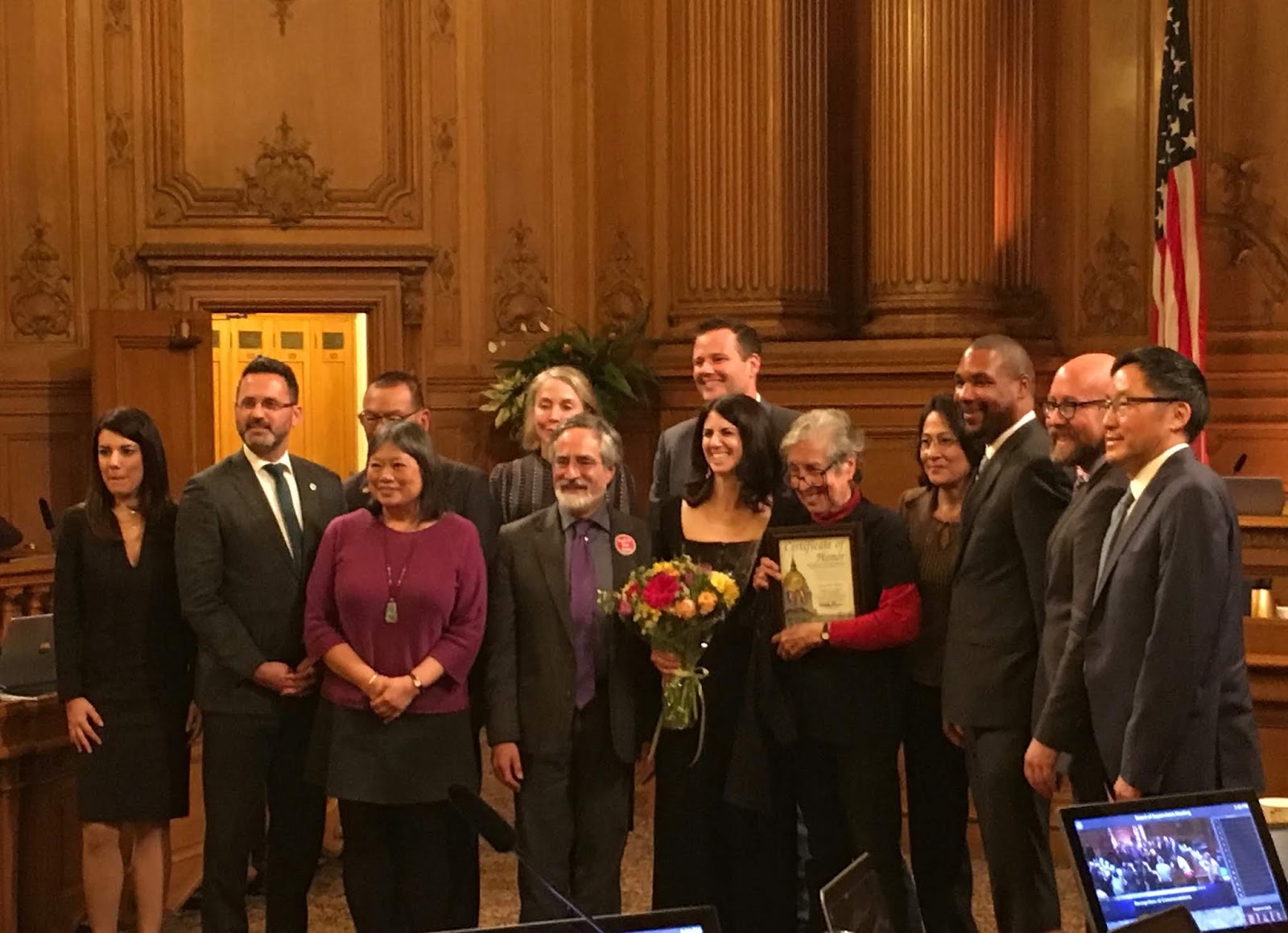
San Francisco District 9 Supervisor Hillary Ronen honored her most cantankerous (and much loved) constituent Giuliana Milanese amidst Women's History Month festivities at City Hall yesterday.
Huli is always there for every working class cause that helps San Francisco remain its unconventional self -- for public education, for affordable housing, for Jobs with Justice. She's worked for every good politician we've had in decades and also for a lot of least-worst ones. Once they are elected, she yells at them.

Tuesday, March 19, 2019
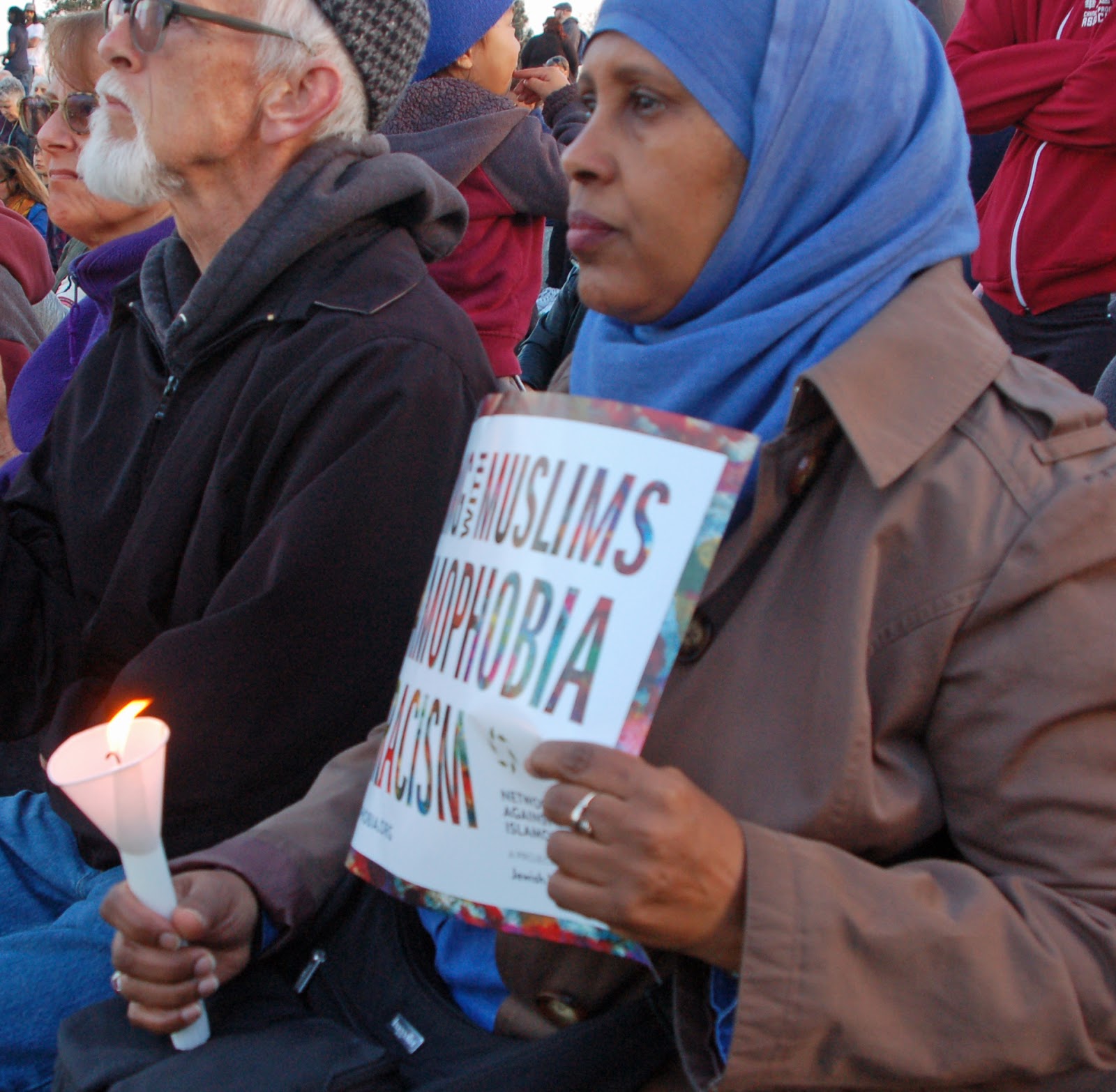
From a vigil for the victims of New Zealand mosque shootings


Monday, March 18, 2019
What is to be done about hate cults?
It was heartening this morning to see that New Zealand's Prime Minister Jacinda Ardern has been both asking her police/counter-intelligence apparatus to investigate whether they ought to have come across clues about the killer in their midst -- and also was pushing to reduce the killing capacity of legal guns. Those are the sort of governmental measures which are appropriate after an atrocity like the Christchurch massacre.
But being human, we also ask, why? What makes a young man from an unremarkable Australian family (which was "shattered" by his crime) into a monster? Why do some individuals take a violent direction?
Deeyah Khan makes films about this question. Raised in Norway, the child of Afghan and Pakistani Muslim parents, and now a Brit, she calls herself "born in the West to parents from the East." In 2015, she used her facility in several worlds to create the documentary Jihad: A Story of the Others. It consists of her revealing interactions with British Muslims who had once been attracted to violent extremism, but who had eventually found other paths through which to express their cultures and serve their communities.
Then Khan jumped off what might look like the deep end into a cesspool of hate, filming US white nationalists in action at Charlottesville, at a rural martial arts training camp, and in their homes. Yes, she reports, there were times when she was plenty scared for herself, a lone, brown, Muslim woman among these posturing men. The product is White Right: Meeting The Enemy.
Both Khan's documentaries are available from Netflix; highly recommended.... Deeyah Khan shared challenging thoughts in a Vox interview about what we can do about these young men who endanger us all and who are suckers for far more evil people.
But being human, we also ask, why? What makes a young man from an unremarkable Australian family (which was "shattered" by his crime) into a monster? Why do some individuals take a violent direction?
Deeyah Khan makes films about this question. Raised in Norway, the child of Afghan and Pakistani Muslim parents, and now a Brit, she calls herself "born in the West to parents from the East." In 2015, she used her facility in several worlds to create the documentary Jihad: A Story of the Others. It consists of her revealing interactions with British Muslims who had once been attracted to violent extremism, but who had eventually found other paths through which to express their cultures and serve their communities.
Then Khan jumped off what might look like the deep end into a cesspool of hate, filming US white nationalists in action at Charlottesville, at a rural martial arts training camp, and in their homes. Yes, she reports, there were times when she was plenty scared for herself, a lone, brown, Muslim woman among these posturing men. The product is White Right: Meeting The Enemy.
Of course, sometimes people who are their targets die -- at Charlottesville, in Charleston, and at Christchurch."I was an egomaniac with no self-esteem."
Both Khan's documentaries are available from Netflix; highly recommended.
They want us to become really afraid; they want us to become divided; they want us to join their “us and them” thing. On a larger scale, I think we have to resist that. It’s an argument for celebrating and nurturing our diversity and nurturing our multicultural society, and our pluralism.
But on a more concrete, practical level, I think we need to support people who want to leave these groups, because we often underestimate how many people, once they’re in it, actually want to leave but find zero support, because everybody is so busy condemning these guys that nobody really wants to extend a hand to them and let them get out. I think that’s really, really important.
... I still feel positive and hopeful, because I do think change is possible, and I think it’s going to require us not giving up. All of these extremists want us to give up, to fear each other and them, to become more divided. And they don’t want us to be kind, or to show empathy, or to organize, or to vote, or to do any of that.
Sunday, March 17, 2019
More in response to the Christchurch massacre

Christopher Dickey, a veteran foreign and war correspondent, is The Daily Beast’s World News Editor. Located in Paris, which has suffered so much terrorism, he brings a clear-eyed perspective to the atrocity in New Zealand.
This is both true and very difficult to take in for people of the liberal left who are accustomed to having to struggle to contain "law enforcement" authorities who too often use their access to force to terrorize and oppress vulnerable communities. Even here in oh-so-progressive San Francisco, vile racist and homophobic texts among police officers have emerged into public view. "Officer Friendly" is hard to imagine. But we need her.At the end of the day, and as difficult as the task may be, the war on white nationalist terrorism must be fought as a war of law enforcement and a war of ideas.
Police and prosecutors loyal to democratic values have to pursue investigations into white nationalist groups with the same zeal that has been applied to radical Muslim terrorist organizations.
Voters in Western nations have to understand that the fellow travelers of white nationalist terrorism are not acceptable participants in modern democracies, and vote them out, or see that they are prosecuted, or both.
To contain the lawlessness of white nationalism, we need active counter-intelligence, cops, and courts. That means demanding that law enforcement come through for democracy. It means supporting whatever law-respecting professionals exist in that system who understand their job is protect all the people, not just the white ones. There isn't any other way. (And by the way, this is also what some of us said and thought in the awful wake of 9/11. That would have made for a safer world.)
As for the "war of ideas" -- that's harder for me to think through. White nationalism doesn't strike me as having any intellectual content except fear, transparent misinformation, and gooble-de-gook created by bigots to disguise how vacuous are their prejudices. I'm not going to invest brain cells in understanding the fables of some French novelist who is selling "replacement" of the white race by Muslims (presumably African?) or those of flim-flam man Steve Bannon. There's no there there.
All this makes me glad that somebody somewhere, including EP, is teaching students to think critically. Kudos to all teachers who do that vital work day after day.
Saturday, March 16, 2019
Governments: do your damn job!

In 2014, the Islamic State of Iraq and the Levant, usually called ISIS in US media, broke into European and American consciousness with ugly videos of beheading of unfortunate western captives. Then they further intruded on our concern by attempting genocide against the Yazidis and overrunning parts of Iraq and Syria. The nations of the world mustered their superior technology and greater wealth of force and smashed this vicious bunch.
I'm something close to a pacifist. I've spent a life criticizing how the US throws its weight around in other peoples' countries. But I'm not distressed by the suppression of ISIS. If there is any circumstance in which government is justified in using its overwhelming force, it is to protect the vast majority of people from murderous fanatics.
So why can't we expect governments to use the tools they possess against the global networks of white supremacy? There's no physical territory involved so this is not about widespread deployment of bombs and guns. But governments should use every legal tool to stamp out and eradicate the whole online infrastructure of "white replacement" ideology that provides the sea in which terrorists like killers in Charleston, Pittsburgh, Oak Creek, and New Zealand swim. And they should be energetic and ruthless.
Oh I know -- at least in the U.S., people have the right to advocate things which others find offensive. But there are limits. We are accumulating a bloody record that shows rightwing racists have been crying fire in a crowded theater of resentments and fears -- and that's not legal speech.
A responsible government would find a way to close these people down before they kill more. Most of them are not blameless citizens (hardly anyone is when the legal eagles get going.) They can be vulnerable to legal constraint if the rest of us want it. We need action.
As Adam Serwer reports:
Yes, we have our own rightwing troll in White House these days. But he too can be constrained if masses of us want it. It's okay to demand of government that it do its legal job and squash this stuff before it grows further. Back to basics: governments are instituted among humans by the people for the defense of the governed.[in January 2019] the Anti-Defamation League released a report finding that attackers with ties to right-wing extremist movements killed at least 50 people in 2018. That was close to the total number of Americans killed by domestic extremists, meaning that the far right had an almost absolute monopoly on lethal terrorism in the United States last year. That monopoly would be total if, in one case, the perpetrator had not “switched from white supremacist to radical Islamist beliefs prior to committing the murder.”
The number of fatalities is 35 percent higher than the previous year, and it marks the fourth-deadliest year for such attacks since 1970. In fact, according to the ADL, white supremacists are responsible for the majority of such attacks “almost every year.”
Friday, March 15, 2019
A continuing trend ...

Dems also have little to be complacent about; young registrants aren't flocking to the donkey party either.... since 2015, Democrats have added 1 million new voters, while Republicans have dropped 250,000.
“It’s a terrible situation,” said Tony Quinn, a former GOP consultant who is now a senior editor of the nonpartisan California Target Book, which tracks state political races. “They’re not getting new voters, and they’re losing the ones they have.”
One of the party’s biggest obstacles in California is President Trump, who has virtually no strong backing in a deep-blue state that lacks the coal miners, steelworkers and other blue-collar types who form his base in other states, Quinn added.
“There’s nothing in California that works in the Republicans’ favor,” he said. “The demographic growth is in Latinos and Asians, who back Democrats, and the decline is in older white people, who are the Republican constituency.”
Does this trend reflect a feeling that democratic (small "d") politics mean nothing to these new voters? Or does living in a one party state feed a feeling that politics is an irrelevance?Through Feb. 10, 142,717 16- and 17-year-olds pre-registered to vote, Secretary of State Alex Padila reports. Their affiliation:
- No-party preference: 51.5 percent
- Democrats: 31.66 percent
- Republicans: 10.42 percent
I wish I could be confident that this apparent complacency won't be broken by an abrupt discovery that young Californians need government to work, whether because of human or climate disaster.
Friday cat blogging

Or so I assume that looks means. Urban cats are usually cautious and curious. I guess so are most people they share the turf with.
Via Walking San Francisco.
Thursday, March 14, 2019
Newsom's bet for life

Congratulations to all the dedicated advocates who have worked for decades to end the death penalty in California, especially Death Penalty Focus and the ACLU. Gov. Gavin's moratorium certainly isn't the last word; there will be lawsuits trying to ensure the state kills more people. This remains a terrible way to get to this end -- through invocation of unchecked executive authority. We've seen that sort of move often enough and many of us didn't like it.
But for the moment, our 737 death row inmates won't have to face execution; a handful of vengeful county prosecutors can try to add to their number with new death convictions, but they are going to look like the terrible spendthrifts these officials are when they commit tax dollars to winning something unlikely ever to happen.
It's worth reflecting on why it has been so hard to get to this point. I bring to this the experience of working to replace the death penalty with sentences of life without parole by initiative in 2012. We fell two percentages points short; the state's tussle over permitting executions ground on and on.
California's death penalty law was put in place by a voter initiative in 1978; it can only be altered by another statewide popular vote. The legislature can't end death sentences, though it sure seems likely that the current majorities would repeal. (On the other hand, elected officials aren't heroes -- many probably like having this decision out of their hands.) Bob Egelko, who has been covering the issue for decades for the SF Chronicle, has assembled a thorough catalogue and discussion of Newsom's assertions in favor of his moratorium, all available at the link:
- Death penalty applied unfairly based on race;
- It is unfair to those with mental disability;
- Innocent people have been sentenced to death;
- The death penalty is expensive;
- It does not make communities safer;
- Most nations have dropped capital punishment.
There is a smallish fraction of us who are rabidly pro-death penalty -- perhaps 30 percent or less whose horror at vicious crimes seems to them to require social revenge killing. There is a similar size fraction, many religious, who experience the continuation of state-sponsored legal killing as morally barbarous.
But an awful lot of Californians don't think about the death penalty much, except when asked to vote on one of our occasional ballot measures. None of the statewide measures voted on in recent years have been headline initiatives. Vast crowds of other, better funded, even more controversial, subjects have commanded higher profiles. The unconcerned middle hasn't really been forced to grapple with the issue. The California death penalty has been floating along on inertia and status quo bias for a while now.
Gov. Gavin has simply made the bet that the underlying stasis he's made more certain by the moratorium will not harm him instate -- while greatly enhancing his liberal reputation nationally. I suspect this is a winning bet.
Wednesday, March 13, 2019
Listen to the Doctor

The United States also limited food purchases with "coupons" during that war, though more to divert manpower and industry to the fight than because of shortages of imports. That US rationing had an impact on my upbringing even though I was born shortly afterward. Like many comfortable citizens of this rich land, my parents thought the main meal of the day had to include meat. What to do when ration coupons were limited? Their answer was to explore alternative meats that were not rationed. They discovered beef liver and smoked tongue and decided they liked them, so we continued to eat these meats throughout my childhood. I did learn to ask whether we were having either one when I asked a classmate home to dinner in the mid-1950s. Wouldn't want some kid retching at the dinner table.'Waste not, want not' was the ethos of the era. Any scraps of food left over were even collected by local councils in order to feed pigs or chickens.
The US then went on to because a prosperous consumption society in the 1950s. The economy boomed after Depression and devastating war. It was a great time for most white families, the world the MAGAs wax nostalgic for. 'Waste not, want not' became downright unAmerican. Unfettered capitalism thrived on more, more, more.
But no more. We who consumed so happily set in motion climate change and now face consequences we can barely imagine. Meanwhile, let's pull together and eat those carrots!
Erudite Partner suggests Dr. Carrot is nonbinary.
Tuesday, March 12, 2019
It is not just Ilhan Omar and Rashida Tlaib

Even skimming highlights emerging trends. Today I was reminded that Muslim women are making a dent in our small "d" democratic politics at all levels. This morning I ran across this about a local legislative special election in Pennsylvania:
In 2016, only about 12 Muslims, men and women, ran for office. Last year, fifty-five Muslim candidates won at various levels. Many of these were women (I haven't been able to turn up the exact gender breakdown). In the San Francisco Bay area, American Muslim women were elected to five local offices in San Ramon, Hayward, San Jose, West Contra Costa County, and Monte Sereno.... The Democrat is Movita Johnson-Harrell, a former victims' services supervisor at the Philadelphia District Attorney’s office, and the Republican is Navy veteran Michael Harvey. ... If she wins, Johnson-Harrell would become the first Muslim woman elected to the Pennsylvania state House.
I care because breaking into the political process is how newcomer communities establish themselves within our ever-changing democracy. I care because I hope that having such visible leaders is at least a small counterweight to a President and political party that is demonizing a world religion; bullied children need to see other options. I care that these elected officials are women because their presence increases many Muslim women's opportunities to define themselves before often ignorant and suspicious neighbors. These elections are what our democratic process offers when it is working. Sometimes the system can be made to work for healing and justice -- let's keep it up.
Monday, March 11, 2019
CleanPowerSF has arrived

This upgrade is mostly automatic: without doing anything, we'll be signed up for 40% renewable energy through the city; if we want, we can pay a little more for 100%. (We wanted.)
What's really important here is the city is doing the work of getting most of us on sustainable power. They are not asking individual citizens to make personal choices to reduce our carbon footprint. It's affirming when we take individual action; it is even better when we reconfigure our social arrangements so we all make better choices together. (Am I a socialist?)
More on CleanPowerSF; more on how it works here. More on the principle of why collective action is healthier and far more effective than staunching our individual guilt over climate devastation here.
Sunday, March 10, 2019
Can we have healthy Democratic primaries?
Seems like some folks in Iowa have the right idea. According to Sean Bagniewski, the chair of the Polk County Democratic Party:
The wise Martin Longman, (also known as Booman,) reminds us that Russian intervention in 2016 gave any enemy of our democratic process, foreign or domestic, a road map for how to persuade us to screw ourselves: just pick at the scabs we all carry from race, gender, and economic injustice. We're vulnerable because we come to the process injured and pissed off. With a little encouragement, we're all too likely to tear ourselves apart.... Meanwhile the intra-Democratic Party group Indivisible is trying to educate its thousands of newly engaged political participants about what a healthy primary season is for and why it might help the #resistance dispose of Trump and the GOP in 2020. This video is an introduction:
... The sad truth is that I feel pretty sure that I'll want to write some similar post several more times between now and next spring. We've got to work together to keep the 2020 primary season healthy.
That's how it ought to be. And it is not always how it is. I'm already seeing some pretty nasty exchanges on social media between partisans of particular candidates and people carrying grudges from 2016. More on the latter here if you want to delve into it.“All of our Democrats take the prospect of defeating Donald Trump so seriously that it’s almost like everybody is on the same team.”
The wise Martin Longman, (also known as Booman,) reminds us that Russian intervention in 2016 gave any enemy of our democratic process, foreign or domestic, a road map for how to persuade us to screw ourselves: just pick at the scabs we all carry from race, gender, and economic injustice. We're vulnerable because we come to the process injured and pissed off. With a little encouragement, we're all too likely to tear ourselves apart.
Let's not go there! For more on the extremely effective methods of Russian-sponsored trolls (and other hostile actors), see this from the Washington Post.... the effort is underway and it is focused not only on creating hard feelings but on spreading damaging and, in many cases, completely fake information about the candidates. ... So far, the bulk of the disinformation campaign has been targeted at four Democrats: Kamala Harris, Elizabeth Warren, Bernie Sanders, and Beto O’Rourke.
... It’s hard to believe that as many as one in six of the tweets you see about a presidential candidate have been generated by a single troll farm, but it’s actually quite possible. Trying to combat this kind of behavior in real time is impossible, so it becomes a game of Whac-a-Mole.
Democratic voters will not be able to avoid being subjected to these kinds of aggressive influence operations. ... If you want to be a responsible citizen, you should resist this whole process. ... Refusing to personally participate isn’t going to make the problem go away. But you don’t want to be part of the problem. Every person who abstains from participating in these efforts to deceive and divide is lessening the impact these trolls will have on the process.
We need to accept that we are engaged in nothing less than political warfare, and as we approach the 2020 election, we need to be more clever than the trolls.
- Primaries are about issues. What issues are most important to the members of your group? You don’t have to negotiate or argue or get down to just your top 2—just make a list so everyone knows what you’re working towards. ... Spoiler alert: saving our democracy is at the top.
- Make some commitments together. This is really about how your group wants to engage, but we recommend that everyone agree to engage respectfully, without attacking candidates, and particularly without criticizing their supporters. We’re all going to need to work hard to elect the eventual nominee, so it’s best if we don’t make too many enemies in the meantime.
- Speaking of which: please, please, please agree you’ll all support the eventual nominee. We love primaries here at Indivisible, but the stakes are just too high for anyone to sit it out if their favorite candidate doesn’t get through. ...
Saturday, March 09, 2019
San Francisco breaks out in bird houses


Friday, March 08, 2019
We have plenty of candidates ... how should we choose?


When Holder bowed out, he wrote up a list of what he thinks we should asking about potential candidates. It's not a list of policy prescriptions, so it might seem just vague sentiments. But it is still early and Democratic policy prescriptions will come. For now, I think it is fair to ask what underlies candidate policy prescriptions? What intellectual and moral foundation do they emerge from? Here are some of Holder's questions about Dem aspirants.
- Is this a candidate of integrity whose honesty will help rebuild trust in our institutions?
- Does the person have the capacity — both mental and physical — to handle the rigors of the Oval Office?
- Does the candidate have the experience to revitalize a federal government that has been mismanaged at home and diminished abroad?
- Will this person have the ability to inspire the American people and bring us together?
- Can this person situate whatever policy prescriptions they offer in the context of our grotesque and growing economic inequality?
- Does this person suggest a plausible theory of how to make government work within a Constitutional system full of check points that prevent forceful action?
- Can the candidate convincingly envision action to enhance justice for those who know they've never had a fair shake by reason of race, gender, family circumstances, or any of the multiple other imposed statuses which leave so many feeling left out?
- Does the candidate value hard earned information, experience, and expertise?
What do you want of candidates beneath and beyond attractive policies? We all want health care and a $15 minimum wage ... but there is so much more.
Thursday, March 07, 2019
Alert to women young and old

Erudite Partner has a new article out: From Mowing the Grass to Cutting the Flesh -- How Young Women Learn to Hate Their Genitals.
As is so often the case, she explores dire subjects without being a downer. Take a look.
Sidewalk scrawl encountered while Walking San Francisco.
Wednesday, March 06, 2019
The season of Lent begins

In our scientific age when human understanding is inflected toward strictly material explanations for all things, this should not be hard to hear. But of course it most always feels hard.For you were made from dust, and to dust you will return.
I was delighted to read this morning a modern iteration of the thought, from Steve Jobs via Kara Swisher:
I appreciate the 40 days of Lent, a season to reflect on hard realities.Remembering that you are going to die is the best way I know to avoid the trap of thinking you have something to lose. You are already naked. There is no reason not to follow your heart.
Many thanks to Dave Walker for the cartoon.
Tuesday, March 05, 2019
Leadership, gender, and the Democratic presidential primary
Some leaders aren't very nice people. In fact, they may be downright unpleasant, yet in some contexts necessary or even essential to the wellbeing of human societies. At least that's what I take from this discussion from Sebastian Junger's Tribe: On Homecoming and Belonging, an exercise in irritating mansplaining. He's nonetheless making a heartfelt attempt to envision how people (mostly men) broken by our wars might find wholeness on their return home.
Amidst various pseudo-anthropological blustering, he describes what researchers learned about leadership in dire circumstances from survivors of the 1958 Spring Hill mine disaster, a collapse which killed 75 miners and left another 99 trapped 13,000 feet underground awaiting a nearly inconceivable rescue.
Having worked over the years to elect various candidates to office, I have some observations about which ones have what it takes, as well as which ones were losers from the get-go. A successful candidate almost always needs an unwavering, almost obsessive, confidence that she is the person for the job that she seeks. Lacking this, she won't have the drive to put herself on track to win. When I've discussed working for candidates, I've pushed hard on this point; if they don't have that drive, I won't do it. That's much like the personality type of Junger's first sort of leaders, the forceful actors.
And yet, on the other hand, the same candidate has to be able to present herself as there "for the people" -- to engage with the messy mix of anxieties and hopes that people bring to choosing elected leaders. This isn't easy, but politicians who can do it can survive a multitude of failings -- think Bill Clinton for example. That set of traits is more like Junger's second category: the empathetic group caretakers.
And, also obviously (and even Junger knows it), the character traits observed in the Spring Hill story are highly gendered; we expect men to be the first sort and women the second.
But now we come into a Democratic pre-presidential primary period during which a remarkable, talented, diverse field of candidates, both men and women, are presenting themselves as possible leaders of the country. All of them, to be successful, need to have some of the attributes of both kinds of leaders. (We can skip over the fact that the current occupant of the White House has neither.)


On the other end of the gendered leadership spectrum , Senator Corey Booker is presenting himself as the country's chance to recover what he calls "civic grace":
I am leaving aside for the moment how genuine Booker or Klobuchar or any of them are in their public presentations. I assume that all the candidates have carefully crafted public personas which the vicissitudes of the campaign may or may not pierce. I intend to enjoy and observe how this fleet of candidates project leadership over the next 8 months or so.
Of what do they think leadership is made? Of what do we the people think leadership is made? Some fraction of our fellow citizens apparently think leadership is all about noisy posturing -- but most of us don't and we're making choices about what we do want in preferred leadership style just as much as we're making choices about policies and programs.
I am not going to engage in the back and forth over Democratic candidates here. Others can do that; there will be lots of venues for that necessary activity. Eventually I'll vote for one here in California. But what matters is that I expect to find some way to work for the election of whichever Democratic candidate emerges from the process. That's #resistance and #hope in 2020.
Amidst various pseudo-anthropological blustering, he describes what researchers learned about leadership in dire circumstances from survivors of the 1958 Spring Hill mine disaster, a collapse which killed 75 miners and left another 99 trapped 13,000 feet underground awaiting a nearly inconceivable rescue.
Junger concludes the human species needs both kinds of leadership; it would be hard to argue. But how does this perspective on leadership mesh with a diverse, complex democratic (small "d") system?Almost immediately, certain men stepped into leadership roles. While there was still lamplight, these men scouted open passageways to see if they could escape and tried to dig through rockfalls that we're blocking their path. When they ran out of water, one man went in search of more and managed to find a precious gallon which he distributed to the others. ... a Canadian psychologist who interviewed the miners after the rescue determined that the early leaders tended to lack empathy and emotional control, that they were not concerned with the opinions of others, that they associated with only one or two of the other men in the group, and that their physical abilities far exceeded their verbal abilities. But all of these traits allowed them to take forceful, life-saving action where many men might not.
Once the escape attempts failed, different kinds of leaders emerged. In what researchers termed "the survival period," the ability to wait in complete darkness without giving up hope or succumbing to panic became crucial. Researchers determined that the leaders during this period were entirely focused on group morale and used skills that were diametrically opposed to those of the men who had led the escape attempts. They were highly sensitive to people's moods, they intellectualized things in order to meet group needs, they reassured the men who were starting to give up hope, and they worked hard to be accepted by the entire group.
Without exception, men who were leaders during one period were almost completely inactive during the other; no one it seemed was suited to both roles.
Having worked over the years to elect various candidates to office, I have some observations about which ones have what it takes, as well as which ones were losers from the get-go. A successful candidate almost always needs an unwavering, almost obsessive, confidence that she is the person for the job that she seeks. Lacking this, she won't have the drive to put herself on track to win. When I've discussed working for candidates, I've pushed hard on this point; if they don't have that drive, I won't do it. That's much like the personality type of Junger's first sort of leaders, the forceful actors.
And yet, on the other hand, the same candidate has to be able to present herself as there "for the people" -- to engage with the messy mix of anxieties and hopes that people bring to choosing elected leaders. This isn't easy, but politicians who can do it can survive a multitude of failings -- think Bill Clinton for example. That set of traits is more like Junger's second category: the empathetic group caretakers.
And, also obviously (and even Junger knows it), the character traits observed in the Spring Hill story are highly gendered; we expect men to be the first sort and women the second.
But now we come into a Democratic pre-presidential primary period during which a remarkable, talented, diverse field of candidates, both men and women, are presenting themselves as possible leaders of the country. All of them, to be successful, need to have some of the attributes of both kinds of leaders. (We can skip over the fact that the current occupant of the White House has neither.)


On the other end of the gendered leadership spectrum , Senator Corey Booker is presenting himself as the country's chance to recover what he calls "civic grace":
Do we allow a man to characterize leadership in that way?... "We need to reignite a more courageous empathy,” Booker told a recent Democratic gathering at a downtown arcade here, where his presentation was punctuated by eruptions of video games. “We need to understand that old African saying that if you want to go fast, go alone, but if you want to go far, go together.”
I am leaving aside for the moment how genuine Booker or Klobuchar or any of them are in their public presentations. I assume that all the candidates have carefully crafted public personas which the vicissitudes of the campaign may or may not pierce. I intend to enjoy and observe how this fleet of candidates project leadership over the next 8 months or so.
Of what do they think leadership is made? Of what do we the people think leadership is made? Some fraction of our fellow citizens apparently think leadership is all about noisy posturing -- but most of us don't and we're making choices about what we do want in preferred leadership style just as much as we're making choices about policies and programs.
I am not going to engage in the back and forth over Democratic candidates here. Others can do that; there will be lots of venues for that necessary activity. Eventually I'll vote for one here in California. But what matters is that I expect to find some way to work for the election of whichever Democratic candidate emerges from the process. That's #resistance and #hope in 2020.
Monday, March 04, 2019
Lobbying at work

You have to ask? I don't know what "too powerful" is, but it is dead obvious that AIPAC is plenty powerful enough to get a bunch of Congresscritters baying "anti-Semitism" every time anyone makes a modest criticism of Israel.
A new generation of people in the United States aren't going to put up with that. They treat Israel as a normal country, self-interested and too often willing to sacrifice human rights for (probably false) security. (You know, like the USA.) Legitimate friends of Jewish safety lose out -- as Palestinians have been losing for two generations now.
Headline ganked from the NYT. The article is very substantially better -- less biased and more informative -- than the headline.
Sunday, March 03, 2019
Road trip remnant
Perhaps you thought the Interstate Highway System, conceived in the 1950s and now connecting most US cities, was our original cross-country automobile route. Or, if you are a little older, you remember when cars drove the United States Numbered Highways. I remember traveling a still vital Route 66 in the 1960s.
But these roads had a predecessor: the transcontinental Lincoln Highway, dedicated in 1913. This ambitious route began in San Francisco and ended in Times Square at 42nd and Broadway in New York. Apparently there's a sign. I'll have to look for it next time I'm in New York. The road predated the Lincoln Memorial in Washington which wasn't dedicated until 1922.
 If you are wondering, since the Bay Bridge didn't yet exist, motorists needed a ferry between the Hyde Street Pier in the city and Berkeley.
According to a 1916 guidebook: One of the original road markers survives in San Francisco on what is now Park Presidio (and California Highway 1).
All details from Wikipedia. I encountered and was mystified by the marker while Walking San Francisco.
But these roads had a predecessor: the transcontinental Lincoln Highway, dedicated in 1913. This ambitious route began in San Francisco and ended in Times Square at 42nd and Broadway in New York. Apparently there's a sign. I'll have to look for it next time I'm in New York. The road predated the Lincoln Memorial in Washington which wasn't dedicated until 1922.

According to a 1916 guidebook:
... a trip from the Atlantic to the Pacific on the Lincoln Highway was "something of a sporting proposition" and might take 20 to 30 days. To make it in 30 days the motorist would need to average 18 miles (29 km) an hour for 6 hours per day, and driving was only done during daylight hours. The trip was thought to cost no more than $5 a day per person, including food, gas, oil, and even "five or six meals in hotels". Car repairs would, of course, increase the cost.
Since gasoline stations were still rare in many parts of the country, motorists were urged to top off their gasoline at every opportunity, even if they had done so recently. Motorists should wade through water before driving through to verify the depth. The list of recommended equipment included chains, a shovel, axe, jacks, tire casings and inner tubes, tools, and (of course) a pair of Lincoln Highway pennants. And, the guide offered this sage advice: "Don't wear new shoes".
Firearms were not necessary, but west of Omaha full camping equipment was recommended, and the guide warned against drinking alkali water that could cause serious cramps. In certain areas, advice was offered on getting help, for example near Fish Springs, Utah, "If trouble is experienced, build a sagebrush fire. Mr. Thomas will come with a team. He can see you 20 miles off". Later editions omitted Mr. Thomas, but westbound travelers were advised to stop at the Orr's Ranch for advice, and eastbound motorists were to check with Mr. K.C. Davis of Gold Hill, Nevada.

All details from Wikipedia. I encountered and was mystified by the marker while Walking San Francisco.
Saturday, March 02, 2019
Pet peeve post about water
Several of the aggressively hip progressive podcasts I listen to have an irritating new sponsor. You've probably encountered this company -- I won't give them a link, but for as long as I can remember, they've been pitching pitchers to filter your tap water if, for some reason, you think you need to do that.
 But now they've got a new shtick: actually they are earnest environmental warriors seeking to save us all by reducing use of plastic bottles. You are promised a warm glow of social responsible when you buy their gadget.
Bullshit. They are selling a product we can and should be working not to need in the first place.
It's true that climate change threatens global water and that plastic bottles are filling landfills and polluting the oceans.
But what people need is access to healthy, adequate water which usually requires government organization and/or regulation. Way out in the countryside -- whether in the US or in the campo where I support El Porvenir helping local Nicaraguans -- local wells can still matter. But most humans live in developed urban areas and need developed water systems. And developed countries usually have such systems.
US tap water is far from perfect, though most of it is just fine to drink. In 2017 the Natural Resources Defense Council issued a report which found that about of fourth of us live in jurisdictions where water should be safer. But they don't tell us to go buy a filter pitcher. The title of the paper tells what we need to do: Threats on Tap: Widespread Violations Highlight Need for Investment in Water Infrastructure and Protections.
Bottled water may be a temporary last resort solution to bad supply. But if we want better water, we don't need either plastic bottles or fancy filter pitchers. We need collective public action to demand that public authorities do their jobs. At the water system level, city, state, and country governments are failing if the water is contaminated. Sometimes old residential plumbing systems are the source of dangerous pollutants: landlords should be held liable for pipes that contaminate; governments should be forced to assist building owners and householders to clean up their acts.
Individual filters -- however slick and hip -- treat a social problem as a consumer fashion accessory. Want cleaner water and less bottles? Jack up your politicians!

Bullshit. They are selling a product we can and should be working not to need in the first place.
It's true that climate change threatens global water and that plastic bottles are filling landfills and polluting the oceans.
But what people need is access to healthy, adequate water which usually requires government organization and/or regulation. Way out in the countryside -- whether in the US or in the campo where I support El Porvenir helping local Nicaraguans -- local wells can still matter. But most humans live in developed urban areas and need developed water systems. And developed countries usually have such systems.
US tap water is far from perfect, though most of it is just fine to drink. In 2017 the Natural Resources Defense Council issued a report which found that about of fourth of us live in jurisdictions where water should be safer. But they don't tell us to go buy a filter pitcher. The title of the paper tells what we need to do: Threats on Tap: Widespread Violations Highlight Need for Investment in Water Infrastructure and Protections.
Bottled water may be a temporary last resort solution to bad supply. But if we want better water, we don't need either plastic bottles or fancy filter pitchers. We need collective public action to demand that public authorities do their jobs. At the water system level, city, state, and country governments are failing if the water is contaminated. Sometimes old residential plumbing systems are the source of dangerous pollutants: landlords should be held liable for pipes that contaminate; governments should be forced to assist building owners and householders to clean up their acts.
Individual filters -- however slick and hip -- treat a social problem as a consumer fashion accessory. Want cleaner water and less bottles? Jack up your politicians!
Friday, March 01, 2019
United Methodists in the desert; White evangelicals in US politics

There are a lot of good people feeling kicked in the gut. For a sense of the anguish of many ordinary Methodists, I suggest this article from The Tennessean out there in middle American. For a truly dire expression of current pain from a retired straight UM pastor, here's Christy Thomas:
You guys won. And you are indelibly stained by your victory.
For me . . . well, the portions of the US church that has freed itself from that kind of hatred and bigotry will get to reinvent ourselves. ... That will be hard. But I know that I am now, for the very first time, ashamed to be an ordained clergy in The United Methodist Church.
... Time for not just radical hospitality but also radical honesty: the church is not a safe place to be. That doesn’t mean it is not good. It is indeed good. But it is not safe, not if she will follow Jesus.
So, let’s pick up our crosses and do exactly that. Let’s be the church reborn. What we won’t be known as: “The United Methodist Church that hates gays.”
From Morris:
From Pastor Dan:In past decades, (white) Evangelical Christians have embraced the political right, both in& out of church. This has alienated congregants of all stripes, but the problems run deeper than you might think. ...
This "crank theologian" has been around a lot of blocks ...1. Disaffiliation doesn't happen equally across Christianity. Mainline Protestants are shrinking because older members aren't being replaced by their grandchildren. Catholics leave because they're disgusted by clerical abuse.
(Somewhat incredibly, mainline Protestants actually have the *lowest* rate of disaffiliation these days.)
2. Disaffiliation is also uneven because it's largely based around two things: tolerance and respect for science. When young people say "Christianity is too political," what they mean is that it's exclusionary. They're also pretty sick of creationism.
Churches that are tolerant/welcoming/supportive don't provoke the same kind of reaction. Basically, just about all of the people who would leave a too-liberal church have left already.
3. Increasingly, the choice people make when they leave a too-conservative church isn't to find a more liberal home. It's to leave the church altogether.
So part of the reason Christians seem to be getting more conservative as they go along is that they're hemorrhaging more liberal members. If you compare the numbers with the religiously unaffiliated, they're through the roof liberal.
(Standard disclaimers here: "Nones" don't necessarily hate faith - they're just not big fans of *religion.* And none of this means religion/faith is inherently conservative. It's a matter of who's practicing it at any given moment.)
Just a couple more things.
4. Conservatism/intolerance alone doesn't explain [white] evangelical attachment to the GOP. I have long believed it's that they share a high respect for authority. That's not the same as authoritarianism - I don't want to tag anyone as a fascist.
It's more along the lines of what George Lakoff calls "strong father" morality. Whatever the case, I think @robertpjones pointed out that as evangelicals grew as a proportion of the GOP, their concerns grew in importance to the party, as you would expect.
5. Last thing: the sharp growth of the Nones has been one reason I've been dubious of religious left outreach. The real action for liberals isn't in the church these days, it's with the people who've left the church.
As a political observer *and* as a Christian minister, I think it's imperative to recognize that those people can and do have coherent moral perspectives that are worth validating and engaging.
Schemes that imply that liberal religion > secular liberalism > conservative faith are really hot garbage. Nobody's morality is "better." Where that morality leads you is another story.
Friday cat blogging

Encountered while Walking San Francisco.
Subscribe to:
Posts (Atom)