Showing posts with label General Convention. Show all posts

Friday, June 01, 2012

"Dear God, you know I am a girl; make it so!"


This is way longer than the clips I usually post here, but not to be missed. Three years ago I had the privilege of working with these brave folks at the triennial convention of the Episcopal Church. Soon they'll be off to another intense episode of consultation, deliberation, exhaustion and perhaps exhilaration.

"I'd give you forgiveness -- but I don't see the sin …"

"I bring the embodiment of death and resurrection .."

"There was never a question about the love …"

"We will work until there are no strangers left at the gate of this church …"

"This is the Holy Spirit doing exactly what Jesus promised the Holy Spirit would do which is to lead us to all truth …"

Enjoy. Find out more here.

Monday, July 20, 2009

A 'family' welcome

Working for LGBT inclusion at the Episcopal General Convention would have been a lot harder if it hadn't been for the warm welcome offered by the Courtyard Marriott where Integrity had set up its headquarters.

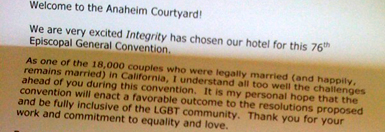
On arrival, each of the 20-or-so of us on the team received a letter with this greeting:
anaheim welcome letter top.jpg

This in a hotel where the rooms feature not only the obligatory Gideon Bible in a bedside drawer, but also The Book of Mormon. The manager had even printed our logo on his stationary for the occasion.
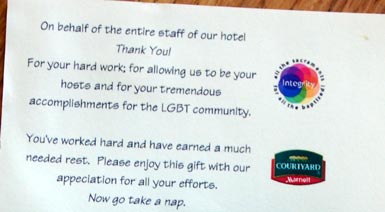
anaheim welcome letter-bottom.jpg

We used Mitch's hotel for a home base and video production studio for nearly two weeks -- without much disturbing the other Disneyland-bound guests, I hope. Sure, we provided some traffic to the bar, but mostly we were too tired even to eat, much less party.

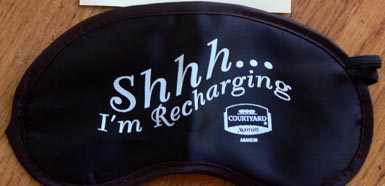
At our farewell dinner, our hosts provided an appropriate gift to the happy crew:
thank-you-card!.jpg

eye-cover.jpg

Thanks to the staff and management of the Anaheim Disneyland Courtyard Marriott.

Blogging will be disjointed for a bit


Forty years ago today, my partner and I watched the moon landing together. (No, we hadn't become a couple yet -- that took another 10 years.) Our reaction: "Oh no, the first thing they do is start littering ..."

Today she defends her doctoral dissertation on the subject of U.S. torture in the post-9/11 context.

And both of us are bone tired, the special tiredness that follows on reaching the climax of a time-limited campaign. Not that all campaigns for justice and peace don't go on forever, but their interim moments do, as an early mentor told me, leave one feeling "flattened as if run over by a truck." The General Convention of the Episcopal Church was a grand experience, one with many lessons for progressives, no matter how little they identify with religious organizations. I intend to write more about it. But probably not today.

Saturday, July 18, 2009

Yes we did -- at General Convention


We're on the road home today, driving the long, hot freeway I-5 between Anaheim and San Francisco. If I do more blogging than this entry, something is wrong.

The General Convention of the Episcopal Church has concluded. This mainstream religious institution has moved into a new place that situates its ponderous body well within the same current of change that swept in a new President last November. And it has done so through its own idiosyncratic, legitimating processes -- this protracted, enormous legislative convening. I'll write more about that in future days.

Today, just some excerpts from various reports. From Integrity, the LGBT advocacy outfit I've been working for:

Thirty three years after promising a "full and equal claim" to the gay and lesbian baptized, the Episcopal Church has affirmed equal access to ordination processes for all orders of ministry for all the baptized, has approved a broad local option for the blessings of our relationships, and has called the church to work together toward common liturgical expressions of those blessings.

Walking with Integrity

Yes, it was a 33 year campaign. That's the kind of disciplined effort and devotion that real change requires of us. Many brave, determined people built the foundation on which this year's achievements stand.

Yet another set of past "outsiders" jumped into the action during this Convention -- and made their presences felt:

"It was a true privilege to participate in the legislative process of this Church, to bear witness to transgender lives and experiences, and to urge the Episcopal Church to fully include and to stand in solidarity with us," commented the Rev. Dr. Cameron Partridge, a member of TransEpiscopal and Integrity USA. "I am thrilled to be able to say that the General Convention voted overwhelmingly to put the Episcopal Church on record in support of such legislation as the Matthew Shepherd Hate Crimes Act and the Employment Nondiscrimination Act, and analogous efforts at municipal and state levels. But I am even more moved to say how many people spontaneously shared with us how their eyes have been opened, their hearts turned, by our presence and stories here. To have someone stop me in a coffee line to say, 'I had never thought about this issue before, and I’m going to take what I have learned here and share it with my little congregation in the Ozarks' means more than I can say."

TransEpiscopal

And this Convention wasn't just about sexual orientation and gender (though that sure covers a lot of ground.) The Episcopal Church put itself solidly in support of such causes as single-payer health care, labor law reform that would make the rules fairer for workers, and even decided it needed to make sure its own lay employees are eligible for pensions! A long time activist with the Episcopal Peace Fellowship told me, "we've never gotten so much support at a Convention."

Sometimes very true observations come from opponents. The Rt. Rev. Martyn Minns, who left the Episcopal Church to become a bishop in a conservative spin-off formation, told the Los Angeles Times:

"Clearly the activists have done a good job promoting their agenda..."

July 15, 2009

Yes we did!

Friday, July 17, 2009

Sartorial silliness

People used to call Episcopalians "the frozen chosen." They had obviously never seen the folks at this 2009 General Convention. I've spent the last few days in the enormous House of Deputies, enjoying the antic outfits that many chose to sport, perhaps in order to temper the seriousness of the deliberations.

First, a note of explanation about these photos. Most are images of big screen projections, 300 feet away from the camera, that showed the people on the podium or at microphones. And many include some portion of this bucking bronco.


Some deputations attach "mascots" to the pillars next to their seating. This animated plastic horse bounced around all day directly between my vantage point and the screens. You've been advised: that shiny brown object in some of these shots is a horse's hindquarters.


The President of the House of Deputies, Dr. Bonnie Anderson, is one of the more subdued figures on the podium, presiding in full (and earned) academicals.


The parliamentarian at her left however, dresses the part, as you'll see in this sequence.


The sartorial tone is ultimately set by the inimitable Gregory Straub, Executive Officer and Secretary of General Convention. This is actually a subdued Straub outfit.


Here's a shot found on the web of Mr. Straub at the 2006 General Convention.


The Rev. Thomas Brown, Integrity's (LGBT advocacy organization) floor manager, fit right in.


And this young deputy also adopted the style (having borrowed the coat).


Lest anyone think the sartorial silliness was a masculine affliction, note that Deputy Mickey Mouse spoke repeatedly (and sensibly) here in Anaheim.


There was also the Hawaiian shirt variant as illustrated by the estimable Deputy the Rev. Canon Michael Barlowe.
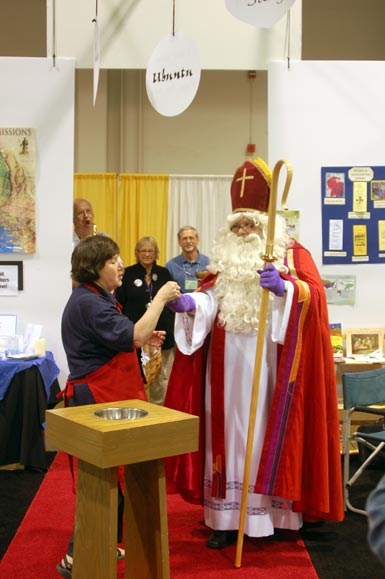
10st.-Nick-in-marketplace.jpg
None of these folks quite equaled the splendor of this gent seen wandering the exhibit hall.

And yes, these folks accomplished many good things, for news of which I'll refer the reader to Integrity's web page.

Thursday, July 16, 2009

More from IntegriTV


If my partner is going to begin a career as a TV anchor, I can hardly be so churlish as not to post the effort. This makes about her 100th arena of demonstrated competence ...

More seriously, in this clip, you are watching a generational transition in a large mainstream institution as it is in process. And that despite the fact that the anchor and many other leaders here belong to an older cohort.

Wednesday, July 15, 2009

Familiar face


Friends and neighbors of janinsanfran will recognize the anchor of this segment of IntegriTV from lovely Anaheim. She's a trooper!

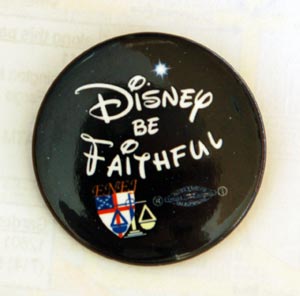
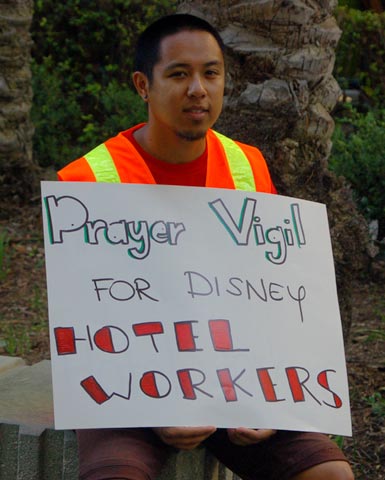
Justice for Disney workers

1button!.jpg
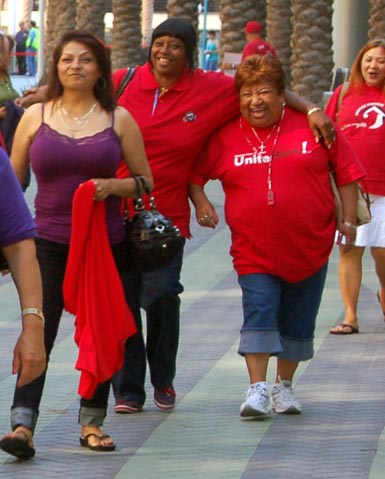
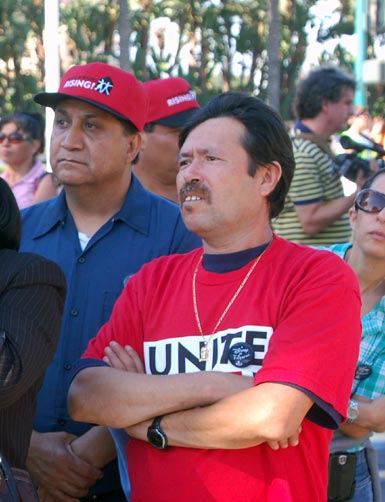
The organizers of UniteHERE Local 11, the hotel workers' union, know a good thing when it comes to town. And if you want religious leaders who'll support low-wage Disney workers, the General Convention of the Episcopal Church is a very good thing.

Ada Briceno, an official from Local 11 of UNITE HERE, a Los Angeles-based union that includes hotel and restaurant workers, said they have been working without a contract since February 2008. Disney wants to replace the union-funded health plan with a corporate plan, she said, which in time, will cost a minimum-wage worker about $500 a month for insurance for a family. "These are low-paid workers, making on average about $11 an hour," she said.

Episcopal Life

Meanwhile, Disney is one of the most profitable corporations around and is hitting up the City of Anaheim to subsidize its expansion plansw.

2prayer-vigil-lovely-boy.jpg
Every morning since we've been here, hotel workers have greeted us with sign up cards for a solidarity vigil and march that finally happened this afternoon.

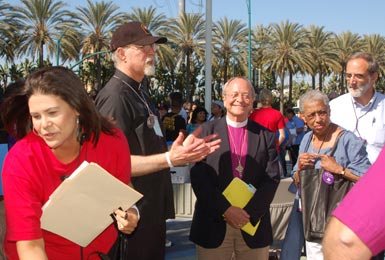
3robinson,-harris,-beckwith.jpg
I escaped briefly from my tasks here to take a look at the demonstration. It sure was nice to find some of my favorite bishops hanging out with the organizers. Left to right, that's Briceno from Local 11, the Rev. Henry Atkins of Los Angeles, Bishop Gene Robinson of New Hampshire, Bishop Barbara Harris, and Bishop Mark Beckwith.

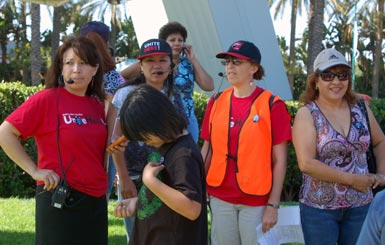
4HERE-monitors.jpg
HERE provided monitors at the ready.

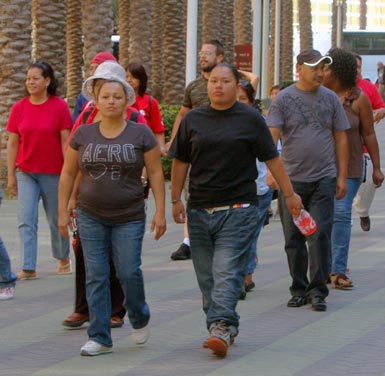
5workers-striding.jpg
And gradually the workers assembled.

6workers-striding!.jpg

7workers3.jpg
The bishop of Los Angeles prayed and encouraged while workers listened intently.

And then, before the march, which was reported by include over 1000 workers, I had to go back to my work. It was a nice solidarity break.

Tuesday, July 14, 2009

Ubuntu revisited

This theme is rich indeed. A couple of days ago, I shared Bishop Desmond Tutu's explication of this African concept as well as some musings of my own. Here at the General Convention of the Episcopal Church, we've heard much more.

Jenny Te Paa, the "ahorangi" or dean of Te Rau Kahikatea (College of St. John the Evangelist) in Auckland, New Zealand, addressed the House of Deputies here on July 11. A portion of her remarks that deals with the inevitable question of cultural appropriation by the rich and strong that arises when one culture enthuses over the core values of another follows.

... one of the markers which we indigenous peoples have found most helpful in these matters is to ask of those seeking to enter more fully into the very different socio, politico, spiritual, cultural worlds of ‘the constructed other’, are you intent on becoming one with or one of ‘the other’?

The most respectful of these options is of course the former. In this way we are each freed to become fully whom God created us to be and to flourish into that God given identity. The actions of one seeking to become ‘one with’ are those of selfless, sacrificial and loving solidarity whereas the actions of one seeking to become ‘one of’, are likely to be characterized by unashamed self-interest! The former option is thus more likely to be true ubuntu, but then I would not be so bold to determine such a thing! I simply raise a respectful cautionary flag.

Episcopal Life Online

[my emphasis]

The Very Reverend Rowan Smith, the Dean the St. George's Anglican Cathedral at
Cape Town, South Africa, shared an additional African perspective in the first few minutes of this video.


If anything is "unAfrican" it is to exclude anybody from community. Ubuntu speaks about our togetherness, about our sharing a common cup ... [F]or the Episcopal Church to take a stand around this [for full inclusion of all] ... is to give hope to particularly Black gays and lesbians in Africa.

If curious about the folks I'm working with, you can watch the rest of the video. The lovely clerical gay man in the piece, Jon Richardson, is my comrade and friend in the legislative monitoring operation. So far so good in this effort -- the Episcopal Church continues to grope toward full inclusion of all, including its gays and even its transpeople. More here.

Saturday, July 11, 2009

What's a circus without a sideshow?


The title was offered by a wise observer of the proceedings.

For more on the General Convention of the Episcopal Church, visit Integrity's GC Portal.

Friday, July 10, 2009

What to wear

This is a postscript to Tidbit of Tutu: the gender of God. One of the very good ways that the Episcopal Church, whose General Convention I'm working at, has confronted this conundrum has been (in very modern times) to admit women into all the roles of sacramental, priestly leadership. Heck, we not only have women priests and bishops, we have a woman as Presiding Bishop -- that's a sort of elected leader of the bishops.

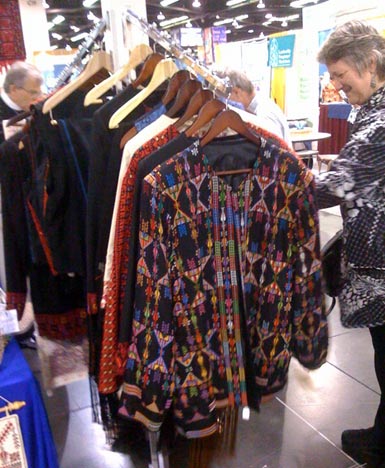
Having all this woman leadership naturally leads to that always challenging question as women break into the professions: what should they wear that conveys the seriousness of their roles and satisfies their desire to be recognized as womanly. I've noticed that many women priests (and academics) solve this problem by wearing colorful "ethnic" jackets over whatever else they wear. Having walked around the marketplace at General Convention, I now know where they get them.

jackets.jpg

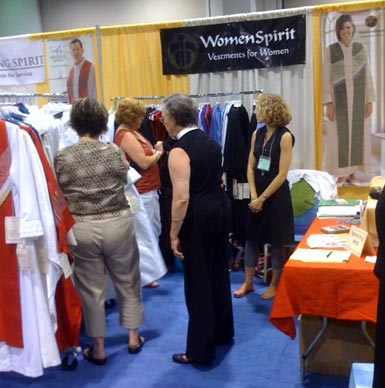
Priests also have issues of fit in their professional garb and there are offerings for them.

womanvest.jpg

One could wish that the issue of what women should wear in order to be both taken seriously and feel attractive might lessen over time, but we aren't there yet.

Wednesday, July 08, 2009

Talking about marriage in the church

We sent this [9:58] to all the people who have votes at the Episcopal Church's General Convention. For more on Ubuntu, see the previous post.


"It's not the gender of the couple, it's the quality of the relationship." Yes.
***

Until July 18, I'll be working my butt off at the General Convention of the Episcopal Church, trying to move us closer to full inclusion of all baptized people, including LGBT people, in all the life of the Church. This time is what we political junkies call "campaign mode" -- the crazy, exhausting 18 hour days of frenetic activity that sometimes win changes we seek and sometimes lead only to deep disappointment. I'm hopeful about how this project will work out. If you are curious about how we're doing, you can follow all the General Convention news at the LGBT advocacy group Integrity's GC portal. I don't expect to blog during this time except perhaps a few photos, but I've got at least a rudimentary post set up for every day, many of them more reflective than the time-sensitive political commentary I often write here. Enjoy.

Tuesday, July 07, 2009

Ubuntu: interdependence and cultural appropriation


The theme of this event I'm attending is Ubuntu. The Episcopal Church website explains:

The Trinitarian design depicts God the Creator in the bright center, God the Son in the cross formed by the longitude and latitude lines and God the Holy Spirit, swirling around the Father and the Son. The swirl is comprised of dancing figures, male and female, with faces of many colors, who symbolize the interconnectedness of humanity.

It's graceful, but I need more explication.

Fortunately, retired Archbishop of Cape Town Desmond Tutu has explained in his wonderful little book God Has a Dream.

The first law of our being is that we are in a delicate network of interdependence with our fellow human beings and with the rest of God's creation. In Africa recognition of our interdependence is called ubuntu in Nguni languages, or botho in Sotho, which is difficult to translate into English. It is the essence of being human. It speaks of the fact that my humanity is caught up and inextricably bound up in yours. I am human because I belong. It speaks about wholeness: it speaks about compassion. A person with ubuntu is welcoming, hospitable, warm and generous, willing to share. Such people are open and available to others, willing to be vulnerable, affirming of others, do not feel threatened that others are able and good, for they have a proper self-assurance that comes from knowing that they belong in a greater whole. They know that they are diminished when others are humiliated, diminished when others are oppressed, diminished when others are treated as if they were less than who they are. The quality of ubuntu gives people resilience, enabling them to survive and emerge still human despite all efforts to dehumanize them.

You know when ubuntu is there, and it is obvious when it is absent. It has to do with what it means to be truly human, to know that you are bound up with others in the bundle of life. And so we must search for this ultimate attribute and reject ethnicity and other such qualities as irrelevancies. When we Africans want to give high praise to someone, we say "Yo u nobuntu"; "Hey, so and so has ubuntu." A person is a person because he recognizes others as persons. ...

The truth is, we need each other. ... In our world we can survive only together. We can be truly free, ultimately, only together. We can be human only together...

According to ubuntu, it is not a great good to be successful through being aggressively competitive and succeeding at the expense of others. In the end, our purpose is social and communal harmony and well-being. Ubuntu does not say, "I think, therefore I am." It says rather: "I am human because I belong. I participate. I share." Harmony, friendliness, community are great goods. Social harmony is for us the summum bonum -- the greatest good. Anything that subverts, that undermines this sought-after good is to be avoided like the plague. Anger, resentment, lust for revenge, even success through aggressive competitiveness, are corrosive of the good.

Africa has a gift to give the world that the world needs desperately, this reminder that we are more than the sum of our parts: the reminder that strict individualism is debilitating. The world is going to have to learn the fundamental lesson that we are made for harmony, for interdependence. If we are ever truly to prosper, it will be together.

That's not an easy teaching for self-regarding, anxious North Americans.

When I heard of the Convention theme, I was reflexively a little anxious about our adoption of it. The Episcopal Church is not an institution which, by and large, understands that mostly white, mostly privileged people ought to consider carefully before they wax enthusiastic about concepts and activities derived from other peoples' cultures.

There's a reason that most of the world thinks Americans are grabby and arrogant. We see something attractive, we think we can have it. Why shouldn't we get a piece, or even take over, what is so obviously a good thing?

Well -- because it is someone else's culture. Theirs not ours. If we blithely assume we can just take up somebody else's concepts, we're not only being happily imperialistic, we're also being shallow and foolish. Cultural mores are the habits of a life time, lived into, not easily put on like a pretty new shirt.

And yet, and yet -- our human species is interdependent. We do live more and more in a global culture. Part of what that gives us is a chance to understand that other people do know things our culture misses. Not all goodness is Made in America. And people like Bishop Tutu do generously (and prudentially) want to share what they know of how people can live in harmony. Learning from each other, with each other, has always been part of how cultures change and grow. So there we are, back to Ubuntu.
***

Until July 18, I'll be working my butt off at the General Convention of the Episcopal Church, trying to move us closer to full inclusion of all baptized people, including LGBT people, in all the life of the Church. This time is what we political junkies call "campaign mode" -- the crazy, exhausting 18 hour days of frenetic activity that sometimes win changes we seek and sometimes lead only to deep disappointment. I'm hopeful about how this project will work out. If you are curious about how we're doing, you can follow all the General Convention news at the LGBT advocacy group Integrity's GC portal. I don't expect to blog during this time except perhaps a few photos, but I've got at least a rudimentary post set up for every day, many of them more reflective than the time-sensitive political commentary I often write here. Enjoy.

Sunday, July 05, 2009

What's this General Convention?

Until July 18, I'll be working my butt off at the General Convention of the Episcopal Church, trying to move us closer to full inclusion of all baptized people, including LGBT people, in all the life of the Church. This time is what we political junkies call "campaign mode" -- the crazy, exhausting 18 hour days of frenetic activity that sometimes win changes we seek and sometimes lead only to deep disappointment.

I'm hopeful about how this project will work out. If you are curious about how we're doing, you can follow all the General Convention news at the LGBT advocacy group Integrity's GC portal.

I don't expect to blog during this time except perhaps a few photos, but I've got at least a rudimentary post set up for everyday, many of them more reflective than the time-sensitive political commentary I often write here. Enjoy.


To get this time started, here's a video [3:11] about the General Convention. H/t to Jim Dela, President of Episcopal Communicators by way of The Lead.


This thing is big -- Episcopal News Service has used this boilerplate to describe it:

The Episcopal Church’s General Convention, held every three years, is the bicameral governing body of the church. General Convention, the second largest legislative body in the world, is comprised of the House of Bishops, with more than 200 members, and the House of Deputies, with clergy and lay representatives from 110 dioceses in 15 nations, at over 700 members.

Wish us luck.