Showing posts with label OFA. Show all posts

Wednesday, August 25, 2010

The 2010 horserace: Dems looking droopy


The conventional wisdom is that Democrats are going to get creamed in the midterm elections in November -- and I think that's probably true. What do I mean by creamed? Roughly speaking, seeing Dems knocked down from holding 58 seats in the Senate to 52 (or even losing enough to lose the majority of 50, though that is unlikely) and losing more than 35 seats in the House of Representatives and so control of the 435 member chamber (all too possible).

Just two years after President Obama won 53 percent of the vote nationwide and carried 28 states, Democrats are in big trouble. Why?
  1. The economy is still rotten; in fact it is probably getting worse. Democrats have been in power; they haven't fixed it. They will be punished.

    No, a lot of voters aren't moved by a health "reform" that will kick in four years from now (many probably don't believe that anything that far away is real and they may be wiser than their rulers). They don't believe that a framework for regulations on financial elites that still has to be written amounts to much either. If folks were back at work and secure in their houses, they might give the Dems a pass, but not when whatever economic security they ever had continues to slip away. Yes, there are nuances, but probably not enough to protect Democrats.

  2. The oh-so-exciting Obama coalition -- the young, the newcomers, the unmarried women, the people of color, organized working people, the religiously unaffiliated, and significant numbers of creative, college educated and more affluent whites -- that won in 2008, simply isn't ripe enough to prevail in these awful circumstances.

    That coalition's time is coming. We've seen it emerging in California since 1995. Democratic demographer Ruy Teixeira has described its outlines yet again as recently as this May. But not yet. The fear, the malaise, created by the Great Recession and Democrats' weak response is enough to stifle enthusiasm in an aggregation not yet sure of itself. The Republican strategy of preventing Obama's administration from doing much of anything is paying off. The Obama coalition is the progressive majority of the future, but its day has not yet arrived.
The behavior of the Obama administration in power looks as if his political team didn't understand why he won. (They weren't alone in this; along with too many others, his victory seemed to me a triumph of deft political footwork.) Actually Obama owed his election to George W -- the nation was ready for a black man with a funny name because it had reached absolute disgust with lying and losing wars, watching disgrace of its best principles, seeing a city drown through incompetence, all abetted by corporate and financial looting by elites.

In June, Organizing for America (OFA -- the Obama email apparatus now under the Democratic National Committee) turned its attention to trying save the Dems by turning out the first time voters from 2008. They are bucking all electoral history with this effort; new voters just don't turn out for midterm elections. But the effort is certainly the right one; the emerging progressive majority is real and its time will come unless the Republicans manage to crack up the country completely first.

Because at root I'm an organizing and campaigns geek, as we head toward the November elections, my interest in the mechanics of politics will overwhelm my attempts to understand and explain issues and policy in our limping democracy. It happens every election season. I've decided to post these thoughts occasionally with the topic "2010 horserace" til I get them out of my system. Expect a lot of these posts over the fall.

Monday, March 22, 2010

Health care reform: I wish I were elated ...

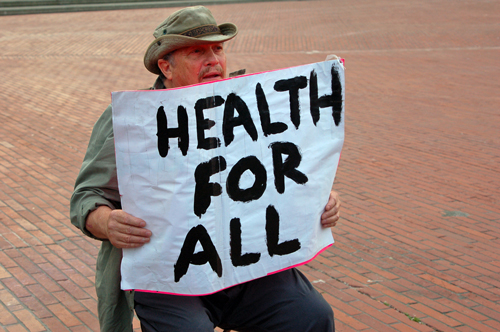
health-for-all.jpg
This fellow pushed at the limits of the possible.

So the House passed the "health care reform". I'd like to be elated; all I can manage is mild relief. As Paul Krugman says:

There is, as always, a tunnel at the end of the tunnel: we’ll spend years if not decades fixing this thing.

Some afterthoughts on both substance and process:

About the law itself:

Will the private insurance products that result be anything that ordinary people can afford to use? Or will they have to buy junk "insurance" so hedged with copays and other costs that they still won't dare go to doctors except in the direst emergencies?
Last week a friend of mine was filling out an application to rent an apartment when one of the stipulations on the form stopped her cold: "Applicants must show that the rental cost will not exceed 25 percent of income." Yeah, and the sky is pink. That statement is one of those economists' maxims about identifying a stable middle class person that may, a long time ago, had some reality in real life. But no one in San Francisco in decades has expected to pay less than one third of their income for housing and often much more. Are the assumptions in this new bill about "affordability" similarly unhinged from reality?

In theory "out-of-pocket expenses will be capped at $11,900 per year per family, or $5,900 per year for individuals." That out of pocket cost for a family is roughly a quarter of the income of the median household in this country. Since 90 percent of that income is almost certainly already committed to housing, food, transportation and health insurance (up to 9 percent of income under the law), where is that supposed to come from?

Oh, there are subsidies -- if you can find out where to apply, if you are not too ashamed to even consider asking for help, if you can understand the forms, if you can hold off the bill collectors while the bureaucracy that might help grinds through its paper work ... All this might "work," but the sunny protestations from policy wonks, economists and Congresscritters that it will be taken care of come from people who never had to work at being marginal or poor.

What we are getting is a punitive, means-tested program. "Fixing the tunnel" will, like fixing the tax code, become an endless struggle to simplify while the cheap and the greedy continue to lobby for ways to game the system.

The new law contains a gaping hole in coverage.
To dodge the political fight, the 12 million or so people in the United States without papers were simply left out. Though these folks are some of the healthiest people in the population (mostly young workers), that's a lot of emergency room visits and a lot of human misery ahead because as a country we are punishing these people rather than adopting reasonable immigration policies.

About the process of passing this bill:

From the point of view of democratic activists (small "d"), health care reform has been a clusterfuck.
The White House decided from the outset that it couldn't pass anything that aroused the whole-hearted opposition of any of the groups that profit from the existing system -- doctors, hospitals, drug companies, medical devices salespeople, or insurers. U.S. health care costs twice what as good or better care costs in other developed countries because all these people make huge profits on the desperation of sick people. But they were too powerful to take on, so the bill does nothing to significantly impede their continued blood-sucking.

This may have been a realistic political calculation. Maybe health profiteers would have sunk a bill that allowed a small public option to compete with insurers or modest drug importation from Canada to put price pressure on drug companies. I don't criticize the White House for weighing the odds of passage and threading the needle the best they could.

But I do criticize them for lying to their constituents. If this was what had to be done, the President needed to level with the people who put him in office -- to tell us the truth that, at this moment in time a slightly slimy accommodation with health profiteers was the best the actually existing, skittish Democratic Party can deliver. Instead, better possibilities like "Medicare for all" or "the public option" were continually dangled out there, then snatched away. This behavior simply pisses of their friends and kills enthusiasm.
  • Coming out of the 2008 campaign, the one thing that seemed certain about an Obama political operation was that it would be smart and subtle. On health care reform, it was ham-handed, tone deaf, and downright incompetent. Item number one: failing to understand until too late that Republican Scott Brown could win a Massachusetts Senate seat running against Washington.
  • Shying away from showing fight for reform in the hope of dragging in a few Republicans for this very conservative bill, the President reinforced the meme that Democrats are wimps. The people who worked their butts off to give the Party its huge majorities felt betrayed. The enthusiasm gap is very real: there are millions who who think something like this: "we elected you -- now fight for us and deliver." Time will tell whether passing the bill brings folks back. More were lost here than were necessary, I think.
  • OFA, the President's vaunted 13 million person email list and campaign apparatus, was neutered by the White House strategy. Making phone calls to thank Congress people who were already reliable votes is a waste of volunteer energy and volunteers aren't dopes. But the White House couldn't/wouldn't target Democrats who were the only votes in play until the very end. So OFA drowned and sank in busy work. It is an open question whether it can be resuscitated for November elections.
In the confused aftermath of the passage of something we won't really be able to evaluate for years, it will be easy to turn on the people who pushed for a better bill. Don't.
Yes, people got angry, shrill and even unreasonable, especially Jane Hamsher at FDL. Well good for them. I don't believe the powers that be would have done anything about this if they hadn't had the specter of furious constituents nipping at their heels. After all, they've got theirs. It takes people with a passion that goes well beyond reason to get anything difficult done, even if their presence complicates the accomplishment. Be grateful for the screamers.

And then get back to work to make this thing better. Not surprisingly, Jon Walker at FDL is out with a quick summary of six improvements it will take to make this "health care reform" more broadly meaningful.

It's never over.

UPDATE: This set of poll results among the very engaged, very informed, mostly progressive community at Daily Kos is interesting. I feel much in the mainstream here: I wanted this bill passed, but both content and process leave me less than joyous.

Friday, February 12, 2010

OFA says "we'll fight"

ofa-hours.jpg
As of this morning, Organizing for America has accumulated activist pledges of 3.3 million hours on behalf of Congresscritters supporting health care reform.

Congressional Dems better pass the thing. It's one matter to disappoint political junkies who have watched every twist and turn of this process and have seen most of its progressive components dropped to win acquiescence from insurers, doctors, hospitals and the pharmaceutical industry. But now the Democratic powers-that-be are trying to call into action people who just know health care reform is the right thing to do. That's a potent force when organized for action as the Obama campaign showed. But should those folks slip into cynicism, the long term harm to hopes for U.S. democracy will be incalculable.

We're very close to slipping off a cliff here. I hear it every day.

Tuesday, February 09, 2010

Health care reform shorts:
Hope for health care reform?

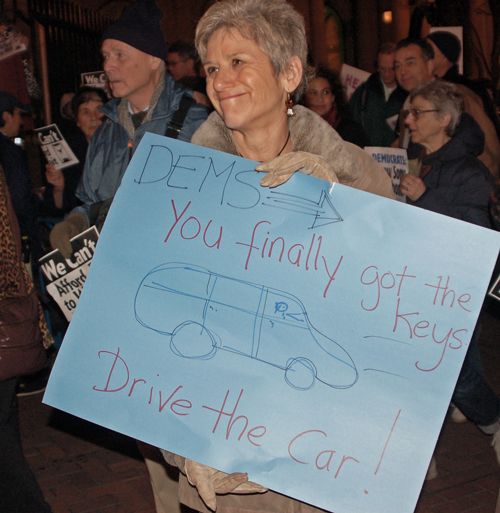
democrats-drive-the-car!.jpg
Well, maybe. If I'm to judge by my email inbox, the Obama administration seems to have noticed that it will be catastrophic among it core supporters to appear to have given in to Republican (and Democratic) obstructionism. The President's proposed talkathon is an element of this, but there is more.

Over the last couple of days I've received four (!) emails from various parts of Organizing for America (OFA) urging me to swing into action. Just this morning from head honcho Mitch Stewart:

A few days ago, President Obama told a story about an OFA supporter in St. Louis who had volunteered during the campaign and organized her community for health reform, but recently succumbed to breast cancer. She didn't have quality insurance, so she put off crucial exams and didn't catch it early enough. And while she fought cancer, she also spent her final months fighting for a chance at health reform so others wouldn't go through the same thing.

The President told this story to remind Congress, the nation, and us: We can't tell her family we're giving up on reform because it's too hard, or too risky.

Okay, so what are we supposed to do? Visit the Action Center where I'm enabled to call my Congresscritters, email them, or write a letter to a dead tree paper. What am I supposed to say in these communications?

Many of our senators and representatives are working overtime to gather support for a final bill and pass reform, and they should know we're standing with them. And the rest need to understand their constituents still demand action.

Vague enough for you? Think that will goose the reluctant?

OFA is marginalized because it has failed to involve and educate its citizen base in both how Congress works and how the health reform might work. Without that kind of background -- background that would enable targeted communication that forced legislators to take notice of the rage in their home towns -- they might as well ask people to wave their hands in the air.

Yes, it would have been hard to do that citizen education work while operating as a subsidiary of the Democratic National Committee -- the DNC protects and acts on behalf of the Democrats we have, rather than the Democrats we need if we are to make progressive change. But to build on the bright promise implicit in the successes of the 2008 campaign, OFA needs the freedom to needle Democrats as much as knuckle-dragging Republicans. And the people it attracted need education in more sophisticated citizen action than simple voter mobilization. Citizen education is an organizing task that OFA should be good at, though it is neither dramatic nor cheap.

Probably can't happen. Too many Democrats in office fear an engaged citizenry. But OFA still deserves watching as desperately tottering politicians, something Obama is soon likely to be, sometimes move in unexpectedly audacious directions.

Thursday, February 04, 2010

President speaks to OFA


It would be greatly exaggerating to call what Obama did in front of some Organizing for America (OFA) folks in Virginia this afternoon a conversation. More like a stump speech from a guy on the verge of exhaustion. The Prez had none of the animation he showed last Friday with the Republicans. Wonder what's going on that left him looking so deflated?

Though he repeated the mantra "I am not going to walk away from these fights," he sure wasn't making any promise that health care reform will get passed. In fact, he defaulted to saying the voters in November will get to express what they think of the "hard" process of Congressional action on reform. Not encouraging.


Watching him online, I kept thinking of John Judis' article He's a Yuppie. Judis gets a lot right -- and something basic wrong. He's a Buppie. Being black, he's got a bit more of an edge than your basic Yuppie; he's had to be a lot smarter and tougher. But he does carry some very Yup mannerisms and expectations -- such as that intellect matters -- that characterize Yuppies. Today he wasn't firing. But he wouldn't be President if there wasn't another more animated way of being the O-man. We'll see.

Friday, January 22, 2010

OFA: left high and dry?

According to Ari Melber's report Year One of Organizing for America: The Permanent Field Campaign in a Digital Age, the preponderance of the work the 13 million folks on Obama's email list have participated in over the past year has been supporting, without legislative specifics or targeting, ill-defined "health care reform." This has been fully 44 percent of all OFA did. (Internal community maintenance came in as the next most frequent ask; I've got a future post on that aspect of OFA.)

The high water mark of citizen-initiated contribution to OFA's healthcare reform work was probably Eric Hurt's video ad that won an OFA contest from among over 1000 entries. Hurt went for the gut. His raw message is just as true today as it was in November when David Plouffe announced its win.


Melber outlines the contradictions the OFA project is trying to surmount. Here's the core:

OFA's legislative posture -- not whether it runs a permanent field campaign, but who the program targets -- cuts across most of the issues facing the organization. The permanent campaign may be less controversial .., if it is primarily waged on behalf of established allies. In turn, however, it becomes less effective when the most pivotal members of Congress receive the least contact and pressure from Obama supporters. And it may be less sustainable, if volunteers conclude that their primary role is to reinforce and thank incumbent allies, rather than actually change the pressure dynamics or voting patterns in Congress.

There was certainly pushback from members who wanted more targeted efforts -- I saw some in meetings I attended. Here's a story from someone writing as "mminka," unusual perhaps in its sophistication, but not unrepresentative what more experienced political activists have felt in OFA.

I worked with OFA on this cause and I liked my group but they were politically soft, and the leadership was also. For example, I suggested we do 'die-ins' where we could all fall down dead in large numbers around the houses or offices of representatives who were opposing reform, to dramatize the stakes in way that anyone, even a reporter, could understand.

They just did not understand what I was talking about. This was too dramatic and extreme for them. They chose to do supportive action, like helping out the Food Bank, to spread vague, generic good will.

And so what happened? The direct and dramatic expression of principal [sic] was ceded to the right - from Obama on down.

Melber, rightly I think, points out that for many (most?) folks who have stuck with OFA,

supporters are interested in the campaign connection to Obama as a person, rather than the agenda-oriented content.

They want to go on feeling that inspiration they reveled in during the competition of the 2008 campaign. And while they may not be very well-informed about policy or governance, they are definitely ready to be "fired up."

I have to wonder what's going to be left of OFA if Democratic politicians, scared chickenshit by losing one Massachusetts election, walk away from health care reform? Not good. And since OFA invested not at all in teaching its troops how the process works, none of Democratic Congresspeople's process excuses are going mean a damn thing to the troops. I imagine they'll feel a bit dumped.

Yet today President Obama, the charismatic figure who pulled them into being, offered nothing more than letting the "dust settle" on the issue he called them to work on. Not very "fired up," that. Yes. activists are likely feeling hung out to dry.

My latest OFA email asked me to organize a State of the Union viewing session for next Wednesday. Can Obama hold these folks? Guess he's going to try.
***

OFA volunteers got to replicate the work that most of them know best last week in the Massachusetts election, trying to drive turnout for Coakley. Despite making some million or more calls, obviously they didn't ride to the rescue -- nor could they have been expected to. Field can amplify an otherwise successful campaign -- maybe picking up a percentage point or so -- but not replace a feeble campaign. I believe the research that finds long distance phone calling as of doubtful utility.

In fact, I more and more suspect that mobilizing a large volunteer base, in itself, is what gives a campaign momentum as much or more than the work volunteers accomplish. The campaign gets the benefit of the ripple effect from all those volunteers' social networks and that is a boost of some importance. If anyone had that in Massachusetts, it was Brown.
***

I've written repeatedly about my experience with OFA on this blog; here's a list of OFA posts:
Obama for America is coming, Day of Service, Collecting support pledges, OFA: listening and learning, Health care and playing defense, Health care reform pressure.

Wednesday, October 21, 2009

Health care reform pressure

ofa-volunteers-at-ucsf.jpg
Organizing for America (Obama 2.0) was at work today, making over 200,000 phone calls from over 1000 sites on behalf of health care reform. These smiling folks were snagging passersby in front of the Millberry Union at UC San Francisco -- that's the Med School campus.

vol-making-calls.jpg
It's hard to know what Congress will make of this show of strength. At this point the question is more what kind of "health care reform" we'll get than whether we'll get something called "health care reform." Judging by the med students I've run into, single payer and the public option are very popular around here.

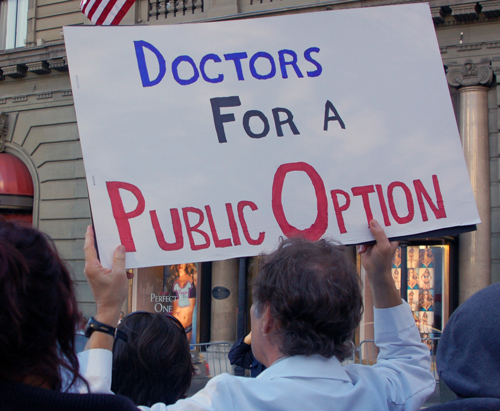
doctors-for-public-option.jpg
This doctor waved his sign outside Obama's Democratic party fundraiser in downtown San Francisco last week.

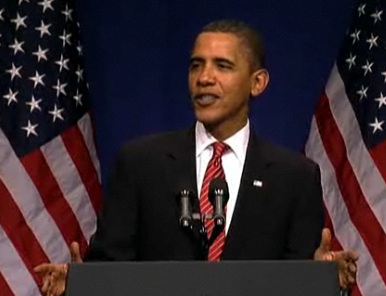
obama in campaign mode-10-20-09.jpg
Late in the day, the President made a campaign-style presentation to his loyal workers via webcast. You can watch it here. He reminded us [my paraphrase]:

...the bill you like least would provide 29 million Americans with health insurance...it will prevent insurers from denying insurance to people because of 'pre-existing conditions' ...it will set up exchanges where people can buy health insurance...

I'm not tired.. I don't know about you, but I'm just getting started, because of you.

His promises were all about improving access for the uninsured and decreasing the society-wide cost of health care; not about changing the underlying health care system. Medicine for profit will thrive in Obama's world. Changing that is not on the President's agenda (nor has he ever said it was).

Democrats better hope this "reform" they are creating works. For a lot of people, "works" means individual (not social) cost containment: they are sick of employment-linked insurance that requires such expensive co-payments that they can't use it. A health care reform that "works" would mean the end of "job lock" -- the inability to change jobs for fear of not being fully covered even if they got a new job with benefits. If most insurance is to be employer-based, the system won't "work" if employers continue to cut back on benefits or stop offering health insurance at all. It won't "work" if insurers can deny insured people medical treatment they believe they need, as managed care plans did in the 1990s.

These are the kind of "details" that the President didn't mention today -- nor did he mention the public option. But this is what people will care about in practice. Do any of these people in Washington understand the feelings of helplessness most of us have in confronting the profit-making behemoths that can decide whether we live or die?

Senator Ron Wyden's office tried to get this across to his Democratic colleagues today. The Congressional leadership was flogging talking points about reform:

"Under our [health-care reform] plan, if you like what you have you can keep it, but if you don’t there will be affordable choices for you that can’t be taken away."

Wyden's aide fired back:

...under the current legislation, seven years after implementation, more than 90 percent of Americans will remain barred from shopping for insurance in the exchange. This means that not only will MOST Americans be stuck with the coverage they have – whether they like it or not – if reform establishes a public option, more than 90 percent of Americans won’t be able to choose it.

via Ezra Klein


I want this President and this plan to succeed as much as anyone, but no amount of rah-rah speeches yet give me confidence that the Dems in Washington are going to get this right. They've made a lot of compromises with the drug pushers, the hospital industry, the medical profiteers. What will be left for the rest of us?

Friday, August 07, 2009

OFA, healthcare, and playing defense


The emails (and fund appeals) are flowing in. Those of us who've kept up a connection with the current iteration of the Obama campaign machine are being called to action in support of our President's healthcare reform. I think it is going to be a tough sell for the organizers. Some of the obstacles:
  • At the meetings I've attended, many folks made it pretty clear that they are fans of single payer, government-run, healthcare reform, of doing away with insurance companies. Our guy took that option off the table before this round started and that remains disappointing.
  • Congress has been muddling with this process for months, but we still don't know quite what is in it. That's a big problem; it's awfully hard to mobilize folks for something that seems nebulous.
  • Moreover, whatever allegiance OFA inspires is in Obama, not in Congress. If anything, activists want their guy to pound some sense into dithering Washington hacks. But they aren't seeing him do that, on health reform, or anything.
  • Because there's been so much process and so little substance, the other side has scored some hits. What will this thing cost? Will it chip away at existing healthcare coverage? This last one is ridiculously easy to sell to the public because gradual erosion is what almost everyone has experienced in dealing with the existing exploitative system.
  • Obama activists don't fully believe this stuff, but nagging questions reduce their energy. After all, the President himself talks all the time about how we have to get health care costs under control. It's not hard to imagine that might mean cutting something we have that we like.
Ultimately, Obama's activists are CHANGE people. The campaign knew that and sold it. Now OFA is trying to mobilize the same group for modest, reasonable, incremental benefits. This is a tough sell; I'm not surprised that the other side is being more visibly successful in turning out anxious, fearful Obama opponents.

And yes -- I'll put in some time agitating for Obama-care, unless I think it has warped into something actively hurtful to access for most people. But this campaign is not a happy one; it is pure defense. If the right kills whatever half-assed healthcare "reform" we end up with, it will cripple many of the possibilities opened up by Obama's election and the hard won Democratic majorities in Congress.

But saying that is a far cry from the joy of last November. The prospect ahead is a long slog up a tough hill toward what may be a false summit, not a glad community dance.

Tuesday, April 28, 2009

OFA: listening and learning


Tonight I attended a listening session for the new Organizing For America (OFA) otherwise known as Obama 2.0. Well over 100 people, most but not all veterans of the Presidential campaign, turned out in San Francisco's Western Addition to see what state field director Mary Jane Stevenson had to say.

Here's the bare poop: OFA's mission is
  • to support President Obama's agenda on education, health care and clean energy;
  • to grow and strengthen our grassroots organization;
  • and to train and empower our volunteers to effect change in our communities.
OFA lives under the umbrella of the Democratic National Committee, but Stevenson assured us, we didn't have to be Democrats to participate. She is the lone employee at present, but there will be regional field staff and offices.


We gathered in circles by neighborhood and talked organizing: what our communities need; what we have; what we'd like to see OFA look like by the end of the year. We brainstormed local projects -- and each neighborhood cluster set a next meeting time back in their area.

I came away with more questions than answers.
  • Some people brought very specific local needs and grievances. For example, there was the woman who finds herself living in a building on top of a toxic dump. Can a national organization supporting the President really do anything for her?
  • For that matter, does such a broad national outfit really want to assume any responsibility for that kind local specific problem?
  • People in my little Mission neighborhood circle kept mentioning that there were lots of groups in the neighborhood working on health and education issues. How does OFA relate to all that existing infrastructure?
  • Elected officials in San Francisco are all "liberals" in national politics. For goodness sakes, the Speaker is our Congresswoman. What does a national pressure group do with activists in such a district?
  • How does OFA relate to existing political formations? In this city we have expensive, highly charged, participatory elections for the county Democratic committee, not to mention a plethora of political clubs. In the Presidential race, the Obama people could ignore these entities. Now OFA is somehow the Democratic Party.
  • Or is OFA a Democratic Party entity? Stevenson did say that you didn't have to be a Democrat, that OFA welcomed everyone; how does that work?
  • What if OFA folks don't agree with the President's policies? In my little group, most were actually in favor of single payer, government-run health care, not Obama's private enterprise solution to universal coverage. Is there any room for them to agitate? Won't they just walk away if there isn't any room?
I could go on and on with the questions.

What was pleasant about this meeting was the sense that everyone brought huge numbers of questions, including our leaders. Presumably answers and structure will emerge -- and if they don't work for this set of activists, people will vote with their feet. Meanwhile, OFA is interesting. I guess I'll go to my neighborhood meeting ...

Sunday, March 22, 2009

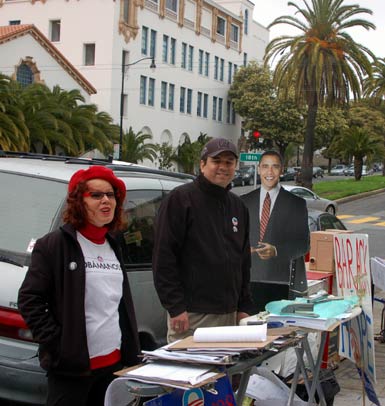
Collecting pledges with OFA

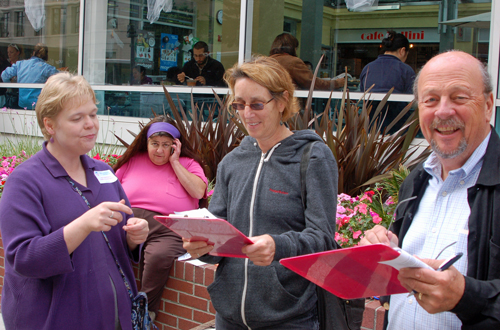
1ready-to-go.jpg
Because I'm a curious codger, I participated in this weekend's Organizing for America (OFA) project and collected signatures on a pledge to support the President's budget. I certainly do support his emphasis on education funding, a more sustainable energy policy and the need for universal health care, though I'd do more, more expensively, than he has proposed. But Obama's what we've got and we need him to be able to forge ahead on these priorities, so I'm happy to help.

2pledge-form.jpg
The pledge form is non-specific. It certainly doesn't overwhelm anyone with policy details. It reads

I support President Obama's bold approach to renewing America's economy.

I will ask friends, family and neighbors to pledge their support for this plan.

My only criticism is that trying to make it easy for the folks doing data entry by putting each pledge on a single page mostly consisting of little boxes cedes the excitement you can get out of having a series of people sign on a list on the same page. That kind of form gives people a sense they are adhering to a movement.

Because I'm hobbled at the moment, I didn't go door to door, but rather collected pledges at our house party for World Water Day and then at church. The folks I signed up could be categorized as pretty politically sophisticated. If an election were a week away, you'd have a chance of getting them to do a little volunteer work. Not one of them suggested that Obama was failing because AIG profiteers got big bonuses or because Secretary of the Treasury Geithner's plan for the financial sector is too management friendly.

Folks seemed to recognize that Obama has inherited a colossal mess -- and are willing to give his efforts the benefit of the doubt. There was no sense whatever that in New York Times columnist Frank Rich's phrase, Obama is facing a "Katrina moment." We may eventually sour on the guy, but for now, the small sample I talked with aren't there or even very worried.

Maybe David Axelrod was right in his somewhat infamous pronouncement:

"People are not sitting around their kitchen tables thinking about [bonuses paid to insiders at bankrupt] AIG..."

***
Bonus: this O.F.A. pledge collection training video [7:36] is as good an example of volunteer training for a mass mobilization as I've ever seen.

Monday, January 19, 2009

Day of service

Celebrating the Martin Luther King holiday with service projects is not really new. But President Obama's call for mass participation this year led to doubling of the number of projects known to the MLK Day.gov site, where the slogan is "Make it a day on, not a day off."

Obama's fans came out in force.

1prepping--miss.jpg
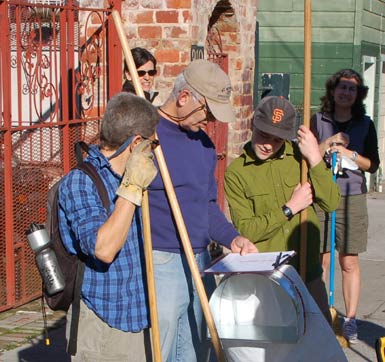
In the Mission district, a group assembled to pick up street litter. We always have ample supplies of that.

2mapreading-miss.jpg
Each little crew was sent off with maps of their turf -- just as many probably had been when canvassing during the campaign. They were told not to pick up needles -- just mark the location for the Department of Public Works to follow up. I usually step on and crush stray needles myself. It seems like a public spirited thing to do.

3underpass-bernal.jpg
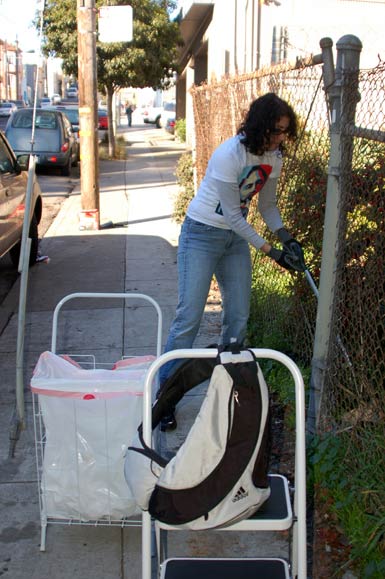
Over by Bernal Heights, just off Bayshore, a group came together to clean out below an underpass.

4pullingout-trash-bernal.jpg
There was plenty of trash just behind CalTrans' fences.

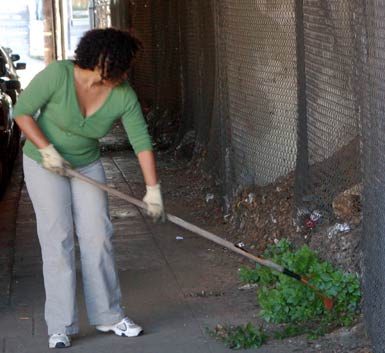
5hoeing-bernal.jpg
And lots up against the fences too.

6where-the-trash-is-bernal.jpg
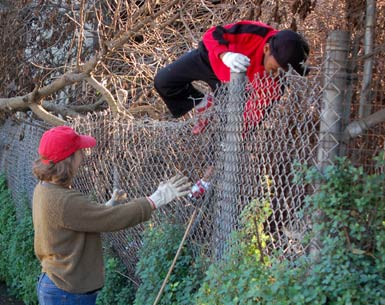
Adventurous cleaners went over the fence.

7small-cleaner-bernal.jpg
And found a lot of stinky stuff.
***
I admit to some ambivalence about these projects. President Obama clearly wants to remind us that sometimes individual satisfaction has to be put aside for the sake of the community. (The guy is beginning to act like the national kindergarten teacher ... that's okay I suppose. We need one.)

His lesson seems good and necessary. But it also seems a little hokie. Can't we form communities that are a little more organic, that seem less contrived? Don't we know we survive by caring for each other? Maybe we only remember the obvious if we occasionally repeat the lesson.

8waiting-laborers.jpg
On the way home, I drove down Cesar Chavez Street.

9waiting-laborers-2.jpg
The usual clusters of unemployed day laborers stood along the sidewalks, occasionally waving at a passing truck, hoping for some pick up work.

10waiting-laborers-3.jpg
These folks work, if lucky, for a pittance everyday, doing the sorts of stuff the volunteer crews were dabbling at. Many of them are supporting families south of the border. I imagine they have some community among themselves -- they certainly have a common interest in avoiding the immigration police.

Their community, whatever shape it takes and I don't claim to know, seems an almost infinite distance from the good people sweeping and bagging trash in today's King day projects.

Sunday, December 14, 2008

Obama for America 2.0: Change is coming

Or is it? Yesterday I attended one of the 4200 or so post-election meetings pulled together by the Obama campaign. I came away thrilled with the enthusiasm so many folks share about staying active in some way -- and with many questions. I'm sure I'm not alone in the latter; very likely the hard working organizers who put the event together are mulling their own questions.


Called by San Francisco Volunteers for Obama, this was no cozy little house meeting. Something like 100 people crowded a large hall loaned by SEIU Local 1021. Like others among the inevitably small sample of Obama events I saw in San Francisco, Reno and Denver, this one was well more than half female, predominantly white, with a small and visible minority of people of color, notably African Americans.


Organizer Tara Schubert called us to order. Happily, like the campaign as a whole, this was an efficient meeting with a clear agenda. The plan was share what San Francisco and California volunteers accomplished, break into small groups in which we talked about what we hoped to see from the Obama administration, bring together and rank (as much as possible) what the small groups thought were priorities, and then plan an activity in service to our communities to take place before the inauguration. All this was to be done in two hours -- and we stuck to the time! Gotta love it.

San Francisco leaders shared some numbers -- 10 million calls from California between August and Election Day; 300000 calls from San Francisco during the GOTV period; 110,000 new registrations in Nevada with help from California; and all with only 12 paid staff in the Golden State.


London Breed reported what it had been like for a Californian to go work in Ohio. She was stunned by what she saw:

"They allow people to live in places that look like they should be condemned. We're sure lucky to live in California.

"We met people who just didn't believe their vote matter. But we visited them so many times, they just gave up and invited us in; they finally wanted to vote."

I did have to wonder whether she has ever canvassed in parts of Oakland.


Then we broke into small groups to talk about what issues we cared about.


Everyone got a chance to be heard.


Scribes recorded what people cared about.

A few comments on this process: at least in my group, people found describing what they might want challenging. Hardly anyone offered any specifics that had policy meanings. Instead they named buzzwords like "global warming" or "healthcare" rather than "reducing CO2 emissions" or perhaps "universal health insurance" or "a single payer health system." In this, volunteers are probably just like the electorate at large: they want the government to fix what they perceive as problems -- they count on leaders to know how. This is fine, if people accurately perceive what are the nation's most important problems and if leaders are choosing good solutions. It is a big problem with democratic governance if those two qualifications are not met, as I would argue they have not been in recent memory.

In my group, I suggested that the Obama administration should work to reinforce the structural props of a progressive democracy -- and that one of those would be enacting the Employee Free Choice Act (EFCA) that would make it easier for workers to organize unions without being bullied by employers. This was received in a friendly manner -- but it was clear that it had no resonance with the people in my group. The idea that workers might need unions and that unions made for progressive voting just wasn't present for these Obama volunteers. A friend in a different group had the same experience when offering the same suggestion.


I found the absence of consciousness around this issue the more strange because we had been welcomed to the hall by SEIU organizer Margot Reed who had made an explicit pitch for support for EFCA.

Folks' indifference to unions confirmed what I also observed on the Colorado campaign: an extraordinary percentage of Obama volunteers were/are middle class people, politically active for the first time, with the kind of skills that make them successes in their jobs and which, given free reign to achieve campaign goals, make for astonishing creativity. What they don't have is very developed political ideas. Will they learn more about the hard policy choices facing their country under an Obama administration? Time will tell. One of the best things about Obama is that, because his is a master of verbal communication, he tries to explain issues to people. That's fine as long as the issues and frames he chooses don't exclude important choices people might prefer. We'll see.


After the small groups, the whole returned to see where our priorities had fallen. The photo above is the resulting visual representation of the result. A quick look points up what for me and several others I spoke with was the great fault of the meeting: organizers had people express their concerns within the messaging categories of the campaign. But this emphatically did not catch some of the energy in the room.

Perhaps most importantly, if you wanted to end the Iraq war, your concern was categorized as "National Security." Now that form of flipping the argument is (marginally) okay as a tactic in a campaign in which a Democrat has to reassure sporadic voters that he is tough enough to protect the country. But the kind of people who work for Obama deserve more plain speaking: we want out of Iraq. In San Francisco, many of us want a lot more than that -- slashing the military budget and turning the cash to domestic needs, for example.

Likewise many of us don't want "energy independence" (a myth) so much as "to stick it to the oil polluters." But the way the discussion was structured precluded bringing those opinions out.


Perhaps most telling was this result (pictured) of the discussions: the meeting simply blanked on the concerns of the low wage working class with poverty and immigration. Now we do know that even in this very special year these folks don't vote much. So U.S. politicians have usually been able to take them for granted. But I am very concerned by a movement in which they are pushed to the edge of awareness, barely represented at all. That won't work.
***
At the end of our meeting, we were given a hand out which listed the goals reached by a meeting of Obama organizers from around the country that had been held in Chicago. Here's the list, apparently what is expected to come out of all this.

1. Organize support for legislation at all levels of government. This includes pushing President Obama's agenda and it also includes organizing around state and local laws/initiatives.

2. Build grassroots electoral strength at all levels, and train and develop grassroots leaders to organize and serve in their communities.

3. Be an organ of two-way communication between the White House and the grassroots, so that each knows and repons to the priorities of the other.

4. Launch a national, grassroots-driven renewal of civic engagement, again at both the local and national levels.

Fine with me -- but the question remains open, for what ends? I intend to stay involved in this process, and to stay hopeful. But I also intend to keep asking questions.
***

To find out for yourself what's going on, visit My Barack Obama.