Showing posts with label israel/palestine. Show all posts

Monday, June 01, 2026

Bibi boasts over Beaufort

Mainstream media have been sharing the news that Israeli forces have seized Beaufort Castle, a Crusader-era high point and fortification on the southern border of Lebanon in a region which is home turf to Israel's foe, Hezbollah. 

The Israelis seem very proud of this conquest, though in modern terms, the ancient "castle" is just some rock piles. Here's the story from Le Monde

Israeli Prime Minister Benjamin Netanyahu vowed to push deeper into Lebanon after his military took over the medieval castle of Beaufort on Sunday, May 31, calling it a "dramatic shift" in Israel's campaign against Hezbollah in Lebanon.

The Iran-backed militant group, meanwhile, said it targeted Israeli forces near the fortress as well as army positions and infrastructure in Shlomi and Nahariya in northern Israel, while air raid sirens blared in the Acre area. Israeli forces used the Beaufort castle, also known as Qalaat al-Chakif, as a base during their previous two-decade occupation of southern Lebanon that ended in 2000.

"We have returned united, determined and stronger than ever," Netanyahu said in a video statement released after the military took Beaufort. "Now my directive is to deepen and expand our hold in places that were under Hezbollah's control. The capture of Beaufort is a dramatic stage and a dramatic shift in the policy we are leading."

Erudite Partner and I had the chance, thanks to a Lebanese friend, to walk about this eerie spot in 2006, just weeks before that year's Israeli assault on the proud and battered country.

The yellow banner of Hezbollah flew defiantly from the castle's pinnacle then. We didn't see any fighters, though there were rumors that they had tunneled somewhere underneath.

Looking south, across the deep ravine cut by the Litani River, we were looking into Israel where a neat modern settlement had been built.

 
Looking the other way, we could see the Lebanese village of Arnoun. It appeared prosperous in its own way that spring, but very much an organic growth on the hillside, not any kind of planned community.
The contrast between the two towns seemed to exemplify two civilizations. Meanwhile the Crusader castle endured, in between. 
 
I wonder if Beaufort will survive its latest occupants. 
 
I am quite certain that the adjoining Lebanese village is by now destroyed and depopulated. Poor Lebanon, fated to try to survive next to its belligerent neighbor.

Thursday, April 09, 2026

"The strikes were everywhere, all at once."

The Guardian's soft spoken reporter Will Christou spells out the shock in the Lebanese capital when Israel bombed central Beirut, killing at least 250 yesterday. This ten minute clip is much longer than what I usually post here, but I would urge readers to take the time to watch. It's not gory; instead, it is morally devastating.

The leaders of Israel are ethical monsters, as are our own US rulers. As, of course also, are the Iranian rulers and the princelings of the Gulf States. 

Saturday, March 21, 2026

Israel is pulverizing Lebanon again -- and plans to stick around

Of course the US/Israeli war on Iran is getting most of our focus in this country. Thanks to the Orange Toddler's folly, we'll all be paying higher gas and more widely inflated prices on everything -- and if that's the worst blowback, we'll be lucky. Nothing about Trump's war gives me any confidence.

Meanwhile, Israel is taking the opportunity to try to kill off its Hezbollah enemies and a lot of other people in Lebanon. Over 1,000 have died in Lebanon since beginning of March, with more than 2,700 injured, according to Lebanese health officials. Over one million Lebanese have been driven from their homes -- that's in a country of slightly less than six million, 16 percent of the population.
 
As the reporter in the news clip explains, Israel plans for its invading troops to occupy much of southern Lebanon.
 
Lebanon's national government, of which Hezbollah represents a faction within a divided civil society, is seeking a ceasefire with Israel. Lebanese government authorities want negotiations if possible.
[The prime minister of Lebanon] Nawaf Salam told CNN World in an exclusive interview [published March 19] that he sought a ceasefire “yesterday, not tomorrow,” as the death toll from Israel’s onslaught against the Lebanese militant group Hezbollah reached 1,000. More than 100 of the dead are children, according to Lebanese officials.
 
... The prospect of a negotiated end to the conflict in Lebanon, which began 17 days ago when Hezbollah fired projectiles into Israel to avenge the death of Iranian Supreme Leader Ali Khamenei, has dissipated over the past 48 hours as Israel’s military campaign has focused on a wider ground invasion. France has suggested some ideas for a settlement, Salam said, and there are contacts with US officials. Yet he shied away from suggesting actual talks have begun. ...
 
... One of the likely sticking points will be that Lebanon does not recognize the state of Israel. ... 
 
...  [Salam] rejected any involvement by foreign troops and insisted that Lebanese territorial integrity was central to a peace deal.

Israel has pushed farther into Lebanon in the past week, and concerns are mounting it seeks to create a deeper “buffer zone” along the border. Israeli forces are occupying the land south of the Litani River, an area it has called on Lebanese to evacuate.

“We cannot accept any buffer zone, security zone, any infringement on our sovereignty,” Salam said. “We cannot negotiate any form of treaty, deal or arrangement with Israel (before our) sovereignty is fully restored.”

To repurpose a dictum attributed to the Mexican dictator Porfirio Diaz: "“Poor Mexico, so far from God, so close to the US.” Poor Lebanon: so close to God, so close to the state of Israel.

Saturday, March 14, 2026

A psychotic war made by two psychopaths

Uri Misgav is an Israeli journalist, publicist, lecturer, teacher and director, formerly with Haaretz, the closest thing Israel has to a mainstream opposition newspaper. 

Haaretz gave him oped ed space to denounce Prime Minister Netanyahu's current war. 

I wish to write my opinion about the war. No filters. It's important to do this because, heaven forbid, a missile will hit our rented apartment in Jaffa or the shelter in the assisted living facility next door where we run to during the incessant sirens. I'm using the free platform provided me by Haaretz, which has been under frontal assault by the government in recent years. It is also my right to make my civic voice heard in a democratic country (still, ostensibly).

I think that this is a psychotic war. One that Israel and the United States entered led by two psychopaths. Vainglorious, narcissistic, disconnected. They're up to their necks in political and legal trouble. They head the two most fundamentalist and anti-democratic governments in the history of their countries. And they have the chutzpah to preach democracy elsewhere.

It gets worse.

At the moment, it's a deluxe war, based on bombing from an open air corridor high above, with almost no enemy antiaircraft or jets. Or bombing by American cruise missiles, which sometimes hit desalination plants or a girls school. The cannon fodder are Israelis and people in the Gulf states. 

Also the Iranian people, whom U.S. President Donald Trump and Prime Minister Benjamin Netanyahu are encouraging to replace the ayatollahs' regime even as they are being savagely bombed and hit by black rain after oil depots were attacked. 

And one million Lebanese who were again ordered to evacuate their homes, or were simply unfortunate enough to live in Beirut. Everything is supposed to give rise to "changing the face of the Middle East for generations."

... I have a name for this war: the roaring psychos.


Mishav, for all his desperation at finding himself huddling in shelters as a consequence of the vicious stupidity of a government he despises, writes obliviously, ignoring the two million Israeli Arab citizens and the additional two and a half million residents of the occupied Palestinian West Bank. These people largely do not enjoy the same high class bomb shelters.

In the Israeli/Palestinian +972 Magazine the journalist Meron Rappaport puts the psychopaths' war in a  perspective that is both closer to home and wider at the same moment. 

Questioner... Where do you see the Palestinians in Israel, in the West Bank, in Gaza, and the Palestinian refugees fitting in Israel’s or Netanyahu’s plan for the region and for Iran? 

RappaportIn two words: not here. I think the genocide and the partial ethnic cleansing in Gaza set a model that this is possible. Or at least I think Netanyahu and his allies think it’s possible, even if we, Israel, failed to do the total ethnic cleansing. 

There are still two million Palestinians in Gaza. Yes, they live in tents and in broken houses, but they are there. But I think it opened up the appetite to do this, that this is possible, that the world will not oppose, that there will be no internal opposition to that. 

Of course we see that in the West Bank, it’s still the semi-official policy in the West Bank. It’s not the official policy — the ethnic cleansing. In Italian there is ufficiale and there is ufficioso. Ufficiale is official and ufficioso is half-official. There is this policy in the West Bank of half-official policy of ethnic cleansing. Still, you have to see the big picture, it does not still succeed fully or even partially. You know, for the communities hit in the Jordan Valley or Masafer Yatta, it’s terrible for every community, but there are still two and a half million Palestinians in the West Bank.

But I think this is the idea. The idea is put on the table. It was more or less agreed upon by the army, which was previously a little bit opposed to this kind of move. So I think that there is a semi-official policy of ethnic cleansing and really wiping out any opponent like Israel did in Gaza. We see it in Lebanon now really leveling out. 

The opposition leader, Yair Lapid, said yesterday that Israel should have no alternative but to go into South Lebanon and bring down a few villages, level down a few villages. This really went into the bloodstream of Israeli society, not only Netanyahu and his allies, the army, the institutions. 

Of course, it will be hard to do the same thing in Iran, 2,000 miles away and with 80 million people but what we are seeing, the bombing, the pressing now in Tehran, other cities are leveling down. The idea is the same. 

This is, I think, really here Israel’s biggest contradiction maybe or problem. Because if this is the thinking — that taking down the Iranian regime — if someone really believes, and of course we put a lot of question marks on this, but let’s say that people do believe that taking down the Iranian regime will make it possible for Israel to live in peace in the Middle East without giving Palestinians their rights. 

If someone really believes in this I think quite soon he will realize this is not the case. I think Israel will learn quite quickly that it did not solve anything, that the Palestinians are here. ...

The vocation of a genuine objector within Israeli society is lonely. +972 Magazine and Standing Together attempt the near impossible: a joint Israeli/Palestinian peace movement from within.

Much as the two psychopaths wish, Palestinians cannot be just erased from the reality of the lands of their ancestors.

Saturday, February 28, 2026

Once again a tin-pot quasi-dictator makes war

Pity the unhappy people of Iran, involuntary extras in evil men's fantasy theatrics. Or maybe I should say who are the target of an unconstrained little boy who likes blowing things up. 

Diana Butler Bass has re-upped a sermon from that uppity Jesuit priest Daniel Berrigan from the beginning of George W. Bush's excellent adventure in Iraq. We know how that turned out ...

Our country is at war. One of the beatitudes, “Blessed are the makers of peace,” touches closely on our situation, which hovers between predicament and holy opportunity.

What indeed can it mean in such days as we endure, to be ‘peacemakers’? Not ‘just war’ theorists, not ‘pacifists,’ not, surely not war makers. But ‘blessed are the peacemakers,’ ‘the makers of peace.’

The term in the original Greek, is disturbingly concrete, physical. One makes peace in somewhat the way one makes a table or a building, a school or a hospital, something useful or beautiful or both. We make peace in somewhat the way two people make a child. Makers of peace. The task is untidy, unfinished, laborious, always to be started anew....

There are always more idiots who think they can blow things up without consequence -- and without regard for dead children. And the task of a decent people is always the same: to make peace, not wars.

Two days ago, the historian Timothy Snyder offered his two most likely rationales for Trump's excellent little Persian war. He sees: 

... two interpretive frameworks: a foreign war as a mechanism to destroy democracy at home; and a foreign war as an element of personal corruption by the president of the United States.

From the United States, the most plausible angle of view is domestic politics, not foreign policy. Wars are a tool of undermining and undoing democracies....

At home, we know Trump's approval is cratering, so no wonder he needs a war. 

[From afar] ... who might be directly interested in Iranian regime change? Who has given it more thought than Washington? Insofar as there was any sort of foreign policy involved here, I suspect that it was that of countries that the Trump administration considers to be its allies in the region.

The basic structural feature of regional politics is a rivalry between Iran on the one side and Gulf Arab states plus Israel on the other. Given that this structural feature is a far more durable element of politics than the wavering and contradictory statements of the Trump administration, it is a good place to start. And where does it lead?

It leads to personal politics or rather personal gain. Given the stupefyingly overt corruption of the Trump administration, one must ask whether the United States armed forces are now being used on a per-hire basis. ...

The sheiks who pay the bribes to the Trump family are getting what they want. Most certainly, Bibi Netanyahu is getting what he wants from his dopey friends.

Let's hope this war stay "little." People far more knowledgeable than I doubt that "limited" war in the region is possible ... 

Monday, September 29, 2025

For these awesome days, a denunciation and a prayer

Days of Judgement by Peter Beinart

I Pray there will be a Reckoning for the Cowardice and Evil that has Overtaken Our Country

Read on Substack

[The text which follows is a transcription of Beinart's video.]

So, at the heart of this period in the Jewish year, between Rosh Hashanah and Yom Kippur, what we call the Yamim Noraim, is the basic idea that human beings are judged, that we don’t know how that judgment manifests itself in the world, but there’s a faith, a fundamental belief that there is some kind of accounting, there is some kind of reckoning, ultimately. And that notion fills me this year with a sense of really tremendous fear because I know that I have been inadequate to the monstrous evil of this period: the genocide in Gaza and the destruction of liberal democracy in the United States. 

There are so many times when I’ve just decided to turn away because it was easier to not look at the images, or to not participate in actions of protest that I could have done, just because I had other things that I wanted to do more, that were easier for me, that were more fun for me, so I really tremble at my own accountability for this. But I guess I also take some kind of comfort in the notion that there may be some collective accounting, some collective reckoning.

Again, many of the prayers that we say during these High Holidays are in the plural. And when I think about collectively, in the Jewish community, and more generally in the United States, I do take some kind of comfort in the sense that there will be some kind of accounting, because the level of cowardice that we see around us is just beyond my wildest imagination. It’s beyond my wildest imagination. 

I mean, Donald Trump is a fundamentally kind of deranged and deformed person, someone who just doesn’t seem, I think, to really, really understand very basic ideas like the rule of law, right? But many, many other people around him do. I mean, we know this because many of the people who are his most fanatical supporters now—J.D. Vance, Ted Cruz, Marco Rubio—they said earlier on, when they weren’t so afraid of him, they said, this man is a pathological liar, this man wants to be a dictator. We know that they believe these things. We know that they can see these things. These things are obvious, right? They’re not subtle. 

I mean, I almost chuckle now at the idea that Donald Trump was really concerned about antisemitism when he used antisemitism as the pretext to try to cripple the independence of American universities. Because we now see that Donald Trump doesn’t need any pretext at all. I mean, when he says that we should shut down television networks just because they criticize him, or that the Justice Department should investigate people just because they’re his political opponents, he doesn’t even need any pretext, right? It’s just the fact that they are limiting his power, and he wants dictatorial powers. That’s really all he needs. 

And when I see virtually the entirety of the Republican Party going along with this—you know, the Republican Party has always, you know, for as long as I can remember, liked to talk about appeasement, liked to talk about cowardice, always imagining themselves as the kind of the Churchills, the manly men, the people who could be counted on in the moment of peril to stand up to the forces of evil. You know, I mean, what an utter irony that has turned to be, right? 

Because it turned out that there is no greater group of appeasers, no greater group of cowards, than the people in the modern Republican Party today, who, because they’re afraid of Donald Trump, afraid that he could get them to lose their job, or afraid that he might go after them personally. Because, after all, Donald Trump goes after Republicans too, right? He’s going after John Bolton because John Bolton had the temerity to criticize him. These people who constantly talk about how tough they are and how manly they are, how they hate appeasement, and how they accuse their opponents of appeasement because they support diplomatic deals with Iran or other countries, now actually turn out to be willing to appease Donald Trump, even when he’s systematically moving to destroy equality under the law, which is the foundation of a free society, right, by basically just using the organs of the state in whatever ways he can to punish his political opponents, to prevent the possibility that people will be able to openly criticize him, and that the other party might be able to beat him in an election. 

And beyond that, I look at the organized American Jewish community. I mean, just go to the websites of the most powerful American Jewish organizations: AIPAC, the Anti-Defamation League, the Conference of Presidents of American Jewish Organizations. Would you realize that American democracy is in peril? Would you realize that the Trump administration is trying to create an authoritarian state? No, you would see virtually nothing of that because these organizations care really only about one thing: about maintaining unconditional U.S. support for Israel. It’s much more important to them that America maintains unconditional support for Israel than that America remains a liberal democracy. They would actually prefer an authoritarian America that supports Israel unconditionally than a liberal democratic America that changes its policy on Israel. 

And the evidence is right in front of you. Just look at what outrages them. Look at what they focus their political attention on. It’s about maintaining unconditional support for Israel. It’s not fighting for liberal democracy. It’s not opposing Donald Trump’s obviously, nakedly obvious efforts at creating an authoritarian, tyrannical state. I take some comfort in the notion that those leaders in our community, as well as those Republicans in Congress, as well as those business leaders, and people in industry, and some of these university presidents, that all of them will be judged. 

I think we’re already in terrible, terrible times, and probably heading for worse. And so, I think there is a Jewish tradition, in moments of great pain and trauma, of taking refuge in the idea that we believe in a God who judges, and that there is some kind of cosmic justice, even if we can’t understand it, even if we may not live to see it. And from the depths of my being, I hope that there is an accounting, that there is a reckoning, there is a judgment for the profound moral cowardice that is allowing the evil that is taking place, both in the destruction of Palestinians in the genocide in Gaza, and the destruction of the basic principles of liberal democracy in the United States. 

And I feel grateful that I have some modicum of faith because it’s that faith that gives me the belief that there will be a judgment and also reminds me that I need to redouble my efforts. 

I need to make a much, much more concerted effort to be part of the struggle against these forms of evil, both in Israel and Palestine that my government is complicit in, and the evils that my government is complicit in in the United States. 

That, all of us need not give in to despair, to not look away, to look this in the eye, and do whatever possibly we can to fight against this evil, which most Americans don’t want. Most Americans don’t want. And just say to ourselves, are we really a country that could allow the likes of Donald Trump to destroy all the things that are most precious in the country, really? Are we that kind of people? I would think that we’re better than that. 

And it’s my hope that one day we will be worthy of having said that in this moment, conscious of the accounting and the reckoning that we believe will come, that we tried to acquit ourselves better in the year to come.

Sunday, August 31, 2025

"Cameras are treated as weapons ... those who hold them as combatants."

On this quiet Sunday morning while reading my daily quota of news, this image stopped me cold:

The story, from the journal +972, begins: 

Maryam Abu Daqqa was my friend. She was a photojournalist and a mother. On Monday, she was killed by the Israeli army in a “double tap” attack on Nasser Hospital, along with four other journalists. She was 32 years old.

I first met Maryam in 2015 during a photography course in the Italian center in Gaza City, where she was one of the trainees. I was drawn to her energy. I remember thinking how quickly she spoke, as if she had more ideas than time to express them.

She came from Abasan, east of Khan Younis, an agricultural town famous for its fruits, vegetables, and delicious cuisine. Whenever I reported on farming there, I knew I could turn to her. She was always ready to help, and her photos of the village and its people never failed to inspire me.

At first, I didn’t know that Maryam was a mother. One day before the war, while I was working in Abasan, I heard a boy call out to her: “Mom!” I was surprised. She laughed and introduced me to her son. “This is Ghaith,” she said proudly. “He is my man, and he will protect me when he grows up.” She told me all of her work was for him. ...

You can read it all.  You should.

* +972 refers to the international area code for Israel/Palestine. 

Friday, August 01, 2025

Netanyahu’s Stalin-grade, Mao-height lie

Chicago journalist Gerald Farinas puts Israel's atrocity in Gaza in proper historical perspective:
 

We are watching people starve to death in 2025, and someone is telling us it isn’t happening.

The pictures coming out of Gaza make my stomach turn. Children who look like skeletons with skin stretched over their bones. Babies who weigh less than Winston, my friends’ white kitten. Mothers holding their dying babies, not from bombs this time, but from hunger.

There have been precedents. 

In the 1930s, Stalin’s government took food away from Ukraine. Between 4 and 7 million Ukrainians starved to death in what’s called the Holodomor.

Stalin’s officials denied it was happening, even as people collapsed in the streets.

In the late 1950s, Communist Party Chairman Mao Zedong’s policies in China led to a famine that killed between 15 and 45 million people.

The Chinese government called it “three years of natural disasters.” They said it’s impossible for them to be at fault.

In the 1980s and beyond, as famines swept through Ethiopia, Somalia, and other parts of Africa, much of the world looked away. We treated African hunger like it was just the way things were, instead of recognizing how wars and politics created these crises.

Each time, people in power said the hunger wasn’t real, wasn’t that bad, or wasn’t their fault. Each time, people died while the world debated.

Are we seriously going to accept Netanyahu’s Stalin-grade, Mao-height lie that there is no famine? 

We seem to have gotten to the moment when even our reality-challenged, narcissist President seems to have noticed. Never of course admitting he's abetting the problem. Never again?

Monday, July 21, 2025

We're going to be living with this question as long as we live

I hate the fashion online that substitutes video clips for text. For a person accustomed to learn by reading, video is slower, less precise, and less memorable than text. But, alas, perhaps we are becoming a post-literate world.
 
In any case, instead of writing frequently, Substacker Peter Beinart offers short videos at The Beinart Notebook. 
 
His most recent post is longer than the clips I usually share here. But if you've got 10 minutes, I highly recommend listening to the whole thing. The anguish in the original needs to be experienced.

An abbreviated transcript:

More deaths than Kishinev, Sharpeville or Bloody Sunday. Every Day. The astonishing scale of the killing in Gaza

So, one of the most difficult and depressing things about this moment is that the slaughter in Gaza goes on and on and on. And yet, it’s been relegated, you know, to the back pages of the newspaper. Americans are now more consumed by our own catastrophes. And so, there’s this way in which we’ve normalized, you know, in Western media discussion in the U.S, there’s been a kind of normalization of just that is kind of routine, that every day Palestinians are dying more and more and more. And it doesn’t even really provoke that much conversation anymore. And I’ve been thinking about how you can respond to that. 

And obviously the people who have tried the most are the Palestinians in Gaza themselves, journalists and others who are desperately kind of recording what’s happening to them and trying to speak to the outside world. ... But I also think there perhaps is a value in just trying to step back and look at the scale of this, and think about how desensitized we’ve become compared to other moments and places in history

... there’s a British academic named Michael Spagat—I actually quote him in my book—at the University of London, and he basically counts death in wars. That’s his academic specialty. He did this very, very large study with the Palestinian political scientist Khalil Shakaki where they surveyed 2,000 households in Gaza in order to try to get a more accurate count of the death toll. ...

... obviously, in Gaza, where many of the hospitals have been destroyed, and there’s been many, many reports of widespread starvation that there would be considerable deaths from that as well. And so, of the overall death toll that Spagat comes to the number of about 100,000, which, as Haaretz reported in a piece about his research, is actually not very different from some other researchers at the London School of Hygiene and Tropical Medicine who’ve come to a roughly similar number.

... So, if one uses that figure of 100,000, that would mean that more than 150 Palestinians in Gaza have been killed per day since October 7th. More than 150 per day.

... But 150 people killed per day over 650 days is really just an astonishing level of death and suffering that has been normalized. ... Even if we think about the horrors, the horrors, the war crimes committed on October 7th, where roughly 1,200 Israelis, mostly Israeli Jews, were killed, right? If you just think in terms of the numbers, there is basically a close to an October 7th in Gaza, in terms of the number of people killed, every week, right? Every week for now 21 months. And the band just kind of plays on, right?

... you can have 150 people killed per day, you know, over 650 days, and yet, you know, much of the world reacts with a shrug, and the world continues to give Israel the military and diplomatic support to make it possible. 

... I think that’s one of the things that people are going to be struggling to face and deal with, and contemplate, and understand about those of us who are alive in this moment. How—when there were other moments in history where far fewer people died, and it sparked the conscience of the world, and led to fundamental political change—how can it be that in this case that this can just be tolerated? I think all of us are going to be living with that question for a very, very long time. 

Thursday, February 20, 2025

Agonies in Gaza, Israel, and the USofA

Jewish leaders have turned our commitment to one another into a moral sedative. ... By seeing a Jewish state as forever abused, never the abuser, we deny its capacity for evil. Before October 7, I thought I understood the dangers of this way of thinking. Turns out I had no idea. From Being Jewish After the Destruction of Gaza: A Reckoning
Peter Beinart is a professor of journalism and political science at the Craig Newmark Graduate School of Journalism at CUNY. In the late '90s and early '00s, Beinart was associated with an annoying cluster of bright young intellectuals at The New Republic magazine who eagerly sought to differentiate themselves from the historical liberal traditions of their perch. Their cheerleading for America's invasion of Iraq was boundless -- until that set of fantasies collapsed amid broken American and Iraqi bodies and a broken society.

Of those folks (mostly men I think) Beinart seems the one who truly turned from ignorant, self-important cleverness toward engagement with deeper verities -- in his case through Orthodox Jewish tradition and practice. He has made himself a committed, honest observer of his world. Integrity requires of him to engage with Palestinian truths and living people as well as with his own Jewish community.

This book is his cri de coeur occasioned by the October 7, 2023 Hamas attack, the subsequent Israeli war of extermination against Palestinians in Gaza (and parts of the Palestinian West Bank), and the apparent extinction of a moral compass within his own small-minded and frightened American Jewish community. He surveys the history of Israel forming itself as a Jewish state, Israeli and American attachment to a victimization mindset, the erasure of Palestinian history and lives, and the failure of all parties to see a way forward without genocide.

I am not the intended audience for this book; he's not writing to a loosely-lefty Christian American lesbian. This book speaks neither to my particular struggles nor my particular terrors. Yet I am inspired by his unstinting choice to look directly at awful realities.

Beinart's concludes:
... it’s worth remembering that the Bible considers states—which in its time meant kingdoms—very perilous things. While they may be necessary to avoid chaos, they can easily become instruments of oppression. When the Israelite elders ask the prophet Samuel for a king, God instructs him to both grant their wish and list the many cruelties a monarch will inflict. Kings are most dangerous when they view themselves ...  as inherently holy and thus infallible.
In Jewish tradition, states have no inherent value. States are not created in the image of God; human beings are. States are mere instruments. They can protect human flourishing, or they can destroy it. ... The legitimacy of a Jewish state—like the holiness of the Jewish people—is conditional on how it behaves.
... Treating a state as a god is a very frightening endeavor. It confers upon mortals a level of veneration that we do not deserve and will always abuse.
... To defend Israel, American Jews are harming our community and our country. More than half a century ago, the writer I. F. Stone noted that “Israel is creating a kind of moral schizophrenia in world Jewry.” Jews whose welfare in our own countries “depends on the maintenance of secular, non-racial, pluralistic societies” were championing a Jewish state “in which the ideal is racial and exclusionist.”
And now all humans between the river and the sea will be further afflicted by the antics of our own orange-faced toddler real estate mogul ... what more could go wrong?

Thursday, November 21, 2024

American Jewish life: not acquiesence, nor complicity, nor renunciation

Tablets Shattered: The End of an American Jewish Century and the Future of Jewish Life by Joshua Leifer is a comprehensive, brave, and thoughtful attempt to describe the history and evolution of his communal home -- and to raise uncomfortable questions.

I was a little hesitant to write about this book -- this is not my tribe after all. I belong to a different and frequently hostile Abrahamic lineage. But I often write ethnographically about my own kind, for example about white supremacy in American Protestantism or Christian nationalism. So I was interested in Leifer's take on his own problematic community. 

His story is full of pointed questions and not a few Jeremiads, well-aimed denunciations of aspects of American Jewish evolution. I will quote here at length from what I think is the fulcrum of his story:

... We are on the cusp of a new -- and in Jewish history, unprecedented -- demographic reality.
By many accounts, Israel has already surpassed the United States as home to the largest single population of Jews in the world. ... By the year 2050, Israel is projected to be home to the majority of the world's Jews. According to a 2015 Pew survey, by mid-century Israel's population "is expected to be significantly larger than the U.S. Jewish population." ...
In raw numerical terms, the eclipse of American Jewry by its Israeli counterpart marked the end of the American Jewish century. From 1945 until the early 2000s, the long postwar period during which the American Jewish identity as we know it took shape, the United States claimed the majority of the world's Jews. No longer...
The Holocaust destroyed European Jewry, and with it the world European Jews had made. In the aftermath, the United States emerged as the demographic center of global Jewish life, while the new state of Israel claimed to be the Jewish people's spiritual core and its national and physical future. ...
For ordinary American Jews, however, Israel mainly made being Jewish easier by allowing them to jettison the pesky rituals and obligations or religious observance for political nationalism. With assimilation imagined by American Jewish leaders as the only alternative, Zionism's replacement of religion seemed a reasonable means of sustaining Jewish identity in a secular age, and the dual-centered model thus appeared as a mutually beneficial arrangement. Most Israeli leaders, however, imagined this situation as merely an interim one. As they saw it, the day Israel surpassed America as the global center of Jewish life -- when the diaspora would finally be negated -- was only a matter of time.
The emergence of Israel as the homeland of the majority of the world's Jews will mark more than a simple demographic shift -- it will constitute a revolution in the most basic conditions of Jewish existence. Diaspora defined Jewish life from 70 CE onward. Centuries of exile constituted Judaism and gave rise to the rabbinic tradition ... By 2050, for the first time in two millennia, most Jews will live in a sovereign Jewish state. It is not just the American Jewish century that will have ended, but an entire era of Jewish history.
American Jews today live in the slipstream of this epochal transformation. The turbulence and incoherence of Jewish life in 2024 owes much to the interregnum in which we find ourselves, the time-space between two paradigms of Jewish existence, increasingly dominated by Israel as the author of Jewish collective fate.
It is a reality to which few have adequately managed to respond. Neither the American Jewish establishment nor the anti-Zionist left offers sufficient avenues for navigating the diasporic double bind. While the former carries on as if nothing has changed, ignorant or inured to the suffering in Israel/Palestine, some on the left hope to escape their condition by fantasizing of Israel's destruction. But neither complicity nor renunciation will work. ...

Leifer sees four main paths forward for American Jewish identity now that the community's century of primacy within the world Jewish community is over: the "Dying Establishment" (think AIPAC, the Israel Lobby), "Prophetic Protest" (think Jewish Voice for Peace), "Neo-Reform" liberal religiosity, and Separatist Orthodoxy. None fully attract him.

The book was completed just days before the October 7 2023 Hamas massacre and Israel's unconstrained devastation of Palestinian Gaza, both the people and the territory. He cannot see his way forward: 

As a Jew and a progressive, I often feel closed in on from both sides, pinched between great shame and great fear. I am infuriated by the crimes of the state that acts in my name, and more worried than I have ever been by the rising acceptability of conspiratorial thinking and demonization of Jews. It often feels like an impossible place.
But it is the place we must hold. ... To change our people, we must be with them. That is our responsibility.
That sentiment should be familiar to any American (which is what Leifer is after all, in addition to being a Jew) who has lived the last 70 years of an ascendent and declining American empire, mucking about the world to the detriment of too many. That too is an impossible place to be. But here we all are.

Monday, October 07, 2024

One year later, somebody has to break the cycle

Can the back and forth, the trading of atrocity and revenge, go on until they are all dead -- until we are all dead? Perhaps. Certainly nothing in the news -- from Palestine, from Israel, from Gaza, the West Bank, from Lebanon, from Iran -- suggests any end ...

Maybe these folks -- Israeli Jews and Israeli Palestinians working together in Standing Together -- seem the only sane voices around. Or maybe they are charlatans. But if so,  they are the kind of charlatans the world needs.

... For as long as we can remember, people who called for peace and non-violence were considered “naïve,” stupid, or even traitors. If the past year has taught us anything - it is that there is nothing more naïve than believing that this cycle of bloodshed and wars is sustainable. There is nothing more naïve than believing that the path we have been on until now is a path we should stay on.

The truth is that on this land live millions of Palestinians and millions of Jews, and nobody is going anywhere. Working toward a sustainable peace that guarantees everyone freedom, safety, equality and independence is imperative for anyone in this land who wants to see a future here. The fates of Israelis and Palestinians, Jews and Arabs, are tied. So no, we are not naïve, and you are not either.

In the face of decades of bloodshed and a year of unfathomable violence and destruction, we are insisting on Jewish-Palestinian solidarity, and insisting on calling an end to the bloodshed once and for all. We are calling on our society to fight for life, in the face of our leadership that only speaks of death. We are calling on everyone around the world to pick a side - but for that side not to be Israelis or Palestinians - for the side to be all of us, the Israeli and Palestinian people on the ground who all deserve a real future, against our leaderships that are only dragging us further into the abyss.

There can be no justice, but can there be peace?

Monday, August 26, 2024

An old good news from Palestine

Mitri Raheb  maintains most European Christians don't get it.

Mitri Raheb is Palestinian, a theologian, and the pastor of the Evangelical Lutheran Christmas Church in Bethlehem. Faith in the Face of Empire offers his insights, rooted in the conditions of occupied Palestine, into how place and circumstance shape the three great monotheistic faiths, Judaism, Christianity, and Islam. These faiths, in turn, shape much of global history.

His undertaking is ambitious and more than a little mind-bending. And that's a compliment.

He wrote presciently in 2014:
My generation might be the last in Palestine to struggle with scripture and its meaning in its original context of permanent occupation. ... For me, as a Palestinian Christian, Palestine is the land of both my physical and my spiritual forefathers and foremothers. The biblical story is thus part and parcel of my nation’s history, a history of continuous occupation by succeeding empires. In fact, the biblical story can best be understood as a response to the geo-political history of the region.
In Palestine, to live under a cruel occupation is not a novelty:
The Bible is a Middle Eastern book. It is a product of that region with all of its complexities. While it might seem that I am stating the obvious, I firmly believe that this notion has not been given enough attention. ...
... The three monotheistic religions did not take root in and grow out of the Middle East haphazardly. And it is not coincidental that the Bible emerged from Palestine, not from one of the empires. It is, in fact, this context of ongoing oppression, of forever living in the shadow of the empire, that brought about the birth of both Judaism and Christianity, and across the sea, Islam. ... The revelation the people of Palestine received was the ability to spot God where no one else was able to see [God].
Firmly situated in his long suffering land, Raheb interprets Jesus' message:

... one cannot understand the Gospels if they are disconnected from their original context, which is Palestine. ... For the people at Jesus’ time, the occupation began with the Romans. Jesus had a far greater understanding of the history of Palestine. He looked at a thousand years all at once, and he saw a chain of empires.
There isn’t a single regional empire that at some point did not occupy Palestine. The first empire to occupy Palestine was that of the Assyrians, in 722 BC; it stayed for over two hundred years. The Assyrians were replaced by the Babylonians in 587 BC, who didn’t last because they were pushed out by the Persians in 538 BC. The Persians didn’t stay long either, because they were forced to leave by Alexander the Great. Then there were the Romans.
Two thousand years after Jesus we can continue reciting the list of empires that ruled Palestine: the Byzantines, the Arabs, the Crusaders, the Ayyubides, the Ottomans, the British, and last but not least, the Israeli occupation.
... We have been trained to naively connect Israel today with the Israel of the Bible, instead of connecting it to the above chain of occupying empires. If we focus on the latter, Jesus’ words make perfect sense. None of those empires lasted in Palestine forever. They came and stayed for fifty, one hundred, two hundred, a maximum four hundred years, but in the end they were all blown away, gone with the wind.
Jesus wanted to tell his people that the empire would not last, that empires come and go. When empires collapse and depart it is the poor and the meek who remain. The “haves” from the people of the land emigrate; they seek to grow richer within the centers of empire. Those who are well educated are “brain drained” and vacuumed up by the empire. Who remains in the land? The meek, that is, the powerless! Empires come and go, while the meek inherit the land. Jesus’ wisdom is staggering. ... Jesus was telling the Palestinian Jews that the Romans who had built those settlements would not be there forever. They would vanish because Palestine would be inherited by the meek.
Forty years ago, when I was first trying to get some kind of understanding of what most people then would have called the "Arab-Israeli conflict," an Arab friend insisted (I paraphrase from memory) that "we don't look at it that way. ... in 50 years, 100 years, 200 years, this thing called 'Israel' will be gone."

I couldn't imagine this. I wasn't going to argue; I was trying to learn. I still can't quite imagine this.

But this historical awareness of how time works in Palestine is very much the consciousness from within which Raheb elaborates a theology of liberation in Christian terms.

Those who are the "have-nots," those who cannot escape the brutality visited on them by the occupier, they cry out of their desperation, "where is God?"

He believes the life and death of Jesus in the context of imperial oppression answers that question.
If the first disciples had gone forth blaming the empire and trying to elicit sympathy, Christianity would not have been born. If the first disciples had believed all that they had to share was the bad news of the cruelty of the empire, they would have remained unnoticed. The cruelty of the empire is not breaking news, and the world, dominated by the empire, is full of such news.
The Spirit empowered the disciples to proclaim the good news, which was different from that of the empire. The disciples went out with the conviction that they had a message to share and that the world was waiting for just such a message. The world understood that if good news could hail from Palestine, then a miracle must have occurred.
This is faith in the face of empire.

Monday, August 05, 2024

Suicide watch

Writing in the Israeli magazines +972 and Local Call, the Iranian-Israeli political activist Orly Noy expresses the agony of this moment on the verge of an even more catastrophic spasm of violence.

Israeli leaders celebrate assassinations — and make the living pay the price

... “Death-worthy” is probably the most well-worn phrase in Israeli public discourse to describe the recent assassinations. It is one among many justifications Israel has found for its uninhibited violence over the last ten months. But there is something terrifying about the fact that the question of whether or not someone is deemed “death-worthy” dictates our fate here more than whether we civilians are life-worthy.

At every intersection since the massacres of October 7, Israel has chosen the path of violence and escalation. Justifications have never been lacking: we must respond forcefully to the attacks; we must persecute those who initiated and executed it; we must intensify the pressure until they return the hostages; we must attack Lebanon in response to the rockets; we must signal to Iran that we will not be silent about its support for Hezbollah.

Ultimately, however, the automatic choice of violent escalation is suicidal. This inertia is so sweeping that it does not allow us to ask basic, existentially vital questions: Has the criminal genocide we are perpetrating in Gaza increased the security of a single person in Israel? Are we safer now, while we wait for the Iranian response? Is Israel doing better on the world stage than it was on October 7?

... It is easy to pin everything on Netanyahu; to say that the war serves his political survival, and that he has an interest in continuing it indefinitely. This is true, but it is too easy a way out. Netanyahu indeed chose to sacrifice the lives of tens of thousands of Palestinians in Gaza, the lives of Israeli hostages, and our collective security for his personal gain. But the Israeli public devoted itself from the very beginning, with chilling joy, to the deadly path that Netanyahu paved.

• • •

While sorting through some of my extensive cache of old demonstration photos the other day, I encountered this.

 The date was December 2008. It's been a long process, but the direction has not changed.

Tuesday, May 14, 2024

Gaza war: a complete military failure and an ominous political success

What follows is an article, in full, about the murderous Gaza campaign by way of Standing Together, a Jewish and Palestinian movement of citizens of Israel organizing in pursuit of peace, equality, and social and climate justice.

The author, Dr. Guy Laron, is a lecturer in the Department of International Relations at the Hebrew University of Jerusalem.


Bringing about the collapse of Hamas isn’t one of the goals of the war in Gaza
 

If we judge the military operation in Gaza by the goals that the government presented to the public, it is obviously a complete failure. After six months of combat, the IDF hasn’t reached its primary goal: destroying Hamas’s control in Gaza. The assessments are that thus far the IDF has disabled a third of Hamas’s combat force and destroyed about twenty percent of the organization’s tunnels. This is a hard hit but not a fatal blow and Hamas is alive and kicking. Not only that, but Hamas has managed to take control of areas that the IDF withdrew from and shoot rockets from those areas to the towns in the Gaza Envelope. 

Moreover, the other declared goal of the operation - bringing back the hostages - hasn’t been achieved either. The absolute majority of hostages that were released thus far were freed as a result of a deal in which they were swapped for Palestinian prisoners.
 In contrast, only three hostages were released as a result of a military operation. Even worse, three hostages were shot dead by the IDF and an unknown number of hostages were killed as a result of the IDF’s indiscriminate bombings (according to what Hamas ordered the Israeli hostage Hersh Goldberg to say in a recently released video, Hamas estimates that 70 hostages died this way). 

The cabinet that decided to go to war included two retired Chiefs of General Staff,
one retired Major General and a Prime Minister, who has approved and supervised many military operations. Moreover, the current Chief of Staff pushed and pressured the cabinet to approve the military ground operation in Gaza. These people knew full well the limits of what could or could not be achieved by the military plans they were approving. Proof of this can be found in the interview that Gadi Eisenkot gave to Ilana Dayan. The experienced General explained well to the senior journalist why the operation has no chance to free hostages: the hostages aren’t held above ground in an isolated object like a plane or a bus, he said, but are hidden in tunnels that the IDF will struggle to reach. Therefore, it’s easy to conclude that the goals of the operation as they were presented to the public were meant to recruit public support for it, but were never the real goals that the cabinet aimed for. 

What then are the real goals of the operation? 

The first real goal of the operation - and it is valuable to the current coalition - is protecting the settlements in the West Bank. The settlers’ movement’s leadership has gained representation in key offices in the current administration: The ministries of Finance, Security, and National Security which is in charge of the police. The judicial reform that the coalition was promoting was also meant to enable a unilateral annexation of the West Bank without providing civil rights to the Palestinians living there. If implemented, this reform would have enshrined the property rights of the settlers. 

In the decade and a half preceding Hamas’s attack, Netanyahu did all he could to convince the Israeli public that the occupation comes at a low cost. Israel, Netanyahu claimed, could become a high-tech powerhouse and forge ties with countries in the region despite the expansion of the settlement project in the West Bank. The key to that, the Prime Minister explained, is to keep the divide between the West Bank and Gaza, as a result of the two areas being controlled by opposing and competing Palestinian organizations. Netanyahu also seems to have thought that Hamas had an interest in becoming a collaborator to the Jewish colonialism in the West Bank as a result of the money they received from Qatar. 

Hamas’s attack on October 7th destroyed all of these assumptions. Hamas used the money from Qatar to build a sophisticated war machine, making a laughing stock of Netanyahu in Israel and around the world. Had Israel limited its response to the attack, focused on rebuilding the security fence and on a hostage deal, the public would have had time to discuss the collapse of “the Bibi doctrine” and demand snap elections. By deciding to start a military operation, the government bought itself time and postponed a public debate over the true costs in money, blood, and reputation, of the settlements in the West Bank. 

By rejecting another hostage deal, the government is taking off the table the question of the “day after”, and any agreement or peace accord which would ensure a long-
term calm along the borders. This is because the government is afraid that any formal agreement with the Palestinians will require an evacuation of some of the settlements. 

In addition, the government isn’t only acting to protect the settlements, but also working on expanding this project through activity that is meant to destabilize the West Bank. For example, the government is refusing to allow Palestinian workers from the West Bank to return to work within Israel and it’s trying to hurt the Palestinian Authority (PA) by refusing to transfer money that the PA deserves according to the Paris Agreements.  

In this way, financial suffocation is created in the West Bank and the ability of the PA to pay officials and police officers is curtailed. The activity of settler militias who damage Palestinian property and expel Palestinian farmers has also continued after October 7th.  

While the fighting continues, the government is acting to promote the second real
 goal of the war, which is the continuation of the government's judicial reform. This continuation is meant not only to reduce Israel’s democratic space but to completely privatize all government services. The government is working towards total privatization relying on sectorial politics to garner support. These are, in fact, complementary steps. Reducing the freedom of speech and the freedom of assembly are tools to suffocate the protests over the collapse of the welfare state. Those who are working most ardently to promote these goals are the ministers of the Religious Zionist party.  

For example, the Minister of National Security continues the task of appointing the police’s senior ranks, turning it into a political party’s militia. Furthermore, Itamar Ben Gvir is privatizing national security by doling out tens of thousands of weapon permits. Thus, the police is losing its status as the keeper of order and security, to a host of local militias. Personal security turns into the mission of individual citizens rather than the state. 

At the same time, the Minister of Finance continues to distribute money to sectors that are close to the government, the Ultra-Orthodox and the settlers. All of this is happening while the health, education and public transportation services are collapsing due to painful cuts that the Minister of Finance is forcing upon them. In this way, following the collapse of the education and health systems that belong to all of the public, the only route for citizens to get education and health services is by joining the settler or Orthodox sectors.  

The third real goal of the operation is a live ammo demonstration of the army’s capabilities, combined with its attempt to recover its reputation. The guilt of the military establishment goes beyond the devastating defeat of October 7th. No organization internalized “the Bibi doctrine” to a greater extent than the army. The army wasn’t only securing the settlements, but creating bureaucratic and technological arrangements that turned the occupation and the settlements into a low-cost operation.
The army identified the unease of the educated bourgeoisie from the mission of policing in the West Bank, so it assigned the mission to the working class that served in specialized police battalions. The sons and daughters of the educated bourgeoisie were integrated into high-tech army units that were meant to allow the management of the conflict even with a small number of personnel. They got to serve in units that promised them profitable employment in the future, and along the way solved the army’s manpower shortage problem.  

Thanks to this, the IDF could move most of its infantry to security missions in the West Bank and leave only a small number of forces along the northern and southern borders. The army convinced itself that the intelligence capabilities of the 8200 unit, as well as the robotic technologies that were deployed along the southern border, would ensure that the army wouldn't be caught unawares, and if it was, it could respond immediately. 

The IDF believed in the “Bibi doctrine” to such an extent that the high-ranking officers in the Intelligence Corps refused to understand the obvious signs of an impending attack. Even when the lower ranks in the intelligence forces - like the field observers or non- commissioned officers in the 8200 unit - brought convincing proof of a coming attack, the colonels at the military intelligence branch shut their ears. Hamas’s surprise attack on October 7th exposed the incompetence of Israel's military leadership. 

To deal with the fear and the shock of the Israeli public, the army is holding onto the military operation as an immediate solution to the hit its image took on October 7th. Since 2006, the General Staff of the IDF, which is usually led by officers from the ground forces, invested in technological capabilities that would allow the army to improve over its poor performances in the 2006 Lebanon war. The current "Iron Swords" war has given these generals an opportunity to check if the investment succeeded and test it on the battlefield. 

When those generals understood that the ground operation wouldn't lead to the defeat of Hamas, the fourth real goal of the operation was born: the mission of revenge. Though they knew that it would create a difficult problem for Israel with the international judicial system, the generals in the General Staff and battalion commanders in the field allowed the soldiers on the frontlines to upload videos and photos that would satisfy the public’s lust for revenge and make them forget the fact that the operation won’t be able to destroy the Hamas. 

That is how the ground operation in Gaza became a military failure and a political success. Under the guise of the operation, the army and the government are rehabilitating their public image and promoting their institutional interests. Their political egoism is expressed in their willingness to ignore the difficult problems that they create: the regional and global isolation of Israel, an eternal conflict in the Gaza Strip, an economic crisis, and political polarization in Israel. These ministers and generals lead to an endless war. After them, the deluge!

Editing: Tom Alfia


Translation to English: Tal Vinogradov 

Saturday, May 04, 2024

There's an arc to campus protests

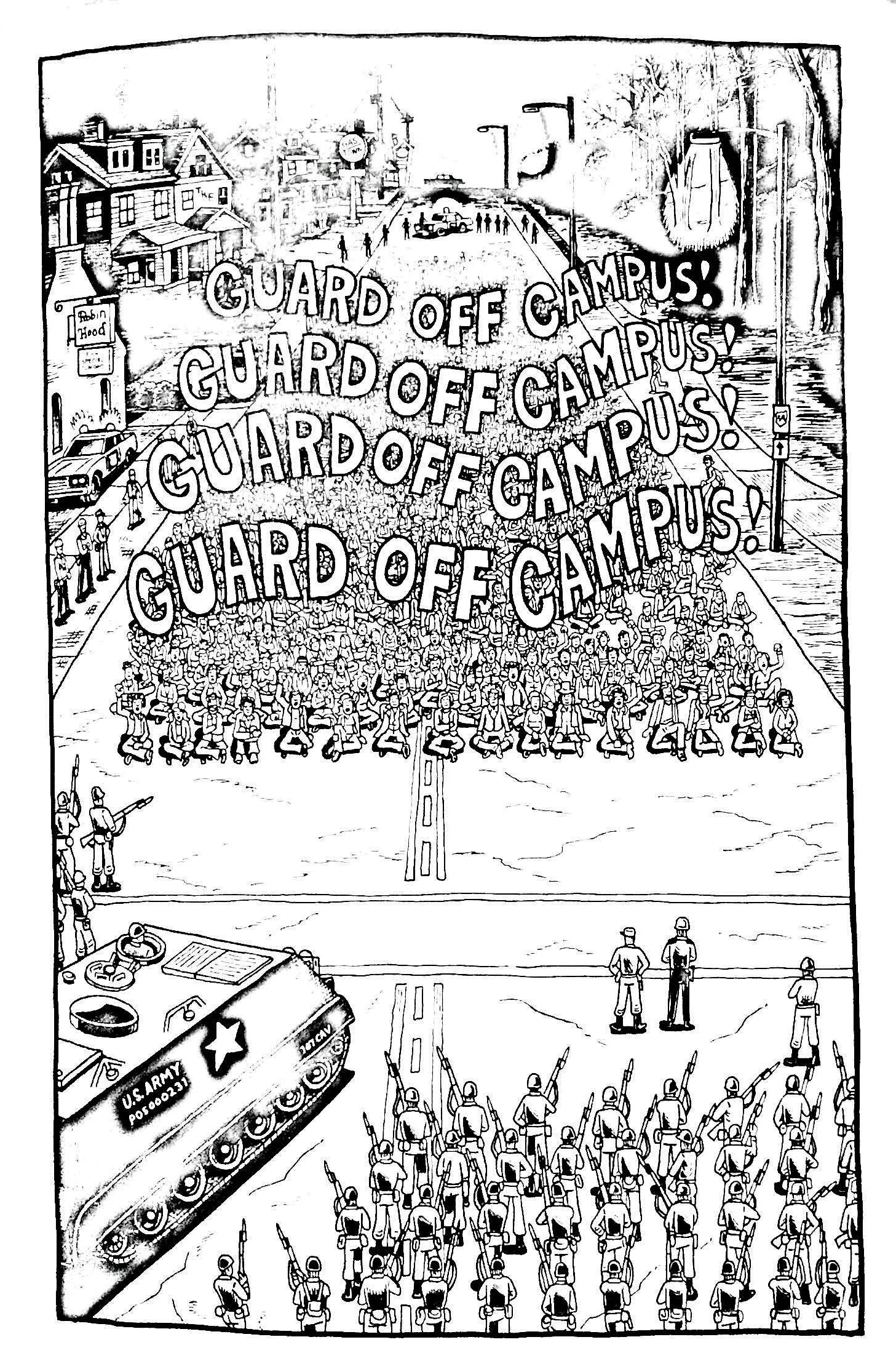
A glance at Derf Backderf's meticulously researched graphic novel Kent State: Four Dead in Ohio seems right on time today.

This artist really did the work, in archives and interviews, to reconstruct the events of the Ohio college massacre on May 4, 1970. A barrage of gun fire from National Guard troops killed four students and maimed more in response to student protests. He tries to portray accurately what students, politicians, cops, and Guardsmen were thinking as the movement against the ongoing Vietnam war both intensified and shifted focus under ham-handed state repression. Overall theme: nobody really knew what they were doing!

Here are a few panels (click to enlarge):
Spring had come and students enjoyed the campus's grassy open lawn.
"Out of the bars and into the streets." During a boisterous evening in town on Friday night, some students interrupted a night of drinking and cruising to take common chants into the streets. The town police department had no idea what to do and bashed heads while intoxicated student rioters smashed store fronts.

The town called in the National Guard. No one seemed to know quite how to act in the aftermath.

Non-campus actors believed all sorts of myths about the mysterious campus activities. What had got into these kids?
For the students, their occupied campus was novel and insulting.

On Monday on campus, a small fraction of students reverted what they had been doing for weeks -- marching in protest. Students had a new target - the occupation of their turf by tired, frustrated, and uncomprehending troops. Many of the Guardsmen despised students they saw as privileged snots.

And so tragedy. A random crew of students were dead; all sides told their own stories. No one was punished. At the time, 58 percent of Americans thought the protesters had it coming to them.

I can highly recommended Backderf's reconstruction of Kent State events, much more detailed and nuanced than what I've offered here.

The book is not a great graphic novel because, for all the artist's efforts, all these characters seem to blend into each other, classic hippies in one stereotype and malevolent pols in another. He could probably have created a clearer visual experience with a lot of editing, but he's determined to report all the available historical strands and the result is not pictures which are easily understood. But this is a terrific effort to tell a complex story.

I got the book from the public library; I hope it is readily available in this moment.

• • •

A few observations from having lived similar events at UC Berkeley during attendance there from 1965-1969 and watching student protests over Gaza today:

• As at Kent State, most students can and do navigate around the edges of passionate protests, going about their lives. They may sympathize, but they are not there. The passionate activists are usually a small minority.
• Repression of campus protests draws a far larger fraction of students (and profs and staff) into the protests, for good and ill. College students, at least back then and likely still, come to think of campus as their place and broadly resent being invaded.
• This can create incentives among a small fraction of protesters to try to create a situation in which cops or others beat protesters' heads. I'm not saying that is all that goes on, but there are always provocateurs, some honest and some not.
• When under attack on campus, it becomes hard for protest leaders to keep the focus on the initial animating issue -- today the call for a Gaza ceasefire and for an end to US complicity in Israel's oppression of Palestinians. If the issue becomes mean cops, the movement is losing.
• Protest leadership demands teaching serious protest discipline. This is hard because the aim is to grow fast. And also, the power of campus protest is attractive moral creativity; apparent rigid automatons chanting only approved messages do not attract.
And we'd be a far worse country if students could never be moved by atrocity. So far, we seem to be that kind of country.