Showing posts with label south africa. Show all posts

Friday, May 16, 2025

Is there a genocide of white South Africans as Trump claims?

Reporting in the U.S. on the Afrikaner "refugees" -- some nearly 60 white people -- that Donald Trump has imported to this country is driving me nuts. Even media nearly as unsympathetic to this human migration stunt as I am seem to me to fail to convey the many complexities of South Africa. I'm not claiming to know all the ins and outs of South Africa as it exists today, but I did live there briefly in 1990 working on an independent anti-apartheid newspaper and came away with some basics that are missing from many accounts.

Some of my observations:

• The local Black-led independence party that led the struggle against white rule, the African National Congress (ANC), has won majorities ever since the first free election in 1994. But it's majorities have declined over time and today it governs in coalition with the Democracy Alliance which has a history as white-oriented party.

• Despite its many faults, including corruption, the ANC has continued to stand proudly for the self-expression of peoples enduring European rule, including the people of Palestine/Israel. We can suspect that the racial views of Afrikaners are akin to white Mississippi in 1963. Most Black South Africans, knowing racism, assume Palestinians have lived under something like the apartheid regime. When the issue is the oppression and genocide of a people, nuance gets lost. (Properly on this in my view, but that's another topic.)

• Rather importantly, given where Donald Trump probably gets his "information," Elon Musk is NOT an Afrikaner. He's from the wealthy English-speaking former ruling imperial class of the country, a man unreformed after the fall of white rule apparently. 

The BBC has published a very helpful explainer that rings true: 

South African History Online sums up Afrikaner identity by pointing out that "the modern Afrikaner is descended mainly from Western Europeans who settled on the southern tip of Africa during the middle of the 17th Century".
A mixture of Dutch (34.8%), German (33.7%) and French (13.2%) settlers, they formed a "unique cultural group" which identified itself "completely with African soil", South African History Online noted.
Their language, Afrikaans, is quite similar to Dutch.
But as they planted their roots in Africa, Afrikaners, as well as other white communities, forced black people to leave their land.

As was true in the United States, this small colonizing minority population could only rule by repressing the vast majority population, indigenous Black and later "coloured" people of Asian and mixed race backgrounds. Unlike in the U.S., neither Afrikaners nor later British imperialists succeeded in killing off the "others," remaining a well-off, empowered minority. They therefore put the others to work on farms and in mines.

In 1948, South Africa's Afrikaner-led government introduced apartheid, or apartness, taking racial segregation to a more extreme level.
This included laws which banned marriages across racial lines, reserved many skilled and semi-skilled jobs for white people, and forced black people to live in what were called townships and homelands.
They were also denied a decent education, with Afrikaner leader Hendrik Verwoerd infamously remarking in the 1950s that "blacks should never be shown the greener pastures of education. They should know their station in life is to be hewers of wood and drawers of water".
Afrikaner dominance of South Africa ended in 1994, when black people were allowed to vote for the first time in a nationwide election, bringing Nelson Mandela and the African National Congress (ANC) to power.
Afrikaners currently number more than 2.5 million out of a population of more than 60 million ...

... South Africa's most recent census, done in 2022, shows that Coloureds, (an officially used term meaning people of mixed racial origin) are the largest minority, making up 8% of the population. They are followed by white people, including Afrikaners, at 7%, and Asians at 3%.

The ANC has stood for what South Africans call "non-racial" government. There's plenty of grievance and prejudice, but by and large Afrikaners can have a chance in the country, certainly better chances than the Black African majority.

Even though white-minority rule ended in 1994, its effects are still being felt.
Average living standards are far higher for the white community than black people.
White people occupy 62.1% of top management posts, despite only accounting for 7.7% of the country's economically active population, according to a recent report by South Africa's Commission for Employment Equity.
The government has enacted a number of laws to try and redressing the balance, such as the Broad-Based Economic Empowerment and Employment Equity Acts. An amended version of the second act imposes strict hiring targets for non-white employees.

As in the U.S., this official affirmative action policy is not popular with white people who previously didn't have to compete so hard. The ANC's coalition partner, the Democracy Alliance, is challenging the acts in court.

Elon is telling Trump lies about his interactions with South Africa, according to its government:

... Trump's close adviser Elon Musk, who was born in South Africa, has referred to the country's "racist ownership laws", alleging that his satellite internet service provider Starlink was "not allowed to operate in South Africa simply because I'm not black".
To operate in South Africa, Starlink needs to obtain network and service licences, which both require 30% ownership by historically disadvantaged groups.
This mainly refers to South Africa's majority black population, which was shut out of the economy during the racist system of apartheid.
The Independent Communications Authority of South Africa (Icasa) - a regulatory body in the telecommunications and broadcasting sectors - told the BBC that Starlink had never submitted an application for a licence....

Only a small minority of Afrikaners are thrilled with Trump's offer of refugee status: 

After Trump's offer, Afrikaner lobby group Solidarity posted an article on its website headlined: "Ten historical reasons to stay in South Africa".
In parliament last week, the leader of the right-wing Freedom Front Plus party said they were committed to South Africa.
"We are bound to Africa and will build a future for ourselves and our children here," Corné Mulder said.

Let's give the president of South Africa, Cyril Ramaphosa, the last word here:

[He] has said it was "completely false" to claim that "people of a certain race or culture are being targeted for persecution".

Referring to the first group who have moved to the U.S., he said: "They are leaving because they don't want to embrace the changes that are taking place in our country and our constitution."

South Africa is one of the most violent and complicated places I have ever spent time. As is usual with Trump and MAGA, they are not doing justice to the intricacy of the nation. Complexity is hard.

Monday, June 03, 2024

South African democracy still being born

Democracy is not only elections. Voting only one way, though important, that we, often poorly but also often earnestly, try to turn our hopes and desires into government by the people.

This month, the number of countries conducting electoral contests is staggering. I focus on the domestic antics, Mr Trump the unstable criminal v. President Biden the wounded healer. But India, Mexico, Iran, South Africa, the United Kingdom, and the European Union are also up in the current moment.

I have no expertise on any of these but our own, but I'm fascinated by developments in South Africa.

Hung on a Cape Town lamp post, 1990
Way back, in 1990, together with Erudite Partner, I had the privilege of working to provide technical assistance to tiny South African newspapers which were promoting the African National Congress (ANC) message of post-apartheid non-racial justice and freedom. 

This was a strange in-between time; a month before we arrived, ANC leader Nelson Mandela had been released from 27 years imprisonment by the whites-only government, signaling that its system for repression of the non-white majority could not last. Cape Town was alive with excitement, hope, and more than a little trepidation.

But nobody yet knew what would come next. Could a democratic system for all South Africans be made out of the aspirations of the freedom struggle? That vision would have to overcome not only racial categories but also rural poverty and yawning educational and economic inequality if South Africans were to forge a multiracial democracy. And very obviously, this wasn't going to be a smooth process. Pure energy couldn't substitute for learning to work together in new ways.

One anecdote: a member of the staff of a newspaper in Cape Town came to us with a personal request. In this moment of liberation, the ANC was forming local branch committees around town; mass organization that had -- of necessity -- worked hidden and underground was going to come out in the open. She was excited; she needed a flyer to post inviting her neighbors to a meeting. Her radical headline was "Come Elect Your Leaders!"

Of course, we helped her. And then a few days later, she brought the flyer back. There must be a different headline: "Come Meet Your Leaders!" We helped with that too. Evidently the local ANC didn't feel entirely ready for an entirely open process.

That small episode came to capture for me the thousands of such difficult transitions that very ordinary people were attempting while moving toward majority rule. Good people who had suffered horrible oppression were trying to build something altogether new and brave -- this would not be smooth and simple.

And it still isn't.

The first universal, free, and non-racial election in South Africa took place in 1994. Nelson Mandela and the ANC completely dominated the new democracy. And until this week, the ANC remained the overwhelmingly dominant party in free South Africa. Sometimes it governed well; sometimes its leaders succumbed to national and world capitalism, grabbed for personal wealth, and became high-handed, forgetting the masses who put them there.

Lynsey Chutel reports on the election last week:

For the first time since the end of apartheid in 1994, the party once led by Nelson Mandela failed to win an outright majority of the votes in a national election. ...
While the African National Congress, or A.N.C., remains the leading party in the May 29 election, the latest tally is widely viewed as a political defeat and a rebuke from voters ... who have become exasperated with the only party they have known since the end of apartheid. In the last election, in 2019, the A.N.C. took nearly 58 percent of the vote. The drop to about 40 percent in this election has cost the party its majority in Parliament, which elects the country’s president.
Voting-aged South Africans born after apartheid, in 1994, have some of the lowest registration numbers, while those who endured the worst of the apartheid regime are aging. Instead, a generation who experienced the euphoria and economic growth of post-apartheid South Africa, and then the decline and despondency that followed, have soured on the A.N.C.
“Maybe they had a plan to fight apartheid, but not a plan for the economy,” Ms. Mathivha [in northern Johannesburg] said.
... “More than anything,” she said, “the A.N.C. has been humbled.”
The humbled ANC will have to try to form a coalition government with other parties. The Guardian has a very clear discussion of the parties involved and how this might work.

Lydia Polgreen, who served as the New York Times Southern Africa reporter in the last decade, muses reflectively from the Cape Town region:

That a mighty party like the A.N.C., which delivered one of the most inspiring triumphs of the 20th century, could a few decades later be dismissed by a loyal voter as mere “politicians,” hardly worth a trek to the polls, may seem like a dispiriting outcome. The A.N.C. could be forced for the first time into an unwieldy coalition government with smaller parties that might not make for ideal allies.
... there are no miracles here, and that is a good thing. Because miracles cannot be repeated. But what can be repeated is the hard, sometimes ugly, always unglamorous work of compromise and negotiation, and the working through of the inevitable consequences of those compromises. It is only through this process of improvisation and invention that true self-determination comes.
The business of ending apartheid as a form of government in South Africa is over. It is never coming back. But if this election tells us anything, it is that the work of building a true multiracial democracy has really just begun.
South Africa is a beautiful place full of brave people. If, under the constraints of a terrible history, a grossly unequal world economic order, and escalating climate emergencies, any nation can construct something new, democratic, and more humane, this land still has a good a chance.

Sunday, March 03, 2024

A different kind of woman

Caster Semenya knows who she is. She's had it with authorities, especially white and European ones, telling her they know her better than she does herself. She tells it like it is for her in The Race to Be Myself: A Memoir.

I love this book. I recommend it unreservedly, especially in the audio version, some of which Semenya performs herself.

She sets up her story like this:

I am Mokgadi Caster Semenya. I am one of the greatest track and field athletes to ever run the 800-m distance. I've won two Olympic gold medals and three world championships ...

... I have what is called a difference in sex development (DSD), an umbrella term that refers to the generic conditions where an embryo in a different way to the hormones that spark the development of internal and external sexual organs. To put it simply, on the outside I am female, I have a vagina, but I do not have a uterus. ... I can't biologically contribute to making new life.
I did not know any of this about my body until soon after August 2009, when I won the gold medal in the 800-m race at the World Championships in Berlin, Germany. I was only eighteen years old and had been subjected to invasive and humiliating gender confirmation tests without my consent just prior to the race. What followed was a media firestorm that continues to this day. ...
... I am a tall, dark-skinned, African woman with well-defined muscles, a deep voice, and not a lot up on top. I know I look like a man. I know I sound like a man and maybe even walk like a man and dress like one, too. But I'm not a man. ... I'm a different kind of woman, I know. But I'm still a woman. ...
I accept and love myself just the way I am. I always have and I always will. God made me. I am fortunate to have had a family who never tried to change me, and a country that wrapped its arms around me and fought for my right to run. ...
... I am a proud South African woman born in a tiny village to people who loved me.They have survived more humiliations than I could possibly know. It is from them that I know about maintaining dignity in the face of oppression. It is my hope that by telling my truth, I inspire others to be unafraid, to love and accept themselves. May this story contribute to a more tolerant world for us all.
Semenya's birth village is in Limpopo, the northernmost province of South Africa. Though the nation boasts gleaming modern cities like Cape Town and Pretoria, agricultural villages in the countryside -- African villages in the racial frame of that nation -- don't even show up on Google maps. It was a long time before Semenya was pulled into the multi-racial, multi-class modernity of South Africa upon leaving the hinterland to take up an athletic scholarship to the University of Pretoria.

It wasn't until she started winning international races that the International Amateur Athletic Federation (now World Athletics) began to get hot and bothered about her gender. And it seems fair to say, then the shit hit the fan. She was tested and barred from competition unless she took testosterone blocking drugs that made her ill. The basis in science for requiring the drug regimen was poorly documented and eventually tossed out by courts. Meanwhile, she strove to stay sane and train hard amidst the dissonance of strangers questioning who she knew herself to be.
... Gender is a simple thing in my part of the world. Mostly people are born boys, or they are born girls. There is also what in our Pedi language we call lahara matana -- a person born with two genders, meaning they are born with both a penis and a vagina. In my culture, these people are not assigned a gender. They are allowed to live their lives and decide which gender is dominant in their soul. They go about their business and everyone is supposed to mind theirs. I have heard that in rich countries doctors can "fix" a child born like this. But how can you "fix" something if you don't know what a child will want to be? We don't believe in surgical intervention on infants for such a thing.
No one ever told me specifically about lahara matanas. I just knew there were people like this when I was growing up. And I wasn't one of them. I was born a girl, and I have never felt confused by that because there is nothing confusing about having a vagina, even if my mannerisms and interests were considered boyish. ...
I knew growing up there were other girls like me, meaning girls who didn't sprout breasts, who had deep voices, or girls who were not into girl things. I grew up with some of them, played soccer with them. They were around, just like I was around. ...
... My family accepted me the way I was, but it didn't mean they didn't deal with comments about my looks and behavior. But my actual gender has never been a thing to be questioned, much less tested. That's the thing people didn't seem to understand -- it was one thing to talk about how I behaved, how I looked on the outside -- my clothes, my voice, my musculature -- but questioning someone's gender, discussing it in public ... that was unheard of in my culture. ...
The gender issue became a difficult one for the politicians in my country. Everyone seemed to support me and my right to run. They saw me as an innocent Black child caught in a terrible situation. For us, it became more than about gender, it became about race. It became about White people coming and telling us Africans what we were and what we were not based on our looks -- the same categorizations and violations of human rights that were happening during apartheid. I became a symbol of how Black people had been violated and exploited throughout history. Would this be happening to a White European teenage girl? When did "rumors" become an official accusation that had to be investigated? My blood and urine had been tested dozens of times by ASA [Athletics South Africa] and the IAAF [International Amateur Athletic Federation] ...
Mostly Semenya's attitude in this book is simple amazement at the stupidity of people questioning her gender -- and proud fury as she asserts herself. She has no time for other women competitors who she thinks don't have it in them to work as hard as she does.
I remember reading how women were barred from running in the early days of organized sports because men thought their body parts would fall out and that it was "unseemly" for women to sweat in public. Well, look closely at professional women's races. Most of us run, cross the line, congratulate each other, and go on with the rest of our business. ... If you are an elite athlete and you really can't breathe and you fall down when you're done with a race, train harder.
I read this book from a stance of awareness that all world class athletes are freaks of nature.  It's just that sometimes we can't see quite how. Human diversity is enormous and a very few people can turn their biological divergence from the mean into athletic success -- such success only comes if they train to their limits and beyond. The best are disciplined freaks. The Olympic swimmer Michael Phelps has some of the largest hands you'll ever see. Brock Purdy apparently has a preternatural ability to see around him and remain decisive when facing being beat to a pulp. They are different, but they wouldn't achieve the athletic successes they have without brutal hard work.

I love the dedication of Caster Semenya's memoir. It seems about right to me:
For those who are born different
and feel they don't belong in this world,
it is because you were brought here
to help create a new one.

Thanks, Mokgadi Caster Semenya!

Sunday, April 07, 2019

Coming up in apartheid South Africa with wit and with Jesus

I guess he had to be a comedian. His memoir's title names his problem: he was Born a Crime. Now he hosts the Daily Show. In the South Africa he was born into in 1984, he was the half-breed child of an illegal relationship between a white man and his Xhosa mother from the rural Transkei. Not to say he was an unhappy accident. His mom knew she wanted a child and got what she wanted. His father was supportive though remote. And young Trevor fit in nowhere among his African kin or his society's rigid racial casts: he was not black African, not colored, not Afrikaans, and certainly not white.

Against all probabilities, Noah's devoted mother raised an independent scamp into the accomplished, gentle, sharp-edged social observer whose wit we now enjoy thousands of miles from his native Johannesburg. This book is a delight.

The book is mostly vignettes from Noah's upbringing, told with vigor and humor. Much of it is about his mother, the mother that walloped him for his own good for any mischief (if she could catch him). She diligently exposed him to every cultural opportunity she knew of, including long days of church: "mixed" and jubilant (suburban megachurch), white (analytical and Biblical), and black (revivalist). The little family unit were faithful participants in all three -- every Sunday! For his mother, Jesus was ever and always her insurance in a crazy, violent world.

His mother taught him practical lessons that stood him in good stead. South African apartheid separated the races into linguistic as well as racial groups; Noah's mom knew how to cross forbidden lines with language, teaching him familiarity with English, Afrikaans, Xhosa, Zulu and some of many other African tongues.

I learned to use language like my mother did. I would simulcast -- give you the program in your own tongue. I'd get suspicious looks from people just walking down the street. "Where are you from?" they'd ask. I'd reply in whatever language they'd addressed me in, using the same accent they used. There would be a brief moment of confusion, and then the suspicious looks would disappear. "Oh, okay. I thought you were a stranger. We're good then."

There's a fluency I wish I had here in California. No wonder Noah knows how to talk to Ammurricans.

The book offers plenty of glimpses of South Africa's system of racial apartheid which excluded four fifths of the population from any power in their nation until 1994 -- and whose legacy still deforms this rich and troubled country. For example this, explaining one of the ways that the young Noah did fit in, while highlighting the contradictions in the lives of women like his mother :

The fact that I grew up in a world run by women was no accident. Apartheid kept me away from my father because he was white, but for almost all the kids I knew on my grandmother's block in Soweto, apartheid had taken away their fathers as well, just for different reasons. Their fathers were off working in a mine somewhere, able to come home only during the holidays. Their fathers had been sent to prison. Their fathers were in exile, fighting for the cause. Women held the community together.  Wathint' Abafazi Wathint' imbokodo! was the chant they would rally to during the freedom struggle. "When you strike a woman, you strike a rock." As a nation, we recognized the power of women, but in the home they were expected to submit and obey.

He does not sweeten the moral horror of the system under which he was raised:

Apartheid was a police state, a system of surveillance and laws designed to keep black people under total control. A full compendium of those laws would run more than three thousand pages and weigh approximately ten pounds, but the general thrust of it should be easy enough for any American to understand. In America you had forced removal of the native onto reservations coupled with slavery followed by segregation. Imagine all three of those things happening to the same group of people at the same time. That was apartheid.

Yet for all this, Noah found a generous moral center. An enormously talented young man, he could easily have ended up just another casualty of poverty without considerable luck, his imaginative ambition, and the moral compass his mother had beaten into him. During a time when he was making a living fencing stolen goods in a black township, he recalls acquiring a digital camera -- a camera that still had on its chip the pictures belonging to the family that had "lost" it. He describes understanding vividly that his hustle was hurting others he never had seen.

In society, we do horrible things to one another because we don't see the person it affects. We don't see their face. We don't see them as people. Which was the whole reason the hood was built in the first place, to keep the victims of apartheid out of sight and out of mind. Because if white people ever saw black people as human, they would see that slavery is unconscionable.

We live in a world where we don't see the ramifications of what we do to others, because we don't live with them. It would be a whole lot harder for an investment banker to rip off people with subprime mortgages if he actually had to live with the people he was ripping off. If we could see one another's pain and empathize with one another, it would never be worth it to us to commit the crimes in the first place. ... That camera made me confront the fact that there were people on the other end of this thing I was doing, and what I was doing was wrong.

After the period chronicled in this book, Noah left South Africa for Los Angeles when he'd been threatened by his mother's violent second ex-husband who had repeatedly attacked his mother. We have been lucky to have attracted this migrant.

Sunday, December 15, 2013

Snapshot from LGBT South Africa

South Africa is well ahead of the U.S. and even much of Europe in legalizing gay and lesbian marriages. Legal status and protections for gay people were a byproduct of what South Africans used to call "The Struggle" -- the long, painful organized social movement that ended white rule and created a non-racial democracy. The Struggle unleashed expansive visions of human freedom -- freedom that was construed to include gay people.

I've written what I observed of this moment previously.

Nelson Mandela's death marks the definitive end of The Struggle era. Forty percent of South Africans were born after the historic election in 1994 that made Mandela -- four years out of prison -- the country's first President elected by universal suffrage. Democracy has not ended grotesque economic inequality nor even brought widespread prosperity. The new era has been concurrent with the world's worst rate of AIDS infection, a coincidence that has been devastating to the country's self-image and confidence.

In this troubled context, South African gays, especially interracial couples, are necessarily anxious. And outside the comfortable classes in the cities, conditions for gays can be brutal. Black South African lesbians and transgender folks are at particular risk. Activist and photographer Zanele Muholi explained this to a U.S. audience recently:

... the expansion of legal rights for the LGBTQ community has been undermined by a rash of hate crimes against these groups — particularly black lesbians.

According to Muholi, this disconnect between the promise of protection under the South African constitution and the actual experience of the black lesbian community has become a point of contention for her.

“It’s one thing to say that we are protected by the constitution, but it’s another to see that the constitution is practical,” Muholi said.

Of the hate crimes endured, Muholi said, the most heinous is known as corrective or curative rape, in which lesbian women are raped by men in the belief that the act will somehow change the sexual orientation of the victim.

The difficult evolution of the "new" South Africa is a reminder that a struggle for freedom and justice never ends. It just changes form ...

Thursday, December 05, 2013

One of the best tributes to Nelson Mandela ever made

Oddly, this comes from ESPN. It captures the feel of the South Africa I encountered while working there in 1990. It's well worth your time, even if you are not sure you like sports.

Don't know if this YouTube copy will get yanked for copyright violation. Here's a link to the trailer from ESPN. The show can be downloaded through iTunes.

#RIPNelsonMandela

The Cape Town tabloid newspaper South (tagline: "you have the right to know") issued this poster in February 1990 when Mandela walked free after 27 years locked in prison for resisting apartheid.

The quotation -- "your freedom and mine cannot be separated" -- was part of his message from prison to South Africans in response to offers, made under tremendous international pressure by the white government, to free him if he promised to remove himself from the struggle. He remained jailed until finally he was released without conditions and then led the transition from whites-only power to majority rule.

The struggle for a nonracial South Africa threw up several leaders of extraordinary flexibility, wide intelligence, and integrity -- among them Walter Sisulu, Joe Slovo, Chris Hani, Archbishop Desmond Tutu, as well as Mandela. How one smallish country gets such a wealth of leadership at one time is a happy mystery. South Africa certainly needed all of them; not all lived to see the new democracy unfold.
***
The thorough New York Times obituary includes this reminder to those who struggle for justice:

Hating clouds the mind. It gets in the way of strategy. Leaders cannot afford to hate.

Tuesday, May 14, 2013

Defenders of Israel throw a hissy fit


American Muslims for Palestine board chair Dr. Hatem Bazian announces a campaign that will put this sign on San Francisco buses for the next month.

This bus sign campaign is yet another free speech effort -- we see a lot of them around here, what's the big deal?

Unless I'd happened on one of the buses, I probably wouldn't have noticed this effort. Nor would I have thought much about it. I have no trouble believing retired South African Archbishop Desmond Tutu when he calls Israel an apartheid state. He's got no axe to grind; in fact, as far as I know he labors in retirement for peace and justice. And he knows plenty about systemic discrimination and exclusion. I'll take his word for it. And the ad itself, highlighting the fact that U.S. taxpayers are paying for systemic discrimination and exclusion, seems simply true to me.

But the campaign got a higher profile on my mental horizon when emails started flying by about a clutch of organizations -- the Jewish Community Relations Council, the Anti-Defamation League, and the American Jewish Committee -- branding the ads as "inflammatory rhetoric designed to delegitimize Israel's very existence," "extremist language," and "bigoted lies and demonization." It seemed as if the triggering word was apartheid. Jewish Voice for Peace jumped into the fray with a collection of other people in addition to the Archbishop who have uttered the dread word:
  • Archbishop Desmond Tutu: "I am aware that many of our Jewish brothers and sisters who were so instrumental in the fight against South African apartheid are not yet ready to reckon with the apartheid nature of Israel and its current government...But I cannot ignore the Palestinian suffering I have witnessed, nor the voices of those courageous Jews troubled by Israel's discriminatory course." Tampa Bay Times, April 30, 2012
  • Israeli Defense Minister (and former Prime Minister) Ehud Barak:"As long as in this territory west of the Jordan River there is only one political entity called Israel it is going to be either non-Jewish, or non-democratic. If this bloc of millions of Palestinians cannot vote, that will be an apartheid state." (2010)
  • Israeli newspaper Haaretz editorial:"The de facto separation is today more similar to political apartheid than an occupation regime because of its constancy. One side - determined by national, not geographic association - includes people who have the right to choose and the freedom to move, and a growing economy. On the other side are people closed behind the walls surrounding their community, who have no right to vote, lack freedom of movement, and have no chance to plan their future. " (2007)
  • Former Israeli Minister of Education Shulamit Aloni:"Jewish self-righteousness is taken for granted among ourselves to such an extent that we fail to see what’s right in front of our eyes. It’s simply inconceivable that the ultimate victims, the Jews, can carry out evil deeds. Nevertheless, the state of Israel practices its own, quite violent, form of Apartheid with the native Palestinian population." (2007)
  • B’Tselem,The Israeli Information Center for Human Rights in the Occupied Territories:This report deals with one of the primary, albeit lesser known, components of Israel’s policy of restricting Palestinian movement in the Occupied Territories: restrictions and prohibitions on Palestinian travel along certain roads in the West Bank. This phenomenon is referred to in the report as the “Forbidden Roads Regime.” The regime, based on the principle of separation through discrimination, bears striking similarities to the racist apartheid regime that existed in South Africa until 1994. In the roads regime operated by Israel, the right of every person to travel in the West Bank is based on his or her national origin. Forbidden Roads: Israel’s Discriminatory Road Regime in the West Bank, Btselem, 2004
  • On 21 April 2010, the South African government expressed "the greatest concern" over: Israeli Infiltration Order 1650, saying that the order has a broad definition of "infiltrator" and unclear terms as to which permits would allow a person to reside in the West Bank, as well as how valid residency might be proven. The South African government said the terms of the order are "reminiscent of pass laws under apartheid South Africa."
Two comments on this controversy:

The ADL has zero credibility with me on anything about apartheid. My friend Jeffrey Blankfort has described the ADL's program in the 1980s and 90s in San Francisco which included funneling "intelligence" from San Francisco police files about US activists to the South African apartheid secret service. I've always assumed that this was the reason that the day after my working group arrived in Cape Town in 1990 to help anti-apartheid newspapers upgrade their technology, we received what seemed a clumsy visit from state security. The men at the door said they were roofers and must look over the house; there was nothing wrong with the roof.

Secondly, it raises my hackles when anyone tries to stifle discussion by outlawing particular language. Israel's existence is not at stake -- unless it manages to commit suicide by fatally alienating all its neighbors and its friends. The charge of legal, forceful systemic discrimination and exclusion of Palestinians by Israelis in the Occupied Territories and even within the 1948 borders is simply true. You can't expect people not to point this out. And pitching a hissy fit when people do won't stop anyone.

Monday, January 07, 2013

An accessible look at the aftermath of the freedom struggle

I feel as if Douglas Foster's After Mandela: The Struggle for Freedom in Post-Apartheid South Africa had been written for me.

On February 11, 1990, Nelson Mandela, a leader of the long struggle of the African National Congress against apartheid, was released after 27 years in prison. The release was televised world wide; Mandela spoke to waiting crowds on the Grand Parade in Cape Town. Millions felt they were seeing an almost unimaginable advance toward greater democracy and justice.

Within the next month a call went out to U.S. activists to send a team to teach digital publishing to newspapers associated with the "Mass Democratic Movement" against apartheid. My partner and I took up the call and in April 1990 began a three month stint working for South African tabloids in Cape Town, the Western Cape town of Oudtshoorn, and Johannesburg. It was a strange in-between time in South Africa: apartheid was clearly going to end, but just how a transition to non-racial democracy could happen was not at all clear. White racist fascists threatened and sometimes acted in terrorist resistance to the changes. Leaders of the African National Congress who had spent decades in foreign exile were returning and re-establishing their connections with the mass movement that had carried on a costly struggle within the country. Black people were going to have power, but what would that mean? -- and which black people? Elections were still years in the future, so the question of who could legitimately claim to voice the aspirations of the masses was unsettled.

Dropped into this, all the two of us were sure of was that we were ill-equipped to understand what we were seeing. Oh, it was heady. We attended the first legal rally by the ANC in decades in the township of Mitchell's Plain. Mandela and South African Communist Party leader Joe Slovo spoke -- Slovo was the more exciting draw insofar as we could gage the response. We saw a one day general labor action against developing inter-communal violence in Cape Town. We met with medical workers in the Khayelitsha township who were desperately trying to prevent the AIDS epidemic they saw coming -- after all we were gays from San Francisco; we knew something about living under that threat.

We certainly came away wishing the ANC and South Africa well -- but we also came away full of doubts. We didn't talk about this much; while we were in his country, Mandela had toured our country being received by liberal adulation. Every anti-racist progressive person in the United States was full of hope for the new South Africa.

We wanted to be that hopeful, but we came away afraid for the future. Our succinct expression of this, voiced seldom and privately, was that South Africa was more like the United States than anywhere we'd ever been. By this we meant that we saw a society proclaiming verbal allegiance to popular democracy and equality, but where huge parts of the population lived in such material and educational deprivation that it was hard to imagine how they could be brought into the national life. We anticipated that the white and "colored" English speakers we had worked with in the media might have a bright future in affluent white-owned enclaves, while black Africans and Afrikaans speakers of all races remained on the outside. (Foster's book bears this out, mentioning prominently some of the folks we worked with who we knew would rise to the top of any heap.)

One of us was asked to create a flyer for an introductory first meeting of a newly legal ANC branch committee. "Come elect your leaders" it was to say -- until the woman making the request came back to say it should read "Come meet your new leaders …" A culture of democratic decision making doesn't spring up without nurturing. Many trends looked like trouble ahead. But like the whole progressive world, we wanted so much for South Africa to remain a beacon of hope. And then, like much of the world, we applauded the 1994 non-racial, universal suffrage, elections that brought Mandela and the ANC to power -- and turned our attention elsewhere.

Foster's publisher describes After Mandela as a

revisionist account of a country whose recent history has been not just neglected but largely ignored by the West.

So it is and anyone seriously interested in the struggles within that wonderful country at the tip of Africa should read it.

Foster surveys the horrors of the unchecked and long officially unacknowledged AIDS epidemic. South Africa has plenty of smart scientists and doctors who saw the HIV plague coming, but for a variety of political and cultural reasons, the ANC ruling authorities flunked the challenge. One of Mandela's sons (and one of that son's wives) died of AIDS -- it was a breakthrough for open truth telling when Mandela, retired from the presidency, chose to speak of this in 2005. Foster reports on the conflicting emotions that HIV/AIDS created in the new country:

There was a deep sense of having been crushed by paralyzing grief right at the moment of everyone's supposed freedom -- "the simultaneity of new life and new death," as one scholar put it. Many people found the accumulation of such deep anguish quite difficult to bear, especially when it felt as though they were being dismissed or mocked by the regular public celebrations of their putative liberation.

The new country confronted intractable problems. Apartheid had been a social and economic safety blanket for white people, especially Afrikaans-speaking ones. The new democracy inherited grotesque economic inequality and only came into being on a promise not to dispossess the holders of wealth. The results are frightening:

…continued high unemployment, violent crime, and an uncontrolled spread of HIV brought people back to ground. These seemed like the intractable triad standing in the way of national progress. "If only the ANC knew how to govern as well as it knows how to campaign" a friend told me … here problems were deep-seated, and not matters of simple good governance alone. The Gini index, used to measure income inequality across populations, showed that South Africa scored far worse even than other middle-income developing countries in Africa, such as Kenya and Nigeria. The index for the country had been heading in the wrong direction -- toward a wider gap between rich and poor -- since Liberation Day, in 1994.

A racial age gap makes all this more difficult:

[Thabo Mbeki succeeded Mandela in office in from 1999 to 2008.]… Mbeki's Cabinet was well aware that economic growth alone would not substantially improve the picture on its own. Even if the country's growth rate surged up to 6 percent, orders of magnitude higher than its current rate, presidential advisor Joel Netshitenzhe figured that many young people from marginalized communities still would not be affected in a meaningful way. …This was the intersection where race, class, and age discrimination were thoroughly, frustratingly intertwined. While blacks accounted for 79 percent of the country's population, they made up 84 percent of South Africans up to fourteen years old. Seventy-nine percent of South Africans aged thirty and over were employed, but only half of those twenty-four and younger who were looking for work could find jobs.

The statistical material I'm quoting here misrepresents what Douglas Foster has done in this book -- though the book would not make much sense without it. Almost all of the book consists of reports of interviews with South Africans -- mostly young; mostly people who grew up after the 1994 liberation; of all races; famous and obscure -- about their hopes, anxieties and dreams. I don't know how a white English speaking US journalist achieved such apparent intimacy with his subjects, but I find their conversations utterly believable. I guess persistence pays off; Foster taught journalism in South Africa for several years. The result is fascinating, hopping from cultural commentary, through gossip, to policy insight, all skillfully woven into a series of story lines about people Foster seems to have cared about and who the reader can also relate to.

You don't need the sort of background I've got to read this book, though I think my experience helped. There's so much more to the South African freedom struggle than the singular moment when the world chanted "Free Mandela." Perhaps this volume can help some people in this country attend to the varied, bountifully contradictory, still mesmerizing, South Africa that is emerging in the 21st century.

Tuesday, November 22, 2011

When constitutions stand, and fail, as bulwarks of freedoms

When Susan N. Herman set out to write a book about abuses by the U.S. government since 9/11, friends told her they didn't want to hear any more about renditions or Guantanamo. The prison in Cuba is not what Taking Liberties: The War on Terror and the Erosion of American Democracy is about. It's about us: about what the government has done and what we've allowed to be done at home.

If you've been paying attention -- or just passing through airports, or entering the New York City subway, or maybe even taking books from the library -- you know that since 9/11 the government has decided we need to be watched, recorded and prodded to ensure our "security." Herman calls this the "Just Trust Us" society, since they dispensed with our Constitutional protections against searches and unwarranted surveillance -- and consistently refused to give courts or anyone else enough information to determine whether all this snooping is providing any safety or just covering the asses of an ever-enlarging bureaucracy.

... the last ten years have inculcated in many Americans a sense that we cannot know enough to make the policy decisions about how much surveillance is too much or whether particular security programs work. While it is certainly true that the rigors of secrecy make it difficult for us to assess what benefits we may be getting from broad material support laws, wholesale surveillance, or massive data banking, for example, there is no good reason why the American people cannot be included in the decision-making process to a greater degree than we have been so far. …

Herman is also clear on a significant reason that both Bush II and Obama have been able to get away with running roughshod over fundamental freedoms:

…the brunt of the impact of our post-9/11 program has fallen on Muslims, a minority in the United States practicing a widely misunderstood religion and easily stereotyped as resembling the 9/11 hijackers. …The milder impact felt by non-Muslim Americans -- loss of privacy, occasional co-optation as government agents, and embarrassing experiences at the airport -- may seem to many like an acceptable bargain. This view, of course, discounts the deeper and less visible damage the New Normal is doing to our constitutional principles, to our democracy, and to our way of life. …

We stand indicted as a people that cling to a "childish" expectation that presidents can guarantee our safety. Since this is delusional, we have submitted to delusional measures -- and thereby voluntarily given up much of our inheritance of liberty.

Herman, the national president of the American Civil Liberties Union, does a good job of cataloging the court proceedings that have followed on current government encroachments on freedoms. Her book is certainly worth reading. So is David K. Shipler's more journalistic survey of much of the same terrain, The Rights of the People.
***

democracy painted over.jpg
While writing about the erosion of democracy and liberty in the United States, I also need to pass on that the ruling African National Congress in South Africa has passed a press law that newspapers fear will mark the death of open speech and free inquiry in that emerging democracy. Such luminaries of the anti-apartheid struggle as Bishop Desmond Tutu and former South African president Nelson Mandela urged the party not to press ahead, but their legislative members have done so. Editors of newspapers across the country joined in an impassioned statement denouncing the new law. Some bits:

Every member of Parliament who presses the green button to vote "yes" for the Protection of State Information Bill will at that moment take personal responsibility for the first piece of legislation since the end of apartheid that dismantles an aspect of our democracy -- a betrayal that will haunt them forever.

… this vote comes amidst escalating attacks by the ANC on reporters, newspapers and the freedom of the press. Adoption of the Bill could be the first step in a series of attacks, including the creation of the media appeals tribunal mooted by the ANC, that slowly strangle our freedom to know what is being done in our name.

The spreading culture of self-enrichment, either corrupt or merely inappropriate, makes scrutiny by a free media which is fuelled by whistle blowers who have the public interest at heart more essential than ever since 1994.

If members of the ANC cannot muster the courage to defy their party's leaders and repudiate the Bill, it will again -- as it was under apartheid -- be up to those willing to go to jail for a very long time to expose the abuse of state power.

The newspapers will go to court, appealing to the higher authority of the country's post apartheid democratic constitution against the legislative attempt to criminalize speech. The country has a long and noble history of struggle for the rule of law; before he was the apartheid regime's most famous political prisoner, founding President Nelson Mandela was a lawyer. The nation's highest court has shown great bravery in defense of liberty, for example by affirming gay marriage rights in 2006. But free speech and civil liberties in South Africa are clearly under threat, just as they are in the United States. Can written constitutional guarantees save them?

Friday, August 27, 2010

Defending a scurrilous press in a democracy

Derrick Z. Jackson, columnist for the Boston Globe, has raised the alarm about press freedom in South Africa.

Embarrassed by media coverage of scandals in [President] Zuma's family and of profiteering by public officials even as millions struggle in poverty, the government has proposed a "Protection of Information Bill." His party, the African National Congress, is calling for tribunals to regulate the media. Earlier this month, a journalist was arrested after reporting that the national police commissioner may have may questionable business dealings.

Under the bill, the government could define so-called "sensitive information" as anything deemed in “the national interest.’’ It has aroused vigorous opposition, and not only from media organizations. Nobel Peace Prize winner Desmond Tutu last week spoke out against the measures as "something that virtually everybody rejects."

When guided by leaders such as Tutu and Nelson Mandela, South Africa developed a rare moral authority that would be tragic to waste. If the country fritters away freedom of the press, it would almost assuredly embolden less democratic nations to clamp down even harder.

The measure definitely seems a frightening move toward authoritarianism. The African National Congress (ANC) almost completely dominates the political scene on the strength of having led the long struggle against apartheid. Politics in South Africa take place as much within the ANC's factions as outside it or in opposition to the party. It could probably brush aside pesky complaining voices while retaining much popular support. That way leads to terrible governance as people in the United States discovered during the period of emotional national unity after 9/11 when President George W was riding high and leading the country off a cliff.

Alerted by Jackson's column, I decided to read a few South African sources on the press law. Not surprisingly, journalists are protesting.

Scores of journalists staged a silent picket outside Parliament's main gates at lunchtime on Thursday. Forming a line along Cape Town's Plein Street, they presented a phalanx of placards to passing motorists, many of whom hooted in support.

"Keep the Press Free", "Hands Off the Media" and "Fight for Your Right to Know", the posters proclaimed.

Savvy writers also point out that media censorship ain't what it used to be in the bad old days before widespread connectivity.

Government needs to realise that this is the 21st century and you can't stop the flow of information because it's not a one-way street anymore. ... Domestic workers, delivery guys, drivers, shop assistants, shelf packers, tellers -- they’re all getting their news online via their cellphones. It is no longer the domain of an elite middle-class. The truth will out, no matter how many laws you pass or how much time you waste. So ditch the act.

Amanda Sevasti, a young, hip ad executive

But other South African writers are less quick to reassure themselves -- or to make a blanket condemnation of the government. Stephen Grootes in The Daily Maverick took a stab at understanding ANC spokesperson Baleka Mbete's arguments for the "Protection of Information Bill" in a local forum.

For her, it is also about dignity, about how people are treated in the press. This is an issue that the Western-style media (we spent ages looking for the right phrasing here, but we think you know what we mean) we have in this country hasn't actually come to grips with at all. The nicknames, the use of first names in headlines, the damage caused to children at school because their parents are in the headlines, all of this, matters to Mbete and many, many people like her it seems. ...

When the ANC says it has "the people" on its side, perhaps we shouldn't rubbish the claim immediately; we may find that it actually does, and partly because of this issue of respect for elders that is so incompatible with the notion of meritorious society on which the Western-style media is based. It's not enough to just say that if you sought public office you have to take what's coming to you. Many ANC politicians and the party's supporters simply aren't built like that. To them dignity matters in a way it simply can't to a person who grew up thinking they were a master of the universe. The media should take this issue seriously and find ways to make its point. ... And a discussion should be had about this. We ignore it our own peril.

Because I worked briefly in the press in South Africa (in 1990, as apartheid was ending but before majority rule) I bring some small amount of nuance to thinking about this situation.

South Africa inherited some proud traditions from "Western-style media", but it also got a heavy dose of the dregs. The now-defunct tabloid where I worked was a "struggle" (multi-racial, anti-apartheid) publication, but it was also trying to survive (barely) in a capitalist market. It had to sell eyeballs to advertisers in competition with purely commercial papers. The local standard looked a lot like Rupert Murdoch's vicious and sleazy New York Post. So our outfit went along with the local standard, publishing prurient, stupid and even dubiously accurate stories to attract notice in the crowd. I particularly remember the time the front page led with a picture and story about an unfortunate young West African who had stowed away on a freighter and jumped ship in Cape Town, all because unable to find a way to live as person of indeterminate gender. The style is unfortunately familiar from supermarket check out lines.

A quick perusal of online images suggests that little has changed. Here's a contemporary South African tabloid:
The sensational style is pervasive in the South African press. It's not surprising that those elements of the ANC who want to rein in the freedom to criticize government figures can arouse popular revulsion against the media's failings and excesses.

People in the United States should not be smugly confident that a turn against press freedom on the basis of sheer disgust could not happen here. In addition to contemporary Murdoch/Fox News/supermarket tabloid entries, our history is full of corrupt sensational journalism from Thomas Jefferson's purchase of a writer to do hits on his political opponent John Adams through William Randolph Heart's ginning up a U.S. war to conquer the fading Spanish empire.

That stuff sells and always will. To be defensible, journalism has to prove its worth to democracy -- to most people -- in every generation. South Africa is a grand experiment in transition from one of the worst systems of oppression ever invented to a difficult democracy that has to hold the allegiance of people from many cultures and standards of living. I marvel at its difficulties and wish it well.

Thursday, November 16, 2006

Gay marriage approved in South Africa


This week, South Africa did what seems to be beyond most of the United States: it legalized gay marriage. The vote in Parliament, where the elected African National Congress (ANC) commands a huge majority, followed a ruling by the country's Constitutional Court that unequal marriage rights amounted to illegal discrimination against gays and lesbians under the 1997 Constitution.

In the spring of 1990, my partner and I were witnesses to some of the history that led to this groundbreaking decision. We had the privilege of working in Cape Town providing tech support to a newspaper that was part of the "Mass Democratic Movement" against apartheid. Nelson Mandela had been released from prison in February; the ANC, which had led the struggle against racial oppression, had just been legalized; and the whole society was bubbling with an awareness of new possibilities.

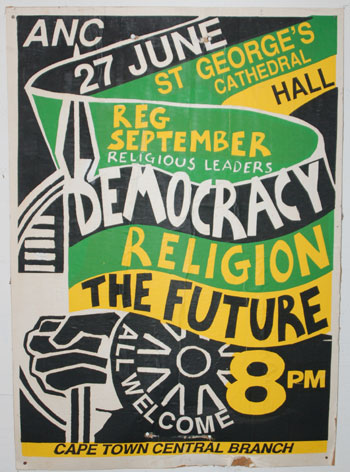
The poster pictured above is a visual artifact of that heady moment: in a style reminiscent of 1960s Haight-Ashbury rock concerts, in the ANC's black, green and gold colors, it promoted what in other times would perhaps seem a pretty dry panel discussion. In Cape Town that year, big questions about ultimate meaning, about democracy, about freedom, were all up for grabs. I snared the poster off a lamppost; they blanketed the town.

Into this vibrant atmosphere, ANC leaders who had spent many years in exile returned to their country. In particular, Albie Sachs, arrived. Sachs is an attorney who defended ANC members under the apartheid government, was jailed without trial by that government, escaped into exile, and then was almost assassinated by a bomb placed in his car in Mozambique by South African security agents, losing an arm and the sight of an eye. On his return, his job was to listen to the hopes of the various "struggle" organizations within the country in preparation for drafting a post-apartheid constitution.

One of the groups Sachs met with in Cape Town was the Organization of Lesbian and Gay Activists (OLGA). Cape Town then and now was "the San Francisco" of South Africa, the place where behavioral limits are broader than in most of the country. Still this seemed an astonishing breakthrough for gays and lesbians in a country where homosexuality was at best something to snicker at. The meeting was possible because OLGA campaigned not only for gay rights, but also was a recognized "nonracial," anti-apartheid group. Nonetheless, the quite open-minded journalists at the paper where we worked were surprised by this open overture from the revered ANC to the gay community.

The paper got an invitation to a press conference held by Sachs and OLGA; our co-workers insisted we come along. We jumped at the chance -- and were bewildered by the dirty looks we got from some of the OLGA people. Much later we understood. Every gay and lesbian in Cape Town had wanted to attend the event. OLGA members had to limit attendance; they thought we were some local lesbians sneaking in, until informed that we were "press."

The statement Sachs made at that press conference remains an extraordinary document in the history of gay liberation. Some excerpts from a transcript we made:

"The question of homosexuality has never been treated in an open and honest way in South Africa. The first thing that has to be done is get the question out in the open and for persons who stand to be most affected by any future dispensation to say themselves what they would like to see. This is part of a very extensive process of consultation and debate, based on the principle that people must write their own constitution. ...

"We don't see the constitution as being the product of a few enlightened (or unenlightened) lawyers. People must make their own input. Somebody said that a constitution is the autobiography of a nation. Everybody is part of the nation. Everybody has a right to contribute.

"In the case of homosexuality in South Africa, there is a special pertinence in this phase where we are overcoming apartheid. The essence of apartheid was that it tried to tell people who they were, how they should behave, what their rights were. The essence of democracy is that people should be free to be who they are. Any full democracy in South Africa, in my view, should be such as to encourage everybody to be who they are. ...

We already know the people in OLGA -- they've been very active in general in the anti-apartheid struggle, they have standing and prestige in the movement, and there is a strong feeling they shouldn't be in any way discriminated against because of their sexual preference. But this goes a little beyond that -- it is part of people in general defining what their own rights should be. ...

"There is too much fear in South Africa in general. We want people to be free, to feel free. This is one more area, in my own view, where there appears to be oppression. We are against oppression and we want everybody to feel they are part of the nation, they are part of the new South Africa, as part of a general program against discrimination, against marginalizing people, against this idea of telling people who they are and what they are. ..."

When the new Constitution came into effect in 1997, equal rights for gays and lesbians were included. And last year the Constitutional Court overthrew South Africa's statute defining marriage as solely a union between one man and one woman, holding the provision a violation of the Constitution's general mandate for equal protection for all and its specific mandate against discrimination on the basis of sexual orientation. The author of that opinion was Justice Albie Sachs. The legalization voted on last week is the follow-on to that decision.