Sunday, July 10, 2016

Toxic times

In this season of oh-so-Amerikkan grief and violence, I keep running across internet writers who ask: is this like 1968? No, it isn't. Both the violence and our country's inability to understand what was breaking apart and what was being born were far greater then. I remember.

But I've seen only one internet-era writer (there are certainly others) discuss another comparison.

... This isn’t 1992, when another case of police brutality sparked one of the worst conflagrations ever to strike an American city.

Jamelle Bouie, Slate

He's referring to the filmed beating of Rodney King by the Los Angeles Police Department and the subsequent acquittal of the cops caught on the tape banging away on the prostrate motorist's body. This too was no 1968, but in addition to the raging fires in black LA, there were righteous disturbances in many other cities including San Francisco. I know -- I was out in that one; it was a fine multi-cultural uprising without serious damage except to a few stores.

Over this last Fourth of July weekend, I streamed all 7.5 hours of O.J.: Made In America. The ESPN documentary is worth the time, especially the first episode which explores how a star football player from the projects on San Francisco's Potrero Hill became the celebrity without "race" -- just O.J. -- in a city where the police department was at war against its large African American population.

Somehow I missed most of the subsequent "O.J." part of the story at the time. I mean, the guy was a great runner on two NFL teams that I followed, the Bills and the 49ers. But once he retired and became a "sideline bimbo" (an on-field reporter where too often looks matter), I forgot about him. I've never been able to comprehend the appeal of celebrities, people who are just famous for being famous, which is what he matured into. So I missed the famous chase of the white Bronco carrying O.J. on the freeways. I didn't watch a minute of the nearly year long trial though I must have caught rumors that one of the police witnesses was impeached as an out and out racist. And, though I assumed O.J. killed his wife and her friend, I was not surprised or (properly as I think now) distressed by his acquittal. I just assumed an LA jury made mostly of Black women would seize the chance take a whack at the LAPD.

The documentary makes all this history, and more, horrifyingly immediate. Intentionally slow, it is very well done. About my only substantive criticism is that they fail to thoroughly explore what an offensive location O.J. chose to put himself in by playing at the University of Southern California. In those days, in the heart of Black LA, that wasn't an educational institution; USC was a private four-year frat party for entitled, mediocre, white products of the upper crust. (Not so much so today; it is a different time.) If O.J. had gone to UCLA, he might not have gotten over the same way -- or perhaps he would have. Who knows?

Nobody won in this story. And we're still inside it, as well as beyond it.

Saturday, July 09, 2016

How very San Francisco!

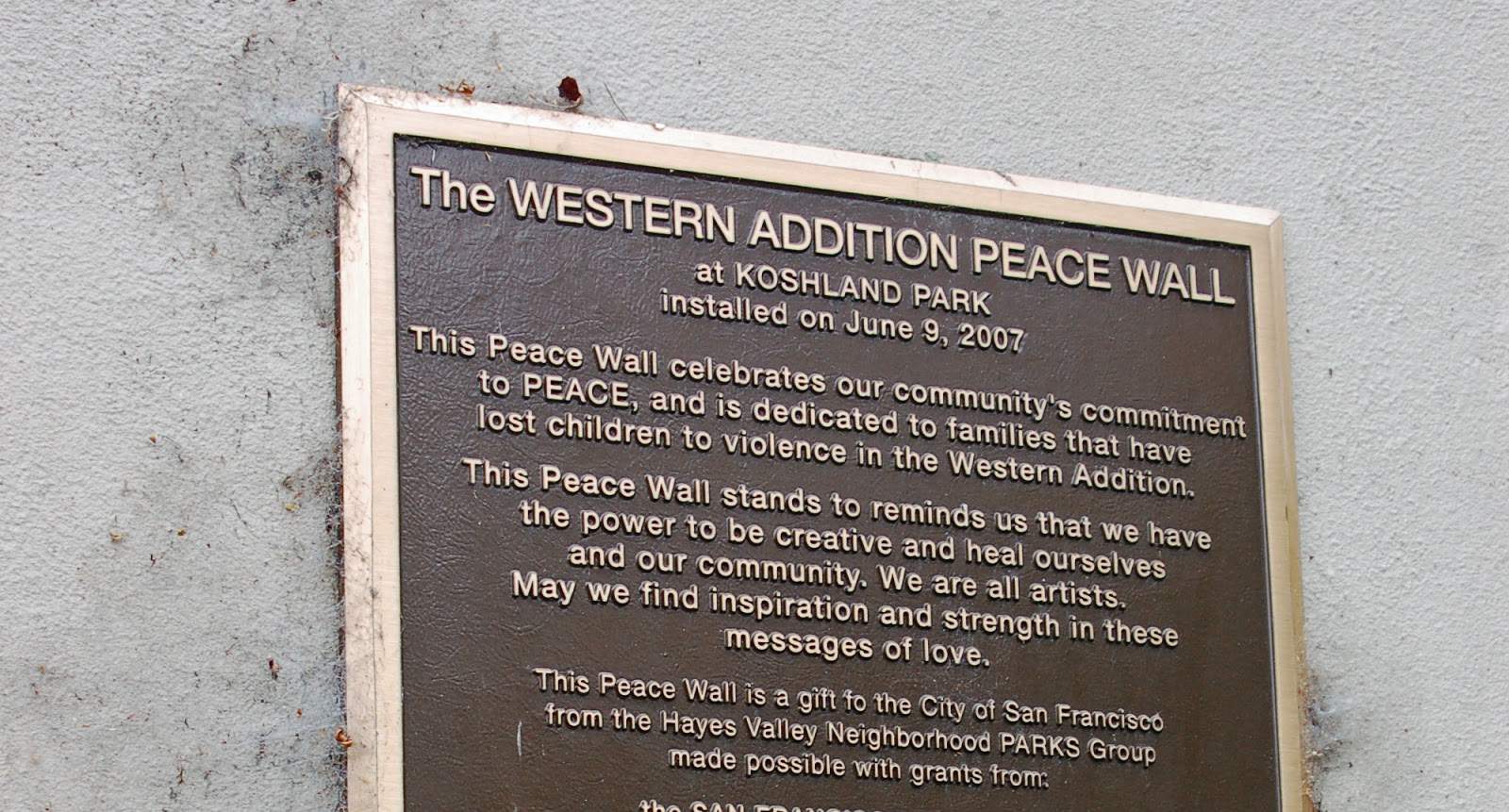
Saturday scenery: Western Addition peace park

After this week that saw the police killings of Alton Sterling in Louisiana and Philando Castile in Minnesota capped by the sniper shootings of five Dallas cops working a peaceful anti-police violence procession, here's how one San Francisco neighborhood responded to local violence in the last decade.

Community residents got grants to design tiles in memory of children lost to violence in this gentrifying enclave next to some of the city's least picturesque public housing.

Some of the resulting "art" seems trite.

But some tiles are challenging ...

... some topical ...

... some childish in the best sense.

Girls Scouts from the Chinese-American school contributed.

Several hundred feet of retaining wall carry the tiles.

There's nothing easy about peace.

All encountered while Walking San Francisco.


Friday, July 08, 2016

Criminals in our midst

A British report -- named after the author Sir John Chilcott -- has told us what we already knew about the U.S. and British war on Iraq: this was an con job perpetrated by elites on their own peoples. They knew or could have known (and if you are the government that's just as bad) that Saddam Hussein was no threat to anyone but his own people. They knew or could have known that they had no plans for what would happen once their armies had crashed into Iraq's cities. They knew or could have known that the country was likely to tear itself apart in sectarian and ethnic rivalries once the dictator was removed. They knew or could have known that thousands of Iraqis who had never wronged them in any way would die and/or be made refugees on their initiative. But they made their war anyway and have paid no penalty for instigating the carnage that continues to this day. They should be defendants on a trial for disturbing the peace of the world, not comfortably retired.

Erudite Partner (Rebecca Gordon) responded to the report at Juan Cole's Informed Comment, always a good source on the interactions between the Muslim world and the West. Her article, Surprise! It was a War Crime, is worth checking out in full. Some highlights:

... members of the Bush administration, including Vice President Dick Cheney and his longtime associate Paul Wolfowitz, actually came into office with an explicit plan ... The ultimate goal would be a realignment of power in the Middle East, with Syria destabilized, a Hashemite king ruling Iraq, and a new regional alliance among Turkey, Jordan, and Israel.

Syria has certainly been “rolled back” in a civil war that has claimed hundreds of thousands of lives and made over half its population either internal or external refugees.The US invasion or Iraq did not cause the Syrian civil war, but it unleashed the shock waves—as Wolfowitz and his co-authors predicted and hoped—that made it possible, as well as creating the conditions for the rise of extremist forces like the Islamic State.

... It’s clear, too, from the Senate torture report and other public records, that U.S. torture in the “war on terror” began because Cheney, Rumsfeld, and Bush needed a reason to invade Iraq. The CIA tortured Abu Zubaydah into saying that Saddam Hussein was in league with al-Qaeda in the 9/11 attacks. They shipped a Libyan named Ibn al-Shaykh al-Libi, who probably had been an al Qaeda trainer, to Egypt. There he was waterboarded until he agreed to the proposition that, as President Bush put it in an October 2002 speech to the nation, “Iraq has trained al Qaeda in bomb-making and poisons and deadly gases.” Donald Rumsfeld wrote his famous memo okaying torture at Guantánamo in hopes that someone there would say the same thing. ...

These men, and their underlings, and their abettors should be in the dock.

Friday cat blogging

Morty can be such a dignified fellow -- you might almost think this was his nature.

Until he does something like leap to the top of a closet door. I don't know what he thinks he'll find up there. Nor, after he gets there, does he seem to remember either. Getting down is usually not so dignified.

Thursday, July 07, 2016

Taking the case to the San Francisco Police Commission ...

Mark Scandrette, Fr. Richard Smith, and La Mesha Izarry

Still no word from the San Francisco District Attorney about charges for the San Francisco Police Department officers who shot Amilcar Perez Lopez six times in the back in February 2016. Neighbors, local clergy and activists took their complaints to the Police Commission Wednesday night, pointing out that the PD removed Amilcar's body from the scene before the D.A.'s office could investigate, violating orders and protocols.

The complaint is just one more avenue to try to move a system that kills black and borwn people with impunity and protects the killers.

Wednesday, July 06, 2016

Happy Birthday to me!

As I turn 69 today, I find myself enjoying a season of unalloyed personal delight as great as any of us are likely to get in a fucked up world.

EP and JA at Portland Marathon, 2000
Why? Because in act of extreme self-indulgence, abetted and enabled by Erudite Partner and my long suffering friends, I've spent the last six months training my aging body to run a 50K trail route at the end of July. This means I have spent endless hours lumbering in the beautiful country around San Francisco, running ten weeks of over 40 miles per week, and 4 of those more than 50 miles. I can do it!

I am a no-talent runner. I never had any speed and I have less at this age than I ever did. I've always been a Clydesdale (a woman runner over 140 pounds), not one of those scrawny, speedy waifs. I enjoy treating my aging body as an interesting, if sometimes frustrating, "experiment of one" as the great running evangelist Dr. George Sheehan suggested that we all do, voluntarily or involuntarily.

Maybe we could blame John F. Kennedy for my passion. The young president came into office in 1960 when I was in eighth grade, bursting with life and advocating physical fitness. Soon we school children were subjected to annual fitness tests -- my favorite part was the half mile run in which I could outlast my agile classmates. But even more, I was attracted to Kennedy's challenge to try a 50 mile hike. The practice became something of craze in 1962-63. I persuaded my parents to let me try. I think I made 16 miles before blisters did me in. But I was hooked on the notion of going far on foot. And I have forged on ever since, on many hiking adventures and a few marathons.

So why stop now? Besides, this year is the 20th anniversary of Californians for Justice, so I'm making my current 50K jaunt a fundraiser I'm calling a Long Run for the Long Haul.

What is Californians for Justice?
Twenty years ago, an initiative seeking to reduce access for young people of color to state-sponsored educational opportunity (Prop. 209) spurred community groups to support the birth of a new organization.

Californians for Justice organized young people and their parents to struggle for racial justice then; Californians for Justice still organizes youth to develop leadership skills and to win improved public education today.

Californians for Justice believes that young people are the leaders our state needs to win the healthy, just and vibrant schools all of our communities deserve. We ensure that students have the opportunity to grow as leaders, and work with them to win campaigns.

When students are part of the decisions that shape the future of California’s schools, students, schools and communities are set up for lasting success. Young people will be able to thrive and achieve no matter where they’re from or where they go on to.

The Long Run has already raised over $1800. Thanks to all who have contributed. We can do more; please chip in if you can for the young people who are the future of California.

Tuesday, July 05, 2016

Digital utopia?

Okay, so our digital economy has transformed the lives of many of us, probably all of us whether we quite know it or not. So how do we make this bounty and its disruptions serve most people instead of making us serfs of entrepreneurial innovators? Throwing Rocks at the Google Bus: How Growth Became the Enemy of Prosperity by Douglas Rushkoff certainly comes with a sympathetic title; I live a block from where several years ago activists blocked the giant white whales of Silicon Valley on their rounds. I see these buses daily and bemoan how the affluent workforce they transport, mostly inadvertently, is reshaping San Francisco to the detriment of our poorer residents and our passionate, quirky culture.

So I'm very open to someone trying to envision how to make something humane of all this invention and profit. Rushkoff is a professor of Media Theory and Digital Economics at CUNY/Queens and media commentator/creator. His project is ambitious; as I read along, I kept thinking of those revolutionary 19th century futurists: Bentham and Mill, Marx and Engels, Kropotkin and Tolstoy -- all big thinkers who tried from their various vantage points to make sense of how industrial capitalism was remaking societies.

Rushkoff wants to influence our understanding of the world on that level. He is propounding a unified theory of the digital economy, situating contemporary innovations in the history of both technology and power relations. According to Rushkoff, Silicon Valley and its progeny including companies, venture capitalists and the technorati have built "digital industrialism" instead of allowing networked peer to peer potential to run to its more humane conclusion. In particular, financial capital has channeled the potential of technologies toward cancerous growth instead of cooperative development at human scale.

And he has concrete prescriptions for a better future (grabbed here from the author's book synopsis):

• Accept that era of extractive growth is over. Rather, businesses must – like eBay and Kickstarter – give people the ability to exchange value and invest in one another.

• Eschew platform monopolies like Uber in favor of distributed, worker-owned co-ops, orchestrated through collective authentication systems like bitcoin and blockchains instead of top-down control.

• Resist the short-term, growth-addicted mindset of publicly traded markets, by delivering dividends instead of share price increases, or opting to stay private or buy back one’s own shares.

• Recognize contributions of land and labor as important as capital, and develop business ecosystems that work more like family companies, investing in the local economies on which they ultimately depend.

Like many futurists, Rushkoff is able to draw a picture of attractive, even plausible, potentialities -- yet never quite gets to that essential step in which we somehow turn a powerful class which holds most of the money away from perpetuating the existing arrangements that have served them so well. I don't have the answer either, but history says this only happens through either social collapse or when the losers in the prevailing economy band together to demand we do things another way.

As I was reading along in this book, I kept having a feeling of deja vu that I couldn't quite place. Where had I encountered thinkers who structured their prescriptions in the way Rushkoff does? Suddenly I realized where: in the Catholic Worker movement whose intellectual leaders, Peter Maurin and Dorothy Day, promoted the "distributism" advocated by 19th century Pope Leo XIII. This was Catholicism's intellectual and moral response to Marxism. It seemed weak tea, but perhaps it has outlived that more muscular revolutionary tradition which degenerated into Soviet-style "actually existing socialism." Rushkoff credits the seemingly bypassed Catholic tradition and finds hope in Pope Francis' writings.

No, we don't need to convert to Catholicism or even approve of Vatican doctrine in order to appreciate the popes' vision of a more distributed economy and to see how it can contribute to our own. ... A form of networked distributism may just be our last best hope for peace in the digital economy today. The conscious application of more distributist principles into the digital economic program could yield an entirely more prosperous and sustainable operating system. Instead of simply amplifying the most dehumanizing and extractive qualities of industrialism, it pushes ahead to something different -- while also retrieving the truly free-market principles long obsolesced by corporatism.

Well maybe -- though I'm unconvinced, I appreciate anyone trying to see their way into a better society.

But I have to ask (and I don't think Rushkoff answers persuasively either question) 1) how do we get to your vision? and 2) who is "we"? who is included?

Monday, July 04, 2016

"Oh! what a lovely war ..."

Homage to past glories on our national day.
Since we're celebrating "rockets' red glare, bombs bursting in air" today, it seems like a good moment to check in on our wars. It's not a pretty picture.

Bombs have sure been bursting in Istanbul, in Dhaka, and in Baghdad.

Our governments (I'll include among that "us"not just U.S. allies, but also governments at the scenes of carnage) blame ISIS. And I don't think ISIS is denying authorship of these horrors.

Peter Beinart points out the killers are not without pretexts for their atrocities, even though there is no excuse for random murder.

The mid-20th century theologian Reinhold Niebuhr once wrote that, “America was menaced as much by its own pretensions to virtue as it was by world disorder.” Niebuhr was no pacifist, nor did he draw a moral equivalence between the U.S. and Hitler’s Germany or Stalin’s USSR. But he urged American leaders to acknowledge that even in just wars, “tyranny [is] defeated with instruments tainted by evil.”

The United States has intervened militarily to prevent ISIS from conquering Iraq and Syria. In that effort, it has carried out more than 10,000 air strikes—strikes that kill many people but go largely unnoticed in the American press. America’s current war may be justified. But America is not innocent. By pretending it is, [Marco] Rubio and other politicians [including Ms. Clinton] mislead Americans about the reasons for ISIS terrorism. And they prevent an honest debate about the costs and benefits of America’s war.

We would rather look away, but we could do with some reminding. The Soufan Group says ISIS is being defeated militarily, but that only points to more suffering and butchery.

Over the past two years, the West has focused on this phenomenon: the persistent and rising threat of attacks such as those in Istanbul, Paris, Tunis, Brussels, San Bernardino, and Orlando, altering policies, laws, and tactics. As the Islamic State enters its third year as a self-proclaimed caliphate, this phenomenon—in which the Islamic State inspires people around the world to act in its name—has completely detached itself from the physical group. This threat to the West will remain, and perhaps grow, as the group suffers increasing losses on the ground. 

But to the millions of Syrians and Iraqis who experience the Islamic State less as a phenomenon and more as a daily existential threat, the announcement of a caliphate was the weary culmination of a long-term corrosion of governance and stability. Life in Raqqa, Mosul, Fallujah, and many other cities and villages was dreadful in the years before the announcement and remains dreadful two years on. Only in the West did the events of June 2014 come as a surprise. 

... As Syria and Iraq mark the second anniversary of the Islamic State, there is reason to hope that a third will not come; however, there is little reason to hope that the group will not re-emerge in some shape or form in the future. The scale of the problem in Iraq—and, even more so in Syria—is beyond comparison and beyond the current capabilities of local, regional, and international actors to resolve. 

Meanwhile, we've got 51 State Department officials calling for deeper U.S. dabbling in the Syrian civil war. Nothing in likely-President Hillary Clinton's past or present pronouncements suggests she knows better. In fact she'd likely embroil us all more deeply. (And yes, we do have to elect her; this is no time for purism.) And then comes word that the Syrian faction allied with al Qaeda has captured the leader of a U.S.-favored "moderate" combatant group -- and presumably all those lovely weapons we've sent him.

Mother Jones blogger Kevin Drum got it right when contemplating our leaders' prescriptions:

This stuff never stops. Everyone wants a miracle cure in the Middle East: the mythical "just right" military response that doesn't involve ground troops; won't get any Americans killed; and doesn't take very long — but that will be magically effective anyway. It's nuts. ... It's snake oil.

Very deadly snake oil, mostly for other people.

Sunday, July 03, 2016

And now for another round of hating homeless people

Sometimes a warm laundromat is the only available place to take a nap.
We do this in San Francisco every few years. Shocked to notice that, yes, as rents soar and old housing burns, there are still people living on the streets, we vote to try to disappear them.

This November, homeless hate will take the form of a ballot measure ordering the police to tear down homeless people's tents, with 24 hour notice and an offer of a shelter bed. Except there aren't any shelter beds for most people on the streets. And we know that they seldom get their seized possessions back. Concurrently, we'll have the chance to push the police to somehow stop car burglaries.

Here's the real story from journalist Tim Redmond:
The key to understanding the two homeless and street crime ballot measures sponsored at the last minute by Sups. Mark Farrell and Scott Wiener is that neither of them has anything to do with homelessness or quality of life crimes.

... Neither measure would do anything that the city can’t already do. It’s already against the law to camp on the sidewalk. It’s already against the law to break into cars or spray paint tags on buildings.

It’s long been the policy of the city that the police first go after serious crimes – murder, rape, assault, arson, robbery, gun violence hate crimes – and that car break-ins, which are almost impossible to solve, aren’t at the top of the list.

... Wiener and Farrell are looking for wedge issues, things that they can use against the progressives. It’s an old tradition among San Francisco candidates who want to cynically use problems like homelessness to advance their careers: Gavin Newsom was elected mayor to a significant extent by running a side campaign called “Care Not Cash,” designed to take money away from homeless people. (And now, in a few years, he may be governor of California.) ... Demonizing the homeless worked for Newsom. Making the cops arrest people for minor crimes while homicides remain unsolved may play well in some neighborhoods. ...
We hold these sham votes over and over. During the last one -- the ballot measure that criminalized sitting or lying on city streets -- I assembled a two part history of these nasty charades, here and here.

It's not like we don't know what homeless people need: they need housing. We choose not to organize ourselves to make it available to them. No, we've made a glittering playpen for tech moguls and their underlings.

Saturday, July 02, 2016

Local media call for Homeless People Vivisection Week

Homeless people live in San Francisco; how can this be? The Chron called on local media to chime in. Some of resulting commentary has been truthful: see Tim Redmond on Why are so many people homeless...? at 48 Hills. Simply put, we've acquiesced in a city and a society which doesn't value providing housing (or any kind of decent life) for everyone. We are not all in this city together; if some people could throw some other people off a convenient cliff, they would. In fact they have.

While Walking San Francisco, I get to see a lot of how we try to drive away unhoused people.

We build barriers to sitting for those without chairs.

No leaning against that planter!

Don't try to grab a nap in a car ...

Or try to rest outside this clinic in the "wrong" hours. Apparently they've given up on suggesting an alternative. You are on your own.

Don't expect to be able to hang on to your property. This neat pile was built up by city workers about to take it away to wherever it is they go with homeless people's belongings. Actually Mission Local investigated: Property of San Francisco Homeless Routinely Disappeared by City.

Sometimes homeless people leave their own mark on the streets:

I'm still homeless. U sick people take and rob, rape, and plunder my nonexistant life. U R false hope.

My transcription and punctuation for clarity.

Friday, July 01, 2016

Friday cat blogging

That's Tokyo doing her fur ball act. She's good at it.

Meanwhile, Morty guards his purple catnip toy on the rug.

Have I mentioned that two cats is a lot more cat than one cat, especially if they are wary of one another?

Thursday, June 30, 2016

Here's what happens when you kick people who could vote ...

They learn to vote. TPM reports:

“The beauty of this country is that we have a voice,” Ehsan Islam began as he looked out onto a room so crowded for Jummah [Friday prayer] that some of the men were on a tarp outside. “We live in a state that is a swing state, that is a very important state, and all the candidates are going to be fighting over this.”

“We can decide the outcome,” he told congregants at the Dar Alnoor Islamic Community Center in suburban Washington, D.C.

There in Virginia, if not across most of the country, he might have a case.

US Muslims are responding to the fear and hatred stirred up against them by the Donald and an industry of Islamophobes just as so many communities have before them: they are organizing themselves to register, to vote, and working to make politicians aware they need to listen up.

According to a New York Times report,

Muslims make up about 1 percent of the United States population. A study conducted by the Institute for Social and Policy Understanding, a nonpartisan think tank, found that only 60 percent of citizens who are Muslim were registered voters, compared with at least 86 percent of Jews, Protestants and Roman Catholics.

“A lot of Muslims didn’t participate in elections because they didn’t see a lot of difference between the parties,” said Emir Sundiata Alrashid of the Lighthouse Mosque in Oakland, where a voter-registration drive was held last month.

The Donald is changing that, big time. And while not amounting to hu-u-ge numbers in most locales, potential Muslim voters are mobilizing.

The Council on American-Islamic Relations (CAIR) offers a toolkit which includes sample questionnaires tailored for local and federal candidates to probe their views on such matters as religious freedom and immigration. The toolkit also includes a "religious pluralism pledge" affirming free exercise of religion which candidates can be asked to sign.

Such tools are the nuts and bolts for getting into the US election game, a game that any community under siege needs as one of many defensive fronts.

Wednesday, June 29, 2016

Still thinking about Brexit

Here in California, we are accustomed to living in a system with a lot of direct democracy, a system where voters can vote on nearly everything, matters vital and trivial. We think it is only normal that we can overrule our representatives in the Legislature and even our Governors. This November, we'll be voting on at least 10 statewide propositions -- and maybe more. That's how we live. By and large, our more successful politicians try to anticipate and conform their actions to policy preferences bubbling among constituents. The ability to meld popular enthusiasms with workable policies is the job of a politician. Otherwise we get terrible law (like the anti-tax rules of 1978's Prop. 13) and many pols lose their jobs.

In Britain, there have only been three all-country referendums since 1975: the first on joining what became the European Union, which passed; the next on adopting something rather like the "instant run-off" voting that we use in San Francisco, which failed; and then the recent vote for Brexit, the vote to leave the EU. Brits don't do this very often.

Compared with what we have in California -- for better or worse -- Brits have a much more attenuated democracy. Without a written constitution, all power resides in Parliament; the party that controls the House rules. Brits have elections for Parliament, but the politicians don't seem to very closely mirror the sentiments of their electors. In the Brexit vote, only 24 percent of the members of Parliament came out for leaving the EU. This suggests that probably more than half of them were out of tune with their constituents. Pointing this out is not to fault them as individuals for failing at some ideal representative function; it is merely to point this is far from unusual in British democracy.

In general elections for Parliament, the regular mode in which British voters express their democratic druthers, it is possible to get quite distorted outcomes that don't look very democratic (small "d") from over here. I've grabbed some charts from the Wikipedia on the 2015 election. Note how little correspondence there is between the percentage of the vote each of the parties won and the number of seats that vote translated into. In particular, the over 12 percent of all voters who picked UKIP (the anti-immigrant party) and got one lousy seat for their pains likely were thoroughly pissed. This can happen in a multi-party system where the victory goes to whoever claws out a plurality within a geographical constituency.

The voters' preference for Brexit seems to have thrown British democracy into a tizzy. Both big parties, Labour and the governing Conservatives, are embroiled in unforeseen leadership struggles; Scotland and Northern Ireland which voted "Remain" are threatening secession; and all this while everyone is trying to absorb the shock of possible major economic and social rearrangements.

E J Dionne in the Washington Post does his pundit thing:

Don’t trash democracy or the voters. Where complicated choices are involved — and Brexit defines complexity — leaders in representative democracies need the guts to make hard calls and submit themselves to voters afterward. They should not use referendums purely to evade responsibility.

[He attributes the Brexit victory to racism.] ... Responsible officials should always be ready to denounce racism. But their job description also requires them to provide realistic policy answers to quell the rage. If center-right and center-left politicians fail to do this, their parties will remain suspect.

That is, in Dionne's view, the kind of not very democratic democracy Britain employs only works if smart leadership is in place to rescue a volatile electorate from itself.

Yet it does seem obvious that if large segments of the electorate felt, accurately, that they were more fairly represented, they might be less volatile, less inclined to throw the system into tipsy gyrations as they just have.

And yes, our electorate here also needs to feel represented, at least in substantial majorities, or our institutions won't work either.

Tuesday, June 28, 2016

Kristina TRULY ran long for the long haul ...

My friend Josh sent me this and I must pass it on. Kristina is one tough, crazy Swede.

My far less ambitious travels have convinced me that, in reasonably undisturbed societies, most people tend to be welcoming to wandering strangers. In fact, perhaps it is a symptom that something big is very wrong when our first instinct is suspicion and fear. (Here's looking at you, Donald.)

Friends can support my little run and the youth organizing of Californians for Justice via the widget at the top right here.

Something good out of Orlando


Former Chilean military official found liable for killing of Victor Jara
A Florida jury on Monday found a former Chilean army officer liable for the 1973 torture and murder of the folk singer and political activist Victor Jara, awarding $28m in damages to his widow and daughters in one of the biggest and most significant legal human rights victories against a foreign war criminal in a US courtroom.

The verdict against Pedro Pablo Barrientos Nuñez after a two-week civil trial in Orlando’s federal court could now also pave the way for his extradition to face criminal murder charges in Chile related to his conduct during a CIA-backed coup that led to Augusto Pinochet’s 17-year military dictatorship and the deaths of almost 3,100 people.

Guardian, June 27

Sometimes the torturers are brought to justice -- or at least the truth is affirmed. Congratulations to the Center for Justice and Accountability for sticking with it.

Monday, June 27, 2016

Summing up Obama: Ta-Nehisi Coates on the Prez and much more

I have to admit I was gobsmacked when I encountered this in a Playboy interview with the Atlantic author. (Side note: who knew there were still Playboy interviews? Didn't the internet kill that mag? Shows what I know.)

In my circles, expressing qualified approval for the President is rare; it feels as if progressive credibility requires disavowing the promise of hope that Obama's election embodied in 2008. Thinking well of Obama is for suckers. Coates is not towing that line, in either the black or white version.

Bomani Jones tossed questions at Coates:

How would you describe the eight years of Obama’s presidency?
I think he did a tremendous job, and I say that with all my criticism of how he talks about black folks and how he talks to black folks. I say that with all my criticism of the morality or the lack of morality in terms of drone warfare. You’re not voting for a civil rights leader; you’re voting for a president of the United States within the boundaries of what presidents do. And within the boundaries of what presidents do, he’s easily the greatest president in my lifetime.

I don’t think people understand what he had to navigate. It’s a hard job already. You’ve got people on TV—and this is just the small end of it—on the internet, everywhere, sending out pictures of you and your wife looking like apes. You’ve got officials in the opposing party e-mailing pictures of watermelon patches in front of the White House. You have an opposition party where somewhere on the order of 50 or 60 percent don’t think you are legally president. You’re giving the State of the Union address and some white dude from South Carolina stands up and yells, “You lie.” Just open, blatant disrespect. You say the most sensible things in the world and people lose their mind, almost scuttling your top agenda in terms of legislation.

You’ve got to be a certain motherfucker to be able to manage all that in your head. Their leading presidential candidate right now is the person who claimed our president was born somewhere else and asked to see his grades. You’re dealing with a party where racism is a significant undercurrent. I mean, whew.

Were you surprised by the level of obstruction?
I was surprised by how much his very presence drew out the racism in the country. I didn’t know these folks were basically going to double down. There’s stuff we don’t even remember. In the 2012 Republican primary, Newt Gingrich just comes out and calls this dude a food-stamp president. I mean, just says it. This is a respectable figure in American politics right now. Five years from now, people will be looking back on this presidency and talking about how great the times were. Ten years from now, Republicans will be talking about how whoever is the Democratic nominee at that point is not like Obama and how magisterial Obama was.

Twenty-five, 30 years from now, they’re going to put his face on the money, if we still have money. And 50 years from now—it might not even take that long—he will be considered one of the greatest presidents in American history.

I agree; we're going to miss Obama and we are beginning to feel it. While we've got him, let's criticize, but also appreciate.
***
Coates just won the National Book Award for Between the World and Me. Though I'd been reading his blog and articles in the Atlantic for years, I didn't rush to acquire the book. I listened to some author interviews and this seemed like a book not written for an old white woman. It's a letter to his black son about their black bodies in the world. While any author wants to be read, I felt this was mostly written for men and secondarily for black people of all genders. Reading it would be eavesdropping on somebody else's conversation.

But a cheap used copy came to hand and I picked it up. I'm not going to try to describe the book. It's a short, approachable, meditative soliloquy on Coates' unfolding black male life. Toni Morrison calls the writing "visceral, eloquent, and beautifully redemptive." The book consists of Coates striving, in public, for the benefit of a son he adores, to speak truthfully. The result can seem harsh, but Coates believes that truth requires such rigor.

Here's a snippet about what he learned about survival growing up in a broken Baltimore neighborhood in the crack era.

There was also wisdom in those streets. I think now of the old rule that should a boy be set upon in someone else's chancy hood, his friends must stand with him, and they all must take their beating together. I now know that within this edict lay the key to all living.

None of us were promised to end the fight on our feet, fists raised to the sky. We could not control our enemies' number, strength, nor weaponry. Sometimes you just caught a bad one. But whether you fought or ran, you did it together, because that was in our control. ...

In the Playboy interview, Coates responds to the notion that he is "pessimistic." In the book, he simply tries to tell the truth as he understands it about the condition of black Americans:

It is truly horrible to understand yourself as the essential below of your country. It breaks too much what we would like to think about ourselves, our lives, the world we move through and the people who surround us. The struggle to understand is our only advantage over this madness. ... The struggle is really all I have for you [his son Samori] because it is the only portion of this world under your control.

I am sorry I cannot make it okay. I am sorry that I cannot save you -- but not that sorry. Part of me thinks that your very vulnerability brings you closer to the meaning of life, just as for others, the quest to believe themselves white divides them from it. ... When their own vulnerability becomes real ... they are shocked in a way that those of us where were born and bred to understand cause and effect can never be. And I would not have you live like them.

You have been cast into a race in which the wind is always in your face and hounds are always at your heels. And in varying degrees this is true of all life. The difference is that you do not have the privilege of living in ignorance of this essential fact. ...

Coates is at pains to distance himself from any of the available spiritual traditions to which many around him have recourse. But he bravely confronts the Sisyphus-like reality that he believes is his. And no, it's not just pretentious. The guy is too down home for that.

Sunday, June 26, 2016

Cross currents

San Francisco pols led by Mayor Ed Lee make a quick exit when booed off the stage at the Trans March. Photo from Mission Local which has the full story.
Some disturbed character (self-hater, terrorist, nutcase, frustrated male, who knows?) massacres 49 queers in an Orlando dance bar -- I guess it might be a good year to show up for the community at the San Francisco Gay Pride parade.

But the parade is just a corporate extravaganza, an opportunity for Google, Facebook, Apple et al. to showcase "liberalism" while they continue to overwhelm the city in all its quirky diversity.

But the parade theme this year is "For Racial And Economic Justice" -- the committee did something right for once.

But in the name of security, police and FBI are surrounding the events with metal detectors and snipers on roofs.

And Black Lives Matter Bay Area, St. James Infirmary, and TGI Justice Project have pulled out of the festivities -- those cops kill poor people of color, after all.

But the Soul of Pride contingent organized by folks from Justice for Mario Woods is calling for all the anti-police violence campaigners from Justice for Alex Nieto, Justice for Amilcar Perez Lopez, Justice for Luis Gongora Pat, and Justice for Jessica Williams to come along to inject the stories of these murdered San Franciscans into the parade ...

What's an old dyke to do?

I have probably worked 15 Gay Pride parades in my time: selling books, collecting signatures on political petitions, distributing propaganda, shouting out for Chelsea Manning ...

I think I'll give the big annual festival a rest this year. The cross currents are too many.

Saturday, June 25, 2016

Saturday scenes and scenery: on the trails

Since I'm running voluminous miles in preparation for the Long Run for the Long Haul, I'm often out when the sun is just rising and the fog has not yet lifted.

I'm not sure what these flowers are, but they line paths everywhere this month. These are on Old Pedro Road on the side of Montara Mountain.

These are on Hawk Hill in Marin Headlands. It is a rugged spot.

Eucalyptus trees are ghostly at first light.

Please support the young people of Californians for Justice as they work with student leaders to win better schools. There's a box in the top right hand corner with a direct link.

Friday, June 24, 2016

For the record: "Sudden in-custody death syndrome" and the SFPD


On this Thursday a Baltimore judge ruled that police officer Caesar R. Goodson Jr. was not guilty of killing Freddie Gray by giving the prisoner a "rough ride" in a police van. I can't say I'm surprised; police historically have been pretty much immune from repercussions from what the San Francisco Chronicle once labeled "sudden in-custody death syndrome." This doesn't mean we can settle for the fact that when (some) people are held by law enforcement, they just end up dead and no one is found responsible.

In the mid-1990s, the San Francisco Police Department delivered at least two prominent instances of this horror story, both involving big Black men and officers who loved their pepper spray.
  • Aaron Williams was a burglary suspect who got the full treatment from SFPD officers who picked him up in June 1995: he was hogtied, kicked, and sprayed at least twice in the face when placed in a police van. He died before reaching the station.
  • Mark Garcia was a recovering crack addict who went on a bender in April 1996, wandering half clothed and disturbed on Cesar Chavez Street. Cops tackled, hogtied and pepper sprayed him; he died of a massive heart attack in the back of a paddy wagon on the way to General Hospital.
What happened next is oh-so representative of what tends to happen after SFPD outrages.

According to a long story in the San Francisco Weekly the Police Commission set up an investigating commission; the cops stonewalled.

After almost a year of work on the issue, the task force recommended no changes in the procedure officers follow when confronting suspects like Mark Garcia and Aaron Williams, suspects who often die in police custody. ...

"There is no way an officer can determine who is susceptible to in-custody death and who isn't," says Deputy Chief Richard Holder, who headed the task force. "Pepper spray will continue to be used."

The use of force debate has since moved on to whether choke holds and shooting at cars is compatible with "minimal force".

In the Garcia case, seven officers were charged with "procedure violations." (One was recently fired Chief Greg Suhr who had command responsibility for the others.) The Police Commission refused to hold a public hearing and threw the hot potato to then-Chief Fred Lau who ruled that none of his officers had done anything wrong. The Garcia family sued for "wrongful death" but a judge tossed the case. After several more rounds of administrative haggling, the Office of Citizen Complaints and the Police Commission agreed in 1999 that officers involved in Garcia's death would suffer no more than 10-day suspensions.

Human Rights Watch summarized revelations in the aftermath of Aaron Williams' death:

Police acknowledged that department policy was violated by using spray twice (others say many more times) on Williams, and that officers did not monitor Williams's breathing as required. ...

Three of the officers involved in the Williams case had been named in previous civil suits for using excessive force, and two of the cases had been settled out of court. One of the accused officers, Marc Andaya, reportedly had been the subject of more than thirty complaints while previously with the Oakland police force, with his supervisor urging desk duty for Andaya because of his "cowboy" behavior. It is not clear why the San Francisco police department hired Andaya in light of the complaints against him while he worked in Oakland.

In October 1996, witnesses testified at Andaya's hearing before the Police Commission, with some stating that Andaya kicked Williams in the neck and head as others held him down. Officers claimed that Williams grabbed pepper spray from one of the officers. Andaya was accused of neglect of duty and using excessive force, but the Police Commission deadlocked on the charges (two for, two against, with one police commissioner absent), which was in effect an exoneration. The two commissioners who voted in favor of Andaya were criticized by the city's mayor and subsequently resigned. Andaya was subsequently fired by a newly constituted Police Commission for lying on his 1994 application to the department. Williams's family has filed two separate lawsuits against the city.

The story of the community campaign that led to Andaya's firing is preserved here. Short synopsis: when all other avenues closed, they realized they had to pin accountability on the mayor who could then be expected to cover himself by taking action against the worst police offenders. Contemporary campaigners might benefit from reading this analysis.

San Franciscans are struggling these days to rein in a police department which has killed five civilians in the last two years in circumstances in which officers' justifications for their use of force strain credulity. Alex Nieto, Amilcar Perez Lopez, Mario Woods, Luis Gongora Pat, and Jessica Williams are dead. No officer has been charged or (as far as we know) disciplined. In fact, since 2000, the SFPD has killed 40 civilians; no officers have been charged. A culture of impunity in the SFPD is not new; in the over 40 years I've lived in this city, new cases involving officers mistreating residents have recurred over and over. Calls for reform seem to achieve little. I plan to write an occasional post "for the record" recalling some of these incidents.

Friday cat blogging

Morty considered exploring the great outdoors, but quickly thought better of it. I encouraged his retreat.

Thursday, June 23, 2016

Teacher lessons

What I decided while reading Dana Goldstein's The Teacher Wars: A History of America's Most Embattled Profession is that perhaps it should be a qualification for high political office to have attended some of our public schools.

That would let me out -- also Trump and perhaps the Prez, though he did go to public kindergarten. HRC, on the other hand, enjoyed a good specimen of the middle class white public education available to the post-World War II generation. (I'm not making an endorsement, just noting a fact.) Perhaps people with power would be a little less mesmerized by the sort of cyclical educational fads that have long washed over public schools if they'd experienced this non-system themselves.

Goldstein chronicles it all: how missionary zeal in the 19th century led to recruitment of unmarried women into teaching -- and locked them into low status and low pay when states realized they were much cheaper than men. How teachers unions have swung back and forth between adopting ruthlessly practical political alliances of convenience with conservative forces or becoming advocates for racial and economic equity, to the point of being called, and sometimes being, "communists".

Having arrived in New York City amid the racial backlash that flared when Black nationalist parents, activists and teachers confronted a largely white labor organization concerned to protect teachers' hard won job protections, I appreciated her narrative of the Ocean Hill-Brownsville conflict of 1968. Right wingers will read this and note the prominence of a meddling Ford Foundation in that community insurrection; many of us will note that racial segregation and unequal schooling are perhaps even more prevalent today as they were then. See Nicole Hannah-Jones on "Choosing a school for my daughter in a segregated city" published just last week.

Another poorly grounded recurrent enthusiasm has gripped public education repeatedly: the idea that somewhere, somehow, there must be people who, if drawn into the teaching profession, would solve all problems. First there were middle class young women shipped to the 19th century west to "civilize" the pioneers. In the middle of the 20th century there was the Teacher Corps, a sort of domestic analogue of the Peace Corps. Lately there has been the controversial Teach for America program out of which came Michelle Rhee who thought she could fire her way to teacher excellence when heading the Washington DC schools -- and ran into a community that supported its teachers. There are no miracles when it comes to bringing and keeping talented teachers into the profession, Goldstein writes:

Underperforming teachers were not hiding some sort of amazing skill set they failed to use either because they were too lazy or were disgruntled about low pay.

Teaching is hard, most people who take up the job realize they can't do it after a year or so, schools are repeatedly "reformed" from various directions -- and some teachers and schools even succeed in enabling students to learn something. They have an easier time doing that in direct proportion to the economic and cultural security of the parents and communities the children come from.

There are no miracles to be achieved by generating massive data sets through over-frequent testing of students either, though that hope also springs up periodically.

Goldstein's book did a terrific job of providing a historical frame within which I can think about education controversies as they fly by. I'm pretty sure that, whatever the schools need, it is not going to come from bystanders like me who never experienced them. It seems clear the schools need more money and an authentic societal commitment to educating all children, not any quick-fix gimmick. But let the people who work in them and the parents whose kids attend them work this out; they don't need foundations, billionaires, entrepreneurs, politicians and con artists. Better public education is hard work. And essential.

Wednesday, June 22, 2016

So many displaced people ...

From The Soufan Group, a summary of a United Nations report:

• A United Nations High Commissioner for Refugees (UNHCR) report released on June 20 showed the highest ever documented number of refugees: 65.3 million people

• The number includes refugees who have fled their home countries, internally displaced persons forced from their homes, and those claiming asylum

• One out of every 113 people on Earth have been forced their homes; such statistics fail to quantify the scope of tragedy and instability stemming from the crisis

• Only 201,400 refugees returned to their home countries in 2015—a highly discouraging sign.

... While the scale of the crisis is global, only a handful of countries are driving the exodus. More than half of the refugees in 2015 came from Syria, Somalia, and Afghanistan. Likewise, the burden of caring for these unprecedented numbers of refugees is concentrated; Turkey, Pakistan, and Lebanon bear most of the burden. Pakistan and Lebanon have dealt with massive numbers of refugees for decades, while Turkey’s experience is more recent and stems from the Syrian civil war. Per capita, Lebanon houses the most refugees by far: 183 refugees per 1,000 residents. The scale of the refugee crisis in Europe is enormous and destabilizing, but it pales in comparison to the endless crisis in the Middle East and parts of Africa.

The British journalist Henry Porter recounted an anecdote to emphasize that it's not only war that has forced people to move.

Walking down a food line on the Greek island of Lesbos during the winter, I was astounded to find young men from Sub-Saharan Africa and as far in the east as Bangladesh. Among them were two agricultural workers from Iran, which struck me as odd because I hadn’t associated their country with the sort of crises that explained the presence of the others in the line.

But once you know about Iran’s climate, it isn’t so surprising. There have been only three years in the last 25 when the country did not record a decline in rainfall. The shortfall has usually been met by using groundwater, but this is drying up. Iran has used 70 percent of its supplies of groundwater in the last 50 years, which means it will have very little to fall back on over the next 20 years.

In the south east of the country, for example, a landscape that was once green with pistachio groves is rapidly becoming barren because the aquifers are running dry. About 15 percent of the pistachio groves in the area have died in the last ten years, and there is absolutely no hope of reversal in that trend.

Quite simply, the water has gone and rains will never replace it.

For once it is not about oil and empire -- this displacement is also about water and climate change.
***
Meanwhile, here in San Francisco, 58 people in the Mission lost their homes in a fire last weekend. There's almost no such thing as finding another place to live in the city. Mission Local has a page explaining how to help.