Friday, April 07, 2017
Honoring his murdered brother
The Góngoras had supportive family in the Bay Area, and for awhile were able to support their families in Mexico with restaurant jobs. But Luis never learned much English and, when he was evicted during the housing boom, ended up on the street. José and his cousins lost touch with Luis. On April 7, 2016, officers of the SFPD drove up to the homeless encampment where Luis was staying and shot him within 30 seconds of their arrival. The police claim he charged them with a knife; six eyewitnesses dispute the police story.
The District Attorney has neither charged nor cleared the shooters. There have been as yet no legal proceedings in the case.
The Guardian published a major investigation of this particular homicide by officer, including interviews with family in the Yucatan and in San Francisco, that is very much worth your time.
If only the president weren't most unstable element here ...
Erudite Partner has published an exhaustive catalog of the crimes the Great Tangerine has indicated he'd like to commit in lieu of developing a foreign policy with discernible objectives: Donald Trump Has a Passionate Desire to Bring Back Torture.
And that's if he doesn't decide he can only demonstrate his manhood by nuking someone ...
Friday cat blogging
We went out to dinner with a friend. On our return there's Morty, perched in one of his usual spots. When we tried to explain that he'd given us a scare, this was how he took it. There's no good admonishing a cat.
Thursday, April 06, 2017
Once upon a war ...
By the time the U.S. entered the war, my Uncle Stevan's war was over. A Serb living just on the Austrian side of the Serbian border, at age 15 he became, under fire, a child soldier in the Serbian Army. Stevan's grandson created this video history of his improbable survival and further odyssey. Enjoy.
This woman nails it
Click through the slide show or read in a more conventional form here.
If this grabs you, you might also like: Against the Rich and Racist: Democrats can win over working-class voters fed up with the wealthy white nationalists in Trump's administration.
Wednesday, April 05, 2017
King's dream lives on


Who better than the ILWU Local 10 Drill Team to lead a labor march down Mission Street to the memorial to the city's 1934 General Strike?
Workers seeking $15 and a union have a hard fight ahead, but there was lot of determination out there yesterday.
Tuesday, April 04, 2017
Trump assaults data, gays, science, and reality itself
Tim Teeman at The Daily Beast did a great job of explaining why for many gay people, this felt such a personal assault.
Teeman has nailed how this hits us.If you want to understand the anger felt over the news that LGBT people not being counted in the 2020 Census, consider this: if you are straight you have always counted. You have no idea what it is not to be counted, or not to count, or what the implications of not being counted may be.
For you, it just happens.
The LGBT population, on the other hand, has been consistently discriminated against, and consistently made invisible. It has consistently been under legal and physical threat. It has had to fight for visibility.
As Harvey Milk said, coming out is the most potent thing an LGBT person can do. Showing that we are here, that we are present, is the most powerful statement of all. This visibility has never been enumerated. No-one’s ever figured out how to definitively. You might have thought the Census Bureau would be best positioned to. Apparently not.
Yet I admit I was skeptical about the report and I certainly hold no brief for the administration. In the 1990s I worked at a think tank that tracked issues of race and public policy. We were very aware of and interested in an emerging debate about whether the Census should offer respondents the option to describe their racial identity as "mixed." On the one hand, a great many people -- being in California lots of them in our office, in fact -- describe themselves that way. On the other hand, allowing such an answer guaranteed statistical chaos. At worst, we might cease to have more than a vague idea of how many people of what "races" were part of the population. The racial categories had changed many times over the country's history. Every change had been fraught. As pressure built for the change, it became obvious that responsible social scientists weren't going to leap into one; changes to Census categories take at least a couple of decades to mellow before they are finalized. (A "mixed" race category was added in 2010.)
So I was a little surprised that a population whose legitimate place is still contested (in over half of states, gay people can get married but we can be fired for being out) was being included so fast. And that skepticism was probably well-founded. Ben Casselman at 538, where they've made it their job to know their data science, interviewed census experts:
If the history of the Census is any guide, It might get there ... perhaps just as a numerically more significant number of people start to identity as neither "male" nor "female," throwing additional categories into statistical chaos.... they doubted the census had been close to adding questions on those topics in any case — regardless of who was in the Oval Office — although they also said it is possible Trump’s administration could make such additions less likely in the future. ...
Gary Gates, a demographer who has long advocated for collecting better data on the LGBTQ population, said adding questions to the census or ACS [American Community Survey] requires an extensive vetting and testing process that usually takes years. And Gates, who served on the Census Bureau’s scientific advisory committee until last year, said the bureau is especially wary of adding potentially controversial questions at a time when its surveys are already under political scrutiny from some Republicans in Congress.
“I can tell you with 100 percent certainty that there was never a plan to add sexual orientation or gender identity to the 2020 census,” Gates said. “That just wasn’t happening. It wasn’t even being considered.”
So something (bad) is happening to data collection on LGBT people under the Trump regime.
Fortunately, scientists foresaw that this vandalism might happen, so much data was preserved during the regime transition.At first, the distress flare of lost data came as a surge of defunct links on 21 January. The US National Strategy for the Arctic, the Implementation Plan for the Strategy, and the report on our progress all gone within a matter of minutes. As I watched more and more links turned red, I frantically combed the internet for archived versions of our country’s most important polar policies.
I had no idea then that this disappearing act had just begun.
Since January, the surge has transformed into a slow, incessant march of deleting datasets, webpages and policies about the Arctic. I now come to expect a weekly email request to replace invalid citations, hoping that someone had the foresight to download statistics about Arctic permafrost thaw or renewable energy in advance of the purge. ...

National March for Science in Washington, April 22
Find one of 428 satellite marches near you.
San Francisco March

Monday, April 03, 2017
Signs of spring in the city
Some women are even bringing out their parasols:

Sunday, April 02, 2017
Resistance activism data
Daily Action has shared a poll of its users from Lake Research which has some data from 28,000 of its 250,000. Researchers emphasize that this is just a snapshot of those who responded to a text poll and that it was taken March 17-20.
We live just about where you'd expect us to. But where are the guys? They have phones too. Those of us who live in reliably blue areas need to think hard about folks who live elsewhere who might want to get active if they received encouragement.
Healthcare was on the chopping block when these opinions were collected; still its prominence is notable as is the concern for climate. I could wish immigration was higher since that was my response, but evidently not so much so.
The answers to this one come closer to my concerns. My overriding issue is the Trump regime's intent to Make America White Again (MAWA) and to undermine the rule of law in any way they can (lots!) Naming Bannon seems a stand in for that. Apparently those fears are widely shared.
Resistance in as many arenas as possible -- against the Republican project to turn the country utterly over to the super-rich; against crony corruption; and against demagogic authoritarianism -- is needed on all fronts at once. We don't know which will matter; any impediments we can create are worth effort. Resist and protect much.
Saturday, April 01, 2017
We have new neighbors
No fooling.
Update, Friday afternoon:
For reasons known only to them, they were moved to swarm again.
After this display, they returned to what I guess is becoming a settled hive.
Friday, March 31, 2017
Yet another football activist

I always liked Anquan Boldin when he was a 49er (2013-2015). On a team with too many mediocrities, he was a standout who gave his all.
I like him even better for this:
Boldin has been telling his story to anyone in Congress who will listen.“It’s amazing, I think, to see how many people will call us ‘athletes’ and will tell us we need to be in the communities, and we need to serve in the different communities that we play in or live in,” Boldin said, walking the tunnels beneath Capitol Hill, hustling from House to Senate side Thursday afternoon. “But as soon as you take a political stand, they tell you, ‘Stick to football.’ You can’t have it both ways. If you’re expecting me to be a role model for younger kids or for society in general, how is it wrong for me to speak out when I do see injustices?”
Unlike so many cases of this nature, the shooter will stand trial in October for manslaughter and attempted first degree murder with a firearm.In the fall of 2015, Corey Jones, Boldin’s 31-year-old cousin, was driving home late from a gig with his band. The guy played drums, had for years. Around 2 a.m., his car broke down at the side of an exit ramp on I-95 in West Palm Beach, Fla. While Jones was waiting for help, a white cargo van pulled up. It wasn’t a police car. The man who stepped out was wearing blue jeans, sneakers, a tan T-shirt and a baseball hat. He wasn’t wearing a police uniform.
“Moments later,” Boldin said, “Corey was dead.”
In the nearly 18 months since Jones’s death, Boldin has asked for answers, the whys and hows that any relative — any citizen, really — would wonder about when an innocent man meets an off-duty police officer in darkness, when six shots are fired from one gun, when three bullets find the body, when one of those lodged from behind as the victim ran away.
But Boldin has become an activist. He intends to continue telling anyone who will listen what goes down between Black communities and police departments after he leaves football. That might be tougher than getting hit while catching passes.
Friday cat blogging
Here, it looks as if someone failed to open a window and left her all too vulnerable to a passerby with a camera.
Encountered while Walking San Francisco.
Thursday, March 30, 2017
Wars, lies, and peace movements
In this post I will share some of his insights, necessarily simplifying what is nuanced, cutting, and heart-wrenching.
As signs along freeways announced during the height of George W's excellent Iraq adventure, war is a lie.
Nguyen writes this while discussing the work of a U.S. artist during the heyday of our Vietnam invasion who painted a suburban housewife pulling aside her curtains to reveal a burning village. The contemporary U.S. way of war is to separate the rest of us even further from experience of combat -- combat which is seldom directly the role even of most members of the military. But it remains ours -- we pay for it, we enable it, we ignore it, we enjoy its fruits when there are any, and we experience the distortion of our "civilization" that becomes the content of permanent war.It is almost impossible for a citizen not to be complicit [in our wars.] ...Thinking of war as a isolated action carried out by soldiers transforms the soldier into the face and body of war, when in truth he is only its appendage.
Just as we are all complicit, we are also all among the victims. No male writer I've ever read on war has been quite so consistently discerning of war's particular injuries to women. Nguyen returns to this theme again and again, in the writers whose memoirs he dissects and in his own observations. War is rape; rape is war.
So what is to be done? Nguyen has thought a lot about this:... ["good"] war stories lead boys and girls to dream of being soldiers, but no one dreams of war's costs, or of being a civilian caught in a war, an orphan, a widow, or a refugee. Children playing soldier may fantasize about glorious death, but probably not dismemberment, amputation, shellshock, inexplicable and debilitating illness, homelessness, psychosis, or suicide, all of which are not unusual experiences for soldiers and veterans.
And does anyone fantasize about being raped by marauding soldiers, which is an inevitable consequence of war? If war makes you a man, does rape make you a woman? ... Rape is an inevitable expression of the collective masculine desire that drives to war, for while not all soldiers are rapists, every army rapes. Despite the endemic nature of rape in war, few would enshrine rape in those many sterile memorials dedicated to victorious war. ... Nations are more likely to acknowledge the murders their soldiers commit than the rapes soldiers have done. Rape is embarrassing
... rape and sexual trauma are as damaging to its victims as the experience of combat, but while soldiers are at least honored for their sacrifice, no such succor is granted to the women these husbands, brothers, and sons raped. The experiences of men raped by men are even more invisible and inaudible, anomalous to the entire notion of war as a rite of heterosexual passage. Rape destroys any lingering ideas of heroism, masculinity, and patriotism, those oily notions that keep the gears of the war machine running smoothly. ...
He outlines what a peace movement is up against today:Antiwar movements oppose and react. They can repeat the logic of the war machine, when, for example, antiwar activists treat victims of the war machine strictly as victims, taking away the full complexity of their flawed (in)humanity in the name of saving them. When a particular war ends, so may the antiwar movement opposed to it. Understanding that war is not a singular event but a perpetual one mobilizes a peace movement. This movement looks beyond reacting to the war machine's binary logic of us versus them, victim versus victimizer, good versus bad, and even winning versus losing.
Nguyen reminds that peace is not about hearts and flowers.Perpetual war no longer requires victory in warfare, as what happened in Korea, Vietnam, and now the Middle East shows. Stalemates or outright losses -- if not too dangerous -- can be overcome. The war machine can convert stalemates or losses into lessons for future wars and reasons for future paranoia by the citizenry, both of which justify continuing psychological, cultural, and economic investment in the war machine. While victories would certainly be wonderful, the war machine's primary interest is to justify its existence and growth, which perpetual war serves nicely. An endless war built on a series of proxy wars, small wars, distant wars, drone strikes, covert operations, and the like, means that the war machine need never go out of business or reduce its budget, as even some conservatives admit.
Yet all those fine sentiments can't be just about letting ourselves off the hook for the wars -- the hatred and cruelty and desire to dominate -- for which we cannot escape our participation, however attenuated.A peace movement is required to confront this inhuman reality. This peace movement is not based on a sentimental, utopian vision of everyone getting along because everyone is human, but on a sober, simultaneous vision that recognizes everyone's unrealized humanity and latent inhumanity. Powerful memory from the low ground presses our noses against this inhumanity in a negative reminder of our capacity for brutality. This memory activates our disgust and revulsion. Powerful memory from the high ground reminds us of a more transcendent humanity that can emerge from looking at our inhuman tendencies. It does so through promoting empathy and compassion, as well as a cosmopolitan orientation toward the world that places imagination above the nation.
Empathy, compassion, and cosmopolitanism guarantee nothing, but all are necessary to break the connection between our identity and the war machine.
Living as humanely as possible requires accepting and embracing complexity.... while compassion may allow us to disavow our complicity, without compassion we could never move the far and the feared close to our circle of the near and dear.
... Cosmopolitanism also underestimates how many of us remain viscerally attached to our nations or cultures, which compel real love and passion in a way that cosmopolitanism does not. To some, cosmopolitans seem to be rootless people, more inclined to love humanity in the abstract than people in the concrete. ... At the same time, cosmopolitanism's Western origins, arising from the Greeks, may mean it is unattractive to non-Western societies opposed to cosmopolitanism's global ambitions and belief in individual rights and liberties. ... The terrorist who does not want to talk with us tempts us to take up arms ourselves, even preemptively. Armored cosmopolitanism is the new spin on the white man's burden, where the quaint idea of civilizing the world becomes retailored for culturally sensitive capitalists ...
Nguyen's book is profound; my summary does not do justice. Read and ponder if you dare.[Yet] without cosmopolitanism's call for an unbounded empathy that extends to all, including others, we are left with a dangerously small circle of the near and dear. ...Understanding that the violent ones, our enemies, are motivated not only by hatred but also by compassion and empathy -- in other words by love -- gives us a mirror to recognize that our own compulsory emotions are just as partial, prejudiced, and powerful. ... Cosmopolitanism and compassion magnify these glimmers of peace. Just as warfare needs patriotism, the struggle for peace needs cosmopolitanism to imagine the utopian future. Without such an imagination and without the expansion of compassion beyond the borders of our own kin, we resign ourselves to the world we inherit.
... [Novelist Maxine Hong] Kingston goes on to say that "peace has to be supposed, imagined, divined and dreamed." This kind of dreaming will not happen without cosmopolitanism and compassion and their persistent, irritating reminder that waging war is easier than fighting for peace. If peace begins with the individuals, it is realized collectively with peace movements, for peace is not simply a matter of praying or hoping, although they, like dreaming, do not hurt.
Instead, peace happens through confronting the war machine and taking over the industries that make it possible ... [He points particularly to the "industries of memory" -- memorials, song and story -- which perpetuate myths of heroism and national virtue.] The strength of weaponized memory is why appeals from the high ground alone cannot stop war or realize peace. ... This is why a need remains for memory that looks at our inhumanity, which we might wish to deny.
Wednesday, March 29, 2017
More and more macabre in Arkansas

As previously noted, the state of Arkansas plans eight executions of convicts in ten days next month -- because its supply of the drug it uses to kill is reaching its expiration date.
But Arkansas is running up against an obstacle. No, not final appeals and other legal maneuvers, though death penalty lawyers are doing their best. But rather, they are having trouble rounding up enough citizen witnesses who want to see the grizzly show. State law requires at least 6 witnesses at each execution; where to find the needed volunteers?
According to ArkansasMatters.com, Wendy Kelley, Director of the Department of Correction, took her problem to a Little Rock Rotary Club.
The article ends with an address anyone wanting to volunteer can use to get in touch with the Department of Correction.At Tuesday's meeting [Bill] Booker, [acting as substitute president,] says after a presentation ..., she casually asked the audience to volunteer as citizen witnesses for the state's upcoming executions.
"Temporarily there was a little laugh from the audience because they thought she might be kidding," says Booker. "It quickly became obvious that she was not kidding."
... "I could understand not even wanting to read about these occurrences let alone have to be in the room or watching," says Michelle Frost, a Little Rock resident. Frost is not sure how she feels about the death penalty, but is sure she would not want to witness an execution.
... Marianne McKinney supports the death penalty. She says "they made their decisions and have to suffer the consequences." McKinney believes the inmates on death row have been rightly convicted and would not mind witnessing an execution.
"I know it may seem cold, but we need justice on our streets to protect us," says McKinney. "I don't think it'd bother me at all."
#SubvertTheCity in the 'hood
Apparently #SubvertTheCity is an international movement.
Tuesday, March 28, 2017
An anti-nationalist for these times
Nguyen is no nationalist. He's a man betwixt and between countries, histories, perspectives, and memories.
These nonfiction chapters survey memorials, fiction, film and the memories they collective construct of what people in the U.S. call the Vietnam war and people in Vietnam call the American war. His parents fled the north of his country for the anti-communist south in 1954 and, after the American war collapsed, landed in U.S. refugee camps and finally in what became the Vietnamese section of San Jose. He's been back to his ancestral country to see where relatives live, where battles were fought, and even the killing field of neighboring Cambodia. In this book, he describes crawling through what were once Viet Cong tunnels from which they ambushed U.S. GIs; these have been converted (also spruced up and enlarged) to accommodate tourist tours. He is more bemused than appalled by all sides' morphing memories.I was born in Vietnam but made in America. I count myself among those Vietnamese dismayed by America's deeds but tempted to believe its words. I also count myself among those Americans who often do not know what to make of Vietnam and want to know what to make of it. ... Today the Vietnamese and American revolutions manufacture memories only to absolve the hardening of our arteries. For those of us who consider ourselves to be inheritors of one or both of these revolutions, or who have been influenced by them in some way, we have to know how we make memories and how we forget them so we can beat their hearts back to life. That is the project, or at least the hope, of this book.
Nguyen insists that only if we can allow ourselves the convoluted, often painful, process of rigorously examining embedded memories can we hope to create a usable past, more peaceful than what we've known. He calls this making "just memories."
He doesn't think "the nation" is the answer to any of this agony. Everywhere -- on the ground and on the page -- he struggles against the worldwide hegemony of the U.S. view of what happened (this intrudes even within victorious Vietnam) and what it all meant....just memory proceeds from three things. First, an ethical awareness of our simultaneous humanity and inhumanity, which leads to a more complex understanding of our identity, of what it means to be human and to be complicit in the deeds that our side, our kin, and even we ourselves commit. Second, equal access to the industries of memory [currently dominated by the wealth and reach of the U.S. capitalist world culture] ... And, third, the ability to imagine a world where no one will be exiled from what we think of as the near and the dear to those distant realms of the far and the feared. ... The nation seduces us, particularly if we happen to be cast out of it as refugees, a population that now numbers at least sixty million, a floating global archipelago of human dispossession. ...
Our English-speaking cultural arena can be profoundly unwelcoming to artists who insist on mixing their realities; he cites such unequivocally white examples as Kingsolver and Sontag as well as more obvious ones of color. Nguyen's recent acclaim seems a breakthrough in this context; but will it just be more tokenism?... defenders of a homogenous America [have] cried out against the barbarians at the gate, those colored hordes who had climbed their way up the hill of civilization to the city of shining light. Reluctantly or fervently, we [authors from various Asian-origins], the barbarians, are also cultural warriors, demanding to be let in to civilization, haunted by the inhuman wars of that civilization. We, too, wish to tell true war stories, which are impossible to disentangle from the battles we fight to tell the stories.
A future post here will take up what Nguyen writes about the essence of war, of cosmopolitanism and compassion, and of the possibility of an effectual peace movement. He has a lot to teach.
Monday, March 27, 2017
The year is off to a scary start ...
We mapped 33 incidents from January 1 to March 20, 2017, where mosques were targets of threats, vandalism or arson.
Council on American-Islamic Relations, CNN
It was always thus ...
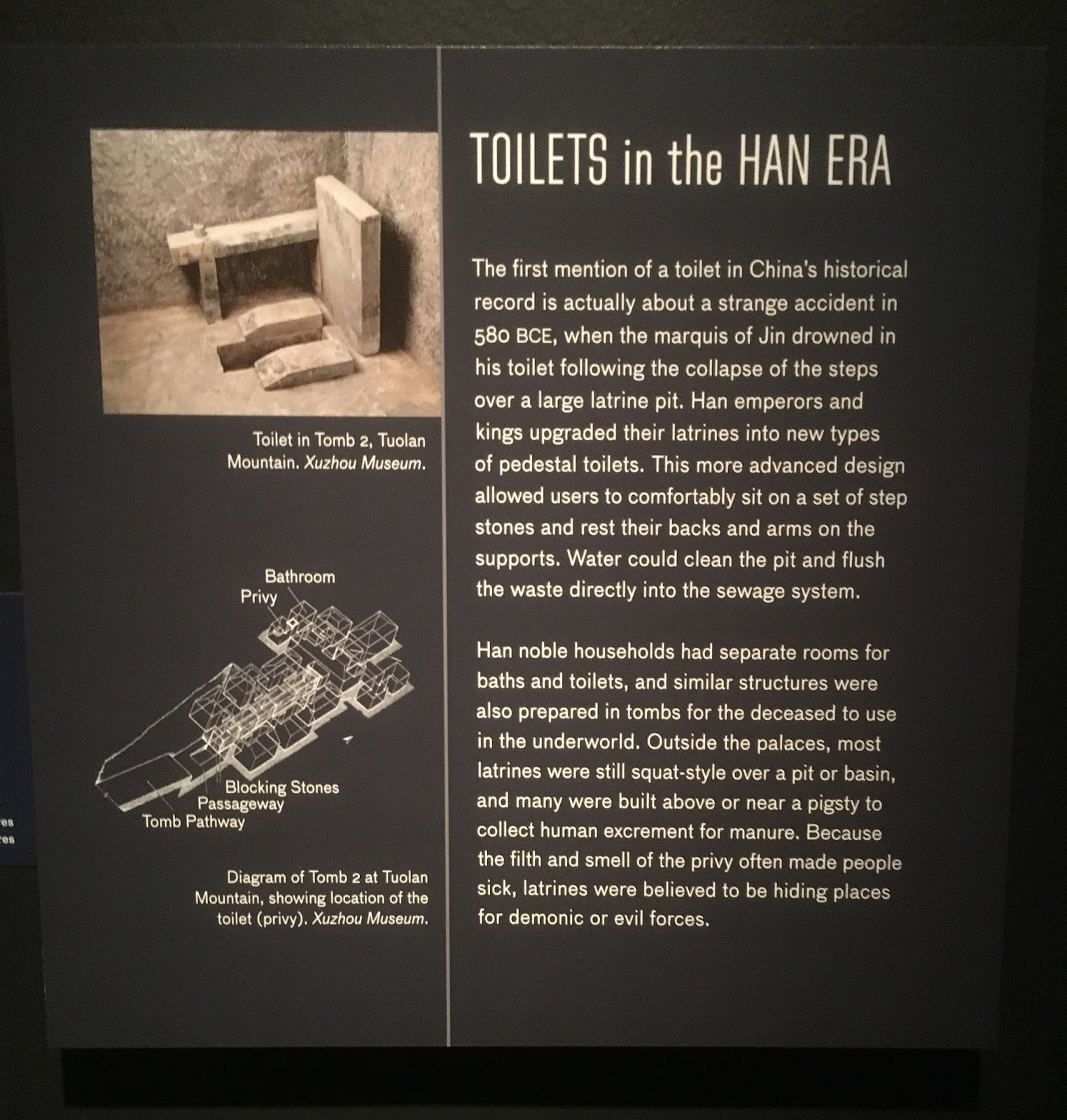
The museum exhibits a replica of what the Han dynasty (206 BCE–220 CE) offered its nobility for this necessity:
As the exhibit notes explain, facilities for common people were nowhere near so elegant, resulting in a stench which provoked folk tales that dangerous demons hid in privies. Modern science would conclude that this wasn't altogether wrong.
Sunday, March 26, 2017
ICE, immigrants, and criminals
Calls from community members and the offices of Senator Feinstein, Rep. Matsui, Rep. McCarthy, Rep. Harrison, and Rep. Pelosi could not stop the ICE human-grinder. Martin was summarily shipped off to Mexico.had no criminal record, had lived in this country for 26 years, his two sons are citizens, and he ended up in deportation proceedings because he was a victim of a fraudulent "notario" [a quack posing as a "lawyer"] 10 years ago. The case was litigated in court, appealed and finally lost for 10 years, and on Wednesday, when he showed up for his green card interview, he was detained and put on the deportation bus.
Sometimes community intervention can win a stay that leaves room for additional legal pleadings. Here's a heartening story of State (a senator) and Church (an archbishop) combining with community pressure to keep a sick elder in this country, at least for awhile.
Immigrants and their advocates naturally point out that these people are NOT criminals under any reasonable definition. But this argument has its own pitfalls.In 2016 more than 60,000 immigrants were cast out from the United States on criminal grounds. According to ICE, “criminal removals” comprised 92 percent of all deportations from the nation’s interior last year, compared with only 3 percent in 1980. Yet immigrants are not committing more crime than in the past. Rather the definition of “criminal” has broadened significantly since the 1990s, when the federal government began criminally prosecuting immigration infractions that were previously enforced as civil matters, while also deporting an unprecedented number of immigrants with minor criminal records. So-called criminal deportations bring into clear focus our nation’s “crimmigration” system, where immigration policy, criminal law, and their corresponding enforcement apparatuses are tightly intertwined. ...
Draconian immigration enforcement -- and the War on Drugs -- and mass incarceration are all elements of Making America White Again (MAWA), all made explicit by the Trump/Bannon gang.... the oft-made claim of innocence furthers a disturbing respectability politics that aids the Trump administration’s assault on communities of color. By insisting that most immigrants do not deserve to be deported, advocates leave unchallenged the idea that the criminals do. The good immigrant narrative misses the ways that overpolicing and mass incarceration produce a reservoir of immigrants with criminal records, creating an endless chain of detentions and deportations....
The Reagan, Bush I, Clinton, and Bush II administrations bloated police department coffers and put tens of thousands more cops in communities of color. More police and bigger budgets meant more arrests, more convictions, and more incentive to police to maintain agency resources. The overpolicing of low-income neighborhoods has meant a sharp increase in the number of immigrants of color encountering the criminal justice —and thus the deportation—systems. In particular, more and more black and brown immigrants, both undocumented and authorized, were arrested and convicted of drug crimes, received longer sentences than their white counterparts, and then were deported. Between 2007 and 2012, there was an increase of 22 percent (totaling 260,000 deportations) in the number of lawful permanent residents and undocumented immigrants deported for drug offenses. Research shows that black deportees are the most likely to be legal permanent residents deported for drug convictions. The intersection of anti-drug policy and the Department of Homeland Security’s expanded deportation powers reflect and reinforce anti-black racism in our nation’s system of law, yet are rarely challenged in tandem. ...
While the good/bad immigrant debate is now being challenged by the immigrant rights movement and civil liberties groups (most notably the ACLU), progressive politicians and organizational leaders have yet to follow suit. Many states, cities and universities are creating sanctuary policies that make exceptions for criminal immigrants. ...
Although there has been growing awareness and action around the abuses behind mass incarceration, too often have they been siloed from discussions of and advocacy around mass deportation. Public pressure has forced many states to remove three-strike laws from their books, but few in the public are aware that the government may deport a non-citizen who has three misdemeanor convictions. Calls to roll back oversentencing in the criminal justice system have not made connections to deportation as a form of extreme punishment. ...
Resist and protect as we can. Join an Emergency Response Team in Northern California.
Saturday, March 25, 2017
Commentary on Mr. Trump's terrible, no good day yesterday
Friday, March 24, 2017
Too good

Stolen from someone I don't know on FB.
Let's remember: when your opponent is sinking, toss him an anvil. Don't ease up. We've got a long way to go.
What does the Trump administration really think about torture?
But very likely this is much more telling:
Guess the Great Tangerine likes him some cruelty to people who get in his way. I have no doubt he'd love to put some obstreperous lawyers on the water board, when he takes a break from trying to wrench health care away from poor people.The United States has declined to join other countries in criticising China over allegations of torture against human rights lawyers.
The UK, Germany, Canada and eight others signed a letter raising concerns about lawyers and rights activists detained incommunicado for long periods.
The letter urges China to investigate torture claims against lawyer Xie Yang and others.
Friday cat blogging
Thursday, March 23, 2017
From inside the wire

One of the things the organization Critical Resistance does that hardly anyone does is ask prisoners what they think. Prisoners have their own, multifaceted and not necessarily uniform, takes on the goings on in the world outside.
The entire collection of responses, including images of original letters, are posted at Prisoners Speak Out: Analysis and Perspectives.Recently, [CR] asked imprisoned people to share their reflections on Trump's presidency and how to strengthen our resistance to what some see as rising fascism. Lacino, Robert, and Asar (quoted here), as well as others have generously offered their analysis and experience.
... The testimonies include excerpts of letters from immigrants, Black men and other men of color, people sentenced to the death penalty or life without parole (the other death penalty), gay people, and people imprisoned in California, Pennsylvania, Florida, and South Carolina.
Asar Imhotep Amen wrote from California State Prison - LA County:
Lacino Hamilton, imprisoned at Chippewa Correctional Facility, Kincheloe, Michigan, had this to say:"Trump's regime will greatly affect me, along with the community at large as well as all presently incarcerated people... Trump's regime serves a deliberate and specific purpose in sustaining white terror, power, and domination. In other words, the relationship between people of color, along poor white folks in America and the holders of state power in the United States is similar to that which exists between the colonized and the colonial master."
Robert Chan, imprisoned at California State Prison - LA County, added his view:Repression doesn’t come and go, it merely becomes more or less evident, as its "spectacular episodes" are spaced closer or farther apart. Donald Trump being an expression of a "spectacular episode". Repression is a permanent blanket covering the movement. Many people don't think this is so, because you don't notice the difficulty you have trying to breathe. This is because you’ve become accustomed to the reality and the weight of the blanket, long gaps between "spectacular episodes” have given many of us the impression that the blanket had been "pulled back” or “lifted". But it’s been here all the time, before Trump was elected president, and we’ve learned to move under its weight, and now consider this type of repression to be normal.
I figure I'm called to live up to Mr. Chan's expectations -- will I?Now is the time to stand with our free-world allies as they daily protest Trump's latest ugly declarations and executive orders. In our thoughts and in our prayers, with our hearts and with our words, we stand with the oppressed and all progressives fighting for social justice. Never before have I been so surprised and inspired by the outpouring of unity that's coalescing in the sea of courageous people stepping up against tyranny.
Wednesday, March 22, 2017
Water for the city
Who knew there was an aquifer there for the tapping under the Sunset District? It's easy to look at this and wonder -- is this a construction boondoggle for politically connected contractors? Well, maybe. But this city has added 150,000 residents since 1980. And new San Franciscans keep on coming, for all the congestion and crazy housing costs. Building some forward looking infrastructure seems a good idea.Smart, reliable, resilient and local: Groundwater for San Francisco
... Developing local groundwater can help diversify our supply portfolio and ensure we have a local source for water should a drought, earthquake or other disaster interrupt our Hetch Hetchy supply.
In March, 2017, the San Francisco Public Utilities Commission (SFPUC) will start pumping groundwater from the Westside Groundwater Basin aquifer that extends to approximately 400 feet below the surface in San Francisco. The groundwater will be treated and blended with our regional drinking water supplies before it is delivered to our customers. Over the next few years we will continue adding groundwater in order to reach our goal of blending 4 million gallons a day (mgd) of treated groundwater with our regional water supplies by 2020.
... On an average day the City of San Francisco – including our residents, businesses and visitors – will continue to rely primarily on the Hetch Hetchy Regional Water System, a system that combines the resources of the Hetch Hetchy Reservoir with 5 reservoirs in the Bay Area, for 60 million gallons of drinking water. Adding groundwater to our regional water supplies makes San Francisco’s water supply more reliable, particularly in the event of droughts and emergencies.
Because everyone needs a clean place to take a dump
The community has pledged 10% of construction costs and to do all the labor, but they need materials.
- $25 - fifteen bags of sand
- $50 - seat & concrete slab
- $150 - metal superstructure
- $485 - 1 household double-pit latrine
Tuesday, March 21, 2017
Tools for resistance: on the lookout for fake news
This works better in a campaign than in governing. Reality bites in the real world. Running hard up against reality -- families broken by deportation, lost health insurance coverage, shuttered food stamp offices -- makes for painful encounters with undisguised truth.

Still, we can work not to play along with the disinformation environment. Let's leave the false stories to the other guys and strive to be sure that we are aren't buying into tales that just aren't so.
Several points:
- If a headline grabs your attention -- and particularly if it is something that feeds your political assumptions -- CHECK around a little. Do you know the publication/site that it came from? Is any other well known source also reporting the story? The big newspapers and CNN have lots of faults, but they don't (usually, though occasionally they'll print a conspiracy fable-maker) run with completely unverified rumors. If something seems just too juicy, or too prejudicial, or too satisfying, to be true, it might be false, even in the age of Trump.
- When you make yourself a source of information (say you write a blog), think hard about how you "know" what you "know." The American Press Institute describes an instructive, easily understood, "hierarchy of accuracy" that journalists can use before deciding to spread something around.
Some facts, quotes, assertions and color are more reliable than others.
The stuff that comes from an eyewitness is better than that which is second-hand.
The stuff that you know for yourself is better than the stuff someone else supposedly checked out … or did they? ... Beware of the idea that you have to post a story because it’s “out there” — floating around.
- Get help. Check out media reporter Craig Silverman's reports on fake news at Buzzfeed. For example, A Trump Official Did Not Say “It’s Better For Our Budget If Cancer Patients Die More Quickly.” Silverman writes a newsletter about this topic. Subscribe here.
- Learn from others who are wrestling with evaluating stories for accuracy. Amnesty International has launched an international Digital Verification Corps working to
This is an inspiring project.blow the whistle on inauthentic materials depicting human rights violations. But equally important is our work at using advanced digital methods to curate reliable multimedia data that can be used to demand accountability for human rights atrocities. The relevance of this work cannot be overstated, especially in an era where everyone with a cell phone camera is a potential news reporter.
- Even more inspiring, given the hard circumstances under which they work, is Stop Fake, a Ukrainian NGO striving to combat a deluge of disinformation from nearby, hostile Russia. Their catalogue of tools includes such articles as How to Spot Visualization Lies (misleading statistical presentations and infographics) and How to Save Online Evidence and Why It Matters.
Monday, March 20, 2017
Judicial horrors
I'll be watching whether Democratic Senators raise two issues in hearings:
- Torture: During the GW Bush administration, Gorsuch was one of the merry band of torture apologists at the Justice Department making up rationales for the divine right of the President to order whatever extra-legal measures he might like in his war on an adjective. It's going to be the supreme test of our legal system whether judges will constrain a runaway president who can always cook up a national "security" threat when he wants to justify something foul. My often disappointing Senior Senator, Diana Feinstein, is the lead Democrat on the Judiciary Committee and, after being mistreated by the CIA herself when looking into abuses, has developed a bee in her bonnet about torture. So she might push for answers in this area.
- Birthright citizenship: I don't know if any Democrat will raise this, but they should. Maybe Senator Maize Hirono of Hawaii could do it; it would be good to hear it from a person of color. The Trump/Bannon project of MAWA (Making America White Again) founders on the fact that anyone born in the country is automatically a citizen under current interpretations of Congressional citizenship statutes and the 14th Amendment to the Constitution. A citizen is any "person born in the United States, and subject to the jurisdiction thereof." But right wing legal activists hope that the application of this principle to children of undocumented immigrants could be ended by simple act of Congress, if concurred in by a sympathetic Supreme Court. They'll go there if they have a chance; the MAWA project is a desperation move, and fails so long as people of color can't be kept from citizenship whether by exclusion or voter suppression and/or incarceration. The great contemporary historian of the Reconstruction era when the US adopted birthright citizenship, Eric Foner, writes of birthright citizenship:
Those were a different kind of Republicans. The 14th Amendment, as Republican editor George Curtis wrote, was part of a process that changed the US government from one “for white men” to one “for mankind.”
Sunday, March 19, 2017
For Lincoln, the country was about a growing, a wider, citizenship
Abraham Lincoln celebrated that truth in July 1858 when the country was still only a few generations old. In one of the famed Lincoln-Douglas debates during his unsuccessful campaign for the Senate, he explained:
It's strange today to read that Lincoln was considered the plain speaker in this oratorical contest; Judge Douglas was the polished orator. Have debates degenerated or merely changed? Is it the spin or the consumers of politics who have changed?... We are now a mighty nation, we are thirty—or about thirty millions of people, and we own and inhabit about one-fifteenth part of the dry land of the whole earth. We run our memory back over the pages of history for about eighty-two years and we discover that we were then a very small people in point of numbers, vastly inferior to what we are now, with a vastly less extent of country,—with vastly less of everything we deem desirable among men,—we look upon the change as exceedingly advantageous to us and to our posterity, and we fix upon something that happened away back, as in some way or other being connected with this rise of prosperity.
We find a race of men living in that day whom we claim as our fathers and grandfathers; they were iron men, they fought for the principle that they were contending for; and we understood that by what they then did it has followed that the degree of prosperity that we now enjoy has come to us. We hold this annual celebration to remind ourselves of all the good done in this process of time of how it was done and who did it, and how we are historically connected with it; and we go from these meetings in better humor with ourselves—we feel more attached the one to the other and more firmly bound to the country we inhabit. In every way we are better men in the age, and race, and country in which we live for these celebrations.
But after we have done all this we have not yet reached the whole. There is something else connected with it. We have besides these men—descended by blood from our ancestors—among us perhaps half our people who are not descendants at all of these men, they are men who have come from Europe—German, Irish, French and Scandinavian—men that have come from Europe themselves, or whose ancestors have come hither and settled here, finding themselves our equals in all things.
If they look back through this history to trace their connection with those days by blood, they find they have none, they cannot carry themselves back into that glorious epoch and make themselves feel that they are part of us, but when they look through that old Declaration of Independence they find that those old men say that “We hold these truths to be self-evident, that all men are created equal,” and then they feel that that moral sentiment taught in that day evidences their relation to those men, that it is the father of all moral principle in them, and that they have a right to claim it as though they were blood of the blood, and flesh of the flesh of the men who wrote that Declaration, (loud and long continued applause) and so they are.
Of course there were a lot people left out of Lincoln's ringing 1858 declaration from a contemporary perspective. Did these voters' sisters count? What about the indigenous people dispossessed in Lincoln's west? But, later, when he had the chance, Lincoln did get around to doing something about the people most excluded from that vision.
Saturday, March 18, 2017
Hannah Arendt on Evil
When I wrote my Eichmann in Jerusalem one of my main intentions was to destroy the legend of the greatness of evil, of the demonic force, to take away from people the admiration they have for the great evildoers ...
I found in Brecht the following remark:
The great political criminals must be exposed and exposed especially to laughter. They are not great political criminals, but people who permitted great political crimes, which is something entirely different. The failure of his enterprises does not indicate that Hitler was an idiot.Now, that Hitler was an idiot was of course a prejudice of the whole opposition to Hitler prior to his seizure of power and therefore a great many books tried then to justify him and to make him a great man. So, Brecht says, “The fact that he failed did not indicate that Hitler was an idiot and the extent of his enterprises does not make him a great man.”
It is neither the one nor the other: this whole category of greatness has no application.
“If the ruling classes,” Bertholt Brecht goes on, “permit a small crook to become a great crook, he is not entitled to a privileged position in our view of history. That is, the fact that he becomes a great crook and that what he does has great consequences does not add to his stature.” And generally speaking he then says in these very abrupt remarks: “One may say that tragedy deals with the sufferings of mankind in a less serious way than comedy.”This of course is a shocking statement; I think that at the same time it is entirely true.
What is really necessary is, if you want to keep your integrity under these circumstances, then you can do it only if you remember your old way of looking at such things and say: “No matter what he does and if he killed ten million people, he is still a clown.”