Friday, February 12, 2010

Budget follies short-takes:
Where did the deficit come from?


Click on the image to open it larger in a new page. It presents a clear history where the famous deficit orginated.

At the end of the Clinton presidency, the federal government wasn't running a deficit: it had a surplus! However Bush II fixed that quick. First there were the tax cuts (mostly on the wealthy) so the government brought in less money. Then there was the economic downturn after 9/11 and tax receipts fell some more. Then we went to war twice (!) without making any provision to pay for it. Wouldn't want people to think that wars cost money, would you?

Finally, Republicans rammed through Congress the Medicare Part D drug benefit, a jerry-rigged edifice that prevents the feds from bargaining down drug prices, leaves some elders in the lurch by not paying for prescriptions that fall into a "donut-hole," and which never had any plan for the government to cover costs except by deficit spending. Not exactly good fiscal management, any of that.

Then Wall Street financial shenanigans brought the banking system to the verge of collapse in 2008 and the government had to bail them out. Or at least so everyone in charge was convinced. That cost billions. And along came the Great Recession (which we're only coming out of if you believe the evidence of statisticians rather than your own experience and your neighbor's) so tax receipts fell. President Obama and the ruling Democrats pushed through the stimulus and are now working on a "jobs stimulus" and that cost some more on top of the Bush legacy.

And that is the source of the deficit. How do we pay it off? Historically, the U.S. has been about to pay its debts because our economy grew, we accumulated new wealth, and remained a safe borrower. Unless the economy has permanently lost its dynamism, that's what will happen again.

Trying to fix the deficit when the economy needs to be put back on its feet is simply insane. What we need now is to get going again, not to cut off the federal pump. That's the only way to pay off the long term debt.

(Since we're in national budget season, I'm not going to to resist offering occasional short comments on budget matters and process under this headline, just as I have done about health care reform. I have strong foundational views on what the U.S. government ought to be doing about and with taxpayers' money that I've laid out in this post.)

OFA says "we'll fight"

ofa-hours.jpg
As of this morning, Organizing for America has accumulated activist pledges of 3.3 million hours on behalf of Congresscritters supporting health care reform.

Congressional Dems better pass the thing. It's one matter to disappoint political junkies who have watched every twist and turn of this process and have seen most of its progressive components dropped to win acquiescence from insurers, doctors, hospitals and the pharmaceutical industry. But now the Democratic powers-that-be are trying to call into action people who just know health care reform is the right thing to do. That's a potent force when organized for action as the Obama campaign showed. But should those folks slip into cynicism, the long term harm to hopes for U.S. democracy will be incalculable.

We're very close to slipping off a cliff here. I hear it every day.

Thursday, February 11, 2010

Health care reform shorts:
The tort reform byway

we-can't-afford-to-wait.jpg

Republicans keep insisting that "tort reform" -- limiting damages or forbidding lawsuits altogether for medical malpractice -- is a way to lower health care costs. Today in his online chat, policy wonk Ezra Klein says no way:

There is no evidence -- zero, non, zilch -- that even aggressive tort reform dramatically changes spending.

Anyone who lives in California and has been around that block knows this is true. We've had aggressive tort reform and our health care sure isn't cheaper.

Republicans like tort reform because they hope it will starve the lawyers who represent people who suffer medical harm and who overwhelmingly contribute to Democrats. This is about political money, not policy.

And nobody is talking about the real driver of malpractice and medical injury lawsuits: the fact that we have no meaningful national health insurance and welfare scheme. If some doctor kills your spouse through obvious error, you sue because you've been robbed of their earnings.

The consequences of malpractice look to an insurer just like any other "pre-existing condition." If your doctor has amputated the wrong limb (it happens!) or you've contracted a hospital infection that leaves you debilitated, insurance companies sure don't want to pay for the lifelong consequences. You get denied, so you sue.

Even if the most dire consequences of medical error don't happen, you know they could, so you're afraid they might. So you sue.

Want to reduce medical lawsuits? Reduce anxiety about access to medical care!

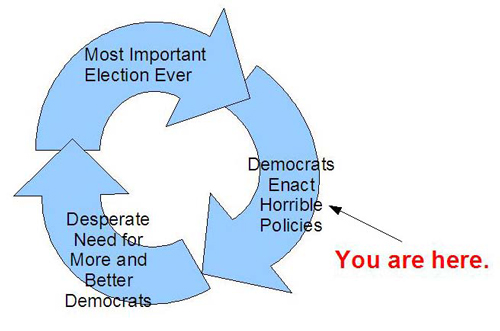
How to break the cycle?

MoreAndBetterDemocratsCycleYouAreHere1 21-03-35.jpg
In this disappointing winter, as we watch Democrats we put in power flap about weakly, Christopher Hayes in the Nation offered an answer to that question:

What the country needs more than higher growth and lower unemployment, greater income equality, a new energy economy and drastically reduced carbon emissions is a redistribution of power, a society-wide epidemic of re-democratization. The crucial moments of American reform and progress have achieved this: from the direct election of senators to the National Labor Relations Act, from the breakup of the trusts to the end of Jim Crow.

So in this new year, while the White House focuses on playing within the existing rules, it's our job as citizens and activists to press constantly for changes to those rules: public financing, an end to the filibuster, the breakup of the banks, legalization for undocumented workers and the passage of the Employee Free Choice Act, to name just a few of the measures that would alter the balance of power and expand the frontiers of the possible.

If I had to bet, I'd say that not of one of these will be won this year. The White House won't be of much help, and on some issues, like breaking up the banks, it will represent the opposition. Always searching and never quite finding is grueling and often dispiriting work. But there is simply no alternative other than to give in and let the field turn hard and barren.

Despite Tea Party whiners and Dick Cheney, I still believe in popular action for democracy. This is always hard work.

Graphic from Democracy in Action.

Wednesday, February 10, 2010

Afghanistan atrocities ahead?

In the next few days, it is very likely that atrocities will be committed by the forces of the United States in Afghanistan. I know that's a strong statement, but think about this sequence of events ...

Last week the NATO command in that country (that's U.S. mainly, as you probably know) held a press conference as reported in the New York Times:

KABUL, Afghanistan-- NATO and the Afghan military are about to launch their biggest joint offensive of the war, and they appear to be making sure the Taliban know they are coming.

On Wednesday, spokesmen for the Afghan Defense Ministry and for the NATO forces announced at a news conference that an offensive involving thousands of troops would begin "in the near future," and while they did not confirm the place, they also did not dispute widespread speculation that the target was the Taliban-held town of Marja.

... If Taliban were to withdraw in advance of the offensive and civilians had ample warning, there could be fewer military and civilian casualties.

"In some cases it may make sense, with a population-centered strategy, to give an awareness where U.S. and Afghan forces are going, and give an opportunity for Taliban and insurgent forces to clear out," said Seth Jones, a RAND Corporation senior political scientist who specializes in Afghanistan. Gen. Stanley A. McChrystal, the American military commander in Afghanistan, has emphasized a counterinsurgency strategy that focuses on reducing civilian casualties and convincing the local population that the Americans and NATO can protect them.

That makes some sense, assuming the people ever heard the announcements and could find somewhere to go. Though unless things presently are unbearable in Marja, they'd probably actually prefer not to be on the receiving end of a massive military attack.

Apparently a good-sized part of the Afghan population of Marja has been getting out. And the commander of the Western troops opines that's a good thing.

Operation Moshtarak will see NATO troops - backed by special forces, war planes, attack helicopters, tanks and drones - attack suspected guerilla bases. ... US Second Marine Expeditionary Force commander Larry Nicholson said that the evacuation of most civilians would give commanders leeway to use air-to-ground missiles, declaring that he was "not looking for a fair fight."

Can't blame him. He doesn't want to be shot at any more than the Marja residents do.

On the other hand, someone in NATO headquarters decided they should start telling residents of the southern Helmand area not to leave. According to Reuters today:

NATO forces have decided to advise civilians in Marjah not to leave their homes, although they say they do not know whether the assault will lead to heavy fighting. "The message to the people of the area is of course, keep your heads down, stay inside when the operation is going ahead," [NATO civilian representative Mark] Sedwill said.

...Under international law, NATO forces are obliged to provide humanitarian assistance to anyone who chooses to flee the assault, said Brad Adams of Human Rights Watch. Having advised civilians to stay instead -- helping ensure the area remains heavily populated during the offensive -- they bear an extra responsibility to control their fire and avoid tactics that endanger civilians.

"I suspect that they believe they have the ability to generally distinguish between combatants and civilians. I would call that into question, given their long history of mistakes, particularly when using air power," Adams said.

Yeah, if I lived in Marja I'd be frightened, confused and very worried.
And to a very considerable degree, I would know what was coming. You see, as Joshua Foust explains, this will be the fourth time since 2007 that Western forces have fought their way through the area. For what?

Public estimates indicate the town of Marjeh holds, at the most, 1,000 or so Taliban operatives—men who have vowed to blend into the civilian population when the troops arrive. It also contains some of -- but by no means the majority-- of Helmand’s vast opium industry. ...

To long term observers of Afghanistan, these operations happen with a depressing regularity-- and all too often the coverage resembles cheerleading more than it does journalism. ... please do not act surprised when we have to have another "surge" next year when more troops arrive, and please do not act outraged when all the farmers prevented from planting opium this year freak out because they're defaulting on their narco-debts and their economies are crashing.

So okay, all the U.S. posturing and journalistic noise from Afghanistan may be so much smoke; this is war, after all. But I claimed immanent atrocities -- what's that about?

The atrocity is that no one has given any plausible reason why thousands of Afghans should be displaced and some number killed, their livelihoods destroyed, and nothing really changed except those still alive left more vulnerable and miserable. The military doesn't intend atrocities, but atrocities are an unavoidable by-product of a war without purpose or end.

Al-Qaeda isn't in Marja -- bin Laden decamped to Pakistan years ago. The NATO troops will leave the burned out town -- maybe next year, maybe next month. Western troops won't hang around anywhere in Afghanistan forever; their countries will stop paying for this war in lives and treasure. Afghan soldiers or police from other parts of the country may hang around for awhile -- or not. The Taliban may fight -- or melt away -- and certainly come back, because some of them live there. This has been going on for 9 years since the U.S. arrived and 30 years since the Soviet Union took a turn at tearing up Afghanistan. Fighting over these places builds nothing; it only destroys. Time to just stop it.

Here's a clip from a displaced persons' camp outside Kabul so we can at least look at the people we are driving from their homes for no defensible plan or reason.

Tuesday, February 09, 2010

Health care reform shorts:
Hope for health care reform?

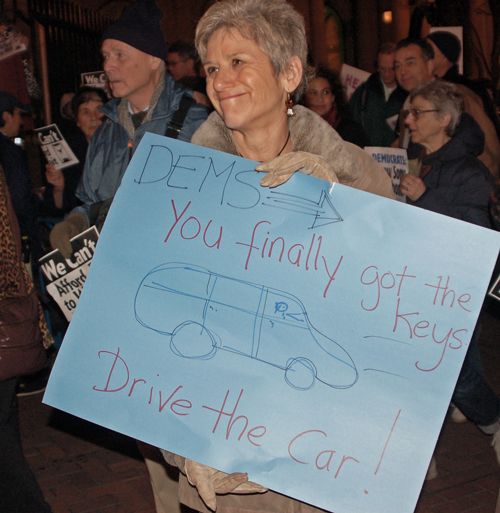
democrats-drive-the-car!.jpg
Well, maybe. If I'm to judge by my email inbox, the Obama administration seems to have noticed that it will be catastrophic among it core supporters to appear to have given in to Republican (and Democratic) obstructionism. The President's proposed talkathon is an element of this, but there is more.

Over the last couple of days I've received four (!) emails from various parts of Organizing for America (OFA) urging me to swing into action. Just this morning from head honcho Mitch Stewart:

A few days ago, President Obama told a story about an OFA supporter in St. Louis who had volunteered during the campaign and organized her community for health reform, but recently succumbed to breast cancer. She didn't have quality insurance, so she put off crucial exams and didn't catch it early enough. And while she fought cancer, she also spent her final months fighting for a chance at health reform so others wouldn't go through the same thing.

The President told this story to remind Congress, the nation, and us: We can't tell her family we're giving up on reform because it's too hard, or too risky.

Okay, so what are we supposed to do? Visit the Action Center where I'm enabled to call my Congresscritters, email them, or write a letter to a dead tree paper. What am I supposed to say in these communications?

Many of our senators and representatives are working overtime to gather support for a final bill and pass reform, and they should know we're standing with them. And the rest need to understand their constituents still demand action.

Vague enough for you? Think that will goose the reluctant?

OFA is marginalized because it has failed to involve and educate its citizen base in both how Congress works and how the health reform might work. Without that kind of background -- background that would enable targeted communication that forced legislators to take notice of the rage in their home towns -- they might as well ask people to wave their hands in the air.

Yes, it would have been hard to do that citizen education work while operating as a subsidiary of the Democratic National Committee -- the DNC protects and acts on behalf of the Democrats we have, rather than the Democrats we need if we are to make progressive change. But to build on the bright promise implicit in the successes of the 2008 campaign, OFA needs the freedom to needle Democrats as much as knuckle-dragging Republicans. And the people it attracted need education in more sophisticated citizen action than simple voter mobilization. Citizen education is an organizing task that OFA should be good at, though it is neither dramatic nor cheap.

Probably can't happen. Too many Democrats in office fear an engaged citizenry. But OFA still deserves watching as desperately tottering politicians, something Obama is soon likely to be, sometimes move in unexpectedly audacious directions.

Budget follies short takes:
More on those people who won't pay taxes

tax-&-income-shares.jpg
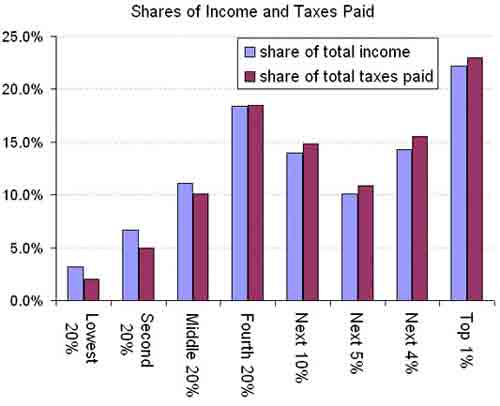
The blue bars are the share of national income earned by the population segments listed at the bottom; the magenta bars are the share those population segments pay of all taxes collected. This actually seems more than equitable, until you remember that the groups on the right enjoy about the highest standard of living of any people who ever lived. From Citizens for Tax Justice via Jonathan Chait.

I like this by Daniel Gross from Newsweek:

I have two pieces of bad news for the over-$250,000 crowd. First, the reversal of some of the temporary Bush tax cuts is probably inevitable, given the appalling mismanagement of fiscal affairs between 2001 and 2008. ... Second, for those of you making more than $250,000, I regret to inform you yet again: Yes, you are indeed rich—any way you slice it.

To a surprising degree, feeling rich or poor is a state of mind. There are people who pull down $3 million a year who are miserable and feel strapped for cash and people who make $30,000 a year who believe they have everything they need. But income data can surely tell us something. And they tell us that $250,000 puts you in pretty fancy company, especially after the collective pratfall the economy took in 2008.

If you think it is important to balance the budget (or reduce the deficit), you are going to have to tax rich people who will always howl. And you are going to have to rein in military spending. There are no other measures that will do the job and maintain some semblance of common responsibility for the general welfare.

(Since we're in national budget season, I'm not going to to resist offering occasional short comments on budget matters and process under this headline, just as I have done about health care reform. I have strong foundational views on what the U.S. government ought to be doing about and with taxpayers' money that I've laid out in this post.)

Monday, February 08, 2010

Alternative voting -- ranked choice voting -- instant run-off voting

Every once in a while I write a screed against "instant run-off voting" (or as "ranked choice voting") as we call it in San Francisco. Here's a sample from 2007 that gets to the guts of my abhorrence of this voting method:

Ranked choice voting has appealed to progressives as somehow "cleaner" or "nicer" than good old, ordinary, messy ugly politics. But it is just a gimmick -- we'll get from democracy exactly what we put into the fight for the sort of city and society we believe in. No voting gimmick is going to bring out more poor and working people to demand their officials represent their interests -- that takes laborious, frustrating, base-building organizing, not a bright shiny voting system.

Given that this is one of my hobby horses, I'm interested to see Renard Sexton at 538 reporting that British Prime Minister Gordon Brown is supporting a referendum on "Alternative Vote" -- that country's name for this system. The object according to Sexton is to make nice with the Liberal Democrats in case Labour could cobble together a majority in coalition with them after losing seats in the upcoming election.

The article reminded me how different politics are in a place where there are more than two functioning political parties and those parties, at least ostensibly, stand for discernible policy platforms. I get to see and practice IRV in what are called "non-partisan" elections that are usually intra-Democratic party affairs with occasional Green, left or anarchist outliers. At our scale, these contests remind me of high school -- winning personalities count for a lot, policy only secondarily, though there are lines some candidates can't cross in some areas, for example failure to support tenant rights.

In the British context, IRV could enable Liberal Democrats and regional parties to win more seats, at least theoretically. But Sexton explains one likely result that is the best argument I've ever heard for IRV:

The main added-value of the AV (we'll use the British acronym for now) is that it allows voters to rank their choices, rather than just voting for one prospective MP. In effect, you can still cast that initial protest vote or two without losing the chance to cast your final lot with the lesser of the two remaining evils if your top choice candidate does not make it. In an American context, it would be like if in 2000 all the Ralph Nader voters in Florida could have had their votes switched to their second choice candidate in the case when no candidate reached a majority initially.

That's the best argument I've heard yet for this voting method. Since somebody is going to win, we do want to default to the least evil. But wouldn't it be nice to be able to vote for someone we thought expressed our actual inclination toward government without risking thereby putting in the most evil?

Take a hypothetical local example. Suppose, yet again, we're faced with the loathsome Diane Feinstein running for Senate in 2012. And it is a tough year for Democrats and she has a real Republican challenger, so we have to decide whether to hold our noses and try to ensure she gets back in, or just skip voting. It would feel better to be able to vote for Bozo the Clown as number one and only then list DiFi. Now there's a good use for IRV.

Spooks impeded?

According to the Atlantic's Marc Ambinder:

About 80 percent of the world's telecom traffic was handled by routers based in the United States before 2001. After the [illegal National Security Agency listening] program was revealed by the New York Times in 2005 and the government tacitly acknowledged that it had set up special technology to monitor the routers, the percentage of worldwide telecom traffic that the U.S. had immediate access to dropped dramatically, according to a technology expert who informally advises the government said today.

Kim Taipale, the executive director of the Center for Advanced Studies in Science and Technology Policy, told an audience at the University of Texas Law Review today that he estimated about 20 percent of worldwide traffic is now routed through the U.S.

Why? As soon as countries realized the extent to which the U.S. essentially controlled the traffic flow, they and their contractees built facilities overseas. Even U.S. telecoms, seeking to avoid surveillance requests from the U.S. government and potential lawsuits from consumers, began to move their capacity outside the U.S.

That is, when Congress, finally, gingerly, stepped in and set some weak limits on how our spooks could collect every electronic communication they could physically get their hands on, world commerce decided to go elsewhere.

I think it very unlikely that any of this actually prevents the NSA from capturing all electronic communications -- go online and the NSA is in bed with you; I assume everyone knows that. It's not clear that any legal privacy regimen can prevent abuses in this area.

But it is sort of pleasant to realize that known U.S. abuse has undercut U.S. market domination in telecommunications. Breaking even uncodified international rules has consequences ...

Sunday, February 07, 2010

Not all news is bad

Speaker Pelosi's office clearly has a fine statistical display artist. Check out this chart:

Readable version here.

Though this is designed to score political points, that doesn't make it false. We'll see.
***
Meanwhile I went in to see my barber Friday. She's a sole proprietor, the very essence of a small business person. And she was mad. She had just read in the newspaper that "that guy Scott Brown says the stimulus didn't help anyone."

"I know better!" Her husband, an electrician, had just got on a long term job at the airport after 15 months out of work. "First they extended his unemployment so we were able to keep our house. Now he's on a project that will go at least a year thanks to the stimulus. The building had shut down, but it started again when the money came in."

She decided she is going to write a letter to the newspaper. "They never explain when one of these politicians says things that aren't true."

That's citizenship. And that's good news.

Two Super Bowl response ads: one to CBS, one to Tim Tebow


Take that marketing execs.

This isn't so much fun, but Planned Parenthood offered its own response ad:

Saturday, February 06, 2010

On beyond the Super Bowl ...

comes the Winter Olympics in Vancouver, BC in mid-February. As per usual, the host city wishes its poor citizens would disappear for the duration. Some locals don't want Vancouver to get away with this ...

Saturday scenes and scenery:
California is weird

I'm still, after about 40 years, enough of an east coast transplant to think Spring ought not to show up on the first day of February. But it sure was happening on San Bruno mountain just south of San Francisco. I offer these cellphone photos of flowers (and one hazard) as evidence of the local oddness.


If the slideshow doesn't work, the set is here.

Friday, February 05, 2010

Friday cat blogging

Billie-close-up.jpg
Billie won't mind at all that the Sunday afternoon thing the humans do with all the yelling and drinking is almost over for another year. Not that he'd allow himself to be scared off his perch. But you have to be wary.

The humans meanwhile prepare to experience football withdrawal. Or maybe Olympics. Skating anyone?

Budget follies short-takes:
Waa, waa, waa: I want mine!


One of the two pillars that make deficit reduction and responsible governance that "promotes the general welfare" (that's from the Constitution in case you've forgotten) so very difficult is the refusal of rich people to pay taxes. More taxes to do anything useful will have to come from rich people: they are the ones with the money. But the conservative polling outfit Rasmussen has documented that magical thinking wins out:

President Obama has now turned his attention to the ballooning federal budget deficit, but a new Rasmussen Reports national telephone survey finds that a modest plurality of voters (41 percent) prefer a budget deficit with tax cuts over a balanced budget that requires higher taxes. Thirty-six percent (36 percent) would rather see a balanced budget with higher taxes. Twenty-three percent (23 percent) are not sure which is better. ...

...almost half (47 percent) of GOP voters think it’s possible to balance the budget without raising taxes, but 53 percent of Democrats don’t....Those in the Political Class are twice as likely as Mainstream voters -- 70 percent to 35 percent - to believe it is not possible to balance the federal budget without raising taxes.

"Mainstream" is Rasmussen's tendencious label for voters who "tend to trust the wisdom of the crowd more than their political leaders..." That is, the Palinites and many others of numerous stripes, including the large fraction of us who want to protect the privileges of the rich because we think maybe we'll join them some day. I wonder if what looks like future prolonged economic stagnation will disabuse more of us of this fantasy?

(Since we're in national budget season, I'm not going to to resist offering occasional short comments on budget matters and process under this headline, just as I have done about health care reform. I have strong foundational views on what the U.S. government ought to be doing about and with taxpayers' money that I've laid out in this post.)

Thursday, February 04, 2010

President speaks to OFA


It would be greatly exaggerating to call what Obama did in front of some Organizing for America (OFA) folks in Virginia this afternoon a conversation. More like a stump speech from a guy on the verge of exhaustion. The Prez had none of the animation he showed last Friday with the Republicans. Wonder what's going on that left him looking so deflated?

Though he repeated the mantra "I am not going to walk away from these fights," he sure wasn't making any promise that health care reform will get passed. In fact, he defaulted to saying the voters in November will get to express what they think of the "hard" process of Congressional action on reform. Not encouraging.


Watching him online, I kept thinking of John Judis' article He's a Yuppie. Judis gets a lot right -- and something basic wrong. He's a Buppie. Being black, he's got a bit more of an edge than your basic Yuppie; he's had to be a lot smarter and tougher. But he does carry some very Yup mannerisms and expectations -- such as that intellect matters -- that characterize Yuppies. Today he wasn't firing. But he wouldn't be President if there wasn't another more animated way of being the O-man. We'll see.

Techno tidbits

The first item here is serious -- the others just diverting, but nonetheless interesting.
***

What's one of the most useful relief supplies brought into Haiti after the earthquake? Tim Lange, admittedly praising his employer's offering, writes

Just two days after the quake, a team from Thomson Reuters Foundation’s AlertNet humanitarian news service touched down in a twin-prop plane at Port-au-Prince’s international airport to set up the first-ever Emergency Information Service (EIS), offering Haitians free, practical SMS messages to help them minimise the disaster’s impact.

Despite countless logistical setbacks, EIS got off the ground in about 48 hours, and since its launch thousands have used the service to report missing persons, shelter problems and food issues.

Landlines and electricity are gone in Port-au-Prince, but even homeless Haitians have cell phones and often can recharge them if existing generators can just be provided with an occasional gallon of gasoline. And text messaging can often function even when other cell phone coverage is weak or spotty, as millions of us know from experience. Good work, AlertNet.
***


It's cold in Germany this winter. Spiegel photo.

If in danger of getting lost, do it under the eye of a webcam.
Der Spiegel relates this tale.

All he wanted to do was take a few nice pictures of the stunning ice sheet which currently stretches into the sea. In his efforts at photographic posterity, however, he quickly lost his orientation. Before long, with darkness falling, visibility low and nothing but ice and snow all around, the man, who is about 40 years old, no longer knew which direction to walk for the safety of the shore. ...

Help came from an unlikely place. A woman sitting in front of her computer hundreds of kilometers away in the town of Westerwald was taking a look at the frozen beach via one of the many Web cams set up around St. Peter-Ording. In the grainy image on her computer screen, she noticed a shadowy figure on the ice signalling with a flashlight. Immediately, she called the local police station to report the man.

Police were quickly able to locate the man and used car headlights to lead the man to shore.

***

Uses of the Wikipedia
Many teachers (including the one I live with) decry their students' turn to the online reference as a primary research tool. "The Wikipedia is not a proper source!" I certainly agree it is not a proper sole source, but it often offers a starting point that leads to other, more tried and true, sources.

Therefore I found it fun to find on the Radical Teacher blog an article by Emily Drabinski making the case that there is pedagogical use for the Wikipedia:

With scholarly communication, the final text is presented as authoritative, the drama that contributes to its production all but invisible, especially to a reader new to that discourse community, eg., most of our students.

A [controversial] Wikipedia entry ... can kick off a conversation about the nature of objectivity in other kinds of texts. The revision page is a rich text from which to draw conclusions about the kinds of things that motivate producers of information -- emotional commitments to certain ideologies ..., desire for objectivity (other users reverse vandalism of the page almost as quickly as it is made), unstated biases and prejudices ..., etc. After such a list has been generated, it might be applied to another text deemed authoritative in the classroom, giving students a way in to critical analysis of what can so often seem, in its stark and clean presentation on the page, simply the truth.

Even better, the Wikipedia entry she uses to exemplify this is about playoff football!
***

Ah, our electronic devices. A Brit comic-journalist experiences the dangers of living without them.

Budget follies short-takes:
Where our money goes

You don't have to believe me. Here's Jon Taplin, a Professor at the USC Annenberg School for Communication, suggesting there could be Life After Empire. He presents this chart:


Then he asks

In what way does this have to be the world's reality? Who named us the unpaid cop of the planet?

... We need to put all of this on the table politically. Just who in Congress has the guts to form a coalition between progressives and libertarians, to really air the cost of empire and to imagine what America could be like once it shed its imperial burdens, is still an open question. But the conversation needs to start now.

(Since we're in national budget season, I'm not going to to resist offering occasional short comments on budget matters and process under this headline, just as I have done about health care reform. I have strong foundational views on what the U.S. government ought to be doing about and with taxpayers' money that I've laid out in this post.)
Wednesday, February 03, 2010

A lesson for our Democrats?


When democracies elect progressive politicians, we hope to see public campaigns like this poster in contemporary Chile.

Maybe our Democratic administration could try to emulate some other moderate progressives who took office under far more difficult conditions than they face.

Chile grew at an average of 5.1 percent per annum during those twenty years. The proportion of the population living in poverty fell from 38.8 percent of the population to 13.7 percent in 2009. GDP per capita was $4,542 in 1989: in 2009 it was $14,299.

... In 1989 there were 249,482 students in higher education -- in 2009 there were 809,417. Chile was investing $7 million in health in 1989; by 2009 that figure had risen to $307 million. In infrastructure, the 27.3 kilometres of the metro line in [the capital] had expanded to 94.5, and major roads improved. Minimum wages increased substantially, and the pension system was reformed to benefit poorer pensioners. ...

The government ... in 2005 was eventually able to reform the constitution to make it more democratic... On human rights, the government has a record that compares favourably with other countries. Since 2000 in Chile, some 779 former agents have been indicted, charged or sentenced for human-rights abuses ... By the end of December 2009, 279 former agents of the military had been sentenced for abuses, of whom fifty-nine are serving out final sentences in prison; while most of the rest are still in the appeal process or have received lesser punishment such as house-arrest or suspended sentences.

Open Democracy

Who were these paragons? The governments of Chile between 1990-2010 that pulled that country back to democracy in the wake of the brutal Pinochet dictatorship. They accomplished all this under the dangerous eyes of a previously all-powerful military that had to be both controlled and appeased in order to enable civilian government to survive.

I sure don't see U.S. Democrats achieving anything like that much.

The article linked to above is an account of how these moderate reformers wore out their welcome after 20 years. It examines whether the election of a President from the right will mean a consolidation of democracy or a swing away from progress. Unhappily, one of the worst omens for continued progress toward social justice is the enhanced weight a government of the right will have to give to the Roman Catholic Church's regressive views. All very interesting and worth thinking about in our context.

Tuesday, February 02, 2010

Budget basics -- into the "willows"


Hiker waste deep in the willows. Not my pic; from here.

I can feel the resistance in me rising again. I'm about to plunge into another set of what trail guidebooks about the Colorado Rockies call "willows." I once read that, imagined graceful hanging greenery and wondered "what are they talking about?" that I should worry about the effort of getting through them? Turned out to a brush-filled, thicket of a swamp, a nasty, trackless place.

The Prez and Congress have moved into budget season -- having so far left themselves with an incomplete grade on health care reform -- and if I want follow developments, I have to plunge into some budget "willows."

This will be tiresome, but not so much so if I hang onto a few basic facts that are largely unmentioned among the commentariat:

The United States is still a very rich country. Okay, so a billion Chinese with a per capita income of $3300 according to the IMF in 2008 adds up to a lot of money -- and a very big deal. But 330 million Americans with a per capita income of $47000 is also a big deal. These days, the US is simply not so much richer than the rest of world that we were during the second half of the 20th century -- but for all our inequalities, we're still better off in aggregate than any other people in history. We can stop whining and start thinking about how to use that wealth to solve our problems of inequality.

The famous "deficit" -- the label for the truth that the US spends more money than the government has to spend -- arises from two sources:
  • Rich people refuse to contribute to maintaining the common good. Since 1980, that would be Ronald Reagan's election, rich people and their corporate shills have bought the best politicians and legal outcomes money can buy to defend themselves from having to pay taxes. They just won't. They'd rather tear down the nation that enables them to get rich than to pay their share. And they have been getting away with this. Sure, this is stupid, a complete failure of enlightened self-interest. Nobody ever proved that rich people are smart; they are merely very determined people who are willing to act greedy and sociopathic.
  • Empire costs a lot. The United States has two (purpose-devoid) wars dragging on, 1000 or so military bases in other peoples' countries, military contractors up the wazoo, and a military force structure so bloated that it can't seem to get 30000 troops to Afghanistan in 6 months and then needs $1 million for each of them to keep them there for a year. This is the definition of insanity. After World War II, Europe was willing to let the U.S. play international cop while it recovered from being reduced to rubble. The rest of the world just wanted the colonial powers off their backs. The world, though still dangerous, has become a more complicated and for many people in Europe, Asia and even Latin America a somewhat better place. It is both interlinked and multi-polar. The era of United States empire is simply over, though we can blow up the planet 99 times. Managing this decline has to be the budget game. That's where future deficit reduction is possible.
Rising health care costs contribute to the deficit, but they are not the main problem. We just got a dose of this today from Ezra Klein:

"long-term deficits are a function of health-care spending ..."

That is only true if we refuse to look at raising taxes on the wealthy and reducing the costs of empire. I see no reason why older people should be unable to go to the doctor so some general can get wined and dined by a war contractor. Or so some politician can get a cushy lobbying job when he decides to leave office. But that's what we are up against.