Showing posts with label urban life. Show all posts

Saturday, April 25, 2026

On lockdown ... behind the plastic gates

Suppose you need a bottle of dish soap. You can buy one at the Walgreens around the corner ... if you can find a clerk to unlock the plastic case where the item is confined. Good luck with that. You push the call button and sometimes a harried employee appears to unlock the soap. And sometimes no one responds. Usually you give up.

Walgreens has taught you to take your business elsewhere. (I get such items at Costco where the quantities are excessive, but you can put what you need in your cart without plastic hindrance.)

The plastic barriers are supposed to deter shop lifters. Makes you envision an old person who who slips a bar of soap into a purse or a kid who pockets a candy bar. I'm sure that happens all the time, but that's not the significant shoplifting problem. That's not what inspired retailers to adopt the plastic lockdown.

Where I live, organized retail theft at scale was happening. I've seen swarms of young males sweep products into laundry bags and run out the door. Those commodities will soon appear on blankets in front of street sellers around the corner. I doubt either the thieves or the street sellers are making much, but it's an economy of sorts. 

I sympathize with Walgreens needing to break the cycle to thrive. I sympathize also with people who get by in the informal economy, much of it extra-legal.

But plastic land isn't working. The only part of the Walgreens store that is crowded is the line for the pharmacy. 

Shopping without plastic barriers is becoming a luxury experience here in the inner city.

• • •

Another kind of plastic gate now collects fares and allows entrance and exit to the regional underground rail system, BART. We used to see groups of young people who jumped the waist high barriers at the fare stations. But no more. In my experience, the gates work reasonably smoothly and are not particularly daunting even to San Francisco's many tourists. 

I hope the gates have improved the BART experience; riders are way down since folks started working from home during the pandemic. This thing was designed to carry the region into downtown San Francisco. Now the system is gaining riders for Saturday events, though business traffic is still sluggish -- as is revenue.

Transit activists in San Francisco and also the five other BART counties are collecting signatures for November 2026 ballot measures to put the public systems on a firmer footing. This is something I can support.  Please do sign on!

Tuesday, August 26, 2025

Our history of racial terrorism cannot be wished or washed away

Next month, Colbert I. King will retire from the Washington Post. He's 85 years old and has seen the District of Columbia change, suffer, and revitalize. 

Educated in the DC public schools, he graduated from Howard University and served in the military. He then "worked as special officer for the United States Department of State through 1970, eventually leaving over objections to the Counter Intelligence Program (COINTELPRO)." (COINTELPRO was a covert FBI program under J. Edgar Hoover, which spied on and disrupted insurgent political activists, including civil rights and anti-Vietnam war leaders.) King then held a series of government posts culminating in an appointment to the World Bank under Jimmy Carter. After a stint in banking, he joined the Post in 1990. (Bio via Wikipedia)

In a city where the federal government often overshadows the lives and struggles of the residents, King frequently has written of and for his city.

King's response to the Trump regime's military occupation of DC was published in the WaPo over last weekend. (gift article)

The spirit of Old Dixie rises in D.C.
“The South will rise again” was not just the wistful rallying cry of the defeated Confederacy. It was also the South’s declaration that the day would come when rules would be restored to the liking of militarily vanquished White people left smoldering below the Mason-Dixon Line.

That day might have arrived this week when National Guard troops from Mississippi, Louisiana, South Carolina and Tennessee were deployed to D.C. as part of President Donald Trump’s takeover of law enforcement in our nation’s capital. ...

King knows what he's seeing in his city.

... the District is a bit player in a larger and more pernicious Trump-led movement: namely, to snuff out efforts to achieve racial equality, to silence talk about race, to show disrespect for Black leadership, and to pretend that America is now, henceforth and forevermore, deemed a color-blind but unmistakenly White-dominated country.

Trump is bent on suppressing the reality of America’s legacy of racial discrimination and well-documented, intergenerational transmission of present-day inequality.

He proclaims himself sick and tired of the Smithsonian’s focus on, as he put it on Truth Social, “how bad Slavery was.” ...  But to appreciate this critical juncture — to come to grips with the retrograde, self-defeating course we are now on — Americans must revisit critical chapters in our history. No matter how painful that is. 

Moreover, racism still shapes lives in the District.

Trump might declare race irrelevant. But that will not make it so in life in the District of Columbia — or elsewhere in America.

Race shows up in the experiences of D.C. residents having to endure the restoration of Confederate statues honoring men who fought to preserve slavery. It reeks out of the mouth of a president who denounces their hometown as a hotbed of “savagery, filth and scum.” Race rears its head when a president pretends that race-linked gaps don’t exist in society due to race-related historical and present-day events.

The Confederacy was crushed, but its spirit exists. It should be captured and displayed as part of our nation’s story.

My Union ancestors who fought the Confederacy called it "The Rebellion." The South's shameful legacy is what Trump wants to revive. King concludes with a question:

Trump’s path is no secret. What is ours?

Friday, January 26, 2024

SFPD picks up a guy smoking in a car on Bartlett Street

Each morning, the street outside fills with parents and children trooping to Buena Vista-Horace Mann school. But not today. Instead, this was the scene.

 
The officer pointing her weapon shouted over a loudspeaker and gestured to a man sitting in a parked car to come out with raised hands.
 
Nothing happened fast and that is a compliment to SFPD. Other officers approached from the side of the car.
 
The cops meant business. We had to hope that nothing scared them.
 
After a few minutes, the occupant of the parked car emerged, stumbling a little but still smoking. 
 
I have no idea what this was about, but I hope there was a real crime involved because this drew a lot of cops and a lot of armament to my 'hood.
 
It feels dumb to watch a thing like this from nearby. Bad stuff can happen quickly. But it also feels as if it is a civic duty to observe ...

Thursday, June 01, 2023

Cognitive dissonance

Driving on the freeway yesterday, I mused that hardly any of the vehicles whipping by looked much like Wowser, our very lime green 2011 Ford Escape. They seemed to all be various sorts of shiny aerodynamic semi-SUVs, Teslas (this is NorCal, after all), and undifferentiated white, gray, and black pill boxes. Wowser, which runs just fine, must be getting old.

Apparently not so; she's just average. Via Matt Yglesias, I discover that S&P Global Mobility calculates that the average car in the US is 12.2 years old!

This is the fifth straight year the average vehicle age in the US has risen. This year's average age marks another all-time high for the average age even as the vehicle fleet recovered, growing by 3.5 million units in the past year. ...

... The global microchip shortage, combined with associated supply chain and inventory challenges, are the primary factors pushing US average vehicle age higher, according to the analysis.... The ongoing effect of supply chain constraints has led to a decrease in vehicle scrappage, which measures the number of vehicles leaving the vehicle population and has been a catalyst for the rise in average age over time.

 ... Additionally, the pandemic drove consumers from public transport and shared mobility to personal mobility and since vehicle owners couldn't upgrade their existing vehicles due to bottlenecks in the supply of new vehicles, the demand for used cars accelerated - boosting vehicle average age further.

Where are all those other aging cars? I sure don't see them. We'll being keeping Wowser for the foreseeable future. I suspect we're different around here.

• • •

Something similar goes for the city of San Francisco these days. With downtown emptied out by the shift to remote work and tech downsizing, there's more than a bit of a pall over the city. The current configuration was built for different uses and the residue of the last boom is no longer serving us ... including the political leadership as well as the built environment. 

So we have people living on the streets, as well as bad drugs most everywhere. And seem unable to envision a better day. 

It's worth recalling, we've been here before. I am not at all convinced that this is not just another one of San Francisco's boom/bust cycles. A dramatic one. A deep one. But this place revives. 

Owen Thomas puts it well in another improbable city survivor, the San Francisco Examiner

The million-dollar views from The City’s hillside open spaces are free. And what they offer is perspective: This is a place worth fighting for — and fighting about. We don’t have to come to some complete concurrence about San Francisco’s future to agree that it has one.

Monday, February 20, 2023

Good riddance

By the time the fourth scooter riding on the sidewalk nearly flattened me during a two mile walk around Mission streets, I'd had it. And then this oblivious idiot came along, looking like a tourist out to turn wheelies among the wild San Franciscans on a busy sidewalk. He was part of a small pack, all looking to be frolicking non-residents.

Go play on your home turf, wherever that may be, and leave us alone.

Heather Knight of the San Francisco Chronicle moans that the Bird scooter company is planning to abandon the city, claiming burdensome regulations. I am completely prepared to believe that the city is miserable to deal with. But I will not miss any scooter company that cuts and runs. These things are dangerous to pedestrians and I have no hope for effective enforcement of any city restrictions. That's just not how things work around here.

Thursday, February 16, 2023

Sharing the road

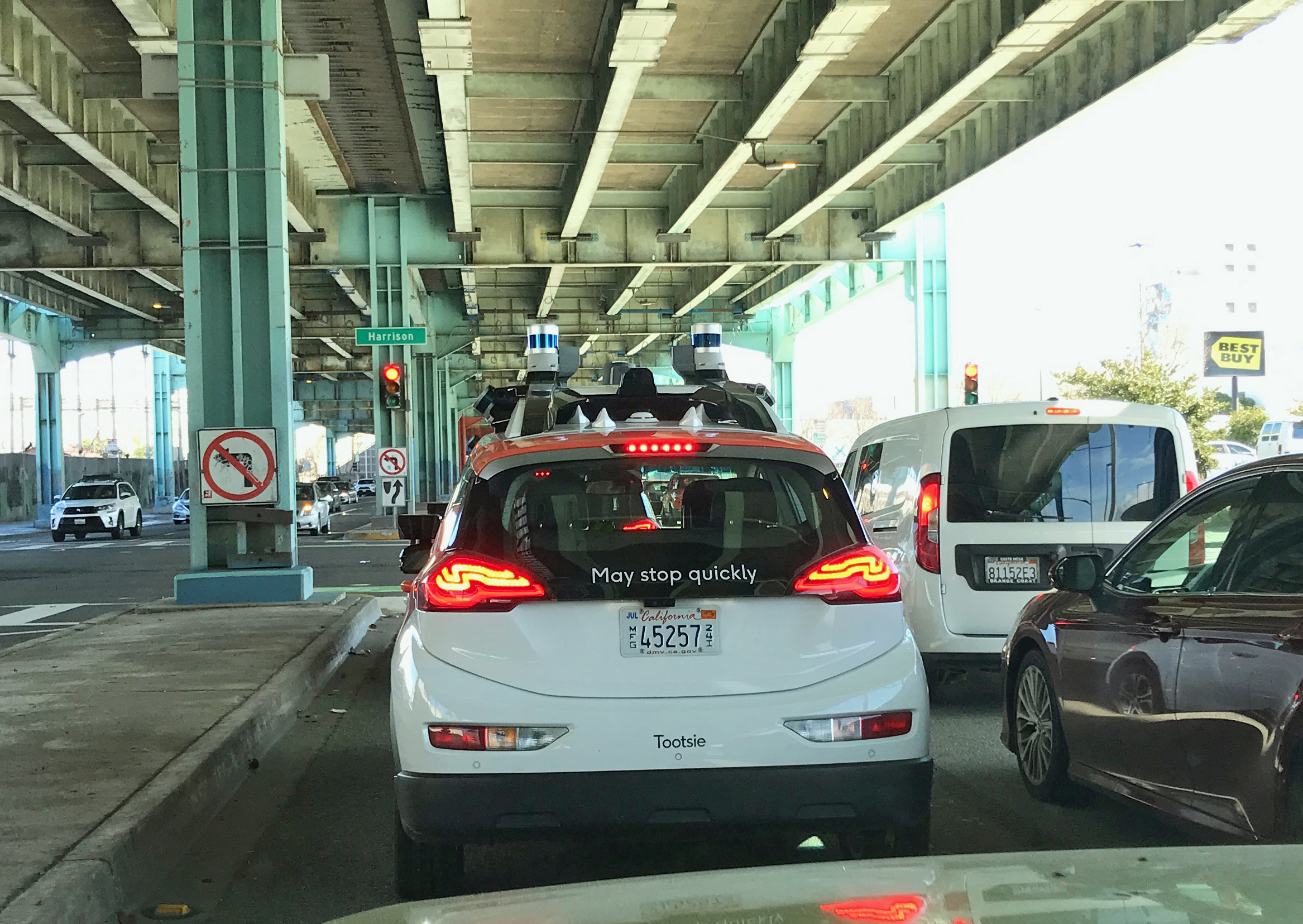
Imagine my surprise when I ventured to the third floor parking lot of San Francisco's Costco and discovered that almost every space was filled with a Cruise autonomous vehicle. I've seen a few of these "self driving" cars around town (always with a driver aboard). But apparently this was where they hole up when off the road.

Cruise -- majority owned by General Motors -- has enjoyed limited permission to offer cab rides in its vehicles between 10pm and 6am. The city is not entirely happy with the result. There have been complaints of hard braking that endangered following autos and occasionally a pack of these cars just bunch up irrationally and block traffic. 

Perhaps to overcome human anxieties triggered by these robot vehicles, the Cruise company gives each car a cutesy name.

Click to enlarge

Meet Mocha, Banana Slug, and Beet.

Nearby I noticed a Cruise in the wild ...

There goes Tootsie.

It's not clear yet whether they'll get beyond the testing phase. Probably. At that point, I imagine they'll drop the cutesy monikers.

Monday, November 28, 2022

Urban improvements ...

You go away for 4 months and come back to find that Costco built an array of solar panels over its parking garage. Little by little ...

Thursday, October 14, 2021

Out and about observations

So what did I learn about our post-pandemic (we hope) city from walking 24th Street east of Mission, Valencia, 24th Street up the hill into Noe Valley, and Mission Street proper? Here are some surface impressions, probably overdrawn, but for what it is worth ...

There are plenty of empty and boarded up storefronts in all these commercial corridors. There are also plenty of dining sheds in what used to be parking spots.

This rather antic one is an extension of the Napper Tandy at 24th and South Van Ness. This establishment seems to be doing a good business, though more around the corner on 24th than here. In general, though there were gaps, the small businesses in the Latino Cultural District seemed to be soldiering on surprisingly well.

In Noe Valley, the dining sheds seemed more substantial and utilitarian. Restaurants which were open seemed to have considerable custom on a warm Saturday. But my impression was that the carnage among the small businesses that occupied street level store fronts was even more extreme than at the other end of 24th. Perhaps the rents were higher to begin with, so casualties of pandemic closures were more numerous?

By comparison, the Valencia corridor felt lively. And not just the dining sheds ... many retail storefronts were open and seemed to be getting traffic. As was true of all of us, pandemic survival was higher among the young and Valencia feels young, busy, and in a hurry.

Mission Street is another world. There's commerce alright. The BART plaza at 24th Street is an open air market -- many of the goods look as if they'd been pilfered from Walgreens. There are lots of closed stores in the section I walked -- far and away the highest percentage among these four commercial strips. But that doesn't mean the sidewalks are empty. There's also the most foot traffic here -- people of all races and gender presentations -- moving purposefully about their business. Yet the demise of so many long time businesses (and this was going on before the pandemic) make the street seem a little sad. There's life, but a little too much unhappy madness, great fatigue, and not enough joy.

They're back! Although a lot of the Silicon Valley folks are still working from home, the Google buses are once more crowding streets not built for such behemoths. Their absence was a gift of the virus.

Monday, May 17, 2021

Open season on progressive prosecutors

We've put up a new window sign: the usual suspects -- police unions, Republicans, and cranky Democratic Party "moderates" who function as the opposition to progressive Democrats in this one party town -- are hot to recall our new District Attorney. Elected in 2019, Chesa Boudin is a nightmare to the throw-away-the-keys, tough-on-crime brigade. Within the considerable constraints imposed by the pandemic year, Boudin has made a lot of moves we elected him for:

• reduced the jail population by 40 percent during the pandemic by releasing misdemeanor and short time offenders.

• joined progressive country supervisors in seeking to bar the police from hiring officers with records of misconduct in other departments. [To which this citizen can only say, well, duh ... ]

• joined other progressive prosecutors in calling on the State Bar of California to prohibit elected prosecutors from accepting campaign contributions from police unions. That reform is going to take a broad political push.

No wonder the usual suspects don't like him. He's working for structural reforms that could help get a fairer shake for communities for whom there's been little justice in "Justice." 

Boudin isn't the only "progressive prosecutor" under attack as a rather bad-humored citizenry emerges from pandemic misery. 

As a San Franciscan, I'm dubious about including George Gascon in this category; he wasn't much for charging our cops when they killed with only flimsy excuses. But, elected to reform the Los Angeles D.A.'s office in 2020, he seems to have changed his ways in his new job. He has angered the usual suspects by refusing to prosecute juveniles as adults, suggested that long sentences accomplish nothing except cost the state money and separate families, and begun to re-examine cases in which cops killed without apparent legal basis. Los Angeles Times reporters James Queally and Joe Mozingo have written an in-depth examination of Gascon's new initiatives. His early record seems impressive, especially in a city which has long suffered from regressive prosecution policies dictated by an aggressive police union.

This week, Philadelphia will see whether progressive D.A. Larry Krasner can survive police and politicians aiming to ride a backlash against new criminal justice priorities. In a city famous for electing a fascist cop, Frank Rizzo, as mayor more than once, Krasner's election in 2017 signaled new times. His record before that campaign: successfully litigating against civil rights infringements by police. He promised "to stop prosecuting drug possession and prostitution and to hold the police accountable for misconduct." But during the pandemic year, murders have increased by 40 percent, though still less than in the bad old days of the 1980s and 90s. A pro-cop former prosecutor who Krasner let go from is office is waving the "law and order" flag in the Democratic primary. We'll find out Tuesday who has the voters on their side. The winner will be a likely shoo-in in the general election.

UPDATE 5/18: Looks like Krasner won his primary decisively.

Tuesday, May 04, 2021

The peculiar problems of peeing during a pandemic

Maybe it's really almost over. A couple of weeks ago, I was able to do something that told me this city is making progress on re-opening from the coronavirus: I found a public toilet in an out-of-the-way park and it was open for use! Yippee! Most such facilities had been closed since March 2020 or a little later.

I can testify to this because I whiled away the pandemic by completing huge chunks of my Walking San Francisco project. Even at the very beginning when we didn't know much about how COVID is spread, it seemed as if longish walks with a camera were permissible. In those traffic free days, the city was quiet and sometimes very lovely in a clean-air spring.

Eureka! It's unlocked.
But walking about the city posed a problem: where should I pee? In the previous eight years of the project, I'd gotten very good at scouting out opportunities. But not in 2020. Coffee shops were not open; public libraries were closed; some big retail, grocery stores and mini-malls might be open, but not the bathrooms; public park facilities were mostly locked.

My best bet for relief became residential construction sites equipped with a porta-potty. But in the early days, the workers were off the jobs and sheltering in place too. Most of their facilities were locked. I became eagle-eyed, looking for unlocked enclosures.

Pretty soon I had quite a few points of "anecdata": there were socio-economic patterns to the availability of urban porta-potties. In poor and working class neighborhoods, they were always locked. Ditto in the truly wealthy areas. Not so in upper middle class residential neighborhoods.  There I could usually find a porta-potty to duck into. As job sites reopened, I could sometimes find workers to ask to use their facilities.

And, of course, I've been an urban runner for decades. That means I am not ashamed to use of what I call "circular bushes," conveniently placed shrubbery. A city presents a surprising quantity of possibilities, often on median strips or around public buildings, in just about every neighborhood. You just want to look out for surveillance cameras. Wouldn't want to upset the security ...

A few months ago, Nicholas Kristof, an observant Times columnist who I often find too saccharine, made a great suggestion:

America’s most disgraceful infrastructure failing is its lack of public toilets. ... the United States is simply not made for people who pee. ... Americans have painstakingly built new norms about dog owners picking up after their pets, but we’ve gone backward with human waste. ... How is it that we can afford aircraft carriers but not toilets? 
... it’s not just the homeless who suffer. Taxi drivers, delivery people, tourists and others are out and about all day, navigating a landscape that seems oblivious to the most basic of needs. The same is true of parents out with kids. 
So come on, President Biden! Let’s see an infrastructure plan that addresses not only bridges and electrical grids, but also bladders and bowels.
Now there's an infrastructure plan I could love. And so would a lot of people on the streets, voluntarily or involuntarily.

Monday, April 19, 2021

Nice find on the Great Highway

End violence against Asians. Click to enlarge.

The empty Great Highway was lovely on a spring Sunday afternoon, a great venue for an imaginative political statement. The sand-strewn stretch of road has been closed to cars since the pandemic locked us in -- and recreational users want to keep it that way. 

Sunset district neighbors are not so thrilled about that idea. They get all the cars that used to buzz by next to Ocean Beach over on their streets. 

But perhaps traffic calming measures can encourage most drivers to take other routes. Hayes Valley is still adjusting after almost two decades from replacing a freeway stub with the much more human-friendly Octavia Boulevard. 

Change is hard, but reducing cars is worth some habit adjustments.

Sunday, April 11, 2021

Signs of San Francisco schools opening?

Last week a city Department of Public Works employee loaded a mid-size truck with the contents of a small encampment that had developed along the sidewalk adjacent to the Buena Vista-Horace Mann yard. In January, one of our unhoused neighbors died over there. Since then, a couple of quiet guys had accumulated a growing horde of urban stuff. Gone now. No idea what happened to them.

I guess the kids are finally returning to schools, at least some of them. This school has been empty since March 2020.

This appeared along the fence:

Very polite, even a little precious. The school district is not screaming NO CAMPING!!!!

And perhaps more amazingly, the city seems to be offering a set of rules for where tent camping can be practiced legally during the pandemic.

"How to protect yourself when sleeping in public places."
Click to enlarge to read the rest. Now I don't believe that most unhoused people would dare trust that the city would follow its own rules. But it's something of a wonder that such instructions even exist.

By the way, in preparation for this post, I put some energy into figuring out which schools are opening next week. It wasn't simple. The best list I found is here.

Thursday, April 01, 2021

Tear them down!

The Washington Post has a feel-good story today about the Biden infrastructure plan's inclusion of funding to tear down dilapidated highways that were built decades ago. In the 1950s and 60s it was conventional city policy to break up cities for the benefit of cars. This policy often had the racist benefit of breaking up thriving majority Black neighborhoods. 

“Nobody thinks you can get rid of a highway,” [Amy Stelly] said.

On Wednesday, Stelly’s effort gained a considerable boost when the White House named the highway, the Claiborne Expressway, an example of a historic inequity that President Biden’s new infrastructure plan would seek to address through billions in new spending.

Stelly, an architectural designer, is part of a growing movement across the country to take down highways bored through neighborhoods predominantly home to people of color. Most were created as the federal government worked to connect the nation after the birth of the interstate highway system. Many such highways are reaching the end of their 50-year life span, raising the question of whether they should be rebuilt or reimagined. 
“It’s the same in many Black communities, not only in Louisiana,” Stelly said. “It’s great the federal government and this administration is recognizing that this is something that must be corrected if we are to be fair and just in America.”

Freeway Revolt monument on Gough St.
I'm reminded that what's recalled as the "Freeway Revolt" has been central to the development of both the physical and political shape of San Francisco. This is a small, very compact city. If planners in the 1950s had gotten their way, it would have been crisscrossed by connected concrete behemoths, running along the north shore from Bay Bridge to Golden Gate, with a connector straight through the Mission and Western Addition, and another around the shore on Bayview landfill. Forget all those charming Victorian houses and startling views of the Bay.

Political resistance was intense. Much of the intricate neighborhood activism which gives the city its intense local politics was seeded in the freeway fight. By 1959, citizen uproar forced the cancelation by the Board of Supervisors of seven of ten planned freeway projects. 

Unhappily, the Freeway Revolt, largely led by white San Franciscans, didn't coalesce with the concurrent struggle against "urban renewal" (better called "Negro removal") centered in the Fillmore neighborhood. This urban catastrophe set the stage for the nearly complete pushout of Black San Franciscans.

And then, San Francisco got lucky. The 1989 Loma Prieta earthquake knocked down the Embarcadero Freeway, clearing the way for the present attractive downtown shoreline.

Let's hope the current infrastructure plan can help additional cities recover some of what they lost to cars in the 20th century.

Wednesday, March 24, 2021

Transit questions

I'll know my personal pandemic is over when I again feel I can ride a bus. Though I'm fully vaccinated, that time has not yet come for me.

I've used BART (our subway) for a short distance this month. It felt fine -- drafty and empty actually. But perhaps irrationally, I'm not ready to try the buses yet.

I came to my enthusiasm for our underfunded bus system (that's "MUNI" in this city) late in life. Though I used public buses to get to elementary school and occasionally to get to jobs, I never liked them. But in the last few years, like NY Times columnist Farhad Manjoo, I've had a bus epiphany. If the system were just a little better, I'd be a vigorous evangelist for buses. Even as it is, creaky and not always on schedule, I love that I can get pretty much anywhere in the city in two bus rides.

The irritating but sharp Matthew Yglesias offers some reflections on what makes for good bus systems and what practices might make them more desirable to more riders.
The truth is that people ride the bus when it makes sense. ... When good transit exists, it’s broadly beneficial and useful to all kinds of people who — for whatever reason — don’t want to drive a car for that particular trip.  
First, there has to be someplace to go where driving your car has some downsides. Second, there has to be a frequent bus that goes there.  
... the key thing about reforms that maximize ridership given a fixed pool of resources is that getting more riders is the way to get more resources.  ...On a political economy level, the biggest problem with U.S. mass transit policy is it’s always conceptualized as something that someone else is going to ride, which is good because it reduces traffic congestion and now it’s easier for you to drive your car.
This is a city, a genuine urban agglomeration. There's plenty of disincentive to driving for most of us, at least into crowded areas and even into neighborhoods with regulated parking. So that points to needing better bus service.

Yglesias argues that transit systems would become healthier if designed to maximize ridership rather than extensive coverage. Bus riders vote! More bus riders vote more! Maximizing means more frequent buses on some lines and doing away with infrequent satellite lines that go where demand is lowest.

Even though I benefit from living adjacent to one of this city's most active bus lines, I find it hard to accept this -- isn't there something wrong with a public utility neglecting what are most likely both the richest (say Seacliff) and the poorest (say Bayview) off-the-beaten path neighborhoods? I think so.

Another Yglesias suggestion is for more widely spaced bus stops, as much as a quarter mile apart. I get it -- the buses would run more smoothly. MUNI has implemented some of this, to a firestorm of upset from small merchants who claim they lose foot traffic. And what about disabled riders and elders who don't walk well? Again, transit is a public utility -- it has to be useful to as many as possible.

Yglesias does help me understand why I can be a MUNI fan -- quite a rarity among San Franciscans who use the system. Because I'm retired and can control my time, I can make a system with relatively infrequent  service convenient -- I just plan on trips taking however long they take. I like to listen to audio books while riding, as buses proceed along circuitous meandering routes to outlying areas. And with my senior fare, it's dirt cheap! Those systemic conveniences don't exist for everyone.

He asks whether pandemic changes that render "the future of the commute in doubt thanks to remote work" might make bus systems less relevant.  Perhaps.

I ask a different question at this fraught pandemic stage: will people who have any alternative come back to the buses when this is over? These days, the buses look empty. Nobody is riding who has another option.

Tuesday, March 02, 2021

City struggles

As a Mission resident, I tend to assume that land use fights are about gentrification. The paradigm: some developer has acquired a buildable bit of the neighborhood and wants to erect something that will drive out existing impoverished residents and replace them with folks with more money. Despite the recognized reality that San Francisco needs more housing, communities band together and squaw, sometimes winning mitigation payments.

But while Walking San Francisco today, I came across lots of evidence of another sort of San Francisco land use kerfuffle out in the West Portal neighborhood.

These signs dotted a several block area. People care.

I have not been able to find what I would call unbiased discussions of the proposed project -- though just reading the proposal as described to the building department seems pretty horrifying. Apparently the builder wants to put five large single family houses on a nearly vertical hillside. 

The signs throw the kitchen sink of objections at the project. There's a whiff of injured expectations of privilege about them.

However, an op-ed in the local Examiner -- an almost newspaper -- by a neighborhood activist presents a convincing story of previous efforts to build on this particular hillside leading to mudslides and broken foundations. 

People who live across the street from the five proposed homes are terrified that a large rainstorm during construction — or even just the construction itself — will result in the mountain coming down on top of them.

It’s happened before.

In the 1970s, damage from an earlier landslide and the continuing threat of more rockfalls temporarily closed a church at the base of Edgehill. In 1982, another slide forced a preschool to move. In 1995, rocks fell on a site at the base of the mountain where 13 homes were being built by developer William Spiers on Knockash Hill Court. Engineers inspected the site, declared it safe, and construction continued.

In January 1997, however, after a torrential rainstorm, the hillside above Knockash Hill Court gave way, and 100 tons of boulders, mud and debris overran a 10-foot-tall retaining wall and slammed into the new homes below. ...

I might join the opposition knowing that history. 

On the other hand, as a general matter, it galls me that this builder wants to put in single family homes. What the city needs is more four-plexes and small apartment buildings. And this West Side neighborhood isn't doing its share. That omission keeps my neighborhood on a war footing against gentrification.

Monday, February 15, 2021

Cities for profit, not for people

Samuel Stein wanted to know why there was so little housing available to poor and working class people in New York City. To make a longer story short, he went to city planner school, studied the various iterations of that discipline, and looked into patterns of development and displacement in his home place -- all amid the additonal distortions furthered by Donald Trump's rapacious real estate empire. Capital City: Gentrification and the Real Estate State is the product of Stein's investigation.

I found the book interesting -- but was reminded that, though there is a national pattern to housing scarcity, in the end housing fights are local.

The most useful part of Stein's story is his succinct description of what economic realities make the present gentrified cities close to inevitable. Gentrification is what happens when industrial production moved out of US cities, whether to lower wage states or to even lower wage countries. When industry made things in US cities, capital had an interest in having workers living nearby. No longer.

And then in older cities you get gentrification:
By definition, gentrification cannot happen everywhere. It is the third stage in a long-term process of capital flow in and out of space: first comes investment in a built environment; second, neighborhood disinvestment and property abandonment; and third, reinvestment in that same space for greater profits. The key to understanding why some spaces gentrify is the amount of money that a landowner -- who effectively owns a monopoly on all rents from a particular geographic location -- can expect to generate from a given lot and the building atop it. Real estate speculators choose to invest in a particular location because they identify a gap between the rents that land currently offers and the potential future rents it might command if some action were taken, such as evicting long-term tenants, renovating neglected or unstylish properties, or demolishing and reconstructing buildings.
And then you get what Stein calls "the Real Estate State." Developers run the city and it becomes nearly impossible for mere residents to make themselves heard through politics.  Sound familiar to any of my Mission neighbors?

This isn't Stein's topic, but even the business section of the New York Times knows that after gentrification's rising rents (using "rents" not in the economist sense of value extracted but in the everyday sense of what you pay the landlord), homelessness balloons.
... Frustrating as this is for prospective home buyers, the real pain is felt among low-income tenants, a quarter of whom — about 11 million U.S. households — are already spending more than half their pretax income on rent. As rising costs filter through the market and the rent burden gets more severe, food budgets get squeezed, families double up and the most vulnerable end up on the streets.
In city after city, studies have shown that homelessness has a distinct financial tipping point. As soon as the local rent burden reaches the point where renters on average spend more than a third of their income on housing, the number of people on the streets starts to rise sharply, according to researchers at Zillow and elsewhere.
So here we are. It's fashionable these days to say the high price of housing in cities derives from NIMBYism which prevents building of more units whose availability would, in some time frame, drive down prices, reducing the housing price crunch.

Well maybe. I'm convinced that more density would make better cities. But how come, in the real world, developers always target for big projects places where a lot of poor people will be displaced if they are allowed to dig up the community? Because they know who is likely to lack the political power to constrain their drive for unconscionable profits. So cities suffer endless land use fights and little gets built.

I know a little more after reading Samuel Stein -- but I know more from having lived inside this sad dynamic for most of the last 50 years.

Saturday, February 13, 2021

Electrify everything

The people who actually know anything about how this society might end our dependence on dirty fossil fuels and still have energy for living are chanting "Electrify Everything" these days. 

Here's David Roberts reporting on the proposals of MacArthur genius Saul Griffith at Vox last summer:

The fastest way to decarbonize is to electrify everything

Griffith begins with a core assumption: We need to make a plan to solve the problem with the tools available. It is unwise, for instance, to bet on a large amount of carbon capture and sequestration coming online in time to make a difference. The technologies are still in the early stage and there are strong arguments they will never pencil out.

Griffith takes a “yes, and” approach. If carbon capture sequestration works out, great. If next-gen nuclear reactors work out, great. If hydrogen-based fuels work out, great. But we shouldn’t rely on any of them until they are real. We need to figure out how to do the job with the technology available.

On that score, Griffith’s modeling reaches two key conclusions.

First, it is still possible to reduce US greenhouse gas emissions in line with a 1.5°C pathway. Specifically, it is possible to reduce US emissions 70 percent to 80 percent by 2035 (and to zero by 2050) through rapid electrification, relying on five already well-developed technologies: wind and solar power plants, rooftop solar, electric vehicles, heat pumps, and batteries.

Think of those technologies as the infrastructure of 21st century life. If everyone uses carbon-free energy to heat their homes and get around, the bulk of the problem will be solved.

Second, to decarbonize in time, substitution of clean-energy technologies for their fossil-fuel counterparts must ramp up to 100 percent as fast as possible, after a brief period of industrial mobilization. Every time a gas or diesel car is replaced, it must be replaced with an EV; every time an oil or gas furnace is replaced, it must be replaced with a heat pump; every time a coal or gas power plant goes offline, it must be replaced with renewable energy....

Roberts is always worth reading. These days his sophisticated understanding of climate possibilities can be found at Volts.  

With these thoughts rumbling about at the back of my mind, it was fascinating to encounter a small corner of San Francisco that was built on these principles -- 70 years ago. At the top of Diamond Heights, there are several streets where in front of each building, embedded in the sidewalk, there is one of these markers.

The Department of Archaeology & Historic Preservation in Olympia, WA explains: 

... General Electric provided the main support for the program, which launched in March of 1956.

At the time, utility companies were rushing to meet the increased demand for electricity in postwar America.  However, as more power plants came on line the cost of electricity decreased.  To increase company profits, homeowners were encouraged to consume more power through the purchase of a variety of electric products. For GE and Westinghouse, the creation of a new market for electric heat also promised to increase company profits.  Additionally, the two corporations not only sold residential electric heating units and a variety of household appliances, but they also sold electrical generating equipment to  utility companies nationwide.

Supported nationwide by 900+ electric utilities and 180 electricity manufacturers, the electricity industry launched the Live Better Electrically campaign through a variety of media outlets. The initial launch came with the offer to send a free 70+ page brochure to homeowners which told them how their lives could be enriched by the use of electricity and purchase of electric appliances.

In the "Mad Men" era, the push to get people to prefer electricity naturally required branding. Hence the Medallion Home markers and such ads as these from Better Homes and Gardens magazine in 1958.

Today maybe smart -- make that essential -- climate change adaptations just need better advertising? Some government seed money might help as well, but we can be sure the electric company giants of the 1950s got plenty of that assistance as well.

The Biden administration seems serious about climate.

Friday, February 12, 2021

Friday cat blogging

It's hip these days to make fun of San Francisco's bounty of window signs. See also Ezra Klein. He's got a point; we're not the paragons of liberal governance we'd like to pretend. But I like some of these signs. 

And I sure wouldn't want to live in some suburb where everyone hides their opinions.

Encountered while Walking San Francisco.

Sunday, February 07, 2021

Migrating politics

I love living in this city. In addition to tech folks come to make their fortunes (for a season), there are always new immigrants. And pretty quickly, these hard working folks open stores to serve their communities and also share their culture with their neighbors.

Like this one. Want someone who knows the home town you left in India or, if another sort of customer, sells the spices you might need for your gourmet Indian cooking class? -- here's the place for you.

And right there in the window, the politics of India come to San Francisco. I'm not going to pretend I know anything about the struggle between the government and Indian farmers. I'm instinctively prejudiced against an imposition of a modern market on farmers, as across the world, that usually has meant dispossession of small holders. But what do I know.? Here's a Vox explainer which might, or might not clarify, what's happening on the subcontinent.

This sort of thing turns up all over the city. Mainland and Taiwanese Chinese duke it out in graffiti in Chinatown. In the outer Portola neighborhood, there are opinionated signs about which Asian country owns islands in the South China Sea. People post opinions about Nagorno-Karabakh. There are Catalan independence supporters in many alleys and occasional advocates of democracy in Belarus.

It's a big world.

Friday, January 08, 2021

Poverty kills

Our unhoused neighbor who had settled in across the street has died. There is no reason to suspect human foul play, just deprivation and possibly her own demons.

She made it as long as she did by projecting a fierce independence; don't mess with me, her whole bearing screamed. So we left her alone. She died alone in her tent.

Mission Local found neighbors who shared memories of Jacqueline ‘Jackie’ Rieber.