Monday, November 07, 2005

Emphatically not a time for reasonable dialogue from All Saints Pasadena


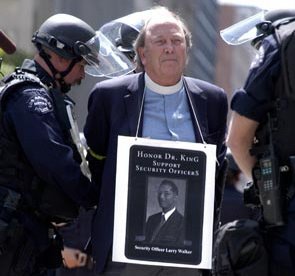
The offending priest: Rev. George Regas arrested 4 April, 2005 supporting Los Angeles Security workers.

The LA Times reports this morning that the IRS threatened All Saints Pasadena, a prominent Episcopal parish, for a sermon in 2004 by its retired rector Rev. George Regas denouncing Bush's Iraq war.

In some ways, I'm even more upset by the tack All Saints' rector J. Edwin Bacon is reported as taking in response, than by the IRS's obviously political audit. The parish got the letter threatening to pull its tax-exempt status in June 2005. Why did they wait to publicize the attack until now? Bullies need to be exposed, not humored or placated with legalistic responses.

The letter on its face aims at political repression: the IRS wrote down that All Saints was a risk because of a "searing indictment of the Bush administration's policies in Iraq" and noted that the sermon described "tax cuts as inimical to the values of Jesus." The IRS is plainly asserting that a church can be punished for opinions stated within its community -- not claiming any action or practical intervention on behalf of a candidate in an election! That is an attempt at thought control.

Fr. Bacon opines that the IRS will eventually drop this case and he is almost certainly right. But given the parish's relative wealth and standing, a lot of others need it to take a far more aggressive, prophetic, stance. More than most who might be attacked for denouncing US imperial wars, All Saints should be able to afford to speak out.

The Episcopal Church has come a very long way from its early 20th century character as "the ruling class at prayer." But we sometimes act as if just being reasonable and practicing decorum will recover an influence we've given away, choosing instead for the poor and the marginalized with whom Jesus associated. Having taken that hard path, any influence the ECUSA may have for good in this society, for the poor and suffering, comes when we push boundaries, following the example of the Founder. And he didn't negotiate politely with the authorities.

Sunday, November 06, 2005

Where there is smoke …


This morning it comes out that the persistent Bush Administration contention that Al Qaeda was working with Saddam Hussein's Iraq was based on statements elicited by torture. The NYT provides the story of how the tale was "offered" by a captured Al Qaeda operative. The excellent "emptywheel" at The Next Hurrah connects the dots to show how very probable it is that this "evidence" for something Bush and Cheney wanted to hear was extracted by torture.

So there it is -- the city on the hill has morphed, before our eyes into its guise of evil empire spewing poisons on the earth. My optimistic ancestors weep from their graves; what do I do?

In the teachings of historic Christianity, hope is not a feeling, but a virtue, an orientation to the human experience to be cultivated as an expression of faithfulness to the knowledge of the goodness of God. Hope at this time of shame and horror is also a necessary civic virtue, an orientation faithful to the vision of a society where justice, not capricious human greed, prevails. Lots of work to do.

Friday, November 04, 2005

Short takes: money -- three possibilities


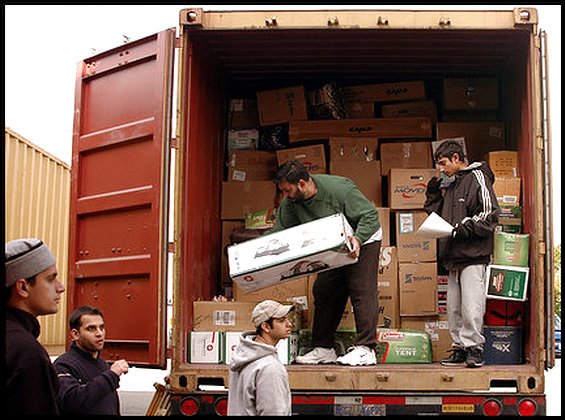
Photo: Aasil Kazi Ahmad

Endorsements for sale?

The nation's drug makers have given hundreds of thousands of dollars to political leaders and civil rights groups that have endorsed the industry's initiative on the Nov. 8 ballot.

"The measure, Proposition 78, would avert state caps on the price of prescription drugs. Those embracing it while taking the industry's money include the conservative Traditional Values Coalition, an emergency-room physician in Los Angeles, the California arm of the NAACP and the Mexican American Political Assn.


Federal budget is 'beyond redemption,' bishop says:

The Right Reverend F. Neff Powell, bishop of the Diocese of Southwestern Virginia, declared, 'The current budget reconciliation package in Congress is quite frankly beyond redemption and should be abandoned.' ….

The Senate narrowly passed its version for the budget on October 27, which includes $39 billion in cuts, including cuts to Medicaid, student aid, and farm subsidies while offering limited Hurricane Katrina relief. The House bill cuts $50 billion for programs serving the working poor, children and the elderly, including eliminating 300,000 individuals and families from nutritional assistance, 40,000 children from free or reduced-price lunch programs, and reducing care for 4,000 foster children....


People power and generosity

Dozens of members of the [DC] region's Pakistani community gathered at the Loudoun County warehouse … in their second attempt at sending badly needed relief to those left injured or homeless by the Oct. 8 earthquake. …

Hanif's group bought 250 tents, 100 sleeping bags and 20 boxes of medicine and other medical supplies. In fact, so many Pakistanis bought tents to donate to the relief effort that local department stores were running out, said Farah Chohan, one of the organizers of yesterday's drive. …

"If we don't do something about it, people are going to die," said Zarrar Husain, another of the event's organizers.

We can help the victims of the earthquake in South Asia via UNICEF-USA among many relief agencies.

Thursday, November 03, 2005

The Governor's Neighborhood


On opening my online LA Times this morning, I was greeted by the ad pictured above. Totally worth clicking through for a sight of the "Bush Bird" that wanders this Sesame Street parody.


Visit Schwarzenegger Street here. And, if you like, you can go on the visit the sponsor, Democratic gubernatorial aspirant Phil Angelides here. I'm as yet agnostic on whether Angelides is the right person to take on the Governator next year, but the race is very important. There is no reason except the recent inability of Democrats to govern this state that it should be led by a celebrity Republican.

On the subject of governors in national politics, Mark Schmidt has some very interesting musings at The Decembrist. Dissecting the defeat of Colorado's tax limitation measure this week, he makes the point that Republicans used to be able to claim they had a stable of governors who could claim they had made state government work -- but their anti-tax mania has ended that situation, leaving the Democrats with the better set of known leaders. He argues "governors are where presidents come from." Worth thinking about. Found the link at Discourse.net.

Wednesday, November 02, 2005

Remembering Tim Sampson

Feast of All Souls/Dia de los Muertos

"On this day, the Church remembers all of the faithful departed who died peaceable deaths, … these were ordinary people…" according to the useful Episcopal liturgical website Mission St. Clare. I like the idea of remembering with delight the people who've been important to us. Today I remember a friend and mentor who left us in 2001 at the age of 66.

Tim Sampson was certainly not ordinary, in the sense of "unremarkable;" however he would never have thought of himself as anyone special, so in that sense, this does seem to be his day. As far as his being one of the "faithful," I really don't know what that means: I think of Tim as a Jewish-Quaker-Buddhist-anarcho-commie-Santa Claus, so I am sure he fits under that word somehow. In any case, his life was the art form of a man who found ways to live out what he believed in.

Tim lived for the struggle for justice and his notion of justice was wide and deep. His concerns bridged divides that often act as barriers between people who ought to be on the same side.
  • He was an academic, teaching for 30 years in the School of Social Work at San Francisco State University. The campus remembered him as uniquely present to students, joining their marches and picket lines.
  • He was a union activist, not only as a member and officer of his own union, the California Faculty Association, but also in support of the bleeding edges of labor such as the United Farm Workers and Justice for Janitors. Not long before he died, he was pushing the AFL-CIO to organize and utilize the energies of retirees.
  • He was a community organizer in the Saul Alinsky and Fred Ross Sr. traditions who had worked with the National Welfare Rights Organization, the Legal Services Corporation, Highlander Center in Tennessee, and the National Campaign for Jobs and Income Support of the Center for Community Change.
I knew Tim best in that last role: periodically he would wander into the CFJ office with a briefcase full of flyers and petitions for various good causes. His arrival was usually literally like the arrival of Santa Claus. We never were sure how we were going to make the payroll in those days. Tim sold CFJ buttons everywhere he went. The $60 or $110 he brought us was an important addition to our pathetic stash!

Organizing to take political and economic power from the strong for the weak is hard, frustrating work that can leave its practitioners cynical and bitter. Tim never succumbed to those temptations. He was enthusiastic about each new campaign, thoughtful, hopeful and warm toward those he worked with. Forgoing the brash, macho posture many organizers of both sexes assume,Tim taught aspiring organizers that:"The flowers of organizational relations grow from personal interest, kindness, and cultivation."

For many organizers, building power for the weak is about harnessing anger and resentment against the powerful. And certainly where injustice and oppression are the rule, anger can be righteous and useful. But it can also be a corrosive addiction and Tim knew that.

When I started organizing, one of my primary motivations, which I came to cherish, was anger. But as my life went on, I learned there is a more powerful force in the struggle for social change, and that is love.

The older I get, the more I know he was right.

¡Tim Sampson, presente!

Tuesday, November 01, 2005

Absentee voting in California:
a field worker's view


Photo by Irfan Khan / LAT.

As a voter, I love casting my ballot by mail, voting "absentee." I have time to figure out all the obscure propositions and can do my civic duty from home.

As a person who works to maximize turnout for my side in elections, I hate absentee voting. When people vote all at once on Election Day, you know when you have to reach them. If they don't vote, you can figure this out by mid-afternoon and chase them down on the phone or in person. And there is something about participating along with everyone else that helps voters feel that they are performing a meaningful activity. That's good for continued political participation, I think.

Today's San Francisco Chronicle reports that:

Next Tuesday's special election could be the first in which half of all votes cast are by absentee ballot. …

"Last November, absentee voters were 37 percent of the turnout," [Acting Alameda County registrar Elaine] Ginnold said. "In this election, they could make up between 50 percent to 60 percent."

Different types of absentee voters have different voting patterns. Of the absentee ballots mailed out for this election, 613,000 are from voters requesting a ballot specifically for this election.

Those voters tend to have the highest return rate, averaging more than 90 percent. Permanent absentee voters tend to vote at levels 5 percent to 10 percent lower.

From the point of view of a person working to defeat Gov. Arnold's initiatives, this is both good and bad news.

According to today's LA Times the Schwarzenegger hopes to make up what he lacks in volume of support by working selectively to maximize turnout among his supporters: "his campaign strategy relies on relatively few people showing up next Tuesday and large segments of voters staying home."

Gov. Arnold hasn't tried to raise the profile of the election in areas where he won't do well; we are not seeing his ads in the San Francisco Bay Area. And he has hired a micro-targeting firm to reach out to voters on the basis of their consumer habits and TV-viewing preferences.

Pollsters like absentee voting; voters can't change their minds at the last minute. Today's Field poll shows "20 percent of the 1,071 likely voters surveyed Oct. 18 through Sunday already have voted by absentee ballot."

Large scale absentee voting makes campaigning more expensive. For one thing, you have to start sooner as folks may vote weeks early. Further, your TV buys become less and less effective as their target audience shrinks because more people have already voted. Gov. Arnold is running into that today as he has launched a new ad saying taxes will go up if he doesn't get his initiatives passed; too bad, many votes are already in the bag.

For a field operation, absentee voting is an expensive nightmare. County registrars furnish lists of who has voted that can be cross-checked against eligible voter lists. Campaigns compile lists of voters who have requested absentee ballots. Then the campaigns have to try to reach potential voters who are holding onto their absentee ballots and encourage them to get them in. The campaigns have to teach volunteers to explain to voters that they can take their ballots to any poll on election day. The process is a recipe for confusion for any but well-staffed, well-funded organizations. It's only merit is to reduce the number of voters you are trying to reach in 12 intense hours on election day.

And yet, mail-in ballots are clearly one wave of the future. For governments, they are cheap and popular. The state of Oregon does all its elections by mail. I don't know if this is good for democracy, but it is a fact of our lives.

Meanwhile, we still have to get out the vote against Arnold's initiatives on November 8.

Monday, October 31, 2005

Are we here yet?

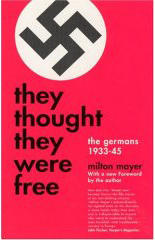
"The world you live in—your nation, your people—is not the world you were born in at all. The forms are all there, all untouched, all reassuring, the houses, the shops, the jobs, the mealtimes, the visits, the concerts, the cinema, the holidays. But the spirit, which you never noticed because you made the lifelong mistake of identifying it with the forms, is changed. Now you live in a world of hate and fear, and the people who hate and fear do not even know it themselves; when everyone is transformed, no one is transformed. …"

Copyright notice: Excerpted from pages 166-73 of They Thought They Were Free: The Germans, 1933-45 by Milton Mayer, published by the University of Chicago Press. ©1955, 1966 by the University of Chicago.

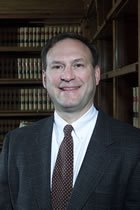
Let's see, the Preznit just appointed to the Supreme Court a guy who, according to Think Progress:
  • thinks states should have the right to force women to have unwanted children;
  • would allow employers to make (their favorite) race a condition for employment;
  • would permit disability-based discrimination;
  • thinks Congress can't mandate a right for employees to take unpaid leave to care for a loved one;
  • supports strip searches of persons not named in a warrant, including a 10 year old girl;
  • has ignored settled law to rule against protections for immigrants.
Charming gentleman.

It still looks like a liberal democratic country, but is it?

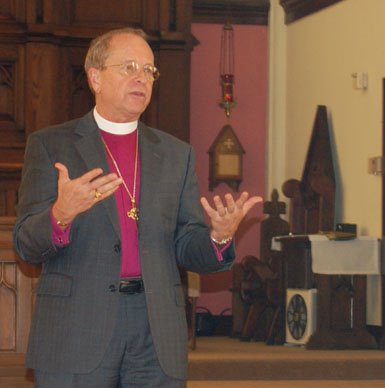
Bishop Gene Robinson speaks at St. John the Evangelist


Yesterday Bishop Eugene V. Robinson of New Hampshire presided over the Eucharist at my little no-count Episcopal parish in San Francisco's Mission District. Bishop Robinson is the "gay bishop," the person whose election and confirmation is the proclaimed casus belli that is exposing strains within the worldwide Anglican Communion. (I think there is a lot more to this conflict; the best primer on the issues I know of appears here.)

After the service, Bishop Robinson talked for nearly an hour with members and friends gathered to meet him. Some points:
  • by supporting gay inclusion, the Episcopal Church is putting its life on the line for the first time since the Civil Rights movement. [Though I know plenty of Black and Brown people who would question whether more than a tiny handful of white religious folks put lives on the line then, I believe Robinson is right that our homophobic conservatives take the decision of the ECUSA to fully include gays as a life and death issue. And what are churches for if not life and death issues?]
  • the intense homophobia of some parts of the Church is a form of misogyny, of a piece with opposition to women's priestly leadership;
  • if Episcopalians really care about being in solidarity with our brothers and sisters in the Global South, we can work to ensure that the ECUSA honors its verbal commitment to the U.N. Millenium Goals by committing at least .07 percent of all budgets to this work;
  • churches ultimately need to get out of the business of marrying people for the state -- they should stick to blessing people's relationships before God. We need new language which separates the form of relationship that legally regulates childcare responsibilities and inheritance ("marriage"?) from a relationship blessed by a religious community ("matrimony"?) The confusion of the two makes the question of "gay marriage" that much more volatile and impedes achievement of full gay civil rights.
Bishop Robinson was warm, wise, sometimes funny, and tough at the same time. If we get a new Bishop here in the Diocese of California (we're in a search and election process now) anywhere near as inspiring, we'll be very fortunate indeed.

Sunday, October 30, 2005

Precinct walk against Gov. Arnold:
a photo essay


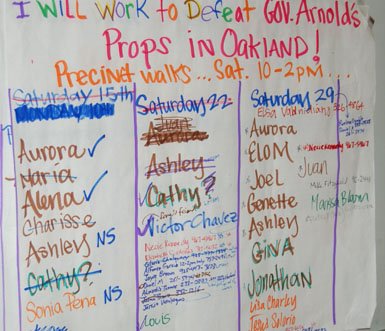
I spent yesterday afternoon going door to door in Oakland with two young women from Californians from Justice (CFJ)* urging infrequent voters to turn down Arnold's initiatives as well as Prop. 73, a measure that requires parental notification before youth exercise their abortion right.

Oakland is friendly territory -- the question here is not whether folks will oppose the Governor's power grab, but whether they will vote at all. Several people said they were not going to vote: "My vote doesn't count; they put Bush back in." My young friend begged these people to go out again: "I'm only 17 and I can't vote. Don't let Arnold take the money for the schools." At least one citizen promised she'd turn out one more time.


Precinct walks happen because people sign up.


Walkers are trained on their goals.


Walkers are trained about the propositions.


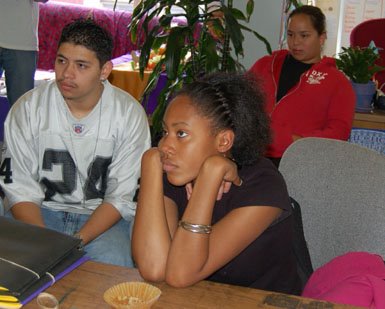
The group listened attentively.


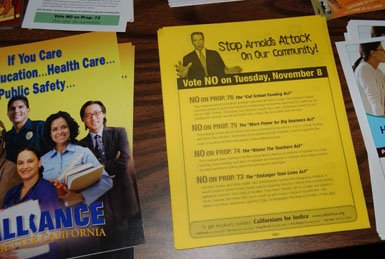
Here's what we handed out.


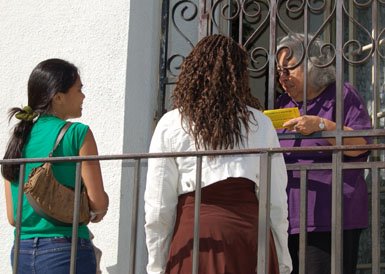
This woman had an absentee ballot. After talking with the young women for awhile, she said she'd be sure to mail it in.


She voted for Arnold in the recall; but not again: "He's bad for the Mexicans!"


This voter was a teacher who wanted to talk.


When you walk a precinct, you have to keep track of your lists.


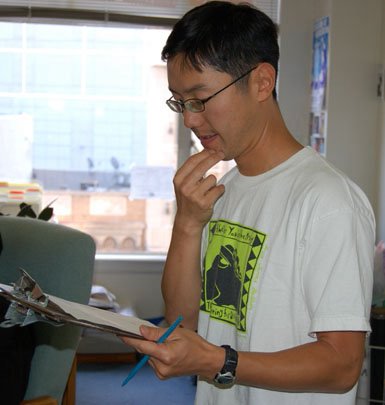
And when you bring your lists back, organizers check over the results.


After all that walking around, it is easy to feel at little glazed over.

*Full disclosure: I worked for CFJ in 1995-6 and again in 2003. The group describes itself as "a 10 year old statewide grassroots organization working to empower communities that have been pushed to the margins of the political process. We bring people of color, young people, and poor people together by leading large-scale community education efforts, training a new generation of grassroots civil rights leaders, and mobilizing public support for major public policy change in California."

Friday, October 28, 2005

We can do better: "Quake copters may be grounded"


A father and son wait to board a helicopter to Islamabad. © UNHCR/B.Baloch

As winter closes in, survivors of the October 8 Pakistan earthquake are in danger of freezing to death without help from the world.

Aid workers are scrambling to supply the millions of Pakistanis who have no food, water, shelter or medicine in the freezing temperatures of the Himalayas. Workers have resorted to rafts and pack mules to reach them, but helicopters, though costly, have proven the most useful.

"When the money runs out, the choppers stay on the ground and that's what's going to start happening in the next couple of days," said Robert Smith, financial expert at the United Nations' leading disaster-relief body, the Office for the Coordination of Humanitarian Affairs (OCHA). (Reuters AlertNet)

The earthquake is believed to have killed 55,000 people; among natural disasters in the last hundred years, that makes this event one of worst ten.

And aid is simply not getting through.

Marc Joolen, Medicins Sans Frontieres's Operations Coordinator, flew over … to get some perspective on how much relief work had been done at the southern end of the quake's death zone in Pakistani Kashmir….

"It's crap -- there are hardly any tents distributed so far," he says as the helicopter swoops over ridge after ridge dotted with sloping tin roofs atop the rubble of caved-in walls that used to be houses. "It seems the higher you go the worse it gets…"

In places people run out waving white handkerchiefs, hoping the helicopter will bring salvation. Joolen tells the pilot not to go any closer for fear of blowing away the cotton and plastic sheets the destitute villagers are using for makeshift shelter. (MSF)

And potential donor countries just are not rising to the need. Pledges have been made for long term reconstruction, but people's needs are not getting support. Jo Leadbeater, Oxfam's Head of Advocacy, insists "we needed 30 times more than they pledged."

Not surprisingly some countries are doing more than others. Oxfam has created an interesting chart showing how much governments have pledged, as a percentage what their fair share of the UN's estimate of need suggests, according to each country's wealth. (Available as a pdf here.) Several countries have promised more than their fair share: Sweden (298%); Luxembourg (211%); Netherlands (135%); Denmark (119%). Others are contributing respectably: Canada (90%); Norway (84%); United Kingdom (79%); and Australia (63%). And some very rich countries have responded pitifully: Japan (16%); Germany (14%); the United States (9%); and France (0%).

Individuals who can do their little bit have numerous good agencies to choose from. Some of my favorites:

Thursday, October 27, 2005

Observations: Seven U.S. cities in 16 days


DC view

The view out the window was often the same: derricks raising virtually identical new concrete and steel buildings. Clearly there are parts of this economy that are booming. If you spend your life in this bubble, you barely see the other parts, which may explain why the devastated Black New Orleans was such a shock and even why we re-elected President Nincompoop.

What follows are some completely personal and probably ignorant observations mostly from second class business hotels while traveling for work:

Baltimore Inner Harbor: a boom town of rather conventional tourist attractions including a Hard Rock Café in a former brick power generating station. Last summer I saw a modern mall in the Monteflores section of Lima, Peru; I'm not sure a deaf visitor from another planet could tell the difference from this one in Baltimore. Perhaps the monster painted crabs are what distinguish the Maryland city.

Washington, DC, 12th and K Streets: more construction -- and a 7 AM picket line outside protesting the use of non-union construction labor. Here, as in Baltimore, it was impossible to walk a block from the hotel without running into a sidewalk diverted into the street for construction. L'Enfant's wide boulevards do make DC a city in which traffic moves comparatively well; all the construction impediments seem minimally disruptive.

Chicago: Medical District Marriott: No derricks here, just lovely yellow and gold autumn leaves. I'm enough of a Californian to forget that this is what we should expect from deciduous trees in October. Construction however is going strong here as well -- on the highway system. It took me an hour to get out of the city because of roadwork.

On the road across Indiana and Michigan: this was great day to be part of middle-American culture, stuck in traffic with Notre Dame football fans (and a smattering of USC boosters in stretch limos) on the way to South Bend; then fighting my way through Ann Arbor just as Michigan kicked off against Penn State.

Detroit Renaissance Center: Surrealistic glass and steel hotel and office building, 80 stories high, General Motors' headquarters, across the river from a Windsor, Ontario casino. The tunnel under the Detroit River from Canada surfaces here. The only reason I don't see a construction crane out the window is that my view is limited to the river; nextdoor one rises from an empty lot.


It took me about an hour and a half to get into this city, thanks to repairs on Interstate 96. The time spent on surface streets showed the classic devastation I expect in rustbelt African American areas: boarded up storefronts in tired looking two story brick buildings; streets empty except around liquor stores; stagnation and sadness. Oh and a couple of monumental megachurches -- those pastors build, whatever else they do.

The downtown is absolutely dead; nothing open on weekends, and though thousands must be employed in these glittering towers, no small business that would serve the weekday workers either. Renaissance Center is an epic monument to failed city planning. The hotel echoes the general failure in ways that are almost comic: even the coffee pots don't work and room service doesn't answer its phone.

Cleveland, OH, Public Square: after Detroit, downtown Cleveland seems clean and bustling, but I really get a sense of prosperity here when I venture to a suburban shopping mall. They have rich people here. And the Rock and Roll Hall of Fame next to the lake. They also have poor Black residents in the older sections and an astonishing number of cold, gray, sometimes ornate late 19th and early 20th century stone churches. Here's one with a mammoth modern hospital rising next to it.


Cincinnati, OH: Another downtown that has lost its work-a-day reasons for being and seeks to live off conventions and sports. In contrast to Detroit though, it seemed at least that weekend to succeed: the Pittsburgh Steelers were in town to play the Cincinnati Bengals and their fans with them. There were some awfully deflated local tigers when when their champions faltered badly. In autumn, all depends on football?
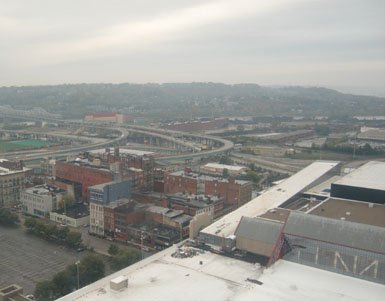

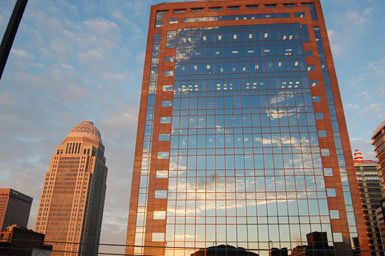
Louisville, KY: Another downtown hoping for tourists, but somehow, though smaller, seeming more healthy than Cincinnati. An old waterfront street is being rehabbed as an arts district. The incoming tourists for the week were thousands of high school aged Future Farmers of America giving the place young life. Or perhaps I was just influenced by the extraordinary sunrise I glimpsed over a modern bit of skyline.
Wednesday, October 26, 2005

Blog toys I didn't resist

A clever student of business has come up with a formula to quantity what a blog is worth in cash. Frankly, I think his result for this blog proves the formula is flawed; while I enjoy writing here, I'm pretty sure this has no monetary value. FWIW:


My blog is worth $14,113.50.
How much is your blog worth?


Another site offers a questionnaire that promises to answer the question "What famous leader are you?" This was not something I'd asked myself; I figure I am myself. However I took the thing and got the result below -- three times on three different days, so at least this test yields replicable results.

I'm sure I'd be more comfortable with a result that named a woman. And much as I respect Gandhi's very effective use of culturally appropriate non-violent struggle against British imperialism, his practice as an old, married man of sleeping next to naked virgins in order to test his self-control leaves him not entirely admirable in my book. I mean, I share my bed not only with my partner but also with an encroaching, indignant feline -- but somehow that is in a different category.

Tuesday, October 25, 2005

Two thousand US deaths in Iraq evoke a violation of Godwin's Law*

I was at a meeting tonight about the need for a movement for universal health care in this country. Many good and useful things were said; information and inspiration was taken.

Finally people broke up in small groups and began chewing over stories. Eventually someone said it: "I'm still not over the last election. Sometimes I just think something is wrong with the people of this country . . . I can sort of understand how they could elect [sic] Bush the first time, but to do it again…" Yes, I've heard that before, a lot.

I came home to read that the 2000th US death has happened in Iraq. Quite literally, only God knows how many Iraqis have been killed in the plague of death our country has released there.

How indeed can the people of the US continue our silent complicity in this crime? This week I am looking for answers in Milton Mayer's classic 1955 study They Thought They Were Free: The Germans, 1933-45. A US Jew who had worked with Quakers, Mayer really wanted to know what made very ordinary men tick under the Nazi regime. (This was not a time that much noted women.) He packed up his family and lived for a year in a small German town, getting to know ten self-identified former Nazi "little men." The book is their story.

Here is a passage from Mayer that speaks chillingly about why those Nazis clung to their leader:

None of my ten friends, even today, ascribes moral evil to Hitler, although most of them think (after the fact) that he made fatal strategic mistakes which even they themselves might have made at the time….

Having fixed our faith in a father-figure … we must keep it fixed until inexcusable fault (and what fault of a father…is inexcusable?) crushes it at once and completely. This figure represents our own best selves; it is what we ourselves want to be and, through identification, are. To abandon it for anything less than crushing evidence of inexcusable fault is self-incrimination, and of one's best, unrealized self. Thus Hitler was betrayed by his subordinates and the little Nazis with him. They may hate Bormann and Goebbels .… They may hate Himmler…. But they may not hate Hitler or themselves.

As the Iraq war claims the 2000th US death and we sit on the edge of indictments of Bush's subordinates for actions they took to defend their criminal war, we can only hope that a majority of the people of this country do not feel the need to cling to the faulty father-figure they've made.

*Godwin's Law is an internet convention ruling out further discussion when someone brings up Hitler. Wikipedia.

Monday, October 24, 2005

The Morning Retch: Racial Profiling in Katrina's aftermath

puke_logo
According to Janet Murguia, of the National Council of La Raza in an oped in today's Washington Post: "The Wall Street Journal reported early this month that 'police and the U.S. Marshals Service swept into a Red Cross shelter for hurricane refugees [in Long Beach, Miss.]. They blocked the parking lot and exits and demanded identification from about 60 people who looked Hispanic, including some pulled out of the shower and bathroom, according to witnesses.'" They aimed to deport "illegal" hurricane evacuees.

What in the world is "looked Hispanic?" That's a category in the Marshals' fevered brains. Maybe they thought they'd find folks lazing around under broad brim hats?

In fact, among others, they found "at least one shelter manager, a former Marine and a Vietnam veteran who happened to be Hispanic. …[He] was also temporarily detained and screened."

The U.S. Keystone Cops would be funny, if they weren't messing with people whose lives had already been blown to bits. Murguia makes a point for all of us:

If there were an outbreak of communicable disease in Katrina's wake -- which is not unthinkable under the circumstances -- the last thing you want to do is convince a segment of the nation's largest minority that the government is not a safe source of preventive care and treatment. If, God forbid, the next crisis involves a biological weapon or an influenza outbreak, the government has just undermined its ability to keep us all safe. Lives are on the line, and not just the lives of the immigrants we too often find expendable.

Sunday, October 23, 2005

Dr. Paul Farmer: moral irritant?


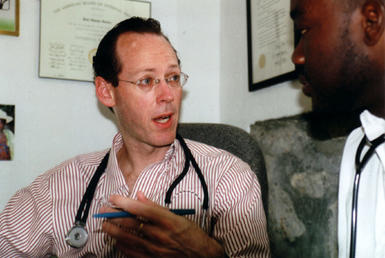
Dr. Paul Farmer of Partners in Health, at his clinic in Cange, Haiti, in a scene from "A Closer Walk," an exploration of the social meaning of the AIDS epidemic. Photo by Worldwide Documentaries, Inc.

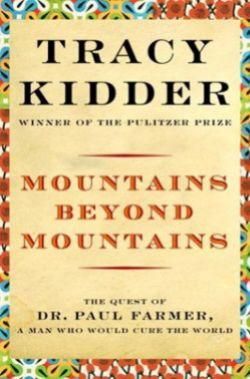
Dr. Paul Farmer believes that it is duty of doctors to serve sick people -- all of them, everywhere, though he has assumed a particular burden of affection and care for the poor of impoverished central Haiti. Tracy Kidder's Mountains beyond Mountains chronicles
  • Farmer's hands-on doctoring of patients;
  • Partners in Health, the organization he and his friends created to give support to his projects and eventually other medical initiatives;
  • Farmer's influential academic work in medical anthropology and as a professor at Harvard;
  • and the enormous impact he has had on world health policy, convincing dubious authorities and funders that the poor, including those carrying resistant TB and HIV, deserve all the care modern medicine can offer them.
Farmer's example of devotion to principle is so admirable, so extraordinarily self-sacrificing and efficacious, that he is more than a little hard to take for mere mortals. The extraordinary accomplishment of Kidder's book is to make this difficultly admirable individual more attractive than frightening.

Farmer makes no bones that there is a cost to doing right by the poor:

White liberals "think all the world's problems can be fixed without any cost to themselves. We don't believe that. There is a lot to be said for sacrifice, remorse, even pity. It is what separates us from roaches."

At the core of Farmer's belief system is "the preferential option for the poor," a phrase and an idea derived from Catholic liberation theology as articulated by Latin American bishops at Medellin, Columbia in 1968. Liberation theology asserts that the world's wealthy, a category that includes most everyone who has enough to eat, a roof over our heads, the ability to read and a stable political environment owe the poor some of our food, shelter, education and respect. "Sin" is not some individual failing, but rather lives in systems in which a few profit without protest from the enforced misery of others. For those who enjoy wealth, sharing is a hard demand and few of us can live up to it. Farmer comes very close, sacrificing comfort, time, and family life for his patients and his vision of world health.

The folks who work with him know though, that not everyone can be Farmer.

Jim Yong Kim, his collaborator, insists "Paul is a model of what should be done. He is not a model how it has to be done. … Let's make sure people are inspired by him. …But … if the poor have to wait for a lot of people like Paul to come along before they get good health care, they are totally fucked."
Farmer himself explains: "I didn't say you should do what I do. I just said these things should be done!"

Perhaps this indifference to others' reactions to his person is the key to Farmer's extraordinary ability to get resources and care for people who have nothing. Farmer is apparently wonderfully focused on results, not on what people think of him. Yet Kidder is also able to convey the warmth and generosity with which Farmer meets all those who fall into his category of "patients" -- a category into which he welcomes just about anyone, including the privileged, who might have need of medical care. In the end, Kidder convinces me that Farmer burns not only with anger at the systemic injustice which condemns Haitians and others to poverty and disease, but also with a love for the well-being of all people that transforms that anger into service. Not a bad model to emulate, even if most of us can't quite pull it off.

Saturday, October 22, 2005

Gov. Arnold runs away from his ads


I've been out of California for 10 days, but the Governator has been right with me. Nearly every time I opened an LA Times article on the web, I saw the ad pictured above. Today the same paper tells me the steady diet of "all Arnold, all the time" is over.

Gov. Arnold Schwarzenegger asked TV stations Friday to remove ads that feature him making a personal appeal to California voters — an acknowledgment, analysts said, that one of the world's most recognized figures has become a weak salesman for his own agenda.

An avid pitchman his entire adult life — selling everything from gym bags to action movies — Schwarzenegger nevertheless now will rely on "ordinary" supporters to promote his four Nov. 8 ballot initiatives in ads, his campaign said.

I can't say I'll miss him. Nor, apparently will other Californians.

The Preznit had to miss him yesterday though -- if there is one pol less popular in California than Arnold, it is Bush. So our anxious governor snubbed Bush's trip to the Reagan library.

It is clear which way the wind is blowing -- so long as enough Californians vote on November 8.

Friday, October 21, 2005

How many deaths will it take til we know that too many people have died?


As we approach the milestone 2000th US casualty in our war on Iraq, United for Peace and Justice urges us to organize rallies and vigils for the day after that death is announced. A worthy idea; I hope there are thousands of vigils demanding peace now.

NPR's "All Things Considered," in its evolving role as government propaganda organ for the educated, preemptively deflected UFPJ's slant on the milestone by puffing the work of Iraq Coalition Casualty Count, a site that very diligently catalogues US dead and prides itself on its connections with their grieving relatives.

But come on -- the people who dying in droves are the Iraqis. They suffered and died under Saddam Hussein as well as under the US-supported sanctions regime that starved their efforts to rebuild after the first Gulf War. But they used to have a more or less functioning country that supported a fairly predictable life.

Now everyone in the place is subject to arbitrary attack by various criminal gangs, some wearing the uniforms of the US Army, some the uniforms of "Iraqi government" security forces, some the plainclothes of the insurgents, some the armor of religious or ethnic fanaticism, some killing for grudges, some killing for money.

The Canadian Broadcasting Company tackled the question of Iraqi deaths and came up with muddled, partial numbers:

Civilian deaths estimated from various sources (Since March 20, 2003)

• Civilian Iraq deaths: 26,661 to 30,018 (as of Oct. 21, 2005)(Source: Iraq Body Count )
• Civilian Iraq deaths: 12,000 (Source: Official estimate from Iraqi interior ministry March 20, 2003-June 2, 2005)
• Iraqi civilian or religious officials assassinated: 52 (Source: Official estimate from Iraqi interior ministry March 20, 2003-June 2, 2005)
Other estimates are far higher.

Journalist Robert Fisk wrote in August, 2005 that all too often Iraqis simply hurry to bury the dead and no one counts them. The article reports the Baghdad mortuary received 1100 bodies in July and that no one knows who many were or why they were killed. He reports that the British Medical Journal The Lancet "concluded that at least 100,000 civilians had lost their lives in the first 18 months after the invasion - more than half of them women and children killed in air strikes. The figures were based on a survey of 1,000 households across Iraq." How many more have died since? We just don't know.

But like every one of those 2000 US soldiers, every one of those dead Iraqis was someone's child, someone's partner, someone's relative. When we hit that nice round 2000, let's try to keep in mind the thousands whose names we do not know.

Thursday, October 20, 2005

Actually they all just hate women


Apparently the US military can't get the Taliban in Afghanistan to come out and fight them. The talibs hide among the population when confronted with superior force. (Anybody remember reading about how the poorly equipped American revolutionaries were so much smarter than the Redcoats because they sniped from behind trees while the Brits expected them to engage in direct battle?)

So the US forces desecrate bodies and burn them. And then they insult the Taliban.

An embedded Australian photojournalist Stephen Dupont reports (as picked up by the NY Times):

[US forces broadcast] taunts, which were delivered in the local language by American forces on the scene, a soldier identified as Sgt. Jim Baker, said: "You allowed your fighters to be laid down facing west and burned. You are too scared to come down and retrieve the bodies. This just proves you are the lady boys we always believed you to be."…

Then a second soldier, who was not identified, chimes in singling out several mullahs by name: "Your time in Afghanistan is short. You attack and run away like women. You call yourself Talibs but you are a disgrace to the Muslim religion and you bring shame upon your family. Come and fight like men instead of the cowardly dogs you are."

… Mr. Dupont explained that the American soldiers had been trying to bait the Taliban fighters to shoot at them. "They want the Taliban to fight them because they can't find them otherwise."

That's right -- come get killed rather than be compared to a woman.

The Australian video interview with Dupont who captured all this on film is pretty interesting. He portrays most of the the US soldiers who burned bodies as frustrated, but also kind of simple-minded: "it didn't mean much to them." Once he got permission to embed with the US unit, they didn't seem to hide anything from him (in contrast to Australian troops who do their best to keep their activities invisible.) The older psych-ops units did at least have a rationale for their behavior.

The usual -- woman-hatred.

Wednesday, October 19, 2005

The Morning Retch: Lower income students just as smart, but less educated

puke_logo
While House Republicans are working to cut $50 billion from programs that help the poor so they can give it to their rich buddies as tax cuts, rising college tuition costs are rapidly working to ensure the poor stay poor.

It is pretty simple, according to a report in the LA Times:

[Students] from families with the highest income and education levels finished college at more than double the rate of high-scoring students from the lowest socioeconomic grouping.

Sandy Baum, a College Board analyst, said the data showed that college completion increasingly was "not about academic preparation; it's about money."…

Citing federal statistics, Baum said the consequences of rising costs and family resources could be seen in the lives of students who scored highly on mathematics exams as eighth-graders in 1988.

Within the lowest socioeconomic sample, 75% of the high-scoring eighth-graders eventually enrolled in college, but 29% had earned college degrees eight years after high school graduation. Ninety-nine percent of high-scoring eighth-graders within the highest socioeconomic sample attended college, with 74% earning degrees. High scorers in the middle two socioeconomic groups entered college at a 91% rate, with 47% earning degrees.

Those who have, get.

One way they get is by way of "merit scholarships" which tend to go to students who would go to college anyway, rather than to students in the most financial need.

The Sarchasm explains that the colleges are not raising tuition to throw money at faculty salaries.

Believe you me, these tuition increases aren't paying for 3 month European sabbatical tours for rich faculty members.

My hard working "freeway-flying" professorial partner would agree.

Tuesday, October 18, 2005

Give backs v. Health Care Now!


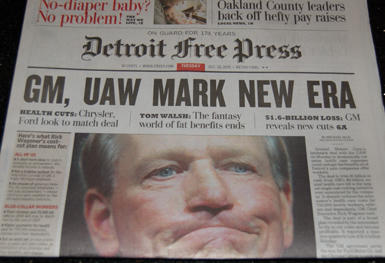
On October 17, the United Auto Workers Union agreed to give in the General Motors' claim that it would go bankrupt if it kept on paying for all the health care it had promised its workers. Business reporters are crowing over the deal. Here's a sample from the union busting Detroit Free Press:

The fallout from Monday's deal will be felt by every Michigan schoolteacher, municipal worker or other employee whose wage-and-benefit package was modeled on the auto industry contracts of yesteryear. Say goodbye to the paternalistic employer that promised cradle-to-grave security.

Some predict that getting the rank and file to go along will be a tough sell for the UAW leadership:

"Why pick on a retired person with a fixed income?" asks David Shaw, 58, who worked in hourly and salaried jobs during 31 years at GM's Baltimore truck and bus plant. Shaw says, "GM has done a poor job in their management ... and because of their failure to do well in the market, they're claiming our costs are hurting them."

Still most expect the giveback agreement to pass when the union votes; workers fear that GM is really sinking and will sacrifice to keep their jobs.

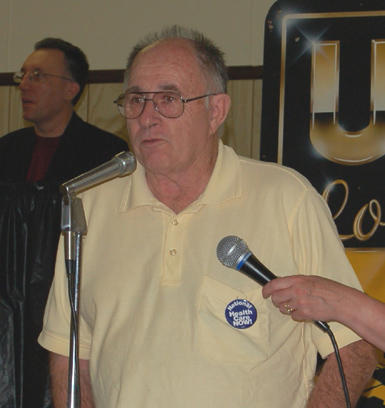
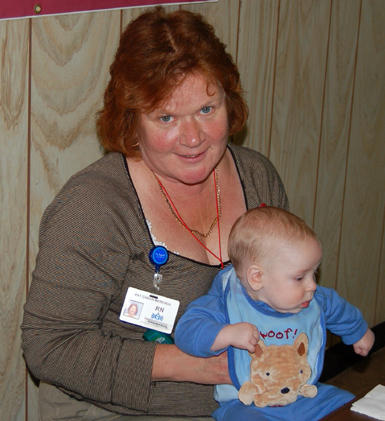
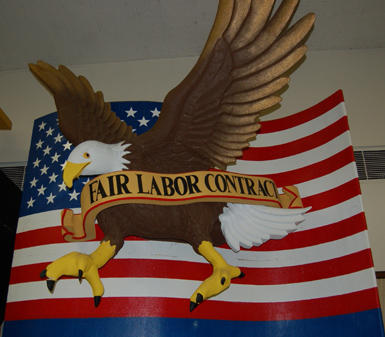
The same day I had the privilege of attending a meeting in Dearborn, MI, put on by the Coalition for Health Care NOW! CHCNOW! promotes "a universal, single payer health care system with leadership from the labor movement in coalition with community organizations." They are close to Rep. John Conyers, advocating for his U.S. Health Insurance Act, H.R. 676. (Conyers was scheduled to speak but bowed out at the last minute to be in DC.) Speaker after speaker hammered away against for-profit, commoditized health care and for a system that keeps "Everybody in; nobody out." Years of analysis, strategizing, organizing and devotion to prinicple reside in this coalition. And no one was kidding themselves that this fight would be easy; ironically, the meeting was held in a UAW hall.

Here are some pictures.


It was a good sized crowd, 200 or more.


Not everyone was an old hand.


Sone folks were out of a different labor tradition; these good people fed us dinner.