Monday, February 08, 2010

Spooks impeded?

According to the Atlantic's Marc Ambinder:

About 80 percent of the world's telecom traffic was handled by routers based in the United States before 2001. After the [illegal National Security Agency listening] program was revealed by the New York Times in 2005 and the government tacitly acknowledged that it had set up special technology to monitor the routers, the percentage of worldwide telecom traffic that the U.S. had immediate access to dropped dramatically, according to a technology expert who informally advises the government said today.

Kim Taipale, the executive director of the Center for Advanced Studies in Science and Technology Policy, told an audience at the University of Texas Law Review today that he estimated about 20 percent of worldwide traffic is now routed through the U.S.

Why? As soon as countries realized the extent to which the U.S. essentially controlled the traffic flow, they and their contractees built facilities overseas. Even U.S. telecoms, seeking to avoid surveillance requests from the U.S. government and potential lawsuits from consumers, began to move their capacity outside the U.S.

That is, when Congress, finally, gingerly, stepped in and set some weak limits on how our spooks could collect every electronic communication they could physically get their hands on, world commerce decided to go elsewhere.

I think it very unlikely that any of this actually prevents the NSA from capturing all electronic communications -- go online and the NSA is in bed with you; I assume everyone knows that. It's not clear that any legal privacy regimen can prevent abuses in this area.

But it is sort of pleasant to realize that known U.S. abuse has undercut U.S. market domination in telecommunications. Breaking even uncodified international rules has consequences ...

Sunday, February 07, 2010

Not all news is bad

Speaker Pelosi's office clearly has a fine statistical display artist. Check out this chart:

Readable version here.

Though this is designed to score political points, that doesn't make it false. We'll see.
***
Meanwhile I went in to see my barber Friday. She's a sole proprietor, the very essence of a small business person. And she was mad. She had just read in the newspaper that "that guy Scott Brown says the stimulus didn't help anyone."

"I know better!" Her husband, an electrician, had just got on a long term job at the airport after 15 months out of work. "First they extended his unemployment so we were able to keep our house. Now he's on a project that will go at least a year thanks to the stimulus. The building had shut down, but it started again when the money came in."

She decided she is going to write a letter to the newspaper. "They never explain when one of these politicians says things that aren't true."

That's citizenship. And that's good news.

Two Super Bowl response ads: one to CBS, one to Tim Tebow


Take that marketing execs.

This isn't so much fun, but Planned Parenthood offered its own response ad:

Saturday, February 06, 2010

On beyond the Super Bowl ...

comes the Winter Olympics in Vancouver, BC in mid-February. As per usual, the host city wishes its poor citizens would disappear for the duration. Some locals don't want Vancouver to get away with this ...

Saturday scenes and scenery:
California is weird

I'm still, after about 40 years, enough of an east coast transplant to think Spring ought not to show up on the first day of February. But it sure was happening on San Bruno mountain just south of San Francisco. I offer these cellphone photos of flowers (and one hazard) as evidence of the local oddness.


If the slideshow doesn't work, the set is here.

Friday, February 05, 2010

Friday cat blogging

Billie-close-up.jpg
Billie won't mind at all that the Sunday afternoon thing the humans do with all the yelling and drinking is almost over for another year. Not that he'd allow himself to be scared off his perch. But you have to be wary.

The humans meanwhile prepare to experience football withdrawal. Or maybe Olympics. Skating anyone?

Budget follies short-takes:
Waa, waa, waa: I want mine!


One of the two pillars that make deficit reduction and responsible governance that "promotes the general welfare" (that's from the Constitution in case you've forgotten) so very difficult is the refusal of rich people to pay taxes. More taxes to do anything useful will have to come from rich people: they are the ones with the money. But the conservative polling outfit Rasmussen has documented that magical thinking wins out:

President Obama has now turned his attention to the ballooning federal budget deficit, but a new Rasmussen Reports national telephone survey finds that a modest plurality of voters (41 percent) prefer a budget deficit with tax cuts over a balanced budget that requires higher taxes. Thirty-six percent (36 percent) would rather see a balanced budget with higher taxes. Twenty-three percent (23 percent) are not sure which is better. ...

...almost half (47 percent) of GOP voters think it’s possible to balance the budget without raising taxes, but 53 percent of Democrats don’t....Those in the Political Class are twice as likely as Mainstream voters -- 70 percent to 35 percent - to believe it is not possible to balance the federal budget without raising taxes.

"Mainstream" is Rasmussen's tendencious label for voters who "tend to trust the wisdom of the crowd more than their political leaders..." That is, the Palinites and many others of numerous stripes, including the large fraction of us who want to protect the privileges of the rich because we think maybe we'll join them some day. I wonder if what looks like future prolonged economic stagnation will disabuse more of us of this fantasy?

(Since we're in national budget season, I'm not going to to resist offering occasional short comments on budget matters and process under this headline, just as I have done about health care reform. I have strong foundational views on what the U.S. government ought to be doing about and with taxpayers' money that I've laid out in this post.)

Thursday, February 04, 2010

President speaks to OFA


It would be greatly exaggerating to call what Obama did in front of some Organizing for America (OFA) folks in Virginia this afternoon a conversation. More like a stump speech from a guy on the verge of exhaustion. The Prez had none of the animation he showed last Friday with the Republicans. Wonder what's going on that left him looking so deflated?

Though he repeated the mantra "I am not going to walk away from these fights," he sure wasn't making any promise that health care reform will get passed. In fact, he defaulted to saying the voters in November will get to express what they think of the "hard" process of Congressional action on reform. Not encouraging.


Watching him online, I kept thinking of John Judis' article He's a Yuppie. Judis gets a lot right -- and something basic wrong. He's a Buppie. Being black, he's got a bit more of an edge than your basic Yuppie; he's had to be a lot smarter and tougher. But he does carry some very Yup mannerisms and expectations -- such as that intellect matters -- that characterize Yuppies. Today he wasn't firing. But he wouldn't be President if there wasn't another more animated way of being the O-man. We'll see.

Techno tidbits

The first item here is serious -- the others just diverting, but nonetheless interesting.
***

What's one of the most useful relief supplies brought into Haiti after the earthquake? Tim Lange, admittedly praising his employer's offering, writes

Just two days after the quake, a team from Thomson Reuters Foundation’s AlertNet humanitarian news service touched down in a twin-prop plane at Port-au-Prince’s international airport to set up the first-ever Emergency Information Service (EIS), offering Haitians free, practical SMS messages to help them minimise the disaster’s impact.

Despite countless logistical setbacks, EIS got off the ground in about 48 hours, and since its launch thousands have used the service to report missing persons, shelter problems and food issues.

Landlines and electricity are gone in Port-au-Prince, but even homeless Haitians have cell phones and often can recharge them if existing generators can just be provided with an occasional gallon of gasoline. And text messaging can often function even when other cell phone coverage is weak or spotty, as millions of us know from experience. Good work, AlertNet.
***


It's cold in Germany this winter. Spiegel photo.

If in danger of getting lost, do it under the eye of a webcam.
Der Spiegel relates this tale.

All he wanted to do was take a few nice pictures of the stunning ice sheet which currently stretches into the sea. In his efforts at photographic posterity, however, he quickly lost his orientation. Before long, with darkness falling, visibility low and nothing but ice and snow all around, the man, who is about 40 years old, no longer knew which direction to walk for the safety of the shore. ...

Help came from an unlikely place. A woman sitting in front of her computer hundreds of kilometers away in the town of Westerwald was taking a look at the frozen beach via one of the many Web cams set up around St. Peter-Ording. In the grainy image on her computer screen, she noticed a shadowy figure on the ice signalling with a flashlight. Immediately, she called the local police station to report the man.

Police were quickly able to locate the man and used car headlights to lead the man to shore.

***

Uses of the Wikipedia
Many teachers (including the one I live with) decry their students' turn to the online reference as a primary research tool. "The Wikipedia is not a proper source!" I certainly agree it is not a proper sole source, but it often offers a starting point that leads to other, more tried and true, sources.

Therefore I found it fun to find on the Radical Teacher blog an article by Emily Drabinski making the case that there is pedagogical use for the Wikipedia:

With scholarly communication, the final text is presented as authoritative, the drama that contributes to its production all but invisible, especially to a reader new to that discourse community, eg., most of our students.

A [controversial] Wikipedia entry ... can kick off a conversation about the nature of objectivity in other kinds of texts. The revision page is a rich text from which to draw conclusions about the kinds of things that motivate producers of information -- emotional commitments to certain ideologies ..., desire for objectivity (other users reverse vandalism of the page almost as quickly as it is made), unstated biases and prejudices ..., etc. After such a list has been generated, it might be applied to another text deemed authoritative in the classroom, giving students a way in to critical analysis of what can so often seem, in its stark and clean presentation on the page, simply the truth.

Even better, the Wikipedia entry she uses to exemplify this is about playoff football!
***

Ah, our electronic devices. A Brit comic-journalist experiences the dangers of living without them.

Budget follies short-takes:
Where our money goes

You don't have to believe me. Here's Jon Taplin, a Professor at the USC Annenberg School for Communication, suggesting there could be Life After Empire. He presents this chart:


Then he asks

In what way does this have to be the world's reality? Who named us the unpaid cop of the planet?

... We need to put all of this on the table politically. Just who in Congress has the guts to form a coalition between progressives and libertarians, to really air the cost of empire and to imagine what America could be like once it shed its imperial burdens, is still an open question. But the conversation needs to start now.

(Since we're in national budget season, I'm not going to to resist offering occasional short comments on budget matters and process under this headline, just as I have done about health care reform. I have strong foundational views on what the U.S. government ought to be doing about and with taxpayers' money that I've laid out in this post.)

Wednesday, February 03, 2010

A lesson for our Democrats?


When democracies elect progressive politicians, we hope to see public campaigns like this poster in contemporary Chile.

Maybe our Democratic administration could try to emulate some other moderate progressives who took office under far more difficult conditions than they face.

Chile grew at an average of 5.1 percent per annum during those twenty years. The proportion of the population living in poverty fell from 38.8 percent of the population to 13.7 percent in 2009. GDP per capita was $4,542 in 1989: in 2009 it was $14,299.

... In 1989 there were 249,482 students in higher education -- in 2009 there were 809,417. Chile was investing $7 million in health in 1989; by 2009 that figure had risen to $307 million. In infrastructure, the 27.3 kilometres of the metro line in [the capital] had expanded to 94.5, and major roads improved. Minimum wages increased substantially, and the pension system was reformed to benefit poorer pensioners. ...

The government ... in 2005 was eventually able to reform the constitution to make it more democratic... On human rights, the government has a record that compares favourably with other countries. Since 2000 in Chile, some 779 former agents have been indicted, charged or sentenced for human-rights abuses ... By the end of December 2009, 279 former agents of the military had been sentenced for abuses, of whom fifty-nine are serving out final sentences in prison; while most of the rest are still in the appeal process or have received lesser punishment such as house-arrest or suspended sentences.

Open Democracy

Who were these paragons? The governments of Chile between 1990-2010 that pulled that country back to democracy in the wake of the brutal Pinochet dictatorship. They accomplished all this under the dangerous eyes of a previously all-powerful military that had to be both controlled and appeased in order to enable civilian government to survive.

I sure don't see U.S. Democrats achieving anything like that much.

The article linked to above is an account of how these moderate reformers wore out their welcome after 20 years. It examines whether the election of a President from the right will mean a consolidation of democracy or a swing away from progress. Unhappily, one of the worst omens for continued progress toward social justice is the enhanced weight a government of the right will have to give to the Roman Catholic Church's regressive views. All very interesting and worth thinking about in our context.

Tuesday, February 02, 2010

Budget basics -- into the "willows"


Hiker waste deep in the willows. Not my pic; from here.

I can feel the resistance in me rising again. I'm about to plunge into another set of what trail guidebooks about the Colorado Rockies call "willows." I once read that, imagined graceful hanging greenery and wondered "what are they talking about?" that I should worry about the effort of getting through them? Turned out to a brush-filled, thicket of a swamp, a nasty, trackless place.

The Prez and Congress have moved into budget season -- having so far left themselves with an incomplete grade on health care reform -- and if I want follow developments, I have to plunge into some budget "willows."

This will be tiresome, but not so much so if I hang onto a few basic facts that are largely unmentioned among the commentariat:

The United States is still a very rich country. Okay, so a billion Chinese with a per capita income of $3300 according to the IMF in 2008 adds up to a lot of money -- and a very big deal. But 330 million Americans with a per capita income of $47000 is also a big deal. These days, the US is simply not so much richer than the rest of world that we were during the second half of the 20th century -- but for all our inequalities, we're still better off in aggregate than any other people in history. We can stop whining and start thinking about how to use that wealth to solve our problems of inequality.

The famous "deficit" -- the label for the truth that the US spends more money than the government has to spend -- arises from two sources:
  • Rich people refuse to contribute to maintaining the common good. Since 1980, that would be Ronald Reagan's election, rich people and their corporate shills have bought the best politicians and legal outcomes money can buy to defend themselves from having to pay taxes. They just won't. They'd rather tear down the nation that enables them to get rich than to pay their share. And they have been getting away with this. Sure, this is stupid, a complete failure of enlightened self-interest. Nobody ever proved that rich people are smart; they are merely very determined people who are willing to act greedy and sociopathic.
  • Empire costs a lot. The United States has two (purpose-devoid) wars dragging on, 1000 or so military bases in other peoples' countries, military contractors up the wazoo, and a military force structure so bloated that it can't seem to get 30000 troops to Afghanistan in 6 months and then needs $1 million for each of them to keep them there for a year. This is the definition of insanity. After World War II, Europe was willing to let the U.S. play international cop while it recovered from being reduced to rubble. The rest of the world just wanted the colonial powers off their backs. The world, though still dangerous, has become a more complicated and for many people in Europe, Asia and even Latin America a somewhat better place. It is both interlinked and multi-polar. The era of United States empire is simply over, though we can blow up the planet 99 times. Managing this decline has to be the budget game. That's where future deficit reduction is possible.
Rising health care costs contribute to the deficit, but they are not the main problem. We just got a dose of this today from Ezra Klein:

"long-term deficits are a function of health-care spending ..."

That is only true if we refuse to look at raising taxes on the wealthy and reducing the costs of empire. I see no reason why older people should be unable to go to the doctor so some general can get wined and dined by a war contractor. Or so some politician can get a cushy lobbying job when he decides to leave office. But that's what we are up against.

Monday, February 01, 2010

A question for our economists


Only 1:10. Worth pondering.

Impunity for torture apologists

So the Obama Justice Department, acting just like the last guys, is about to issue a report finding that the intellectual authors of national disgrace, the political lawyers who cooked up a half-assed rationale for torture, didn't do anything really wrong. They meant well, so the crimes committed following their logic don't count. This reminds me of students who figure they deserve an A for effort, even if they didn't learn anything.

I find it hard to think of anything new to say about this. I'll leave commentary to Adam Serwer:

There's a consistent theme here that is both bipartisan and supported by elite opinion-makers in the press: The powerful should never be held accountable for their lawbreaking. Whether it was the Bush administration's lawyers ensuring that their colleagues would be protected not just from legal accountability but from professional sanction, or the Obama administration's "looking forward," we now have an unassailable culture of impunity for government lawbreaking in the name of "national security" -- whether such lawbreaking furthers national security interests or not. The rationale here is dangerous, supported by the notion that the powerful should be immune to sanction for abuses of power because of the responsibilities they shoulder. The opposite is true: It is precisely because they are so powerful that accountability is essential.

Now, the Obama administration is struggling to defend itself against right-wing demands that detainees in their custody be tortured. And why not? Whatever their anti-torture rhetoric, the administration's actions have given the public the impression that no laws were broken, and no one did anything wrong or deserved of punishment.

My emphasis.

When one extreme administration embraced torture as national policy, it could be thought of as a panicky aberration. When a succeeding administration, supposedly representing "change," ratifies impunity from any sanction arising from crimes against individuals and international treaties, it settles the United States into a comfortable berth among the world's torture states, on a par with such charming places as Turkmenistan, Egypt and Burma. Lovely.

Health care reform shorts:
The Republican reform proposal


Though I'm furious with Senate Democrats for getting health care reform of some sort to the one yard line and then stalling, it's still important to remember what the other guys were offering. Not much.

Some may question the source of this graphic, but the underlying data supports it.

Consider this post as hommage to this Nate Silver discussion of Democratic messaging difficulties.

Sunday, January 31, 2010

What do we know and who knows it

On learning that Pew Research says only 26 percent of U.S. citizens know that it takes 60 votes to end a filibuster and thus enable the Senate to end debate and vote on a bill, I did what I often do when I want to get a slant on popular opinion: I asked my partner what she thought her students knew about this. She teaches college freshman at a moderately selective private college. Her young people seem a plausible slice of smart young people.

"Easy," she replied. "They all saw 'How a Bill Becomes a Law' in high school." Here's a YouTube version of this high school classic. [3:01]

Note there is no mention in this of the filibuster or other undemocratic aspects of legislative procedure -- no wonder folks don't know how Senate procedure is stifling democratic (small "d") government.

The Pew Survey linked to above is interesting. Only 32 percent of us know that every single Republican voted against health care reform. You can take the quiz yourself and see how well you line up with the general public.
***
Meanwhile, the progressive blogosphere is a agog because President Obama visited the Republican Congressional caucus meeting on Friday, took policy questions, and swatted the dim-witted drivel the Republicans offered out of the park -- all live on TV. Transcript is here. Here's the video. [85:56]


Here's an idea: how about something a little more demanding for our brilliant leader? It would be great to see whether he could interact so intelligently with people who have a little more intellectual heft. The President should go on live TV with a panel of folks who actually know something about health care reform and take a shot at explaining why the strangely contorted half-measures that Congress has come close to passing is good for us. Some suggestions for the panel:
  • Congressman John Dingell (D-MI) who has introduced health care reforms in 27 sessions of Congress;
  • Senator Byron Dorgan (D-ND) who champions drug importation to create price pressure on the pharmaceutical industry;
  • T. R. Reid, a journalist who has studied health care around the world;
  • Dr. Marcia Angell, former editor of the New England Journal of Medicine.
Blogosphere health policy journalists who've done the work of helping hapless Democrats explain what they've come up with may be somewhat compromised, but Jonathan Cohn and Ezra Klein would make smart moderators.

Now that's a TV show I'd tune in to. I think this President might be up to it. But, unlike the Party of No, these folks would require him to work to make his points if they weren't too cowed.

Saturday, January 30, 2010

Saturday scenes and scenery:
Bethany Center Senior Housing murals

1bethany-tall.jpg
San Francisco's Mission District has a lot of murals. My pick for the most original blend of building with art are the ones on the undistinguished boxy apartment block that is Bethany Center Senior Housing. I don't know anything about this place except what is on the website -- but I love it that they say they want to be more than "a reliable landlord." In San Francisco, a reliable landlord is a marvelous thing!

2artist.jpg
It would be pretty cool to live behind a window with this figure on its outside.

3snapshot.jpg
Or this very San Franciscan snapshot of another time.

4guitar-player.jpg
This fellow could easily be a current resident.

5pianist-and-dancer.jpg
They are having almost too good a time!

6pseudo-ticket-window.jpg
At ground level, artist Dan Fontes painted a ticket window in an exit alcove along with his credits. He called this enormous project "¡Salud!"

Friday, January 29, 2010

Bill Clinton and his historian

The Clinton Tapes: Wrestling History with the President is an oddity. The respected historian Taylor Branch (Parting the Waters : America in the King Years 1954-63) knew Bill and Hillary Clinton from way back in the trenches of George McGovern's ill-fated Presidential run. They weren't close, but there was trust. So when Clinton wanted to record real time accounts of his presidency for posterity (and his memoirs), Branch agreed to act as the interviewer in a secret oral history project. Over nearly 80 sessions, Branch prodded and encouraged the President to expound on what he was doing and what he cared about. Clinton kept the tapes (hidden away in a sock drawer from prying lawyers as the Republican's legal witch hunt against him increased in intensity), but after each round of talk, Branch made his own notes on Clinton's musings. This is the book Branch has made from those notes.

For me, reading this amounted to catching up on a decade in which I paid little attention to Washington. California was fighting, via ballot initiatives, over how to live through the transition from a majority white state into its multi-racial reality. There was lots of local work to do. I retained only three strong impressions of the Clinton presidency: 1) that many progressive friends were overly hopeful in 1992 and much disillusioned soon thereafter; 2) that Clinton was willing to gash the safety net for poor women and children by signing a Republican "welfare reform"; and 3) that the guy squandered his term because he couldn't keep his dick in his pants. Obviously I was not a Clinton fan.

This book did give me a more nuanced and somewhat more appreciative sense of Clinton. I do politics. Even if I don't much like them, I respect people who can engage in political struggles with clear sight and without personal rancor -- idealism is essential, but passions need balance or will turn sour. How could I not warm to a guy of whom Branch concludes:

He loved politics so much that he could speak almost fondly of his own defeats. ... He wanted to deal with the politics, win, lose or draw, because he loved it. He loved being with the people who hated him!

Those are qualities we need in a President, plus a self-confident maturity that Clinton didn't have. The current one might even be so well-balanced as to be a little scary.

Mostly during the 1990s, I ignored Washington's foreign activities. Like most folks my age, I was a little confused about the implications of the sudden collapse of my lifetime's permanent U.S. enemy, the whole Soviet bloc. And I don't think I was alone; actually, I think official policy was nearly as adrift as we the citizens. Certainly we didn't get any "peace dividend" -- remember that hope?

Consequently, I found this book interesting for its accounts of that decade's turmoil in Bosnia, Northern Ireland and especially Haiti, a country that gets more attention than it would have otherwise because Branch had a friendly acquaintance with President Jean-Bertrand Aristide. Clinton believed he took huge political risks when he restored Aristide to (a constrained) power after generals had overthrown him. His advisors and opinion polls wanted no U.S. involvement:

[General Colin] Powell was telling him that Haiti was a worthless, miserable country, governable only by the military...He explained to me that national polls had favored a U.S. invasion of Haiti briefly ... when thousands of desperate Haitians were washing up on the shores of Florida. ...The Coast Guard started diverting refugees to Guantanamo. People had cared about the refugees because they were black, and now they don't care because Haiti is black. "We've got racism working against us instead of for us," the president fumed. ...
I have to wonder whether we'll see a replay of this over the next few years -- or perhaps this is a slightly different nation. Meanwhile, it bodes well that Clinton (and Mrs. Clinton) are deeply involved again in Haitian relief.

Branch's book lags at times; it is very long and, like the conversations themselves, not tightly constructed. Many people will not be so indulgent of Clinton's weaknesses as Branch became. But it seems an honorable contribution to history's first draft.

Howard Zinn: thinking about Obama and our dreams

howardzinn-blog.jpg
At Historians against War conference, 2006

Our job is not to give him a blank check or simply be cheerleaders. It was good that we were cheerleaders while he was running for office, but it's not good to be cheerleaders now. Because we want the country to go beyond where it has been in the past. We want to make a clean break from what it has been in the past. ...

Some people might say, "Well, what do you expect?" And the answer is that we expect a lot.

People say, "What, are you a dreamer?" And the answer is, yes, we're dreamers. We want it all. We want a peaceful world. We want an egalitarian world. We don't want war. We don't want capitalism. We want a decent society.

We better hold on to that dream -- because if we don't, we’ll sink closer and closer to this reality that we have, and that we don't want.

Alternet, May 2009

The activist historian, who managed to somehow mesh unflinching integrity with hope, will be missed.

Thursday, January 28, 2010

Obama as jovial national daddy

1Prez-makes-a-joke.jpg
I took in the State of the Union speech with the good folks of Organizing for America at Everett and Jones in downtown Oakland. The barbecue joint and music club is a grand community institution where the Obama campaign worked out of the back room for months. I can't imagine a more pleasant setting in which to watch an event I wasn't much looking forward to.

2happy-spectators.jpg
A lot of folks simply seemed to be having a good time, perhaps remembering endless hours of hard work during 2008.

3watching-screens.jpg
Once Obama got going, he had this audience's attention.

I have plenty of criticisms. A spending freeze that omits the military part of the budget from scrutiny is nonsense. Obama's rationale for the "entitlement commission" he's determined to set up by executive order repeated a common falsehood: it is simply false that Social Security spending is out of control; SS costs as a percentage of GDP are pretty much flat. Medicare and Medicaid costs are skyrocketing -- mostly because U.S. providers insist on being paid twice what doctors and hospitals get in the rest of the world while insurers skim off their profits. You can't blame that on sick people. And I wish he didn't feel he had to talk tough about the remote "threat" of an Iranian bomb, a notion refuted by numerous CIA threat assessments.

4applause.jpg
And there was a lot to like too. The education section, helping students be less burdened by loans and aiding community colleges, pointed in great directions. It was good to hear him reiterate that he'll continue to wind down the Iraq occupation and begin some withdrawal from Afghanistan in July 2011. His advisers have been nowhere near so clear on that. What's not to like about making lobbyists disclose all their contacts with Congress; that will cause fits all over K Street -- it's burdensome and will drag a lot of dirt into the light should it ever happen. He even managed to sound hopeful about health care reform, more or less.

5he-done-good.jpg
The best of the speech was its informal authority. He talked to these Congresscritters (and the Supreme Court) like the fractious first graders they act like. And they took it. They have to -- he's not personally cowed by them; he's willing to talk with them; it's clear they can't figure out how to handle him. He gave nice props to the House for passing the hard stuff it has tackled this year -- and by implication told the Senators they sucked, all with a lovely smile.

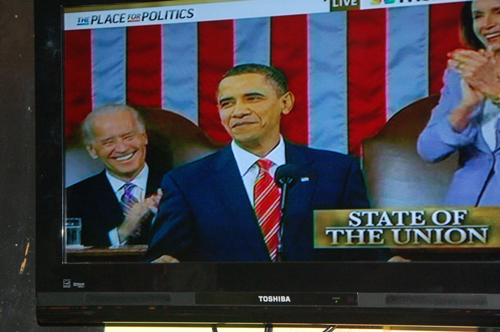
It was a pleasure to watch Joe Biden enjoying himself. It was a pleasure to see Nancy Pelosi simply enjoying his takedown of her silly brood -- I am often very critical of her as my Congresswoman, but she sure seems to be good at the role of Speaker that she so much sought.

I didn't expect to come away from the SOTU anything but mad and discouraged, but I was wrong. Just maybe, with enough popular pressure, Obama's presidency doesn't have to be a complete flop. All those happy people at Everett and Jones deserve more than a feckless failure.

Wednesday, January 27, 2010

Make a road where there is no road


Partners in Health was working in Haiti long before there was an earthquake. And Partners in Health will be there long after the TV cameras leave. PiH employs 11000 mostly local workers around the world, in 4000 in Haiti.

Poor people around the world, including this country, need access to health care that is well within the capacity of medical knowledge. The obstacles to provision of health care, around the world as well as in our own country, are social, not technical. We can work for health care for all here; we can help others work for health care for all in their own countries. It's called solidarity, an old fashioned virtue.

Video [2:30] from Boston Globe.

Great Blue Heron

heron-in-GGP.jpg
When the storms stopped for a moment, this fellow showed himself in Golden Gate Park. Yes, that is a Great Blue -- he folded his neck when I pulled out my camera, masquerading as a Night Heron.

Tuesday, January 26, 2010

Obama's lovely little war


These people simply have no idea what they are doing -- except killing more people.

Obama slides into political imbecility


You may have heard this morning that the President intends to announce a budget "freeze" on discretionary spending -- not counting "security."

The Economist, not exactly a socialist rag, remarks:

If it weren't enough that the proposal treats voters as children and a serious problem as a political football to be kicked around, the president's plan also appears to endanger an economy that hasn't meaningfully raised employment in over a decade and it solidifies defence spending as the untouchable budget category, when in fact it should be anything but.

While administration flunkies try to tell us they'll only make smart cuts to "wasteful" programs, the largest item in the "wasteful" column is untouchable. In fact,

...it's worth noting that 30,000 additional troops in Afghanistan will cost $17 billion in 2011, almost exactly what is being cut from the budget by this maneuver.

Tim Fernholz, TAPPED

It was hard to imagine that any Democrat could govern as badly as the Bush regime, but we are rapidly getting there.

Managing an empire in decline is hard, maybe impossible, but our politicians of both parties are finding an endless supply of ways to make things worse. We the people are in for a very tough ride.

Health care reform shorts:
Get on with it, already

Still-waiting-blog.jpg
In today's email from my Congresscritter Nancy Pelosi, I was glad to see this:

[In the last session of Congress,] the House and Senate both passed landmark health insurance reform legislation that will lower costs to consumers, preserve and provide choice of doctors and health plans, ensure peace of mind that coverage can't be delayed or denied, and expand access to affordable health coverage for millions of Americans. I look forward to sending a final bill that meets these core principles of health insurance reform to the President's desk as soon as possible.

The contours of how to move on are totally obvious: compromise and fix as much as of the accumulated dreck in the existing Senate bill as possible through an amending reconciliation measure requiring only 50 votes. Then the House passes the existing Senate bill with the reconciliation amendments. No obstructing Republicans need be involved.

Democrats look like champions, not chumps.

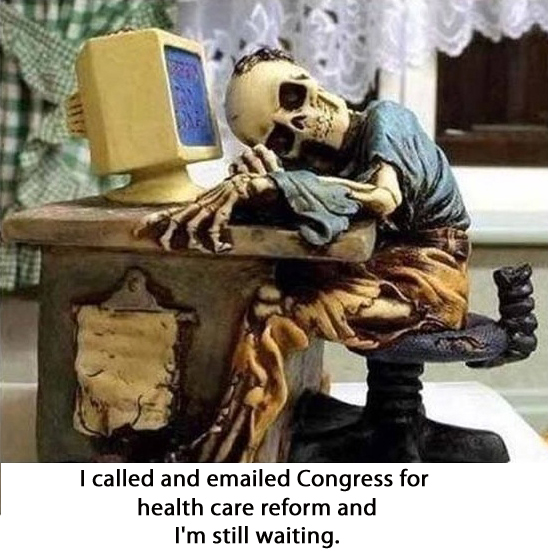
How complicated is that? Everyone needs to call their Democratic reps and demand action.
***

And let's stop blaming the screaming Left for the difficulties getting this done. When the Left screams, it is because people are dying for lack of health care and fear (or fact) of bankruptcy. Progressives have compromised away single payer, and medicare for all, and the public option for next to nothing. If this crashes, it is not their fault. And it need not crash.
***

I don't know the original source of the graphic on this post. It came to me passed around in email, possibly in union circles.

Monday, January 25, 2010

One person, one vote fantasy


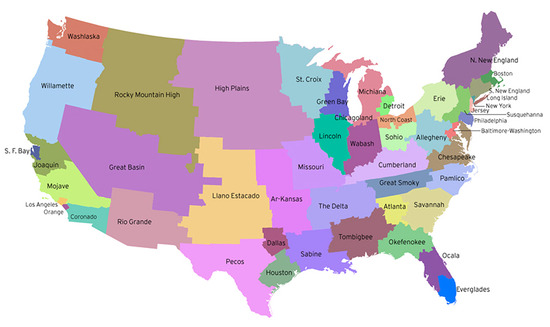
This map shows what dividing the country into 50 states based on roughly equal populations of about 5-6 million people while retaining some respect for existing boundaries could look like. Click on the map for a larger view. Such an arrangement would give us a Senate -- still with the two representatives for each state -- in which every Senator represented roughly the same number of people. If we are serious about the idea that each citizen's vote should give that citizen equal representation, we'd need to move to something like this. The map is the work of Fake is the new real; by way of James Fallows.

Alternatively, we could simply decide as a country that retaining the Senate is so grossly undemocratic (small "d") that it should be done away with altogether. Think how much less we could spend on elections -- and how much fairer our democracy would be to all its citizens. Californians should be especially attracted to such a solution. As Harold Meyerson wrote recently in the Los Angeles Times,

When the Constitution was adopted in 1787, the representational disparities inherent in a system that accords all states the same number of senators had yet to reach absurd proportions. In the 1790 census, there were 11 Virginians (residents of the largest state) for every one Rhode Islander (residents of the smallest). Today, there are 68 Californians for every resident of Wyoming. Constitutionally, Californians are the most underrepresented Americans in the Senate by a large margin.

Obviously neither redrawing the states nor abolishing the Senate are likely reforms. But the Constitution mandates an anti-democratic legislative body that turns itself into a further impediment to democratic governance by adhering to voluntarily adopted rules that render it a useless logjam.

Something is going to have to give. Getting the Senate to work -- or getting rid of it -- has become a necessity if the U.S. government wants to continue to claim to be democratic. Do we have the political creativity and the gumption to solve this democratic impasse?

Sunday, January 24, 2010

Nominate an exemplary citizen

The morning after the Massachusetts election debacle, I got one of those Whitehouse.gov emails those of us who've continued with Organizing for America (OFA) are peppered with. It came in the name of Michelle Obama; they want nominees for the Presidential Citizen's Medal:

This year, the President will be looking for several qualities in the special few he honors: people who have demonstrated a commitment to service in their own community or in communities farther from home; who have helped their country or their fellow citizens through one or more extraordinary acts; whose service relates to a long-term or persistent problem; or whose service has had a sustained impact on others’ lives and provided inspiration for others to serve ...

Here's the video invitation [1:43] that went with the email:


Not feeling that the White House had been doing all it could for the country, I decided I would send a nomination. Here's what I wrote:

Van Jones has bounced through more identities, all seeking the common good as he understood it at the time, than most of us even contemplate.

Raised in Jackson, TN, he graduated from University of Tennessee at Martin in 1986.

After internships at several southern newspapers, he went on to Yale Law School where he responded to that elite, white environment by entering a Black nationalist phase in which he called upon his community to improve itself.

In 1992 he came to San Francisco to intern at the Lawyers Committee for Civil Rights, saw injustice in prosecutions of young people arrested during protests when police assailants of Rodney King were let off the hook for the beating, and became a convinced leftist campaigner for all victims of injustice. His work against police brutality became Police Watch, which morphed into the Ella Baker Center for Human Rights, which spawned the "Books Not Bars" campaign to reduce youth incarceration.

Seeing the planet under threat from human-induced climate change and poor communities in need of stable, good paying jobs, Jones threw himself into Green for All, an environmental justice effort to offer employment fixing the problem to people who need jobs to make a better life in their communities.

Jones is also a deeply spiritual person and an enthusiastic father.

Jones served briefly in the President's administration working on environmental policy until the Right smeared him over the ordinary detritus of life campaigning for justice.

Somehow I don't think they'll select my friend Van. But he seemed an inspiring example of exemplary citizenship.

You can make your own nominations until January 28 at this site.

Saturday, January 23, 2010

Message to Democratic politicians


How about this for a Super Bowl ad? [1:01] Sexist, but on point.

Via Salon.

Saturday scenes and scenery:
Ocean Beach, San Francisco

Two weeks ago, on a morning that drew out the surfers, the ocean looked like this. This is cold California; they wear wetsuits.
surf-at-beach.jpg

This past week, at a rare interval between squalls, the ocean looked more like this.
roiled-ocean.jpg

Or this.
high-tide.jpg

I took that last one from the edge of the southbound lane of the Great Highway between Sloat Blvd. and Fort Funston, a stretch of road that has since been closed until further notice because the ocean is undermining it.

Ah, an El Niño winter. Less than an hour later I was caught out running in a windwhipped thundersquall.

Friday, January 22, 2010

Money in politics

So yesterday the Supreme Court decided that corporations have a right to buy as many politicians as their cash flow allows in the interest of "free speech."

Here's how the good, honest government advocates at Common Cause responded:

"The Roberts Court today made a bad situation worse," said Common Cause President Bob Edgar. "This decision allows Wall Street to tap its vast corporate profits to drown out the voice of the public in our democracy."

I don't doubt he's describing the real world. But it may surprise readers of this blog to hear that I also am no particular fan of campaign finance reform as it has usually existed.

I work in campaigns. Campaigns require money. Campaigns that anyone beyond the candidates gives a damn about attract money. Campaign finance law sets the rules for how that money will flow and be disclosed. Since there must and will be a money flow, campaigns then devote themselves to finding a way to do with whatever money might be available what they think they need to do without egregiously breaking the law. Campaigns become a full employment project for finance lawyers, accountants and other experts. Well-financed campaigns figure out how to get around the regulatory maze created by "reform." Outsider campaigns are far more likely to get dinged for sloppy reporting or lack of financial creativity. Does that help achieve democratic equity?


This video discussion of the Supreme Court's decision is much longer -- 22:45 -- than I usually post on this blog. And it is utterly worth watching in full. Yale Law School professor Heather Gerken has nuanced thoughts on issues of money and free speech. If she's right, the decision will almost certainly increase outright corruption in the form of lobbyists "ingratiating" themselves with office holders. But she also has some notions for a progressive fightback that I think we need to listen to. If the latest gift from George W. Bush's Supremes has you scared and pissed off, please watch this and think about it.

OFA: left high and dry?

According to Ari Melber's report Year One of Organizing for America: The Permanent Field Campaign in a Digital Age, the preponderance of the work the 13 million folks on Obama's email list have participated in over the past year has been supporting, without legislative specifics or targeting, ill-defined "health care reform." This has been fully 44 percent of all OFA did. (Internal community maintenance came in as the next most frequent ask; I've got a future post on that aspect of OFA.)

The high water mark of citizen-initiated contribution to OFA's healthcare reform work was probably Eric Hurt's video ad that won an OFA contest from among over 1000 entries. Hurt went for the gut. His raw message is just as true today as it was in November when David Plouffe announced its win.


Melber outlines the contradictions the OFA project is trying to surmount. Here's the core:

OFA's legislative posture -- not whether it runs a permanent field campaign, but who the program targets -- cuts across most of the issues facing the organization. The permanent campaign may be less controversial .., if it is primarily waged on behalf of established allies. In turn, however, it becomes less effective when the most pivotal members of Congress receive the least contact and pressure from Obama supporters. And it may be less sustainable, if volunteers conclude that their primary role is to reinforce and thank incumbent allies, rather than actually change the pressure dynamics or voting patterns in Congress.

There was certainly pushback from members who wanted more targeted efforts -- I saw some in meetings I attended. Here's a story from someone writing as "mminka," unusual perhaps in its sophistication, but not unrepresentative what more experienced political activists have felt in OFA.

I worked with OFA on this cause and I liked my group but they were politically soft, and the leadership was also. For example, I suggested we do 'die-ins' where we could all fall down dead in large numbers around the houses or offices of representatives who were opposing reform, to dramatize the stakes in way that anyone, even a reporter, could understand.

They just did not understand what I was talking about. This was too dramatic and extreme for them. They chose to do supportive action, like helping out the Food Bank, to spread vague, generic good will.

And so what happened? The direct and dramatic expression of principal [sic] was ceded to the right - from Obama on down.

Melber, rightly I think, points out that for many (most?) folks who have stuck with OFA,

supporters are interested in the campaign connection to Obama as a person, rather than the agenda-oriented content.

They want to go on feeling that inspiration they reveled in during the competition of the 2008 campaign. And while they may not be very well-informed about policy or governance, they are definitely ready to be "fired up."

I have to wonder what's going to be left of OFA if Democratic politicians, scared chickenshit by losing one Massachusetts election, walk away from health care reform? Not good. And since OFA invested not at all in teaching its troops how the process works, none of Democratic Congresspeople's process excuses are going mean a damn thing to the troops. I imagine they'll feel a bit dumped.

Yet today President Obama, the charismatic figure who pulled them into being, offered nothing more than letting the "dust settle" on the issue he called them to work on. Not very "fired up," that. Yes. activists are likely feeling hung out to dry.

My latest OFA email asked me to organize a State of the Union viewing session for next Wednesday. Can Obama hold these folks? Guess he's going to try.
***

OFA volunteers got to replicate the work that most of them know best last week in the Massachusetts election, trying to drive turnout for Coakley. Despite making some million or more calls, obviously they didn't ride to the rescue -- nor could they have been expected to. Field can amplify an otherwise successful campaign -- maybe picking up a percentage point or so -- but not replace a feeble campaign. I believe the research that finds long distance phone calling as of doubtful utility.

In fact, I more and more suspect that mobilizing a large volunteer base, in itself, is what gives a campaign momentum as much or more than the work volunteers accomplish. The campaign gets the benefit of the ripple effect from all those volunteers' social networks and that is a boost of some importance. If anyone had that in Massachusetts, it was Brown.
***

I've written repeatedly about my experience with OFA on this blog; here's a list of OFA posts:
Obama for America is coming, Day of Service, Collecting support pledges, OFA: listening and learning, Health care and playing defense, Health care reform pressure.

Thursday, January 21, 2010

Looking at the horror


One year ago, President Obama said he'd close the Guantanamo prison camp within a year. He hasn't.

Nor has his Justice Department been willing to even investigate, much less prosecute or punish, people who committed the crimes of torture and murder of prisoners. In fact, the new administration is now party to the cover-up, eager to hush up what was done by agents of the U.S. government. In general, U.S. media just want to forget about it.

So do most of us -- who wants to think about horrible things, even if true? We'd rather forget things like this implausible official story of the deaths in 2006 of three inmates in separate cells.

According to the NCIS documents, each prisoner had fashioned a noose from torn sheets and T-shirts and tied it to the top of his cell’s eight-foot-high steel-mesh wall. Each prisoner was able somehow to bind his own hands, and, in at least one case, his own feet, then stuff more rags deep down into his own throat. We are then asked to believe that each prisoner, even as he was choking on those rags, climbed up on his washbasin, slipped his head through the noose, tightened it, and leapt from the washbasin to hang until he asphyxiated. The NCIS report also proposes that the three prisoners, who were held in non-adjoining cells, carried out each of these actions almost simultaneously.

...The fact that at least two of the prisoners also had cloth masks affixed to their faces, presumably to prevent the expulsion of the rags from their mouths, went unremarked by the NCIS ...

Great work, NCIS -- you'll never make it on the TV series.

Scott Horton of Harpers has just published credible accounts from U.S. military personnel then serving at Guantanamo that make it seem far more likely that these guys were pulled out of the cellblocks, taken to a mysterious out building staffed by mysterious "other" personnel -- and came back as corpses. The bodies of the men -- who had been cleared of terrorist connections -- were eventually returned to their relatives (minus their necks) and the relatives say they showed signs of torture.

The Obama Justice Department considers past investigations quite adequate. I write about this here to urge anyone reading this to go read Horton's meticulously researched story -- you aren't going to hear about it from U.S. media.

You aren't going to hear this one either.

It is not hot stabbing pain that Omar Deghayes remembers from the day a Guantanamo guard blinded him, but the cool sen­sation of fingers being stabbed deep into his eyeballs. He had joined other prisoners in protesting against a new humiliation – inmates ­being forced to take off their trousers and walk round in their pants – and a group of guards had entered his cell to punish him. He was held down and bound with chains.

"I didn't realise what was going on until the guy had pushed his fingers ­inside my eyes and I could feel the coldness of his fingers. Then I realised he was trying to gouge out my eyes," Deghayes says. He wanted to scream in agony, but was determined not to give his torturers the satisfaction. Then the officer standing over him instructed the eye-stabber to push harder. "When he pulled his hands out, I remember I couldn't see anything – I'd lost sight completely in both eyes." Deghayes was dumped in a cell, fluid streaming from his eyes.

The sight in his left eye returned over the following days, but he is still blind in his right eye.

The Guardian, U.K. 1/21/2010

The Guardian is a mainstream newspaper in Britain. The world is hearing about Mr. Deghayes, but not people in this disgraced country. Actually Deghayes' story is quite inspiring -- go read that one to0.

And over the next few days, at least join Amnesty International in a campaign for a U.S. Torture Commission to bring these things to light. That's not enough -- but it's one thing we can and must do to repudiate our country's offenses against human life and dignity.