Sunday, October 09, 2005

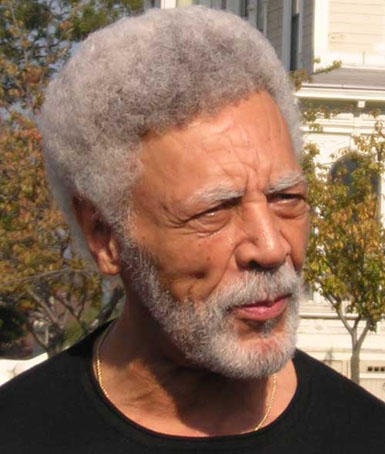
Ron Dellums running for Oakland mayor


The following is from Van Jones of the Ella Baker Center for Human Rights. It is long, but it is worth reading in its entirety. I post it here because too often people who read blogs are unaware of tremendous grass roots stirrings that go on in the real world -- and we are darn useless if we just stay in cyber space.

Sinking under a host of socio-economic problems and still in mourning after the Katrina catastrophe, the African-American community is in deep pain. It finds itself directionless, losing ground and lacking the world-class leadership it needs to right itself.

In other words: Black America is in desperate need of a hero. And Friday afternoon, a hero returned.

In an emotional, see-saw speech, former U.S. Congressman Ron Dellums announced to a deliriously happy crowd of 500 that next year he will run for Mayor of Oakland.

The announcement was a dramatic turn-about, since he mounted the podium apparently intending to say no.

A grassroots movement had sprung up to draft him, collecting 8,000 signatures using only volunteer labor. But Dellums, the hero of the anti-apartheid struggle and mentor to anti-war Congresswoman Barbara Lee, has been working for the past few years as a well-paid D.C. lobbyist. Though he looks like a fit man of 50, he is actually almost 70 years old.

In other words, he is finally earning some money. And no one could fairly begrudge him the chance to spend his twilight years unburdened by all the problems of urban America. Oakland has one of the highest crime and murder rates in America. Its schools are crumbling and in receivership. The city council is dysfunctional and firmly in the pocket of big developers. No one in his right mind would willingly take on the challenge of turning this town around.

Rumors had begun circulating earlier in the week that Dellums was going to attend the culmination of the signature-gathering, thank the volunteers and then decline to run. And so I was not surprised as Dellums stood before the expectant crowd and began working through reasons that he might not seek the office.

But as the crowd screamed, stomped, chanted and wept, the old lion began talking himself into making a very different announcement.

He began to speculate about the impact of Oakland as a model city, providing health coverage for all its residents, and setting an example for the nation. The crowd began cheering.

He talked about the need to fix the schools, preserve economic diversity in the gentrifying city and to embrace the young men hanging on street corners. The applause was overwhelming, thunderous. Black women were weeping in the aisles.

Dellums looked out into the crowd, surveying the sea of tearful, hopeful faces. "Like a jazz player, I honestly didn't know what I was going to say today, how this song was going to end until the very last note," he said. "But I can see your pain."

He hesitated, looked at his wife. And then he said: "And if Ron Dellums running for mayor will bring you some hope ... then let's do it." Bedlam.

Whether the on-stage decision-making was authentic or high theatre, it was a powerful and cathartic drama for all who witnessed it. And it is the first sign of hope in Black America in a very, very long time. The cries of joy and relief and hope that swept the room were testimony to the pent-up need for heroic leadership in times like these.

Cynics will say that we have been down this road before, with promising Black mayors disappointing their urban constituents. And Oakland in particular has suffered from eight years of a celebrity mayor named Jerry Brown, who did little to help the poor and much to aid the developers. Furthermore, Dellums' announcement essentially sinks the very worthy candidacies of progressives Greg Hodge and Nancy Nadel -- both of whom have labored in the local vineyards for years, while Dellums grew rich inside the beltway. All valid points.

But Black America needed someone larger than life to step up to the plate, right now. As one man said, "Well, we couldn't save New Orleans. But maybe we can save Oakland."

I believe that the candidacy of Ron Dellums is a signal event in a post-Katrina resurgence of progressive Black politics. Oakland will emerge as a laboratory for a very different kind of social policy than we have seen in this country for a very long time. And his tenure will give ample room and space to further groom a newer crop of leaders, who can take over upon his retirement.

And I believe this, not just because of the kind of person Ron Dellums is.

I believe it is true because of the kind of people Oaklanders are.

With the prospect a city hall on the side of the people, and not in the pocket of big developers, this town has a fighting chance again. And, through Oakland's bright example, so do we all.
- by Van Jones

Ron Dellums was first elected to Congress in 1970 and served through 1998,replacing a Democrat, Jeffery Cohelan, who dithered about representing his constituents and coming out against the US war on Vietnam. In Dellums, the self-assertion of the African American community and the antiwar movement came together to help change what it meant to be a Democratic politician in Northern California.

We need once against to change what it means to be a Democratic poltician. Triangulation and capitulation to war and greed are not good enough. Let's make Dellums' run a good omen. And get behind him. Being an executive, the mayor of Oakland, is a tough job.

Saturday, October 08, 2005

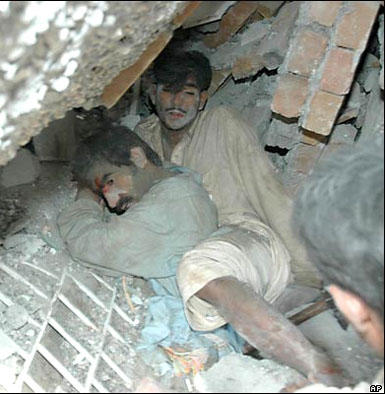
Earthquakes, disasters, death tolls


Earthquakes are well covered in the news here in San Francisco. We've been there; we know the terror when terra firma acts more like jello. When we hear one has happened somewhere, we'll stop and pay attention; I vividly remember seeing TV footage of people caught in the shake that struck Mexico City in 1985 and feeling horror and fear. And that was before we got our own mini-"Big One" in 1989.
Today's news from Pakistan and Kashmir brings it all up again. Apparently the epicenter was well off the grid near Muzaffarabad, the capital of disputed Kashmir. According to BBC correspondent Zaffir Abbas in Islamabad:

Millions of panic-stricken people came out in the open as the tremors continued for nearly three minutes.

Three minutes is a hell of a long time. In 1989, we got off with a mere 17 seconds of shaking.

The early estimate of the death toll is "thousands," meaning the authorities don't know, but fear there are many. It does seem clear that "hundreds" of children died when a school collapsed.

We need to take note: a death toll in the thousands is more than US authorities claim died in the inundation of a large US city and devastation of a long stretch of our coastline. There are many devastated Pakistanis and others in that region tonight. Can we imagine their plight -- despite having just a month ago watched live on TV what Katrina did? If not, why not?

The chart that follows is something I found after Katrina that puts the death tolls from various 20th century disasters in some kind of context:

UPDATE, OCTOBER 8, 2005, 9:00 PM PDT: Pakistani authorities now say some 18,000 died in the quake. That puts this event in a category with the disasters listed in the chart above.

Friday, October 07, 2005

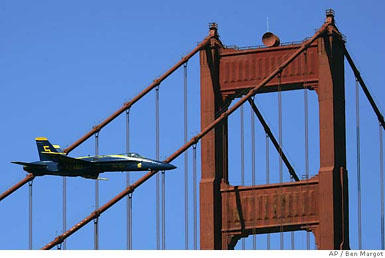
I hate the Blue Angels


Every fall they come; every fall the US Air Force buzzes San Francisco in conjunction with Fleet Week. What crap! No city should be subjected to stunt pilots flying low over populated areas to demonstrate their cajones and prove US power to say "fuck you" to the world.

It is not like the damn things don't fall down. In October, 1998 two of the planes crashed into Georgia woodlands -- how many would have died if that had been a neighborhood in San Francisco? Previously, two planes collided during one of these shows over Niagara Falls; one pilot died.

Why does the Navy do these displays? In its own words, the Navy declares:

The mission of the Blue Angels is to enhance Navy recruiting, and credibly represent Navy and Marine Corps aviation to the United States and its Armed Forces to America and other countries as international ambassadors of good will.

The Blue Angels are a recruiting gimmick -- and in the eyes of anyone who questions the US, a very public threat.

Though someone must have invited them, a lot of San Franciscans could do without the Blue Angels. The Chronicle interviewed the downtown lunchtime crowd subjected to practice runs yesterday.

"They're the products of the devil,'' said street artist Ulysses Dickerson, who was trying to sell his $25 paintings of angels and nymphs. "They're overlords. They're invaders. But there's always something happening in San Francisco. One week it's anti-Bush rallies, the next week it's the military saying, 'Look what we can do.' "…

"At first it seems kind of cool,'' said Christina Wolf, munching on a chicken salad. "But then it reminds you of what Iraqi citizens experience every day. But over there it's real. So I guess it's a mixed message.''

At a moment when even President Nincompoop is calling for fuel conservation, each F/A-18 uses approximately 8,000 pounds or 1,300 gallons of JP-5 jet fuel in a show.

Aren't there any local authorities that can interrupt this nonsense?

Thursday, October 06, 2005

Of fear uncovered and community coming together


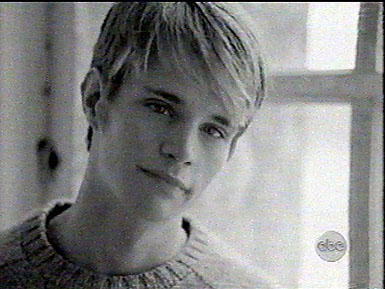
Last night my little San Francisco Episcopal church held a memorial mass for Matthew Shepard and all victims of violence. For anyone who has forgotten, Shepard was a college student who was gay-bashed and left to die hung on a fence outside Laramie, WY in October, 1998. I found the service unexpectedly moving and thought provoking.

Less well known among the facts of his short life, Shepard was raised an Episcopalian. And he was also an activist for justice; his father reminisces that "the hope of a better world, free of harassment and discrimination because a person was different, kept him motivated."

In the sermon last night, the priest, himself gay, spoke feelingly of how "this could have been any of us." That assertion might seem improbable to an outside observer. Though this little congregation is full of gay men and lesbians, it is also largely older, middle class, employed, including many homeowners in a city where owning a house is close to having wealth. This is not some bunch of scruffy outsiders. If gay people can be ordinary, we're it.

And yet the fear of anti-gay violence about which the priest spoke is real. There are individuals who are so distressed by the very existence of gay people that they will try to maim us. And there are a lot of other people who don't want to know that or take the threat seriously. And there are important institutions including churches that do not exactly preach hate, but do treat gays as radically Other, outcasts from their human family.

When I was younger, I felt that fear all the time. When I worked in construction I had to wonder; would one of the guys I worked around make a "mistake" that could injure "the girl," "the dyke"? Now that I am a post-menopausal woman, mostly working in positions of some authority, the fear has receded. But when I visit a small town, I still wonder if my very existence is an offense to those I meet. I don't think straight people know that fear, unless they are members of racial minorities. That's what makes a church service marking dreadful events so potent; it offers a chance for people to stand together, repudiating the fear.

Sometimes dramatic events rip the cover off social realities that we usually look away from. Matthew Shepard's murder made anti-gay violence visible, just as Hurricane Katrina showed us the terrible poverty in which some US people, especially Black people, live their whole lives.

For anyone interested, I'm posting the quite thought provoking prayers we used last night in a diary at Street Prophets.

Wednesday, October 05, 2005

Useful idiots shocked and offended


I admit it. Melanie at Bump in the Beltway does most of my Washington Post reading for me. I haven't the energy to sort through the sycophantism to find the interesting bits -- fortunately she does.

Today she passed along The Right's Dissed Intellectuals by Harold Meyerson. It is a great piece; Meyerson has nailed why conservatives are wailing about Bush naming the pedestrian Harriet Miers to the Supremes:

The problem isn't only that Miers is not openly a movement conservative but that she's as far from a public intellectual as anyone could possibly be. In one fell swoop, Bush flouted both his supporters' ideology and their sense of meritocracy. Worse, he bypassed the opportunity to demonstrate their intellectual seriousness -- conservatism's intellectual seriousness.

…her nomination was … an affront to the amour-propre of conservative intellectuals everywhere.

Yes -- that is indeed what apologists for greed, sexism and racism care about: their self-image as esteemed deep thinkers. They whore their intellects for the powerful and want to be admired.

The Miers announcement says to them that the President (who they think they created) disdains their brains -- they are just interchangeable, useful tools of the truly powerful. It is a nasty come-down.

Tuesday, October 04, 2005

Civil liberties in English speaking countries under assault on three continents


Last week's bombing in Bali, Indonesia probably was just background noise to most in the US. After all, US deaths in Iraq are approaching 2000; what are a few, non-US (and mostly non-white), dead people in a faraway Asian country? But Bali is a vacation backyard for Australians and the explosions were an echo of the attack three years ago on a Bali bar that killed 202 people, mostly Australians. That attack is sometimes referred to as Australia's 9/11.

Last summer I had the privilege of traveling for several weeks with fine bunch of Aussies. They were wonderful folks to go on trek with, full of bawdy humor, grit, and adventurousness. And to a person, they were horrified to hear of how the US government has indulged since 9/11 in no fly lists, racial profiling of Muslims and other immigrants, apparently arbitrary detentions, and abusive overseas prisons.

Now it seems Australia is getting a dose of similar assaults on civil liberties. The Prime Minister, John Howard, from the center-right "Liberal" Party, had already won agreement from state and territorial leaders for a package "anti-terrorism" laws before the latest suicide bombings. How much more support will he find now?

According to Australian Broadcasting Corporation radio the new laws

will include a provision to detain suspects for up to two weeks without charge. They will also expand stop, search and question powers to areas such as transport hubs.

New control orders to restrict the movement of suspected terrorists could also include house arrest. The legislation enables the federal government to expand its powers to proscribe organizations that advocate terrorism. …

The Prime Minister, John Howard, has agreed to apply a 10-year sunset clause, or expiry date, to the new laws, and a review of the legislation after five years.


Sound familiar? The English speaking countries of the world are rapidly chipping away at their proud heritage of limitations on governments' arbitrary intrusions on the lives of the people. The Australian package very much resembles what Tony Blair has put in place in the UK. (Howard was in the UK at the time of the July 7th London subway bombings and aftermath.) Last week UK police used the new anti-terrorism laws there to detain 600 people who sought to protest at the Labour Party congress!

Civil liberties campaigners point out that these laws are particularly dangerous in Australia because there is no charter (like European Union human rights conventions in the UK) or constitutional provision (like the US Bill of Rights) that would offer courts a chance to review how they are implemented by authorities.

Liberty under law seems a fragile reed these days.

Monday, October 03, 2005

Dorothy Day writing on the 1918 flu epidemic


During Pandemic Flu Awareness Week, I have nothing to add to the excellent work of the Flu Wiki. If you aren't already scared silly about bird flu, read the articles there. The question raised by endemic bird flu in Asia is not whether the world will someday experience a lethal pandemic, but when? Will our structures of health care delivery be adequate to care for the sick and limit effects? Will the worst of the toll, both from sickness and social disruption, fall as usual on those already in need?

I have nothing useful to add on those questions. Instead, I thought about who I had known who lived through the pandemic in 1918 and what they conveyed to me. My parents were in that category, but they were children and all they remembered was not being allowed to go out -- practical quarantine by smart parents.

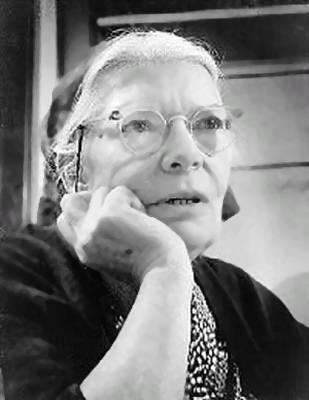
However, Dorothy Day, the founder of the Catholic Worker Movement which is sometimes described as anticipating Vatican II and liberation theology, did sometimes reminisce about the epidemic. What I remember hearing from her was that overwhelmed medical facilities could do little for those who fell ill -- and how hard those lucky enough to stay well worked caring for the sick.

In 1918, Dorothy Day was twenty-one and had already jumped in adulthood with gusto.

She [had] attended but … not graduated from the University of Illinois. "I really led a very shiftless life, doing for the first time exactly what I wanted to do."

In 1916, her family moved to New York and she went with them, to pursue a career as a revolutionary journalist. She became a regular correspondent for left-wing publications such as the Call and the New Masses. She got involved in the hot-button issues of the day: women's rights, free love, and birth control. In 1917 she joined pickets in front of the White House, who were protesting the brutal treatment of women suffragists in jail; they wound up serving thirty days in the workhouse at Occoquan. Source: Beth Randall's excellent short biography.


Still she felt she was not doing enough to make a better world? What could she do next as the US plunged further into a European war she viewed as an imperialist crime? Day decided she ought to work to alleviate the suffering of the poor. So she signed on to be trained as a nurse at Kings County hospital in Brooklyn just in time to work through the influenza epidemic of 1918. Here's part of her account of this time as she wrote it in From Union Square to Rome, an autobiographical account of her conversion to Catholicism.

Since so many nurses had enlisted for the Red Cross, often there was no more than one nurse to fifty patients. Even though we were probationers and not given very much responsibility, and there were ward maids and orderlies to take care of many of the disagreeable details, we had a great deal of physical labor. It was a city hospital and patients had to be very sick before they were admitted. We had to change each bed every day, bathe all our patients, rub them down with alcohol, dress bed sores, give out the medicines, attend demonstrations, and generally assist in the irrigations and injections, tappings for spinal and lung fluid, and all the other treatments for patients in the medical and receiving wards. …

That was the year of the influenza epidemic, and we worked so hard that we fell unconscious into our beds at night and had to drag ourselves out of sleep in the morning. I had to take cold baths when I got up because if I got into warm water I fell asleep. Most of the nurses were keen and zealous over the work. We were all so busy we did not have time to suffer over the human misery we saw, although it was heart-breaking to see young people dying all around us of the flu. Often we had to prepare for the morgue as many as eight corpses a day.

Every morning we were expected to have our wards in order by ten o'clock, and it used to give me pleasure to see everyone cleaned and washed and neatly tucked under white counterpanes in the long rows. They were good patients because they were poor and did not expect too much. They were uncomplaining, and they accepted their suffering with stoicism. They did get good food and clean bedding. In the middle of the morning we gave everyone eggnogs, and in the male wards most of the men who were in the habit of drinking got a good stiff drink of whiskey in the eggnog. …

One got into the habit, in the hospital, of consistent, sustained effort and of disregarding fatigue, both physical and mental.

In the end, Dorothy Day learned during that year that her calling was not nursing, but writing and advocacy on behalf of the poor. However, the year of disciplined labor during the flu epidemic set the pattern for the rest of her days. She took that lesson and followed it all her life; after her conversion to Catholicism, she imposed on herself a regular rotation of daily mass attendance, prayer, and reading and writing; orderly practice gave her a fundament of calm amid the pressures of leading an often chaotic movement providing refuge for the needy and the downright nutty.

Sunday, October 02, 2005

Five more deaths in Iraq: Iraqi Christians in the war's path

In light of the terrible toll of death and destruction the US invasion of Iraq has inflicted on that country, the disappearance and presumed murder of the entire lay leadership of the Anglican Church of St. George, Baghdad, seems almost a footnote. According to BBC News:

The five Iraqis were last heard from on 13 September when they reported they had already been attacked traveling on road between Ramadi and Falluja….

The missing include the lay pastor of St George's church in Baghdad, Maher Dakel, his wife Mona and son Yehiya.

But five violent deaths are never just a footnote; in this case they are one more episode in an ongoing tragedy.

Why is there an Anglican church in Baghdad? Apparently the usual reason -- where the British empire was, there are Anglicans. But Christianity in Iraq is not a foreign import.

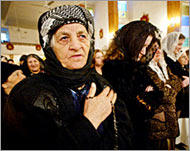
There have been Christians in the area since the first century. Al-Jazeera reports that prior to the invasion, three percent of the population belonged to Christian Churches, primarily the eastern-rite Chaldeans, some Nestorian Assyrians and a sprinkling of European-origin denominations. Many Iraqi Christians still speak Aramaic-Syriac, the language of Jesus.

The US invasion has put all these Christians at risk from Muslims and nationalists who can easily jump to the conclusion they are collaborators with the occupiers. There doesn't seem to be much documentation that their risk is much greater than that of the secular urban middle-class, but that is little comfort. As today's New York Times reports middle-class life is withering in Iraq for people of all faiths.

In fact, St. George's Church did benefit from the invasion. Shuttered and looted under Saddam Hussein, contributions from US and British churches helped to restore it since 2003.

Since then, the church has established itself as an important center for the Iraqi Christian community and has the largest Protestant congregation in Iraq. The parish ministers to a predominantly poor congregation of approximately 200 adults and 100 children, many of whom are widows and orphans. The ministers tend to the spiritual and humanitarian needs of the broader community -- which includes both Christians and Muslims -- offering shelter, protection and help.

So on some level, the invasion which is destroying the lives of so many, has also been a boon.

How are people of good will to respond to these contradictory realities? Recently Church of England bishops proposed that Western churches ought to apologize for the war:

Acknowledging that the British government is unlikely to apologize for the "gravely mistaken" war, the bishops suggest that churches should do so by making a "public act of institutional repentance." … While criticizing Western democracy as "deeply flawed," the bishops appeal for greater "understanding" of what motivates terrorists, and say efforts must be made to address their "long-standing grievances." The war on Iraq, they say, appeared to have been executed "as much for reasons of American national interest as it was for the well-being of the Iraqi people."

Strong stuff -- and controversial. The right-wing Times of London complained that "the bishops of England had confirmed that the war against Iraq was a Christian crusade against Muslims."

The call for an apology certainly seems right to me -- but even more, concrete work and organizing to return Iraq to the Iraqis seems to me the role for concerned Christians in the United States. The results may be good or bad -- but nothing the US is doing in Iraq can make the situation any better; we made the problem and cannot be part of the solution, if there is one.

Friday, September 30, 2005

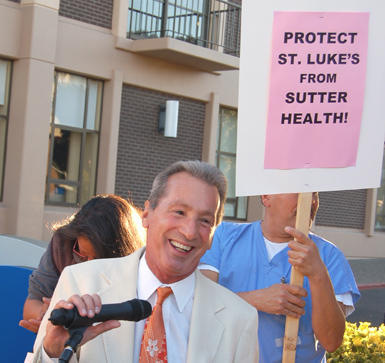
Sutter to close St. Luke's Hospital?
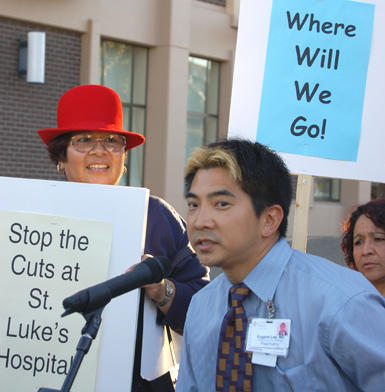
Community asks where will we go?


Sutter Health is a monster conglomerate that operates 26 hospitals and numerous associated clinics, home health agencies, a medical equipment company, and some insurance companies. Although nominally a non-profit, in 2003 it took in $465 million in excess of revenue over expenses. Nice haul if you can get it.

Three years ago Sutter absorbed financially challenged St. Luke's Hospital from the Episcopal Diocese of California. St. Luke's is the true opposite of a profit making entity. Founded by the Rev. Thomas Brotherton in 1871, the hospital had faithfully continued the mission he set it for 130 years ago:

St. Luke's doors are open wide for the reception of all colors, nationalities and creeds. Its benefits, refused to none, will be limited only by its means.

When Sutter took over the facility, the company promised the church and the city to continue care for low income area residents; aside from an imploding county hospital, St. Luke's was then and still is the only option left for medically indigent San Franciscans.

Now those promises look as if they are being violated. Despite objections from city officials and doctors, Sutter has closed the St. Luke's psych unit. They say it was underutilized; psych ward doctors say the hospital had reduced staffing to ensure that psych doctors could not admit, despite numerous calls from other overburdened hospitals.

[T]he low patient count in the unit was not a reflection of decreased need but due to a 'systematic reduction of MD staffing' that has prevented the unit from taking more patients and decisions by the hospital to not accept low-profit patients.

Dr. Lee emphasized that his former patients "have no where else to go."


Dr. Eugene Lee

Community members and St. Luke's workers fear that this blow is just the beginning of a gradual erosion of the hospital's mission. Next on the block apparently is the Neo-Natal Intensive Care Unit; if Sutter closes that, who is going to choose to give birth a child in a place where a medical problem will mean shipping out the sick baby to another hospital?

The fear is that Sutter plans to merge the hospital with California Pacific Medical Center (one of Sutter's profit centers); this is well under way. Then patient care at St. Luke's would be gradually cut back, citing efficiencies in sending patients to other CPMC units. Finally, acute care at a gutted St. Luke's would be deemed too expensive, so the building would be turned into offices.

This scenario is completely plausible, since Sutter has inflicted a similar process on the former Davies Hospital, now barely a medical facility, just an annex of CPMC.

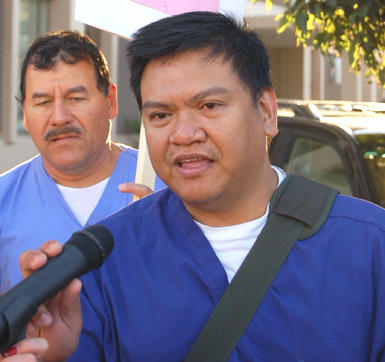
Yesterday, workers and patients insisted they would not submit quietly to the killing of Rev. Brotherton's dream. They marched and rallied at the hospital; and left the brief demonstration promising to be back.

Supervisor Tom Ammiano cheered up the crowd, but also admonished Sutter: "you need a lot of things from the City and we know it."


A patient had her own warning to Sutter: "you know where I live: right here. We know where you live."


RN speaking: "I didn't go into nursing for the money; I do this work for my patients."


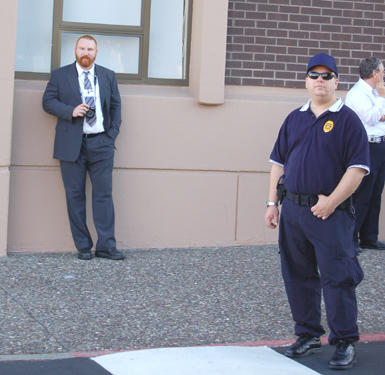
Not everyone was happy about the rally; Sutter's security stood by.

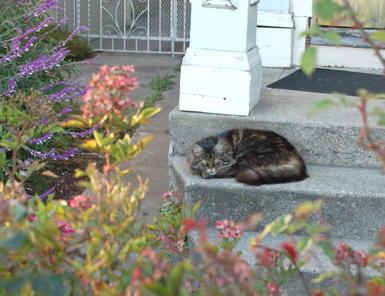
Friday cat blogging: Pidg at home


We call this beast "Pidgeon Eater." She's semi-feral, as you might guess from her attitude looking at the camera. She hangs around the house next door, but is definitely nobody's cat.

How did she get her name? It is amazing how little is left of a pidgeon when eaten by a cat. Just a beak and feet, plus a few feathers, littering the sidewalk of a morning.

Wednesday, September 28, 2005

Katrina aftermath: No picture here

The photos are over at BAGnewsNotes. Photographer Alan Chin is discussing his images from flooded New Orleans in comments. Shooting in black and white, he has captured something of the mythic scale of the physical and psychic devastation. His observation that stopped me cold:

His subjects were "amazed that the story was getting coverage in more than just the local New Orleans or Louisiana media."

What desolation! Take a look at the pictures yourself

A calendar for the ages


This is just too good to pass up. The image above is from a fundraising calendar offered by the First Parish Church in Framingham. From the creators' FAQ:

The calendar was designed to address the worship of youth culture in our society, show our youth that the elders in their church have a wonderful sense of whimsy and humor, and demonstrate to adults and youths that women are beautiful at all ages.

Why did the individual women decide to pose for the calendar?
Reasons include: it would be fun; something I always wanted to do but never had a chance to do; love celebrating senior women; great for senior women everywhere to see that their contemporaries are bold and adventuresome; time to respond in a positive way to society’s worship of youth; we should be proud of our bodies and our talents and let the world know that; have a sense of humor and thought this would be a whimsical thing to do; knew the photographer, Lynne Damianos, would create a high quality, tastefully designed photo.

You can order one from the link above. I did.

Tuesday, September 27, 2005

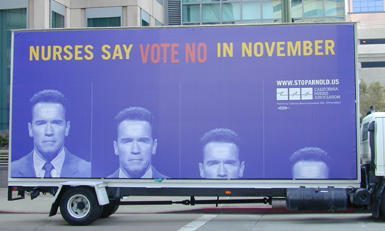
Arnold is for sale!

arnie on ebay
For a little while today, this ad really did appear on eBay -- all too briefly. I guess eBay didn't want to make a political point for the California Nurses Association who put up the item. You can see CNA's version here.

In 2003 Californians recalled Governor Gray Davis in part because he broke all records for political fund raising. Now Schwarzenegger is desperately begging corporate donors for more and more millions to try to salvage his unpopular initiatives in the special election he is putting the state through this fall. I wonder what he is promising them?

Last week he announced, six months early, that he will run for re-election next year. The Secretary of State won't even accept gubernatorial filings until February -- I guess he had to reassure the fat cats that he won't pull out after they invest in him this fall.

Yes, Arnold is for sale -- but the people of California aren't buying.

Full disclosure: I am temporarily working for CNA; because I got the email to staff, I was able to capture this screen shot before eBay pulled the ad.

Monday, September 26, 2005

An Urban Home


What's that? Somebody's front door.

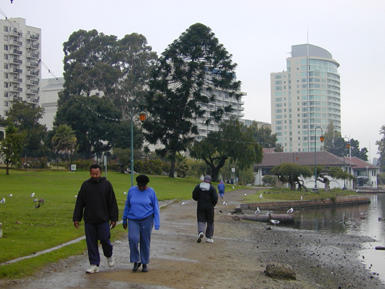
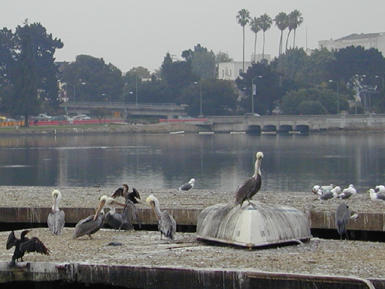
Most mornings I run around Oakland's Lake Merritt. The tidal estuary adjacent to downtown is the oldest wildlife refuge in the United States, a sanctuary for many species of native and migratory wildfowl.

Every day runners, walkers and practitioners of Tai Chi circle the lake. And some live here.

One morning I saw a pair of legs emerge from the hole pictured above. A young woman, clearly dressed for work in clean slacks and a dark shirt, stood up and brushed herself off. She combed her hair, and walked off toward the city center. The pictures that follow show what she might have seen along the way.


View out the front door. Some folks pay a lot of money for this.


If she turned back, she would see this wall which covers the side of the automotive bridge that makes her home.


Not all the sights and smells are pretty.


Some visitors are unwelcome.


There are many passersby.


And there are neighbors.


Many are walkers.


Some preen themselves.


We're coming into downtown now.


But one last neighbor clings to the edge of the lake.

"The law, in its majestic equality, forbids the rich as well as the poor to sleep under bridges, to beg in the streets, and to steal bread."
-- Anatole France, a leftist novelist who won the Nobel Prize for Literature in 1921

Sunday, September 25, 2005

For many immigrants, it has happened here

tnguyen
Author Tram Nguyen

We Are All Suspects:
Untold Stories from Immigrant Communities after 9/11

By Tram Nguyen; Foreword by Edwidge Danticat


Sometimes only stories enlighten. There are all sorts of statistics that should tell us how we have become a more isolated, closed-down nation since 9/11 -- for example overall foreign enrollment at U.S. universities fell 2.4 percent in the 2003–04 academic year, the first such decline in more than three decades.

But in this book we meet real people: among them, Abdullah and Sukra Osman of Minneapolis and Somalia; Ban Al-Wardi, once of Iraq, now of Los Angeles; Muhammed and Asmat Saeed of Manhattan, Toronto and Pakistan -- they all discover, mostly to their shock, that this country is not the place of opportunity and freedom they had believed. Xenophobia and racism, seized upon by a rightwing US government after trajedy, run unleashed, destroying the hopes their victims held on to as they worked to make new lives in North America.

Researchers will find the "timeline of major events and policies affecting immigrants and civil liberties" invaluable. But what those of us outside the affected immigrant communities don't usually have a chance to appreciate are the daily wounds inflicted by a hostile state: families divided, arbitrary disruptions of life, the anxiety of carrying the fear that any accident or unknown misstep may get you locked up and thrown out.

Sixteen year old Aleena Saeed was on her way to a medical career, had been accepted into a "gifted" program in her New York City high school. But after 9/11, she and her parents, refugees from Pakistan who were accused of no crime but whose immigration papers were incomplete because of backups in government offices, now await deportation back to dangers they fled. After attempts to regularize their status failed and their father was detained, the Saeeds await deportation from Canada. They have lost their friends, their home, and their livelihood, but for sixteen-year-old Aleena:

The worst part, she said, is "losing all your dreams."


Tram Nguyen, executive editor of Colorlines magazine, herself a refugee whose family fled Vietnam in the late 1970s, eventually becoming US citizens, captures these nightmarish stories in a gentle voice. The book is a must read for all of us worried about the path our country is taking; for immigrants of the wrong color, since 2001, it has happened here.

Saturday, September 24, 2005

Pictures from San Francisco antiwar rally


When you are in the middle of a large march, it is hard to take coherent pictures. Both protesters and police estimated the crowd was 20,000. And in fact I didn't take these as my camera chose this moment to self-destruct. But my partner snapped a few images:

After all, this was San Francisco.

We marched with the nurses.


Young friend and protester.

Thursday, September 22, 2005

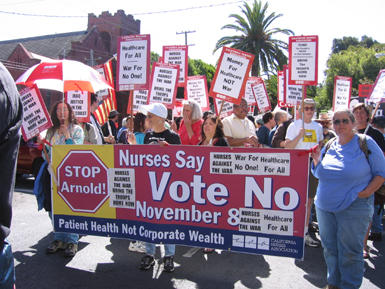
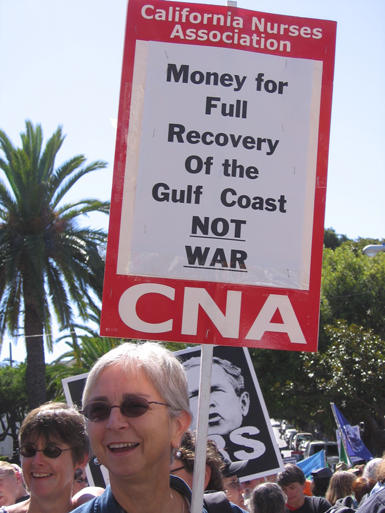
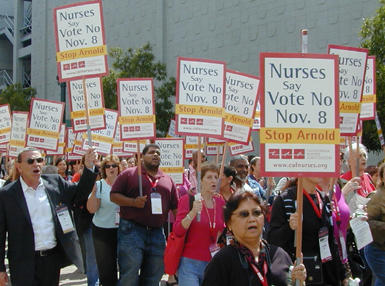
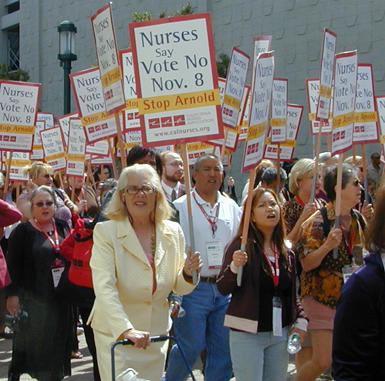
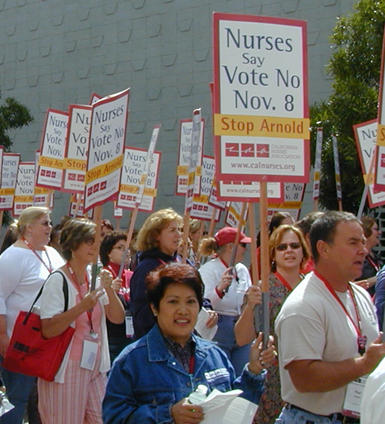
Nurses rally in Oakland against Schwarzenegger


Members of the California Nurses Association converged on Oakland this week to attend the union's House of Delegates meeting. Today they took to the streets at midday to denounce Gov. Arnold's special election.

Arnold said of the nurses he was going to "kick their butt" but it looking like the incredible shrinking Governator is on his way to a spanking from the RNs.


Oncoming doom


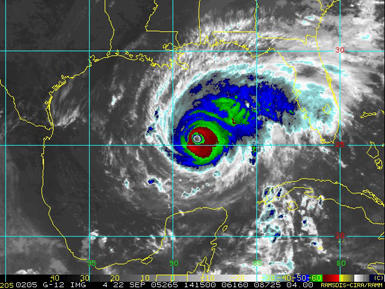
Steve Gregory's Wunderground blog describes the latest Hurricane Rita projection:

The storm has PEAKED in intensity, but remains an extremely dangerous Hurricane … By the time of landfall Saturday morning, Rita should be a CAT 4, with winds of 120mhp, and gusts to 150mph. Enough to cause tremendous wind damage to well built, non masonry structures.

However, the storm surge will cause complete devastation within 1-3 miles of the coastline near the point of landfall….

A tidal surge of 20-24ft will come onshore near and to the right of the point of landfall, with a 15-20 foot surge extending for up to 80 miles east of the strike point. From 80-120 miles east of the landfall point, a storm surge of 10-15 feet is likely3-5 foot above normal tides will affect those living as much as 300 miles to the east - which includes Southeast Louisiana. Keep in mind, riding 'on top' of the storm surge will be huge 30-40ft wind driven waves.

Hopefully most people who would have been under that surge will be long gone. After Katrina, very likely evacuation will look like a better deal.

The only thing I can imagine analogous to how folks in the way of this hurricane's violence must feel is how residents of Baghdad must have felt in the winter of 2003: You know it is coming; you know what it is going to do; and there is not a damn thing you can do to stop it.

For most of the people of Baghdad, the aftermath has been worse than the anticipation and the initial event. Let's do what we must not to repeat that pattern.

Wednesday, September 21, 2005

Don't tell me it isn't about race


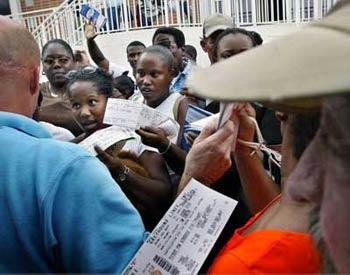
These people were trying to get on the last bus out of Key West before Hurricane Rita passed through yesterday. Screwed again by a system that throws them away. Via BAGnewsNotes.


Fortunately, Rita didn't hit the Keys directly:

It was almost as if she was stopping to take breaths between blasts. Calm followed each moment of fury.

Rita would blow hard for 10 minutes, bending trees, pushing the sea onto streets and gently rocking parked cars. Then, right before it seemed the sky was about to unhinge, the wind would quiet, giving all a chance to straighten and almost stop swaying. South Florida Sun Sentinel

So she blows on to Texas (or even more awfully, Louisiana again.) Who will be left behind this time?

Tuesday, September 20, 2005

Katrina for the undocumented means hiding and working harder


Recent weeks have been a revelatory experience for much of the mainstream media and through them for many middle class US white people: the hurricane laid bare the extreme poverty in which many African Americans pass their lives. Further, it reminded the nation that Black-White is our historic paradigm for understanding "race" in our collective lives.

But New Orleans and surroundings had many residents from other non-white groups; what happened to those communities? Here's some reporting beyond Black and white:

Illegal immigrants afraid to get storm aid:
Some sneak into shelters at night and then slip out in the morning, praying they won't be noticed. Others avoid government help altogether, preferring to ride out the chaos and destruction alone in a foreign land.

For illegal immigrants, the aftermath of Hurricane Katrina has meant not only living without a home, money or belongings, but also steering clear of the government officials who have flocked to the area, for fear of deportation.

Somewhere between 20,000 and 35,000 undocumented persons, mostly of Mexican and Central American origin, lived in the path of the hurricane. Many did not evacuate; "four roommates - three Mexicans and a Honduran - decided to ride out the storm in their trailer in Marrero. They were asphyxiated by a faulty generator after the storm passed."

Those who weathered the storm looked for informal resources they could trust:

Where Have All the Hondurans Gone?
…in Houston, when the first of Katrina's Honduran evacuees trickled into town, most didn't go to the city's public shelters, the Honduran consulate or to the Astrodome. Instead, through a network consisting mostly of word-of-mouth tips, many found their way to El Coquito, a Honduran restaurant.

Meanwhile, the Department of Homeland Security announced a 45-day moratorium on fining employers who hire undocumented workers.

Not surprisingly, Latinos are concerned that this gesture is just the prelude to the usual practice of using up and throwing away imported workers:

So undocumented Latinos, if you speak English and can read this, here’s the deal: You can go along on the underpaid, exploitation-filled work gangs to clean up our American city of New Orleans, and your employer won’t be in danger of being prosecuted (for 45 days, anyway). But tengan cuidado: if someone decides to report you, you may have to turn in your rags and dust masks, and stop cleaning our country and head back to yours. Que Dios os bendiga.

For the undocumented, Katrina very likely means more of the same, only tougher conditions.