Friday, December 13, 2013

Some Occupiers kept pushing even after most of us moved on


Over a year ago, I wrote here about the efforts of a group of one-time protesters who regrouped as Occupy the SEC after their encampment was forcibly cleared. They aimed to influence the rule making that would determine whether the Dodd-Frank "financial reform" would do any good. Well, the part of Dodd-Frank known as the Volcker rule has now been formally promulgated. This is supposed to force the banksters to use their own profits if they want to gamble with exotic financial products, instead of risking our federally insured deposits.

Astonishingly, Lydia DePillis reports that the SEC didn't completely blow off these organized, studious "occupiers." One of them, Akshat Tewary, explained to her:

They've cited our suggestions 284 times in the final rule, and in a lot of those contexts they agreed with us, and a lot of the time they disagreed with us. They're not going to say that Occupy said this and we're going to follow it, but we are pretty comforted that they followed at least some of our suggestions.

[For comparison, the rule cites the Securities Industry and Financial Markets Association (bank and finance lobby) 599 times , Americans for Financial Reform (a liberal coalition) 179 times, and Senator Jeff Merkley 176 times. -- note from DePillis' post with my clarifications]

… the number of times that they cited us suggests that regulators are subject to public oversight. It was heartening to be part of that conversation, and I think it indicates there's potential for that kind of activism going forward.

DePillis wanted to know what "Occupy the SEC" would be doing now. Apparently the Volcker measures are constraining enough so that they expect Wall Street to go straight to court to try to free itself from them.

… if there's a lawsuit that's filed, they can expect us to file an amicus brief on the other side.

I'm grateful for the willingness of these folks to dig into the weeds of financial policy; this sort of expertise is not all it takes for change (and the Occupy the SEC folks know that) but not having this sort of competence limits any progressive reform movement.

Thursday, December 12, 2013

The war inside the Democratic Party

I think most Warren supporters understand that the goal of “economic populism” isn’t getting an economic populist into the White House, but rather to change the way economic arguments are conducted in Washington and by Democratic politicians. The point is to make sure Cory Bookers don’t happen anymore.

There’s no good reason that reliably liberal states should be electing senators as friendly to Wall Street as [newly elected New Jersey Senator] Cory Booker. But if you can’t stop a Cory Booker, the next best thing is to force him to change his positions to avoid pissing off the base. And there’s already some evidence that that’s worked on Booker: He quickly reversed his stance on Social Security after pressure from the economic populists.

The goal isn’t, and shouldn’t be, to block Hillary Clinton. The goal is to make sure a potential President Clinton is beholden to a better Congress and a better Democratic Party.

Alex Pareene, Salon

Exactly. And something crucial to remember as we stumble into the next election cycle and the next … we need to elect more and better Democrats who fear the people. If they don't start that way, we have to make them feel the fear. It is that simple.

And this doesn't start with high-profile national elected officials like Presidents and Senators. If we want better Dems, we have to work to put them in the local offices, state legislatures and the House of Representatives.

Wednesday, December 11, 2013

Warming Wednesdays: a treaty has slowed global warming


Back in the very early 90s, my partner came home from work one day and announced: "I'm now a licensed pollution trader!" We roared with laughter at what we took to be her latest bizarre assignment for the environmentally oriented foundation where she was the controller. One of the more imaginative (or possibly wacko) donors had had the brain storm that he could buy up the new permits the government was handing out under a treaty that aimed to reduce global production of the chlorofluorocarbons (CFCs) that were making a hole in the atmosphere. He would donate the permits to the foundation. The foundation would take them off the market forever, helping to prevent additions to the ozone problem.

I didn't follow how that particular scheme worked out, but I did eventually learn that the treaty, known as Montreal Protocol which set up what I now recognized as a cap-and-trade system, had apparently prevented CFC-caused ozone depletion.

Today Justin Gillis reported that scientists now evaluate the Montreal Protocol as very successful in reducing CFC emissions.

It incorporates pragmatic, business-friendly principles that have allowed it to operate smoothly for more than two decades, achieving its goals — and then some — with little controversy.

But current research says the treaty has done more than save the ozone layer. Those CFCs we are not using in air conditioners and refrigerators are potent greenhouse gases. According to the Grist story on the research:

Without the Protocol, environmental economist Francisco Estrada of the Universidad Nacional Autónoma de México reports, global temperatures today would be about a 10th of a degree Celsius higher than they are. That’s roughly an eighth of the total warming documented since 1880.

That's right. We'd already be significantly warmer without these relatively non-controversial emissions restrictions. And now most countries are looking at extending Montreal to limit other warming agents.

Compounds called hydrofluorocarbons (HFCs) replaced CFCs in many uses -- and it seems these too are potent greenhouse gases. Along with much of Europe, the US has been one of the good guys seeking to add these compounds to the Montreal framework. China came onboard with the effort last summer. Now only India remains reluctant among major producers.

Replacing HFCs to reduce global warming looks both effective and politically possible. Our species seems better at chipping away around the edges of a problem than taking it head on -- for our posterity's sake, let's keep chipping!

Tuesday, December 10, 2013

"Mixed Nuts"


No post this morning. The time that might have gone into writing one was taken up by watching this laugh-out-loud 1994 Christmas comedy with the church book group. Yes, it's terrible, but it's a sort of terrible that has aged well. Rent it if you can. It probably helps if you enjoy the tacky delights of Venice Beach.

Monday, December 09, 2013

A sign that Obamacare will get off the ground?

Wandering around San Francisco, these placards are common. Has this big convenience and drug corporation become a propaganda outlet for the Department of Health and Human Services?

Well -- sort of. According to MarketWatch, Walgreens has signed up with a private partner to help potential pharmacy customers navigate how to buy insurance under the new system.

Walgreens store personnel are directing individual customers who inquire to the GoHealth Marketplace, a resource where they can shop and compare health insurance plans, enroll and find other important tools and information. Consumers can access the GoHealth Marketplace online from www.walgreens.com/healthcarereform or via phone at 855-487-6969. Walgreens also is providing informational brochures and other materials in stores.

… Customers receive one-on-one support from licensed GoHealth advisors who can help guide them through the selection and enrollment process (over the phone or online). As an approved Web-Based Entity, the GoHealth Marketplace offers all plans available on the federal and state marketplaces - and can assist individuals regardless of income level or subsidy eligibility.

Judging by the folks I see in Walgreens, these stores, at least in urban areas, attract a population that could use more access to health insurance and who might need some help navigating the thicket. I see no sign that the Go-Health website has a Spanish section however. Past of the reason Walgreens is trusted in my neighborhood is that the managers are two older Spanish-speaking women, like much of the clientele.

Of course Walgreens' enthusiasm for the ACA is not altruism. They are counting on millions more paying customers with insurance. Apparently drug/convenience store chains are in a battle for market share. Ever wondered why in cities so frequently you can see a Walgreens on one corner, a Rite-Aid across the street and CVS down the block? (Downtown Oakland comes to mind.) Martin Hiltzik explains:

Those three national pharmacy chains have been jostling with one another over prime locations for years. Recently the competition has stepped up.

… The chains are aiming to become your one-stop shop for all your prescriptions. In California and most other states they already can vaccinate you against common diseases like flu. They're adding other services of the type that physicians traditionally claim as their monopoly, such as managing diabetes and other chronic diseases.

Most dramatically, Walgreens announced in January that it had formed Accountable Care Organizations in partnership with three big medical groups in New Jersey, Texas and Florida. These organizations, which are encouraged under Obamacare, replace Medicare's traditional fee-for-service model with pay-for-performance: When they deliver better patient results at less cost, they get to keep some of the savings. Who opposes this trend? That's right, your local medical association.

According to Hiltzik, the pharmacy in these stores occupies 10 percent of the floor space but brings in 50 percent of the profits, so it is worthwhile to these chains to expand their specialized medical interventions and try to compete on service levels. There's roiling activity in the chain pharmacy business.

Hiltzik's article is fascinating. He offers a rule of thumb about the proliferation of chain drugstores:

… in any given middle-income ZIP Code there are three chain drugstores for every two Starbucks.

I guess my zip code is still not middle class -- we're short on Starbucks I think, though we're rich in drugstores. But that's true only if I don't count the independent coffee joints as Starbucks precursors.
***
Interestingly, Walgreens has moved its own 120,000 insured employees into health insurance provided through a private insurance "exchange" that apes the state exchanges offered to the newly insured under Obamacare. This is not required by the new law. Employees can now among choose plans labeled "bronze," "silver," and "platinum" with differing coverage, costs and deductibles (apart from the employer contribution) as they might in the new program. If this becomes the trend among big companies, the insurance market will begin to look more familiar to ordinary insured people which may help with getting through the maze.

On the other hand, insurance didn't become a maze for no reason. It profits insurers to keep us a little confused and dependent. There are big changes afoot.

Sunday, December 08, 2013

An endangered language?


A friend suggested that I might want to look into a website called Priceonomics.com. She was right. The business of the site seems to be crawling the web for data and selling the results; their blog is a potpourri of odd and less odd factoids collected along the way. It's fun for a stats geek.

I was particularly struck by a posting that reports: Only 4% of Languages Are Used Online. The author became aware that his Egyptian friends largely used Latin characters on the web rather than Arabic letters. Arabic is in no danger of erasure by technological change, but the web does "endanger" many less widely used tongues.
But thousands of other languages may never make the leap into the digital age. A full 96% of the world’s 6,000+ languages appear to be dead when it comes to use on cell phones, laptops, and tablets, meaning that the Internet could be to languages what a certain comet was to the dinosaurs.

…Linguists note the extinction of languages with some pessimism: around 2,500 out of 7,000 languages spoken today are endangered. But the picture [mathematical linguist András] Kornai emerges with is much more alarming. Only about 170 languages, or 2%, are vital or thriving online. Another 140 (1.7%) are borderline cases. The remaining 96% (over 6,000) are still or “digitally dead.” And in Kornai’s opinion, given the prerequisites of a strong publishing infrastructure that includes technical tools to make it possible to use a language on digital devices and broad use by the younger generation, those 6,000+ languages have no hope of making the leap into the digital future.
This fit with some of what I saw on my recent trip to Bhutan. Dzongkha, the national language of Bhutan, is just the sort of language that gets left out of the international discourse on the web. According to an article in the Wikipedia, on Wikipedia, only about 160,000 of the Bhutanese are native speakers; the other 540,000 have other home tongues. Though Dzongkha is required for official business and is used for self-consciously Bhutanese culture (see this artist, for example), the language of instruction in the schools is English. English serves to bridge language gaps between Bhutanese and also with their large, sometimes culturally encroaching, neighbor India. And English is easily used on the web.

Bhutan is one of the those countries which is leaping much of the industrial age to move directly into the digital one. Instead of installing the wiring for telephone communication, they've gone straight to ubiquitous cell phone coverage. People don't listen to radio; because so many have electricity, a byproduct of the national export of hydropower to India, they've gone straight to television and computers.

A Bhutanese living room in an unpretentious house
One member of our group suggested that her elementary school teacher daughter's third grade class might make good pen pals for Bhutanese students. She had to be politely told that the children would have to use email; land postal service is an expensive relic of another time, barely known outside the capital. But schools seem to be wired. And our guide explained that one third of Bhutanese are in some kind of educational program. When he graduated 20 years ago, Bhutan had 43 graduates from college that year. Now 3000 complete college annually. These young people, and every shop keeper and professional and business person, are all online; most likely in English.

Bhutan aims to retain much of its traditional culture while adapting and succeeding in a very different present. Language will be an issue and could be a stumbling block …

Saturday, December 07, 2013

Saturday scenes: The pay is too damn low

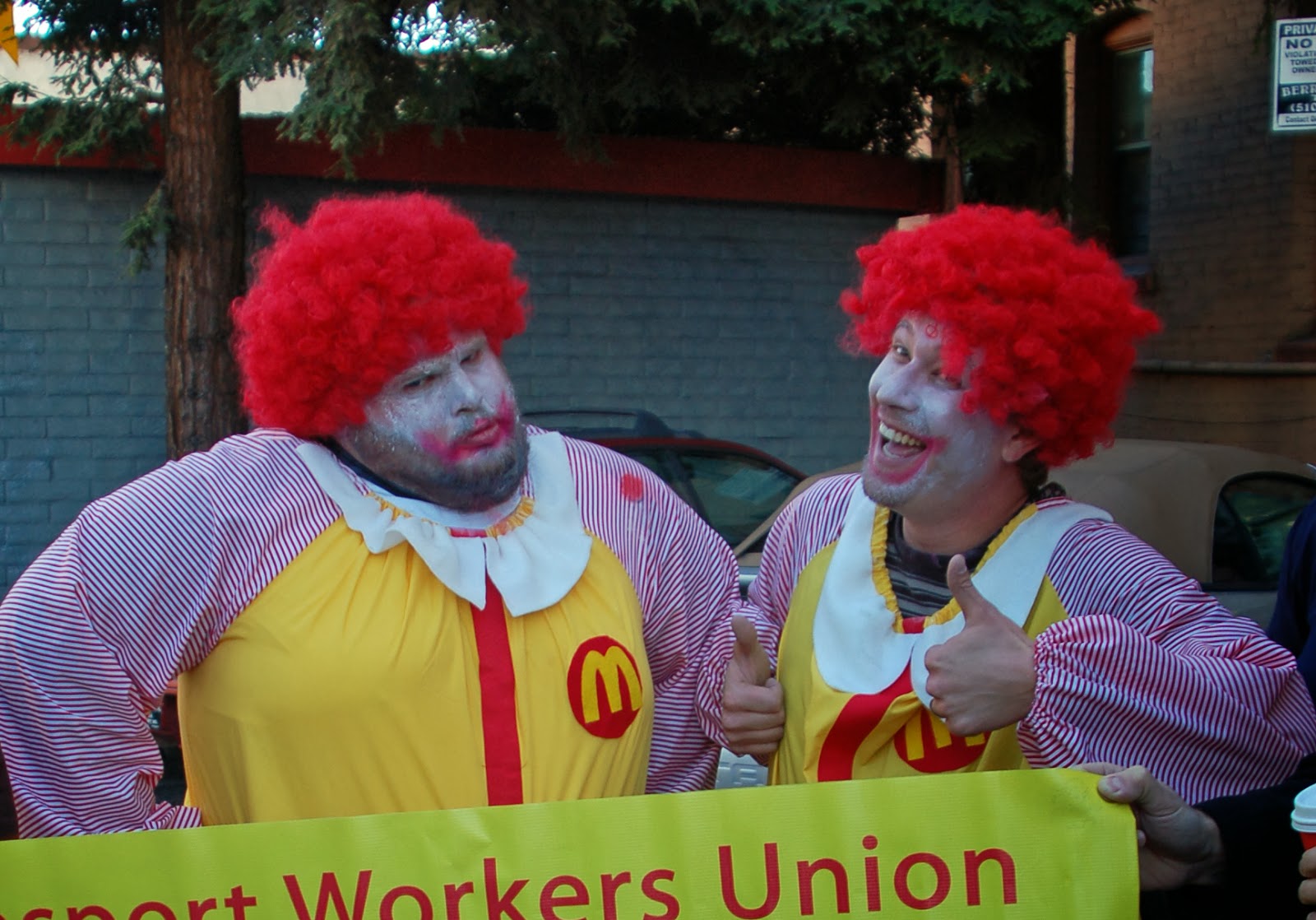
Clowns were on hand at Mickey D's on Thursday in downtown Oakland. Workers and friends staged a lunchtime Low Pay is NOT Okay action.

This did bring out a small crowd, an excited, determined one.

With a simple message ...

 and two clear demands.

Here's a good article on the California movement to raise the minimum wage.

Friday, December 06, 2013

Her "day in court" (she's barred) is Kafkaesque


Lately I've been writing rather cavalierly about the abusive treatment our post 9/11 Heimat Security regime inflicts on people in the process of trying to fly.

But thanks to Nell writing in the comments, I'm now following more closely Dr. Rahinah Ibrahim's ongoing challenge to her no-fly list status through the excellent series of accounts at Papers Please! (Should you follow this link and find that Dr. Ibrahim's story is no longer the lead item, just enter "Ibrahim" in the search box in the right column.)

Ibrahim is not some no-count, anonymous foreign Muslim. According to the Associated Press' trial coverage, she's

... 48, lives in Malaysia with her husband and four children and is dean of the architecture and engineering school at the University of Malaysia.

She was apparently added to the no-fly list when a graduate student at Stanford over ten years ago

The current trial is beyond Kafkaeque. Ibrahim can only testify on videotape. The U.S. government barred Ibrahim's U.S. citizen daughter from flying in from Malaysia to testify by putting the daughter on a no-fly list. This intervention was revealed by the Malaysian airline, then the U.S. spooks implausibly denied their actions. More here. Lawyers for Ibrahim were subjected to a clearance process under an order from the trial judge and thus allowed to learn what the government says is Ibrahim's watch list status -- but they are barred from telling their client.

The theory about what caused Ibrahim to be barred from flying that is presented in her legal briefs is that 1) linguistically-challenged Feds confused the similar names of a Malaysian academic association with an Islamic terrorist outfit and 2) the FBI wanted to recruit her to spy on Muslim mosques while she was grad student in California, but she stiffed them, so they stuck her on a barring list and still refuse to admit they screwed up.

The AP summarizes

"Once you're in the system it's almost impossible to get out," Ibrahim's lawyer Elizabeth Pipkin told the judge Monday during opening statements at the trial. Pipkin said Ibrahim landed on the no-fly list through inadequate training of list administrators and their bias regarding religious and national origin.

I find that totally plausible. We always refused to speculate on why the government once apparently briefly listed a couple of San Francisco peace activists. But it always seemed likely that our awkward detention was the product of a "round up the usual suspects" impulse after 9/11. Having made the initial mistake, the government was willing to devote huge resources to avoiding any kind of scrutiny, as much to avoid embarrassing itself as to maintain any legitimate "state secrets."

The judge in Dr. Ibrahim's case seems frustrated and appalled by the government's evasions of ordinary legal procedures. (Our judge, Charles Breyer, the brother of the Supreme Court judge, acted equally critical of the Feds. Experienced federal court judges don't like to be handed lies and gobbledegook.) Let's hope he forces this story into the open. He'll take a lot of shit if he does, but under our current surveillance state regime, only occasional courage on the part of fortuitously placed individuals seems to impede the rush to pervasive tyranny.

Meanwhile, testimony in this trial taught me that I better get hold of a copy of Jeffrey Kahn's book,Mrs. Shipley's Ghost: The Right to Travel and Terrorist Watchlists, to keep up on these issues. More to come.

Friday critter blogging


Jupiter seems to harbor a deep-seated fear that he'll be left behind.


It's not so, Mr. Dog.

Thursday, December 05, 2013

One of the best tributes to Nelson Mandela ever made

Oddly, this comes from ESPN. It captures the feel of the South Africa I encountered while working there in 1990. It's well worth your time, even if you are not sure you like sports.

Don't know if this YouTube copy will get yanked for copyright violation. Here's a link to the trailer from ESPN. The show can be downloaded through iTunes.

#RIPNelsonMandela

The Cape Town tabloid newspaper South (tagline: "you have the right to know") issued this poster in February 1990 when Mandela walked free after 27 years locked in prison for resisting apartheid.

The quotation -- "your freedom and mine cannot be separated" -- was part of his message from prison to South Africans in response to offers, made under tremendous international pressure by the white government, to free him if he promised to remove himself from the struggle. He remained jailed until finally he was released without conditions and then led the transition from whites-only power to majority rule.

The struggle for a nonracial South Africa threw up several leaders of extraordinary flexibility, wide intelligence, and integrity -- among them Walter Sisulu, Joe Slovo, Chris Hani, Archbishop Desmond Tutu, as well as Mandela. How one smallish country gets such a wealth of leadership at one time is a happy mystery. South Africa certainly needed all of them; not all lived to see the new democracy unfold.
***
The thorough New York Times obituary includes this reminder to those who struggle for justice:

Hating clouds the mind. It gets in the way of strategy. Leaders cannot afford to hate.

Coming up amid the 1970s at their least attractive

Joshua Safran's memoir, Free Spirit: Growing Up On the Road and Off the Grid, wasn't quite what I expected it to be. On the basis of Maureen Fiedler's interview with Safran on Interfaith Voices, I thought I'd be reading about a young man unfortunate enough to have been brought up in a lesbian-separatist Wiccan collective in the 1970s. That's an environment I have some familiarity with; though I always thought those folks were missing much of life, I certainly knew enough of them in San Francisco in that time.

In fact, the Wiccan separatists barely have a bit part in this book. Rather, this is the chronicle of Safran's mother Claudia's serial relationships with progressively more useless -- and finally violently abusive -- men while her precocious son dragged himself up through miserable physical conditions and the fog of her unhinged anarcho/leftist/hippie fantasies. Claudia was determined that her son absorb the miscellany of half-baked, vaguely countercultural notions that swirled through the San Francisco Bay Area in the '70s. Many of these ideas had some thoughtful, intelligent exponents. Claudia wasn't one of these; she seems to have grabbed on to them in sequence as they flew by, much as she grabbed on to a series of lovers.

The young Joshua seems to have understood something was amiss from a very early age. He describes a trip when he was about five with his mother and the lover of the moment:
"The outdoor bathing concept became so popular with Bob and Claudia that we started screeching the van to a halt at the first signs of standing water. We were soon bathing in lakes, streams, and pools of brackish effluent. Watching them frolic in the water before me, I detected something familiar in their playfulness. They were acting like children. Which was weird because I felt like an adult."
A short foray into a public school system taught him how different his upbringing had made him from his age peers.
It was a thousand little clues that, taken as a whole, added up to a startling and unsettling conclusion. They were all straight. Every single one of them. I was the only kid who wasn't. It was me who wasn't normal. … Of all the nicknames I received in first grade -- including Big Nose, Elvis (because of my hairdo), and Josh Doesn't Wash (which had some truth to it) -- the most accurate was probably E.T. My failure to speak a common language undeniably set me apart, but my fundamentally differing conception of reality was positively extraterrestrial.
Mostly what comes through in this account is the horrors of miserable rural poverty. Safran's mother was never very employable and much given to chasing after her latest magical delusion about how they'd live. The mother and son (and the man of the moment) slept in broken down vehicles, sheds and tents in the rain forests of the Northwest; covered themselves with rags; and often didn't know where their next meal was coming from. This is rural poverty, honestly recounted and only unusual in that the lead actors are mostly whites. Their neighbors in suffering seem to have run to Mexican migrant workers and Native Americans. The book is worth reading simply for its stark recounting of life at the bottom. Millions of children still grow up in circumstances nearly as awful as these.

Eventually young Joshua and his mother had had enough. She fled the last alcoholic and violent lover. The young man rejected her rebellion against the conventions of U.S. society. Somehow he survived high school and went on to Oberlin College and become a lawyer in Berkeley who advocates for survivors of domestic violence.

Safran explains what became his anchor as he dug himself out of this unpromising beginning:
Judaism became my rebellion. I had come to believe that everything that animated my mother was painfully contrived. Her 1970s Wiccan spirituality, her Marxist political perspective, her anarchist Utopia. These were all fabricated fads as outdated as their human creators. I craved authenticity, .. a tradition …
This conclusion -- only touched upon briefly in the book -- explains why Safran seemed an appropriate interview for Interfaith Voices. I get it too. After all, somewhere along the line, I become an Episcopalian, seeking a tradition with some seasoning behind it. I'm less dismissive of the excesses of the 70s than Safran, but I didn't begin to suffer from them as he did.

This is an interesting book about a cul-de-sac within our national experience that is disappearing from memory. I'm glad it exists.

Wednesday, December 04, 2013

Tar sands on the way to the Bay?


What happens if President Obama listens to activists and turns down Canadian and international oil companies that want to build the Keystone (tar sands) pipeline across the United States to the Gulf Coast? The oil companies have a Plan B: they want to ship their valuable toxic sludge by rail and barge to the West Coast of the United States for refining and/or transshipment to China.

Climate activists showed up in San Francisco this morning at a hearing of the Bay Area Air Quality Management District seeking to get the local board on record against any such plan. They insist:

  • Allowing tar sands to be shipped to Bay Area refineries would increase demand for tar sands, dramatically increasing carbon pollution and climate change.
  • Refining tar sands releases more air pollution than conventional crude oil and increases the risk of dangerous accidents like the one at Chevron's Richmond refinery, which sent 15,000 people to the hospital.
  • An expansion of tar sands refining in the Bay Area also increases the risk of rail accidents like the tragedy in Lac-Megantic, Quebec, last July, when an oil train derailed and exploded, killing 47 people.
  • Expanded tar sands refining would also increase oil tanker traffic in and around the San Francisco Bay, increasing air pollution and risking a devastating tar sands spill in the bay. A tar sands tanker spill would be particularly devastating since tar sands are far more difficult to clean up than a conventional oil spill.
  • The Air District should impose a moratorium on permits for oil infrastructure projects, including oil terminals and refinery upgrades, that would allow the oil industry to ship tar sands to the Bay Area to be refined.
  • The Air District has already passed a resolution opposing the Keystone XL pipeline -- now we need it to take an equally strong stand against importing the world's dirtiest, most dangerous fuel, tar sands, into our communities.

If the oil campaniles get their way on this, the most effected Bay Area community would be Richmond, again. Long the home of a Chevron oil refinery that periodically spews poisons on its surroundings, Richmond is a diverse low-income community where polluters have long acted as if they could get away with murder. Too often they have. Community groups have fought to reduce toxic pollution in Richmond and their organizations were out in force this morning, among them the Asian Pacific Environmental Network, Idle No More, Communities for a Better Environment, as well as San Francisco's 99 Percent Coalition.

Warming Wednesdays: why the politics of climate are so tough


Studying U.S. history, I found it impossible to understand how the exuberant, creative young nation of the 1820s-50s, a country so proud of its own novelty and freedom, could have been so shackled to the slave system on its Southern plantations. Then I got it: slaves -- African-origin human beings -- were the wealth equivalent for their owners of the value of the contemporary U.S. stock market. Abolitionists (and the slaves) wanted to strip the rich of their patrimony, all of it. No wonder it was a decades long process before the crisis that enabled the other states to destroy the "peculiar institution."

We're living another such crisis. Serious efforts to reduce carbon emissions mean not developing and not burning the oil, gas and coal deposits that energy companies already count as their wealth. Here's Bill McKibben:

Yes, this coal and gas and oil is still technically in the soil. But it's already economically aboveground – it's figured into share prices, companies are borrowing money against it, nations are basing their budgets on the presumed returns from their patrimony. It explains why the big fossil-fuel companies have fought so hard to prevent the regulation of carbon dioxide – those reserves are their primary asset, the holding that gives their companies their value. It's why they've worked so hard these past years to figure out how to unlock the oil in Canada's tar sands, or how to drill miles beneath the sea, or how to frack the Appalachians.

If you told Exxon or Lukoil that, in order to avoid wrecking the climate, they couldn't pump out their reserves, the value of their companies would plummet. John Fullerton, a former managing director at JP Morgan who now runs the Capital Institute, calculates that at today's market value, [the known] 2,795 gigatons of [potential] carbon emissions are worth about $27 trillion. Which is to say, if you paid attention to the scientists and kept 80 percent of it underground, you'd be writing off $20 trillion in assets. The numbers aren't exact, of course, but that carbon bubble makes the housing bubble look small by comparison. It won't necessarily burst – we might well burn all that carbon, in which case investors will do fine. But if we do, the planet will crater. You can have a healthy fossil-fuel balance sheet, or a relatively healthy planet – but now that we know the numbers, it looks like you can't have both.

Trying to stop the Keystone pipeline is one element in a fight that means changing the nature of wealth in our society. We're trying to strip some of the richest people around of the only thing they seem to value.

No wonder the Koch brothers and their slightly less visible friends will fight us to planetary death to hang on to their assets.

Tuesday, December 03, 2013

After 8 years, government still won't say why she can't fly

Here's an update I never expect to write. I first reported about the "no fly" list case of Stanford grad student Rahinah Ibrahim in 2008. The precipitating incident occurred in January 2005. And her effort to find out why she was listed continues to this day:


The clip is a interview with a Council on American Islamic Relations (CAIR) attorney, Munia Jabbar, in which the lawyer shares a careful explanation of the U.S. government's Kafkaesque "terrorist" watch lists.

Back when we were pressing our no fly list lawsuit, we used to jokingly refer to it as "the case that wouldn't die." Ibrahim seems to have the real undead case -- and the government still refuses to tell the people it lists why they've been included (Hint: being Muslim-surnamed seems to count) or what they could do to get clear of the lists.

Blog day off


Flew home from Massachusetts yesterday. This business of erasing time and space is getting tiresome, or at least I'm tired. More later maybe, or not.

Monday, December 02, 2013

Inequality's discontents


Do watch the video. It is a little saccharine, but it is true.

Over the past weekend, workers at Walmart stores protested pay policies that put shopping where they work beyond their reach. On Thursday, workers at McDonalds, Wendy's and other fast food joints plan one day walkouts, asking for a $15/hour wage. Retailers are complaining the over-hyped "Black Friday" was a bust.

Get used to it.

Henry Blodget, who was chased out of Wall Street finance in the early '00s for illegal security trading and who now pundits at Business Insider, explains to capitalists why their racket is in trouble. He takes his argument from a guy named Nick Hanauer who was the founder of online advertising company aQuantive, which Microsoft bought for $6.4 billion.

What creates a company's jobs ... is a healthy economic ecosystem surrounding the company, which starts with the company's customers.

... entrepreneurs are an important part of the company-creation process. And so are investors, who risk capital in the hope of earning returns. But, ultimately, whether a new company continues growing and creates self-sustaining jobs is a function of the company's customers' ability and willingness to pay for the company's products, not the entrepreneur or the investor capital. Suggesting that "rich entrepreneurs and investors" create the jobs, therefore, Hanauer observes, is like suggesting that squirrels create evolution.

... Rich people don't create the jobs. Our economy creates jobs. We're all in this together. And until we understand that, our economy is going to go nowhere.

Not so different from the AFL-CIO message, though Hanauer is a billionaire with a plane and a lavish lifestyle. Even current winners are beginning to notice that something isn't working.

It doesn't take much foresight to suggest that political and social events in the next few years will be played out in the context of economic failure that is the byproduct of unhindered inequality. So are we, together, going to change things? It is more than time.

Sunday, December 01, 2013

Drug inequalities


This floored me. I know that patterns of past poverty and racial discrimination can do intractable damage to the life chances of many individuals. Who your family is and how well off they were can make or break you. But apparently that truism even applies to the efficacy of some drugs!

Huh? Well … the emergency contraceptive pill, "Plan B," has a well-documented record of safely working for women in Europe. Last spring, after a long fight with medical advocates and losing a court ruling that held the drug is a safe medical intervention, the Obama administration allowed this pharmaceutical to be sold over the counter to U.S. teenagers.

But it turns out the drug isn't going to work for a lot of young women.

After years of fighting to make Plan B available without a prescription to girls of any age, the discouraging announcement that Norlevo, a European drug identical to Plan B, loses effectiveness in women who weigh more than 165 pounds and is completely ineffective for women who weigh more than 176 pounds, casts a dark shadow on what was previously celebrated as a victory for women’s health and empowerment. The racial and economic disparities of those who can benefit from Plan B turn out to be much starker than previously understood.

Rachel Cohen, Ten Miles Square

Which girls are most likely to weigh above the limit of the drug's effectiveness? That's right: those who are poor, black and brown. Cohen explains that

… the average weight of American women during the years of 2007-2010 was 166.2 pounds. The average weight of non-Hispanic black women aged 20-39 was 186 pounds, and among Mexican-American women, 78 percent were overweight or obese.

Being heavy often is a mark of past and current poverty in this country. Even chemicals can seem to conspire against you.

Saturday, November 30, 2013

Obama's problem with moral prescriptions -- and ours


Writing about the messy launch of Obamacare, Linda Greenhouse, long time Supreme Court reporter and legal scholar for the New York Times, notes:

One of the failures of the Affordable Care Act saga, it seems to me, has been the president’s unwillingness or inability to present universal health care as a moral issue, a moral right in a civilized society. Thus the administration meets the moral claims of its opponents in technocratic mode, one hand tied behind its back.

This is a pithy description of the essential void that ever since 2008, many of us have been surprised to encounter from the Obama administration. The Prez launched his career by inspiring, most notably at the Democratic convention in 2004 when still an obscure Senate candidate and in his 2008 "race speech." But in most of his Presidency, he has dodged "the vision thing" (in the words of another President who couldn't seem to speak to it, the first Bush.) This instinct to evade the moral argument is probably most pronounced when it come to the Affordable Care Act (ACA).

As somebody who works in politics, I understand why. This country is experiencing such jarring technological change in the context of such rapidly escalating human diversity, that polling reveals that we are pretty much without agreed upon "universal" values. What looks to some people like one of their most basic rights -- unhindered use of their private property, for example -- looks to others like an assault on the community's continued enjoyment of health, wellbeing, or even life itself. I wrote that thinking of an economically strapped landowner who wants to lease his land for oil extraction, while his neighbors fear destruction of their water supply. But the contest between individual autonomy and the general welfare reveals moral chasms in most areas of lives.

In no arena is this so obvious as in provision of universal health care. Many of us look at Republican efforts to kill off Obamacare as nothing less than vicious cruelty to the unlucky among our fellow citizens; our Republican neighbors fear the health insurance program will be literally used to kill them! Another fraction of us, pollsters make it around 15 percent, remain outraged that their political authorities would come up with a half-baked, complex, kludge of a health reform that protects established medical profiteers. Why can't we just throw out the insurance companies and big pharmaceutical companies and go straight to a rational single payer system? Rather than speaking to this maelstrom of conflicting values, the Obama administration tried to sell the ACA as a technocratic, largely value-free, fix.

But to pass as a simple, obvious technocratic solution to a problem whose definition we don't agree on, Obamacare had to slide into place without major hitches, convincing us that our data driven betters could glide over and around our ethical conflicts. Oops. Now we're living in the backwash of moral conflicts that were not evaded. Plus, people aren't getting the health insurance they were promised and came to hope for.

I find it hard to blame Obama too much for not hammering away at the moral case for health care reform. Polling shows that the corollary of the fact that the people of this country do not currently share any "universal" values is that there are no "authority figures" who can speak ethically to majorities of citizens. Once upon a time, scientists, college presidents, even business leaders, could command an audience. For some, particular religious leaders can still fulfill that function, but the same leaders repel others. For a moment in 2008, Obama occupied such a position for a bare majority of us, but that moment long ago washed away in the ebb and flow of actual, messy, governance.

In this divisive context, it is a pleasure to watch the assertive attempt by the new Pope Francis to chart a viable course for a morally divided world. Regardless of their religious affiliation or lack thereof, many many people seem momentarily moved by seeing a world leader even try! Bless him, though I suspect his universality will eventually founder on the great unbridged divide of patriarchal religious systems, the need to affirm the full humanity of women. Still, it is a delight to have in the world someone who even tries with some success to be a universal moral leader. Humanity is still not satisfied by technocracy alone.

Friday, November 29, 2013

Friday cat blogging: a few Bhutanese felines

Cats are everywhere in Bhutan ...
...including at the feet of this large monk.


This one was along the roadside at Chimi Lhakang.


And this one was one of the few residents of the disused former royal palace at Bumthang.


This one ruled the roost at a rural temple ...


while this one hunted among cut rice stalks.


This creature lives with the nuns at a mountain nunnery.