Saturday, December 17, 2005

Gender roles quiz

Androgynous
You scored 83 masculinity and 60 femininity!

You scored high on both masculinity and femininity. You have a strong personality exhibiting characteristics of both traditional sex roles.


My test tracked 2 variables How you compared to other people your age and gender:
free online datingfree online dating
You scored higher than 70% on masculinity
free online datingfree online dating
You scored higher than 45% on femininity
Link: The Bem Sex Role Inventory Test written by weirdscience on Ok Cupid.

Hmmm...
Seems about right for a tall, physically competent dyke born in 1947. Those of us who came of age in the liberation movements of the 60s and fought our way to feminist consciousness in the 70s quite commonly seem to have cultivated this mix of characteristics based on available gender roles. Those who came both before and after us tend to label us "butch." Many of us just think of ourselves as women who like ourselves.

Thanks to Republic of T.

Friday, December 16, 2005

Does it matter when we do what we say we don't do?


I may be naïve, but I sure hope it matters. Today the Senate, via Senator Lindsay Graham's legal dodge and good dose of obfuscation seems likely to pass a gutted version of the McCain amendment that will put the U.S. on record as "not doing torture" while in fact preventing persons tortured by the U.S. from going to court to complain about it. There's a Catch 22.

For weeks we've been treated to the Prez and Condi telling all and sundry "we do not torture." And concurrently we have the drip, drip, drip revelations that the U.S. both turns over unlucky "rendered" prisoners to others to torture and practices "harsh interrogation" tactics that sometimes leave dead bodies lying around. And many of us with longer memories know the U.S. trained thousands of Latin American torturers at the "School of the Americas" in the 80s (that military outfit is still on mission today, renamed the "Western Hemisphere Institute for Security Cooperation.")

We live with a strange, divided consciousness. On the one hand, anyone listening at all knows that our government is violating international norms and laws. Concurrently, the torturing authorities still need to lie about it, volubly, and even go through complicated charades like the current McCain amendment shenanigans to backstop the lies and give legal cover for continuing to torture.

Why bother with the lies? Why not just come out and nakedly assert: "We can and we will. Fuck you." While I am sure this is closer to GWB's preferred style (and is the style his U.N. enforcer John Bolton), they apparently can't quite do that.

I guess they do still need some international cooperation. Other governments may envy the U.S.'s freedom to act lawlessly, but at least the European ones can't afford to admit that to their own populations.

And they are hampered by a surprisingly strong residue of respect for rights and laws among people who work for the U.S. government. Today's report that the President, on his say-so, threw out the constitutional requirement for warrants to wiretap U.S. citizens betrays that many high ranking officials had reservations. They talked to each other. They leaked. The new conduct bothered them; they were accustomed to feel governed and sustained by law; they also feared they might someday suffer consequences for trashing the law.

A senior government official recalled that he was taken aback when he first learned of the operation. "My first reaction was, 'We're doing what?' " he said. … Some agency officials wanted nothing to do with the program, apparently fearful of participating in an illegal operation, a former senior Bush administration official said. Before the 2004 election, the official said, some N.S.A. personnel worried that the program might come under scrutiny by Congressional or criminal investigators if Senator John Kerry, the Democratic nominee, was elected president.

Nobody is talking high principle here, but at least there seems to have been a habit of deference to law.

I think the strength of that deference is part of why they need to torture and imprison lawlessly. It is not just the bodies of the captives that are on the line, but also the whole edifice of moral and legal constraint on the guys with the most war toys. They want that broken, definitively.

Even as the U.S. sinks more and more deeply into the authoritarian pit, I find it hard to believe that lawlessness will completely win out.

One of the mysteries of twentieth century history is that vicious, murdering governments again and again held the bodies of their most effective enemies in their control -- and didn't kill them. Nicaragua's Anastasio Somoza was a brutal dictator who responded to popular unrest by bombing his own cities. But though he tortured and imprisoned his enemies, the Sandinistas leadership survived to overthrow him. (And be "destabilized" in turn by the U.S.) The apartheid government of South Africa tortured Steve Biko and many others to death. They imprisoned Nelson Mandela for 27 years, but he lived to negotiate a relatively peaceful transition to democratic rule by the majority. Some vestige of legal constraint limited even these brutes.

Slowly, unevenly, a majority of this dangerous species of ours seems to have learned that some limits on our murderous tendencies are needed for survival. And so, prudentially, we begin to codify limits. International law gets enunciated, even if it is mostly ignored.

After storms of lawlessness, those once all powerful may be surprised to find themselves reviled -- think Pinochet. And though it may be hard for people in the U.S. to see, Eurocentrics that we are, even the loathsome Taliban were originally hailed in Afghanistan as the restorers of law; it looks likely the young Sadr may get to play that role in Iraq once the U.S. retreats.

The drive toward some rule of law seems to be universal. (What form of law remains to be struggled over, of course.) So our lawless government has to lie about torture and tries to get as many as possible to participate in the falsehood. Though not yet challenged, they know some kind of guilt, some sense of crossing a necessary line. The rest of us are left to build from that weak, but real, foundation.

Thursday, December 15, 2005

In honor of defenders of the Bill of Rights


December 15 is Bill of Rights Day. President Franklin Delano Roosevelt proclaimed it, in 1941, just a week after the country was thrust into a terrible war by the surprise Japanese attack on Pearl Harbor.

A couple of years ago, when I was giving a talk in Tacoma about my lawsuit to find out why I was on the no fly list, I met a retired military man. He had sat down one day and read the Bill of Rights -- and ever since he has devoted himself to activism to preserve these liberties. In honor of Tim Smith's work I'll list those rights here:
  • Freedom of speech, press, religion, peaceable assembly, and to petition the government.
  • Right to keep and bear arms.
  • Protection from having to house troops.
  • Protection from unreasonable search and seizure.
  • Due process, double jeopardy, self-incrimination, private property.
  • Trial by jury and other rights of the accused.
  • Civil trial by jury.
  • Prohibition of excessive bail, as well as cruel or unusual punishment.
  • Protection of rights not specifically enumerated in the Bill of Rights.
  • Reservation of powers of states and people.
Roosevelt's U.S. honored its freedoms as much in the breach (think Japanese internment) as in fact. We're probably doing worse.
  • Today the Washington Post tells us that the Pentagon is building a wide ranging database that names nonviolent protesters as military threats;
  • the U.S. continues to lock up several Uighers (a Chinese minority) in the Guantanamo prison camp, even though even the U.S. military says they have committed no offense and are no threat to the country;
  • Meanwhile Cobb County, Georgia went to appeals court today asking to be allowed to place anti-evolution stickers in high school science textbooks, something a lower court found would introduce a religious position into the curriculum;
  • and yesterday the U.S. House of Representatives passed an extension of the USA PATRIOT Act (signed 46 days after the 9/11 attack). Civil libertarians in the Senate led by Russ Feinguld (D-WI) plan to filibuster.
It hasn't been a good week, or a good couple of years, for rights and liberties.

In honor of the day, it seems right to hear from some of the men who wrote the Bill of Rights.

"The spirit of resistance to government is so valuable on certain occasions, that I wish it to be always kept alive. It will often be exercised when wrong, but better so than not to be exercised at all. I like a little rebellion now and then. It is like a storm in the atmosphere." Thomas Jefferson, letter to Abigail Adams, February 22, 1787

And, perhaps even more subversively

"Liberty, when it begins to take root, is a plant of rapid growth." George Washington

The plant needs some cultivating.

Wednesday, December 14, 2005

Death and life


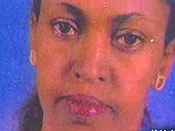
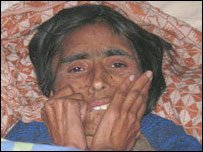
Left: Tirhas Habtegiris; Right: Naqsha Bibi

First, death: A Dallas TV station reports that a Plano hospital gave the family of a patient an ultimatum: find other care for her in 10 days or have her respirator disconnected.

Tirhas Habtegiris was an East African immigrant and only 27 when she died Monday afternoon.

She'd been on a respirator at Baylor Regional Medical Center at Plano for 25 days. …

[H]er brother Daniel Salvi was stunned to get [a] hand-delivered notice invoking a complicated and rarely used Texas law where a doctor is "not obligated to continue" medical treatment "medically inappropriate" when care is not beneficial. ... [O]n the 11th day, Tirhas Habtegiris was taken off the respirator and died.

Even though her body was being ravaged by cancer, this family says Tirhas still responded and was conscious. She was waiting one person.

"She wanted to get her mom over here or to get to her mom so she could die in her mom's arms," says her cousin Meri Tesfay. Ten days was not enough time, [family members] say, to get a mother from Africa to America.

"A fund issue is what I understand. Because she is not insured and that was the major reason the way I understood it," Salvi said.

George W. Bush signed the law that made this denial of care legal, so it is tempting to blame him and/or the peculiar barbarism of freewheeling Texan capitalism. However I would not be surprised if many U.S. states have similar laws.

Life: According to the BBC Naqsha Bibi was recovered from under the rubble of her home in Kashmir on December 10. She had survived since the October earthquake crushed into a tiny space in what had been her kitchen. Apparently a trickle of water kept her alive, though she weighed less than 75 pounds when pulled out. She was found by accident.

"We started clearing the debris of her house on 10 December, mainly to pull the iron sheets off the collapsed roof to build ourselves a shelter," says Faiz Din. … "We first thought she was dead but she opened her eyes as we were pulling her out."

Although her muscles remain frozen in a fetal crouch, doctors in Muzaffarabad believe that with liquid feeding and physical therapy, she will be able to recover.

Dr Abdul Hamid was one of the doctors treating Naqsha. When asked how someone could possibly survive for such a long time, he said, "medical science may struggle to accept it but there are miracles in this world, you know."

Tuesday, December 13, 2005

Changes in the 'hood


Before

After

Somehow I don't think this transformation is going to make much difference.

For the last couple of months, major renovations have been going on inside the dive down the street from my house. The old El Zarape had been on this corner for at least as long as I have been here -- well over 10 years. I don't remember ever seeing more than two tables occupied out of eighteen or so. If fact, I often wondered if the place were some kind of money-laundering front.

The "now open" Velvet Cantena appears designed to appeal to a similar prospective clientele: members of the Latino business class making a night out. I just don't think there is much of a market for such a restaurant in this neighborhood.

Despite encroaching gentrification accompanied by rising property values and higher rents, this part of the San Francisco Mission District is still heavily Latino. But Spanish speakers here are mostly new immigrants, Mexican men who shape up on the sidewalks and Central American families crowded into rooming houses. Prosperous Latinos, often business owners, move their families to the inner suburbs where the schools are better and the living more secure. They may still work in the neighborhood, but they don't live here and I doubt if they'll play here.

For one thing, the Velvet Cantena can't provide parking.

It will be interesting to see whether this place endures or the new operators sell out to restaurateurs who will cater to the young white Mission crowd that travels by public transportation and eats out frequently. That's who one sees in restaurants around here.

Bearing witness:
Guantanamo fasters and the CPT 4


Marchers break bread at liturgy outside Guantanamo gate
Published by Witness Against Torture. Photo by Scott Langley.


This post is an update on two sets of people who have stretched the boundaries of activism for peace -- people whose bravery has to be a challenge to all of us arm chair critics.

In Cuba, outside the U.S. base at Guantanamo: Twenty two mostly Christian activists continue a water-only fast at a Cuban military checkpoint outside the base today. The Witness Against Torture website explains:

They have completed their 5 day, 50 mile march and are now waiting for permission to enter the US base. They hope to be allowed to visit the prisoners, something that should be a simple act and one that is rooted in their religious tradition. In the Gospel of Matthew, 25:36, Christians are charged to perform the Works of Mercy. Among these works is the visitation of prisoners.

NewsDay reports that "Stacey Byington, a civilian spokeswoman for U.S. Naval Station Guantanamo Bay, told The Associated Press in an e-mail message that access to the base is limited to those with official or authorized business."

The marchers have not indicated how long they will remain outside the gates, bringing further attention to this U.S. prison in which nearly 500 men are held outside the reach of any internationally recognized legal procedures. Detainees released from Guantanamo have repeatedly claimed they were tortured. Thirty-two prisoners are on hunger strike to protest what they say is cruel and inhumane treatment. Twenty-five of those prisoners are being fed through tubes.

In Iraq: nothing has been heard for several days from the kidnappers of the four members of the Christian Peacemaker Team. The Toronto Globe and Mail reports somewhat morbidly:

The Swords of Righteousness Brigade said it would kill Canadians James Loney, 41, and Harmeet Sooden, 32, as well as long-time British peace activist Norman Kember, 74, and American Tom Fox, 54, unless all 16,000 Iraqi prisoners held in British and American military prisons are released. The first deadline was last Thursday -- 12 days after the four were abducted at gunpoint from the streets of Baghdad. The deadline was then extended until Saturday. The captors then broke off all communication --another standard tactic, which puts families through agony and places the governments of the captives' countries in a precarious position.

Many of those held hostage in Iraq are never heard from again.

The article goes on to point out that the kidnappers have gone out of their way to show the Canadian members of the foursome with free hands and able to speak, while the U.S. and British men are chained in orange jumpsuits.

In Canada:The Canadian press has been much more diligent in following this story than U.S. media. In particular, it has recounted the impression Jim Loney made on the First Nation communities in Kenora, Ontario:

Kenora activist Bobby Herrington praised Mr. Loney's inner strength. "He's right up there with a small number of native elders -- he always has that presence, that aura about him, that things can be okay."

Loney's hometown paper from Sault Ste. Marie published a friend's Advent meditation on the kidnapping:

Advent is a sacred space set aside to plumb the depth and breadth of what it means to wait and pray for peace, for reconciliation – no matter how frightening, how painful the Birth. Waiting in a Nazi cell, the Jesuit priest Alfred Delp confronts his fears and asks, "Are these hours of waiting preparation for an extraordinary Advent?"

For us, Jim's community of friends, it has already been an extraordinary Advent.

We stay awake with Jim and the others. …

Neither Jim nor Christian Peacemaker Teams is waiting for false freedom.

Neither Jim nor Christian Peacemaker Teams is waiting for some empire's shock and awe to deliver them.

Both Jim and CPT believe, as Oscar Romero put it, that "we live by that power that even death cannot overcome."

Monday, December 12, 2005

From the human garbage heap:
San Francisco Municipal Court

This morning in San Francisco Municipal Court, I watched an acquaintance (I'll call him JPW) receive a sentence of 16 months in state prison for a felony burglary conviction. Between credit for time served and the good behavior he usually manages when he is inside, this will probably mean that he'll spend six month in San Quentin prison.

Afterward he'll be on the street, broke, homeless and on parole. If he goes by back to drugs, which is likely, he'll wind up inside again; since the current rap is a felony, he is now one third of the way to "out," a mandatory sentence of twenty years to life.

From what I could see, JPW was treated reasonably well. He was represented by a concerned Public Defender (we have very good ones here). He seemed to understand what was happening. JPW is a smart guy with a bad meth habit who has burned everyone he knows. As far as I have seen, he is not aggressive or violent, though beligerant when high. The judicial and prison system is becoming his home.

Municipal Court is the lowest rung of that system, the garbage dump of society. Everyone looks rumpled and frayed, not just the defendants, but also the judge, the lawyers, bailiffs, and spectators. Some observations, not necessarily meaningful:
  • The courtroom itself is dilapidated. Over in the State Building the seal of California is brightly colored; here it is dull gray. Some seats are broken; signs admonish spectators not to talk, eat, drink or chew gum during the proceedings. No one paid any attention to these rules until the judge shouted at one point "I can't hear!"
  • The court processes daily an enormous flood of arraignments, appearances, bail requests, and scheduling difficulties -- all briskly, but with some attention to individual particulars.
  • This judge was not at all hesitant about overruling the very young representative of the District Attorney's office; at one point, she responded to a request for $75,000 bail for a guy who had failed to appear 3 times saying "that's not enough; I'll make it $125,000." On the other hand, she casually looked over a felony charge the DA proposed and reduced it to a misdemeanor.
  • Most of the defendants on the calendar this morning were in custody, brought to court from the jail in handcuffs and orange pajama suits.
  • Translation is provided for defendants who don't speak English, but it looked really doubtful that putting the words into their own languages was doing anything to enable them to understand what was happening.
  • Folks who end up before the bottom rung of the courts don't manifest high levels of ability to play the games society demands. A couple of guys charged with low level gang related offenses turned up not only with their mother, but also with their buddy who sported a t-shirt saying "Stop Snitching."
  • Almost all the defendants were men of color who must have felt they had wandered into a wonderland presided over by aliens: the judge, lead sheriff, DAs and most of the Public Defenders were white women, several appearing to be lesbians.
All of this was something most of us never see, yet there are whole populations of folks like JPW who live here. Is this okay? Even if we had the will, is there anything we could do about it?

Sunday, December 11, 2005

Fun with Google


This silly exercise has been floating around the blogosphere. I'm ready to bite. You enter your first name and word "needs" in Google -- in my case "jan needs." Then you capture the first ten items (more or less) and list them on your blog. Here goes not much:

1. Jan needs a man. Like hell I do. What would I do with one of those?

2. Jan needs to be seen today. I seldom want to be seen; after all, being seen usually leads to interacting which leads to stress. And, nonetheless, most everything worth living for.

3. Jan needs to get a lot of new things for my new home. I don't need any more damn things; I have too many things now in a nice old home.

4. Jan needs a new desktop computer. Nope, I'm a laptop kind of gal.

5. Jan needs to go to bed sooner on weeknights. True. This blogging thing tempts me to act like a college sophomore with a late paper.

6. Jan needs critics. Absolutely. How else do I figure out what I'm doing? Not that I promise to like criticism, but I have spent a lifetime trying to learn how to sit still and listen.

7. Jan needs cancer databases. Not that I know of, thank goodness.

8. Jan needs help. Often. Jan also needs help accepting help.

9. Jan needs to be on order confirmation pages. Huh? I am not a business form.

10. Jan needs replacing. Hope not, though some days I could use some spare parts. Do they make replacement plantar fascias?

Thanks to SarahLaughed for the meme.

Cross border medicine


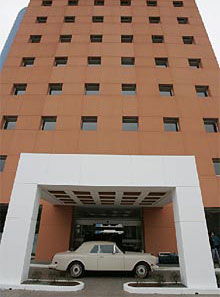
The comprehensive private care facility's opening this week in Tijuana drew VIPs, some of whom arrived in this Rolls-Royce. Photo: Jim Baird, San Diego Union-Tribune

You got to hand it to rampant capitalist entrepreneurship -- it is creative. Smart MBAs figured out they could send U.S. customer service jobs more cheaply to India. Huge success. Big pharmaceutical companies managed to keep drug prices uncompetitively high in the U.S., so Canadian pharmacies discovered they could make money selling the same drugs to U.S. consumers. Great business model. Health care costs are out of control in the U.S.; a Mexican private hospital chain thinks it can prosper by building a new facility in Tijuana and attracting U.S. patients.

The hospitals' operators are counting on drawing a significant portion of their patients – as much as 25 percent – from Southern California. They are offering care at lower cost, they say, but at standards similar to those north of the border. Hospital administrators say their services will cost about 40 percent less than comparative care at a San Diego hospital. …

"We really welcome that they come," said [Dr. Patricia] Aubanel, a heart surgeon who has worked on both sides of the border and founded a cardiovascular center in 2002 at Hospital del Prado. "It's good for the city. It puts us at another level of competition, which is always good."

Growing numbers of patients from across the United States reportedly have been going to Mexico in search of elective procedures such as gastric bypass operations and plastic surgery offered at a fraction of U.S. prices.

There have long been clinics of dubious quality in Tijuana. Maybe this outfit can give the town a better medical reputation.
Sounds to me like a new incentive for linguistically challenged Amuuricans to learn Spanish.

Saturday, December 10, 2005

March against U.S. torture


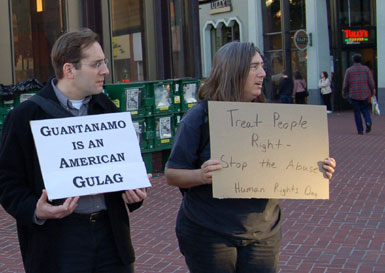
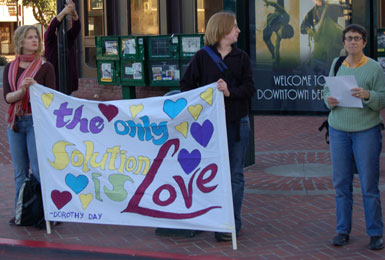
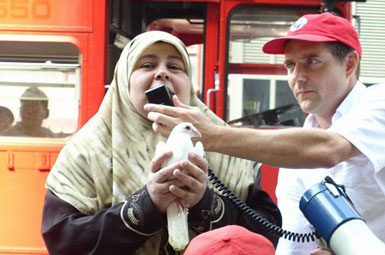
Twenty-five Christians in the nonviolent tradition of Dorothy Day and the Catholic Worker movement have been marching for four days from Santiago, Cuba to the U.S. prison at Guantanamo Bay, a distance of 50 miles. Today they arrived at Guantanamo City, the Cuban town outside the detention camp. Tomorrow they will attempt to visit the prisoners. If denied entry to the base, they have said they will fast and pray for the abolition of torture by all nations.

Catholic Worker Matthew Daloisio explained: "We want our fellow Americans to see the shameful acts of torture and abuse taking place in this and other illegal prisons hidden across the globe. We pray that others will join us in urging our government to allow us to perform this act of Christian faith."

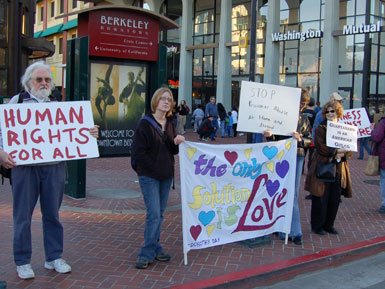
This afternoon, a small but determined group of Catholic Workers, Quakers, members of Jewish Voice for Peace, and assorted agitators and friends held a support vigil in downtown Berkeley. They also marked International Human Rights Day. U.N. Secretary General Kofi Annan proclaimed that day this way:

"Let us be clear: torture can never be an instrument to fight terror, for torture is an instrument of terror."

Some pictures from the Berkeley vigil follow:


Migrants -- dispensable cogs or human beings?


That question is really what is being argued when Republican politicians attack 'birthright citizenship.' Birthright citizenship is the legal determination, enshrined in the 14th Amendment that outlawed slavery, that if you are born in the U.S., you are a citizen. About 90 House Republicans want to throw out that principle. And they are not just blowing smoke; a Rasmussen poll in November found that 49% of those asked want to end automatic citizenship for children of "illegal" residents, while only 41% support retaining it.

Meanwhile, Latino and other immigrant leaders are appalled:

"This is about attempting to deal with a serious policy problem by going after people's babies…." said Cecilia Muñoz, vice president for policy of the National Council of La Raza.

Many strands are embedded in this discussion
  • the hunger that drives people to come where the jobs are regardless of legalities,
  • the pragmatic interests of employers who want cheap labor,
  • and the fears of those already here.
Opponents of "illegal" migration fixate on "law breaking." Considering that these folks seem to be among those of our citizens who are otherwise proudly distrustful of government, this seems odd. It is hard to escape the suspicion that employers of cheap labor are manipulating fearful people to get themselves a compliant migrant workforce.

Repealing birthright citizenship would create a class of persons who were not quite the same as the rest of us. Children of the "illegal" might well be stateless with no government to serve as their advocate. Their parents would have it ratified that they are "less equal" humans than the native born.

We are already on that path in other arenas. The President has declared his right to imprison Jose Padilla, a U.S. citizen, without trial, because he says so. There's healthy friction in the legal system about that assertion and some chance that some version of the rule of law will prevail. But in the eyes of our current rulers some are clearly "less equal."

The history of the U.S. is the record of the struggle to understand and enshrine in law the full equality of all. Women, those who are not Christian, those who are not white, gays -- we all were less than human once. Will we allow employers of cheap labor to drive the country backward?

Friday, December 09, 2005

The eyes have it
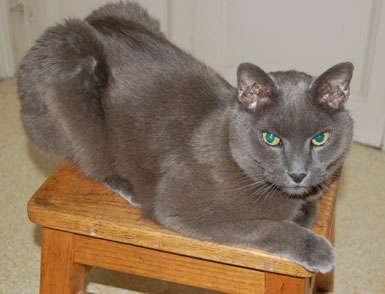
Friday cat blogging


Billie is an enthusiastic youngster.


Griveny is grizzled old guy.

Both beauties; both their own cats.

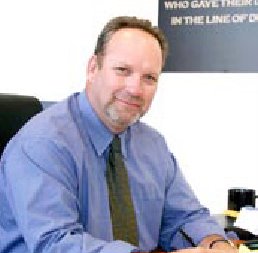
The guy knows the ropes


Gary Delagnes of the San Francisco Police Officers Asssociation

This is yet another post in which I'll bring some history to bear on current events. I see this morning that San Francisco's finest have once again been caught doing what they too often do best: spreading their racist, sexist and homophobic attitudes out for all to see. The SF Chron reports that in addition to the offensive video clips found on an officer's web site yesterday, the Christmas party film project also included scenes of "a black officer eating from a dog bowl and one of an Asian officer having difficulty riding a bicycle." Nice fun and games those SFPD boys get into out in the Bayview, San Francisco's last poor and gang-ridden Black neighborhood.

The local story broke into the NY Times which reports that, in addition admitting that video was "stupid and immature,"

Mr. [Gary] Delagnes of the [SFPD] union bemoaned the fact that "every lefty in San Francisco is going to love this."

It is not surprising that Delagnes worries over the ammunition this latest police escapade will provide to critics of the SFPD's more material faults, like occasionally shooting suspects. Before Delagnes attained his current eminence in the police union, he was at the center of quite a few shenanigans himself, racking up as many as 100 conduct complaints during his active duty career. (San Francisco doesn't adjudicate citizen complaints; it buries them in paper work, so there is no way of knowing how many of these were justified.)

His best know escapade rivaled the current brouhaha. How's this for an example of mature police conduct?

During San Francisco riots in 1992 over the Rodney King jury verdict in Los Angeles, [Police Chief Richard] Hongisto had hundreds of people jailed. In the wake of those arrests, the Bay Times gay newspaper ran a suggestive illustration of Hongisto with the headline, "Dick's Cool New Tool: Martial Law.'' Police Officer Gary Delagnes and other officers responded by grabbing more than 2,000 copies of the newspaper off news racks.

Hongisto was fired; Delagnes continued his rise in the department. He knows the guys he defends from his current perch; he has always been one of the boys.

Thursday, December 08, 2005

Jury deliberations

olivernorthnewsprintsm sami.al-arian-sm
Yesterday a jury in Tampa, Florida acquitted Dr. Sami Al-Arian on 8 of 17 charges involving supporting Palestinian Islamic Jihad. They were deadlocked on the other counts. Jurors have since said that a majority favored a complete acquittal.

Al-Arian is a stateless Palestinian who has lived in the U.S. since 1975 and had taught computer science at the University of South Florida. He was a prominent spokesman for justice for Palestinians in both popular and academic venues, playing host to visiting foreign Arab and Islamic leaders and collecting for Palestinian charities.

These activities led the Immigration and Naturalization Service to put his citizenship application on hold in the mid-1990s. After 9/11, he came under more suspicion. In particular, Bill O'Reilly of Fox News claimed his academic activities were a front for Palestinian terrorism. In February 2003, Attorney General Ashcroft trumpeted indictment of Al-Arian and others as leaders of Islamic Jihad. Al-Arian insisted he had done nothing more than speak up forcefully for his people. The government jailed Al-Arian, mostly in isolation, for two years. And now, though a jury has largely exonerated him, he will at best be deported or perhaps held in indefinite confinement.

The fog of accusations, fear and distortion around the case is thick. Florida politics is mixed up with Middle Eastern politics. I don't claim to know much about it. But I was fascinated by what the jurors who acquitted Al-Arian had to say about their deliberations:

"Usually, there were 10 of us for acquittal on the charges, sometimes nine of us," said Ron, a juror from Pasco County who did not want his last name used. … "Of course, we hate terrorism," said Ron. "But the evidence making these guys terrorists just wasn't there."…

Jurors say they were strongly affected by the jury instructions. In particular, they kept returning to these words: "Our law does not criminalize beliefs or mere membership in an organization. A person who is in sympathy with the legitimate aim of an organization but does not intend to accomplish that aim by a resort to illegal activity is not punished for adherence to lawful purposes of speech."…

"The evidence wasn't there to put a guilty verdict on it," said Juror 112, a 40-year-old truck driver from Lakeland named Todd.

"People assume. They assume guilt," said Todd. "People really need to think about things before they make a decision. You really need to get the facts first. I sat in that room for six months. Until you've sat through something like this . . . you cannot sit in your car or at your house and determine guilt."
Jury service sometimes evokes extraordinary capacities for serious thought and responsible discernment in the most ordinary citizens.

In 1987 I was called for Federal jury service. Like most people, I was not happy about this -- I expected tedium and wasted time, as I can't imagine the prosecutor or defense attorney who'd risk putting me on a jury. But I dutifully showed up and sat through an hour or so lecture from a court official on the importance of a good faith, honest and sincere effort to carry out the task we might be given. Then the two hundred or so of us were left in a room furnished like a high school cafeteria (I remember the same orange plastic chairs and tables) to wait to be called into court. There was nothing to do but watch a bank of televisions.

On the tube, a ramrod straight Marine was swearing to "tell the whole truth." It was Lieutenant Colonel Oliver North testifying before the Iran-Contra congressional investigating committee. He was a picture of uprightness, explaining how he'd organized a secret army of "freedom fighters" using every kind of ruse to hide from Congress -- and carried out his Commander in Chief's implied, though never explicit, instructions. After all, laundering money and trading arms for hostages was "defending freedom."

The tangled tale of illegal acts and lies to cover them made me feel ill. But I figured North looked the part of a good guy; his "sincere" pose was probably playing well with most people. And when I got outside the Federal Building and read more about his testimony, it was clear he was going over well.

But for the next 3 days, I had to go back to the jury room, to sit in front of those televised hearings. Gradually, little circles of strangers began to talk with each other. And something amazing was happening -- we were all thinking like jurors, not a TV audience. People began to comment: "he looks good, but I don't trust him"; "does he really think he has a right to break the law?"; "they think they are above the law because they are in the government." In that room, Oliver North was convicted, while in most of the U.S. he successfully played the role of hero.

And then, we, the prospective jurors, were all excused, never finding out what happened to the case we'd been brought in for.

A gift wins friends:
how simple can you get?


On Tuesday, Venezuelan and U.S. officials helped pump the first delivery of heating oil into a building in the Bronx. Photo Credit: By Rick Maiman -- Bloomberg News

This is just too perfect; President Hugo Chavez of Venezuela knows how to make friends. The U.S. government wants the populist leader gone, but his constituents fought off a coup attempt in 2002 and voted in a parliament to his taste just last week.

Now he is selling heating oil from his country's ample stock cheaply to nonprofits that serve poor residents in the U.S. Northeast. The gesture is popular reports the WaPo:

NEW YORK -- A green Citgo tanker truck chugged up a hill with a grim view of tenement buildings, elevated subways and treeless sidewalks to deliver Venezuelan heating oil, a "humanitarian" gift from Venezuelan President Hugo Chavez.

Moments before the orange-gloved worker snaked the hose to a Bronx tenement, Eartha Ferguson, a manager and resident of a low-income building, said: "I call it a gift of survival. It comes at a good time, a very needed time."

"The government should have done it," said Shirley Manuel, 52, a tenants' rights activist, wrapped up tightly in her wheelchair. "This is their country, this is their people -- they should be taking care of their own."

Rep. Jose E. Serrano (D-N.Y.), who brokered the oil deal, brushed aside suggestions that Chavez was playing petro politics. "To those who say this is to score political points," he told a shivering crowd when the first oil arrived, "I invite any American corporation that wants to score points with my community to start this afternoon."

The Venezuelan leader knows the maxim every teacher tries to impart to aspiring writers "Show, Don't Tell." If you want us to believe governments can serve the poor as well as the rich, show us.

This is not the only time I've seen a regime the U.S. government opposed woo U.S. citizens with generosity. When I visited Cuba in 1988 with a scraggly band of lefties, the Cubans offered to fix up our teeth for free, knowing full well that dental insurance was out of the question for most. The power of the gesture was less in the value of the offer itself (though for some it was a great gift) than in the recognition of our likely situation and needs in our country. We felt seen, just like Shirley Manuel.

Wednesday, December 07, 2005

Why would you want a union?

union-yes2
So few of us now belong to a labor organization that most of us probably don't even ask ourselves that question. If we do, we may think a union is just something that takes a bite out of our paychecks but never does anything else. Sometimes that may even be true, but not always.

Today I got a nice reminder of why having a union might be a real benefit. My partner is a "freeway flyer." That is, she makes a living by teaching as "adjunct faculty" at various colleges. "Adjunct faculty" is fancy language for a temp worker -- she gets no benefits and no guaranteed contracts. But one of the places she works does require her to be part of a faculty union.

Yesterday she taught her last class of the semester; today she got a note from her union rep:

In case you are interested, here is information regarding unemployment.

All part-time faculty are entitled to collect unemployment benefits based upon legal precedence set forth in the Cervisi case that was litigated by the CFT local at City College of San Francisco over a decade ago.

There are two key elements to demonstrate your legal right to collect benefits. You have been laid off due to "LACK OF WORK". In other words, there are no more classes to teach. Thus, you are legally unemployed. It doesn't matter if the employer still owes you money. You are unemployed after you finish teaching your last class.

The possibility of reemployment is "CONTINGENT UPON ENROLLMENT". While you may think it probable that you will be re-employed, technically, and thus, legally, you have NO GUARANTEED CONTRACT to be re-employed.

Semester after semester, part-timers' classes are cancelled due to lack of enrollment, so apply for the unemployment insurance benefit that you have paid for in your payroll deductions. To do so, go to ….

Now my partner is an adult; she knows this -- but all of us could use often use someone to remind us that we have rights and should use them.

I can't stop thinking about them


James Loney, one of the four Christian Peacemakers kidnapped in Iraq, doing what peacemakers must do: giving voice to the voiceless, in this case the wife of an Iraqi detainee. Photo source.

We can only wait, hope and pray that those who have seized these men will release them unharmed.

Their team continues the work in this statement about the kidnapping:

We believe there needs to be a force that counters all the resentment, the fear, the intimidation felt by the Iraqi people. We are trying to be that force: to speak for justice, to advocate for the human rights of Iraqis, to look at an Iraqi face and say: my brother, my sister,

Perhaps you [the kidnappers] are men who only want to raise the issue of illegal detention. We don't know what you may have endured.

We never can know what others have suffered; we can only control what we do ourselves.

Often the interventions of the "nonviolent" seem to me shallow, self-indulgent. It can be very easy for comfortable citizens of the superpower to "give up violence" while enjoying all the benefits of our country's wealth and power.

But then there are those who really do it, like these brave men. I don't know how it works, but I observe over and over that there is a power in the lives of those who willingly risk their safety and survival for the good of others. Our culture may scorn this notion, but that can't reduce its efficacy.

You can leave messages of support to the families of the kidnapped men here. I keep musing on the job that someone must be doing at that site, screening out the vitriol that undoubtedly will mix with expressions of love and hope. I guess the CPT folks might say that when we unleash the hatred of war, we bring it home with us.

Tuesday, December 06, 2005

President in free fall


Watch him get bounced around here. If he starts to get stuck, you can help keep him going by dragging with your mouse. Hat tip to sastreman.

Monday, December 05, 2005

Left of center comes out to vote


A line forms at a polling place in Caracas, Venezuela. Photo Credit: By Howard Yanes -- Reuters

Major U.S. newspaper were full of stories today about what happens when an aroused people decide they want more than just a return to the center.

From the WaPo:

[I]n the city's poor neighborhoods, where Chavez enjoys broad support, … lines of voters remained throughout the day at the high school where Chavez later cast his vote, many of them dressed in red, a color that has become a symbol of support for his government. Voters there said they believe the election was fair and dismissed the [opposition] boycott as a failed stunt to avoid embarrassing losses.

The NYT also reported on the collapse of the right wing parties:

"Chávez would have annihilated them [even if they had not boycotted,]" Alberto Garrido, a critic of the government and an author of several books about the president, said by phone from Caracas. "… There are people in the opposition, but the opposition leadership is in tumult, without a strategy. Tomorrow, Monday, they will not know what to do."

With polls indicating that government candidates would crush them in the election, opposition leaders had for weeks threatened to pull out. They accused electoral authorities of using digital fingerprint machines at polling sites that would permit the government to determine how individuals had voted. Last Monday, in a decision brokered by the Organization of American States, the National Electoral Council announced that it would not use the machines.

But to the surprise of election monitors, opposition parties began announcing their withdrawal on Tuesday,…

"The main objection was the digital fingerprint machine, which was removed, and now their line is we don' t trust the system, there must be another trick there," said José Miguel Vivanco, the Americas director of Human Rights Watch, which has been harshly critical of Mr. Chávez.

"It's really hard to understand what exactly the political opposition leadership has in mind," he said. "But certainly it is not going to help them to present themselves as victims that deserve solidarity from the international community. With these kinds of tactics I don't think they'll gain any ground."

Now I'm not going to claim to know anything deep about Venezuela. Chávez may very well be a demagogue of the first order, but clearly a majority of the people think his populism gives them a better deal than the opposition so applauded by the U.S. Because Venezuela has oil wealth, there is some surplus which Chávez can use to improve the condition of the poor majority. What else is a government for?

Off Center -- does anyone care?

Off Center: The Republican Revolution and the Erosion of American Democracy
by Jacob S. Hacker and Paul Pierson


This Yale Press book is insightful, well argued, but not quite what I was looking for.

The subject is domestic politics. The elephant in the living room, U.S. wars around the world promoted through lies and waged by executive fiat, is not even in the picture.

The authors, academic political scientists, argue that, since winning the House of Representative in 1994, Republicans have overthrown the checks and balances thought to constrain U.S. politics. They have successfully enacted a rightwing agenda that ensures that the ability of government to ameliorate "free market" inequities is gone. Actual policies led by tax giveaways to the rich and new heights of unscrupulous manipulation of civic ignorance, disengagement, and prejudice have built a durable barrier to any challenge to their rule.

If you want to know how rightwingers do it, Hacker and Pierson are absolutely worth studying. They are particularly good on the parliamentary ruses, such as rogue "conference committees" and holding votes open, which enable Republican leaders to both overcome and give cover to their own centrist members.

They are perfectly clear about the right's deformation of the system in service of the wealthy:

Over the past thirty years, American politics has become more money-centered at exactly the same time that American society has become more unequal. The resources and organizational heft of the well off and hyperconservative have exploded. But the organizational resources of middle-income Americans -- from labor unions to mass-membership groups -- have atrophied. …

In 2000, more than 40 percent of those in the bottom of the income spectrum reported that they did not vote, compared with just 13 percent of those in the top third.

The ballot box offers no easy cure. Money talks, the rest of us limp.

The blogger and historian Stirling Newberry has a memorable name for this system: "Representative plutocracy -- the money goes to politicians to represent it to the voters."

Having asserted and proved that the U.S. political system is broken, Hacker and Pierson's prescriptions for a fix seem weak: they suggest longer term political calculations, reform of Congressional procedures, more transparency in government. Those are all worthy projects, but a little feeble in the face of a brutal power grab by determined oligarchs.

Perhaps the weakness of their countermeasures derives from their analytical premise: this is a book about subversion of U.S. constitutional arrangements that have reined in radicalism of right and left, that once empowered "the center." What the heck is "the center?" For those who feel trapped on either side, it is looks like an unpleasant quagmire of immobility. Given that historic constraints on rightward movement have been broken, what would inspire people to take up the difficult, painful political struggle to turn the state in a new direction? Moving politics toward a mythical middle will not supply mass motivation for change.

Most people, those left of center anyway, engage with politics out of necessity, not inclination. They want the state to make sure they have a chance in life. Since the folks with money start with advantages, they want the state to balance the scales. They don't give a hoot about "the center." They don't understand why a country this rich can't do a better job of taking care of its citizens. They don't understand why the U.S. should send young people to get killed in wars that no one will explain to them. Those are the kind of motivations that change political trajectories -- I assume Hacker and Pierson know that, but one of the ways we're currently "off center" is that no one with a respectable platform is supposed to say so.

Sunday, December 04, 2005

Who dares write stuff like this?

The situation in which [former New Orleans] residents find themselves is an extreme example of a trend underway for a quarter-century, a shift of economic risk from business and government to working families, and an increasing reliance on free markets to manage society's problems.

Safety nets such as unemployment compensation, employer-provided healthcare insurance and pensions, and, recently, effective disaster relief have been reeled in or removed. Increasingly, families from the working poor to the affluent are left largely to buy and sell their own way to safety even when their individual efforts seem utterly outgunned…

Some leftist rag? No.

The author is LA Times reporter Peter G. Gosselin who writes regularly on economics as lived by ordinary people. Such reporting is pretty darn rare in mainstream media. In the fall of 2004 he wrote an extraordinary three part series discussing the question: "why so many families report being financially less secure even as the nation has grown more prosperous?" If, like most of us, you missed it, go back and look. To its credit, the paper is keeping this older material accessible on its website.

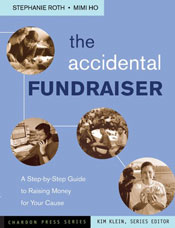
The Accidental Fundraiser

This is a shameless plug. Two friends of mine have written a how-to book about ways to raise money and I'm excited about it. Suppose you've just learned that you made the mistake of not going to the meeting and were appointed to put on your group's annual fundraising effort? Or your child's school sends a note that it will no longer provide craft project materials and you've been talking with other parents about how lousy the school board is? Or your poor parish church needs a new furnace, pronto, before everyone stops coming to sit through another sermon while freezing.

The Accidental Fundraiser: A Step-by-Step Guide to Raising Money for Your Cause is addressed to you. Stephanie Roth and Mimi Ho have provided everything you need to decide what strategy will likely work in your situation. They then provide exhaustive planning tools, work sheets, sample flyers, and good advice to get you through the job.

This isn't about the big stuff, about grants for thousands of dollars or government money that will sustain a large program or campaign. This is about fundraising at human scale, about the tips and tricks through which we dredge out $1000-5000 from networks of friends and acquaintances. Sure, on some level, we're just passing around the same five dollars. And also, we are too often compensating for the failure of governments, local as well as national, to do their job of caring for the general welfare. But though these small efforts we are also building and sustaining communities; Roth and Ho know this and celebrate it.

Even better, if you feel stuck with managing a fundraising project, doing it with Roth and Ho won't make you feel like you have entered an alien universe of nonprofit bureaucrats. They sprinkle very concrete stories from small progressive projects all through the book: you meet bike activists, anti-big box store campaigners, gay health advocates and rural organizers that you wouldn't mind knowing outside a book.

I've decided to give The Accidental Fundraiser (along with a small sum) to some of the organizations that hit me up at this season. Maybe we can have more interesting fundraisers next year.

Saturday, December 03, 2005

Snippets from headlines


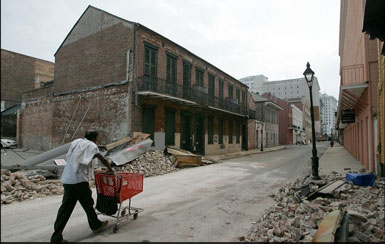
Photo by Justin Sullivan

All from today's WaPo:

Agency Calls for Troops, Reporting Threats of Violence

Former Secretary of Homeland Security Calls for More Training

Feb. 4 Elections… Are Postponed

Residents… [may] … not stay in the area, which still lacks electricity.

Workers…have been advised against wearing clothing with the agency logo in public.

No, not Baghdad -- New Orleans.

Friday, December 02, 2005

Airline security panic abating?
No-Fly List update


The regional carrier Cape Air is proud of its painted planes.

My own travails with the Transportation Security Agency seem to be over. I fly these days with no more hassle than any other traveler who is white and U.S. born. And we learn today that the TSA is going to change its strategy for smoking out "terrorists," adding more random pat downs and permitting nail files on flights. Just maybe some of the more irrational aspects of our airline "security" panic are receding.

Nice -- but these changes don't address the "no-fly list," that apparently arbitrary, and still secret, roster of those someone in government wants to subject to special scrutiny or prevent from flying. For the last several months, an Irish-born Cape Air commercial pilot, Robert Gray, has been barred from doing his job because, according to the Cape Cod Times, the TSA says he is a "threat to aviation or national security." The agency refused to state why. Gray sued the TSA, not surprisingly. "Court documents appear to validate his claim of never having supported any 'terrorist or other illegal activity'; in fact, Gray has never been arrested, nor has he had any prior involvement with the criminal justice system." The ACLU is trying to settle the case out of court.

The government would probably be wise to settle. Here's what Bruce Schneier, who The Economist calls a "security guru," a member of the government's own Secure Flight Working Group on Privacy and Security, has to say about these lists:

[The TSA screeners] check travelers against the 30,000 to 40,000 names on the government's No-Fly list, and another 30,000 to 40,000 on its Selectee list. They're bizarre lists… Who are these people, anyway?

The truth is, nobody knows. The lists come from the Terrorist Screening Database, a hodgepodge compiled in haste from a variety of sources, with no clear rules about who should be on it or how to get off it. …

The program has been a complete failure, resulting in exactly zero terrorists caught. And even worse, thousands (or more) have been denied the ability to fly, even though they've done nothing wrong.

If that sounds harsh, Schneier is even tougher on programs which would pre-clear some travelers, for a price, to fly without much scrutiny. He claims that creating any loopholes will simply give a smart terrorist a new way to slip through a crack:

It may be counterintuitive, but we are all safer if enhanced screening is truly random, and not based on an error-filled database or a cursory background check….

Exactly two things have made airline travel safer since 9/11: reinforcement of cockpit doors, and passengers who now know that they may have to fight back. Everything else -- Secure Flight and Trusted Traveler included -- is security theater. We would all be a lot safer if, instead, we implemented enhanced baggage security -- both ensuring that a passenger's bags don't fly unless he does, and explosives screening for all baggage -- as well as background checks and increased screening for airport employees.

Then we could take all the money we save and apply it to intelligence, investigation and emergency response. These are security measures that pay dividends regardless of what the terrorists are planning next, whether it's the movie plot threat of the moment, or something entirely different.

Maybe as panic recedes we can also re-examine our rush to "profile" the potential terrorists. As Schneier says, racial, ethnic, and religious profiles simply encourage anyone who seriously aims to do harm to recruit against conventional stereotypes.

UPDATE: January 24. 2006 -- According to the Cape Times, "Robert W.G.M. Gray, the Irish-born Cape Air pilot who sued the federal government to get off its no-fly list, could return to the cockpit as soon as tomorrow, according to an airline representative....What persuaded federal officials to remove Gray from the list remains a mystery, as do the specific reasons he was initially considered a security threat."

Why am I not reassured about the state of our civil liberties?

U.S. propaganda in Iraq:
Who is the target?

The story was broken by the LA Times a couple of days ago that U.S. tax dollars are paying a PR firm to place feel good stories in the Iraqi press. As far as I can tell, most of the commentary is missing the point. (Laura Rozen is an important exception.) What we have here is reversion to the "low intensity conflict" style of operations that predominated in U.S. overseas adventures in the 1980s.

What is "low intensity conflict"? It is certainly not "low intensity" for those on the receiving end. Rather, it is a military doctrine that recognizes that:

"The roots of insurgencies are not military in origin," [Reagan's] Secretary of the Army John Mrsh explained, "nor will they be military in resolution." Source.

When the U.S. military could not impose its will through force of arms in Central America, it turned to "total war at the grass-roots level." Death squads, destruction of civilian infrastructure, secret bombing, and spreading endless lies were the order of the day then, and have become so once again as the U.S. loses even the feeble grip it won in Iraq through Rumsfeld's invasion-lite.

The U.S. public doesn't want to sacrifice to fight an imperial war. So the Iraqis get "low intensity conflict." The U.S. public gets the psych-ops treatment. The Administration had to lie its way into the Iraq invasion; as its rationales have collapsed, it has had to more and more to adopt tactics of stealth and dissimulation to keep the war going.

Though most of the follow-up stories have failed to highlight this, the original LAT story contained the real nugget about our PR exploits, deeply buried:

U.S. law forbids the military from carrying out psychological operations or planting propaganda through American media outlets. Yet several officials said that given the globalization of media driven by the Internet and the 24-hour news cycle, the Pentagon's efforts were carried out with the knowledge that coverage in the foreign press inevitably "bleeds" into the Western media and influences coverage in U.S. news outlets.

"There is no longer any way to separate foreign media from domestic media. Those neat lines don't exist anymore," said one private contractor who does information operations work for the Pentagon.

Iraqis don't have to look to their "free press" to find out who makes their lives miserable; the target of this operation is right here among the credulous in the USofA.

Thursday, December 01, 2005

Beltway gasbag on display


Richard Cohen is a racist windbag. How else to interpret this:

Iraq is not Washington, D.C., I know. (It's probably better managed.)

Sure, score on the pathetic hamstrung government of this 80% Black city lorded over by the same rapacious thugs who led the U.S. into Iraq. And pat yourself on the back for noticing that the Iraq adventure is FUBAR.

Sickening.

Iraq war's Nixonion phase entered


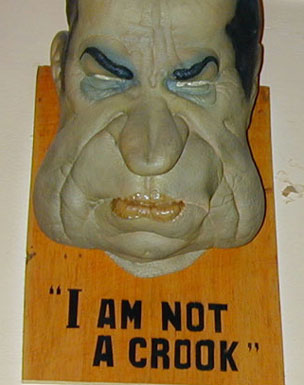
The 37th President hangs on a bar wall in Cusco, Peru.
My goodness this is moving along quickly -- the progress of our "Vietnam on steroids" experiment, I mean. Yesterday the Preznit announced that we are now deeply into the Nixonian stage, attempting victory through Iraqization. Sure, that's a nice fantasy. Reporters don't even pretend to believe this stuff:

Bush, in his speech at the U.S. Naval Academy, spoke of progress toward independence, of land restored to Iraqi control, of gains in stability and democracy, and of the "skill and courage" of newly trained Iraqi security forces.

But on the streets of Baghdad, such optimistic rhetoric contrasts sharply with the thunder of suicide bombs, the scream of ambulance sirens, the roar of racing police cars bearing men with masks and machine guns, and the grim daily reports of assassinations, murders and hostage-taking.

It took mainstream media awhile to print this obvious truth, but I guess better late than never.

Today I took part in an interesting exchange about the political implications of the current Nixonian moment in which commenters highlighted a quite specific lesson:

  • The GOP has [a] problem… absence of a noisy Vietnam-style antiwar movement to deflect the blame onto.
  • Without a bunch of scruffy hippies as the face of the calls for a phased withdrawal, the Nixon strategy won't work.
That is, the longstanding rightwing line that any impediment to U.S. imperial ambitions must take the form of an unpatriotic "stab in the back" just won't fly at present. A grizzled ex-Marine, Congressman Murtha, has become the face of opposition to the war.

That seems right, but, I think, points to what has been a central obstacle to building a mass, engaged antiwar movement in the Iraq invasion era: there is simply no force to support. In the Vietnam era, many opposed to the war came to support Vietnamese nationalist aspirations; in Iraq there are no good guys. Antiwar folks are left to say "a pox on all your houses" and "let them all alone." Some of the most potent symbols antiwar folks have been able to offer have been military families unhappy with the war and the bereaved Cindy Sheehan. Their work has certainly brought home the "leave them all alone" message in reference to beleaguered U.S. grunts.

Yet the kind of people who will risk disapproval (and worse) from their fellow citizens to build an antiwar movement don't want to simply be naysayers. They are precisely those among us who hang on to the hope that "another world is possible." A few of the bravest become Christian Peacemakers and risk their lives. Let us hope that those currently being held captive get out alive.

But if that sort of action is what it takes to make a potent antiwar movement, the bar is too high. Most people will never be heroes. So the antiwar movement has been left to chip away at the edges of the national consciousness, supporting little vigils and occasionally larger marches, pestering Congresspeople, advocating for more truthful media coverage of the ongoing disaster.

The current Nixonian moment seals the story; the U.S. will leave Iraq. If the Bushies are true to their trajectory (and they are far less competent than the Nixon guys), the U.S. will leave with its tail between its legs. The difference will be that people here will pay a far greater price as U.S. power and wealth cannot cushion the pain of peak oil, genuine economic competition, and climate collapse.